Following on from yesterdays post I thought it would be good to include some examples of approach grafts that were at Taisho en while I was studying. The two examples below are using approach grafting for two different reasons. The first is grafting roots onto an upper section of a trunk to shorten a bonsai. The other is using the technique to both replace foliage and graft on new roots.

What do you do when you want to shorten the trunk of a species such as Tsuga that doesn't aerial layer well? Approach graft!

Here you can see some new roots being grafted to a Tsuga trunk. The roots have been wrapped in cloth and are both watered and fed as if in a standard pot.

The taxus tsuga above was an interesting bonsai with an un-interesting lower trunk. The image of the bonsai could be greatly improved by shortening the trunk and hence roots were approach grafted onto the trunk.

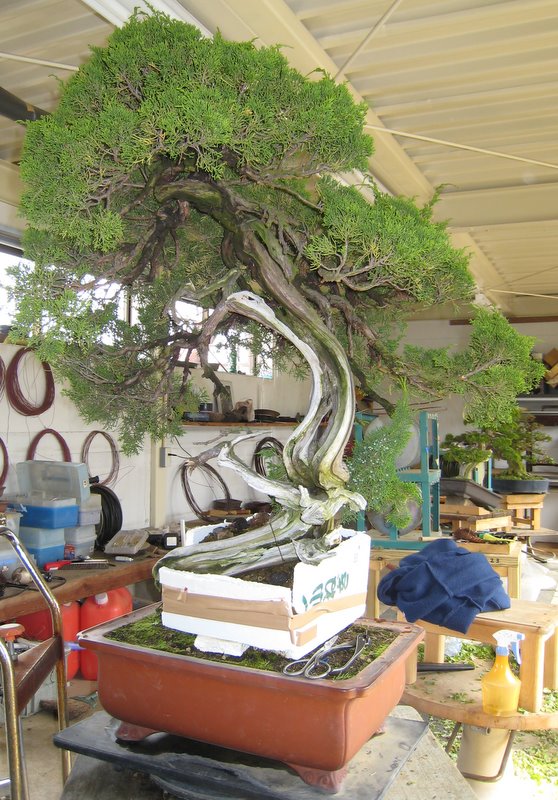
The below juniper was undergoing a major change too. It was a tosho or japanese needle juniper (Juniperus rigida). It was very large stock extending about 2-2.5 meters in length. It had some great movement and excellent jin/shari. The future for this tree was to break it up into sections. By grafting new roots and new foliage along the live vein at key points the large piece of stock would be able to be broken down into 3 or 4 bonsai, all with nice movement and good foliage. Shimpaku juniper was grafted onto the tree instead of more tosho as it is a more popular species and therefore easier to sell once the separation is complete.

As you can see this is a large piece of stock that is both too big to become an exhibitable bonsai (by Japanese standards) and the foliage is that of needle juniper which is not popular in Japan at the moment. How would you improve this material? Approach grafting.

In this case roots are being grafted onto a section of live vein in order to allow the entire trunk to be split up into smaller individual bonsai.

Hopefully from these two posts you can see the possibilities that this technique can provide. The ability to manipulate your stock and bonsai is a powerful tool in the bonsai artists arsenal. Shortening trunks, adding branches and changing foliage types can be controversial in some bonsai circles but I think that when push comes to shove the results speak for themselves.

I have been quite lucky that I have been able to visit a number of Japanese nurseries (SEE HERE). I love seeing the high quality trees and amazing level of finish and polish that these trees posses, but what I have also found very interesting during these visits is looking  into the back of house areas where bonsai are in various stages of transformation.

Air layers, grafts and other techniques are all on display out the back of most nurseries. It not only gives you a look into these techniques but also gives you some ideas on what sort of material to apply these techniques to.

One such technique is approach grafting.

A needle juniper is slowly changing its clothes. Soon it will be a much more valuable shimpaku. The white lump is the rootball of the scion which is wrapped in towel to protect its roots.

While I was studying at Taisho-en I was able to see this technique used to improve a range of stock. Shimpaku were given smaller foliage. Needle junipers were given shimpauk foliage. Roots were moved closer to the foliage to shorten trunks. It was obvious that after only a short stroll through their back of house that this was a valuable technique.

The technique itself, whether you are grafting on new roots or new foliage, is rather simple.

  1. Find a scion whip of the same species around 1-2 pencils thick and slice a sliver of bark off opposite sides at the point you want the whip to be grafted.
  2. Cut a channel in the trunk the same depth as the whip is thick.
  3. Widen this channel with a sharp knife to ensure clean cuts. The width of the channel should make a snug fit for the cut down section of scion.
  4. insert the scion into the stock trunks channel. Ensure that the cambium layers meet up accurately along the top edge of the channel cut.
  5. Fix the scion into the channel so it will not move or become miss-aligned. You can tie it with grafting tape or use a nail or two, screw etc.
  6. Cover it all in some type of sealant and wait for it to take.

I drew up a quick diagram to help explain the technique a little.

The scion whip can be from several sources. It could be a long branch doubled back on itself and grafted into the trunk, or could be a small whip that is growing in its own pot. If your scion is of the second type you may need to wrap the root ball in hessian or towel if the root ball ends up in a strange position after being grafted.

How long does the graft take to be successful? That is a difficult question. It is species dependent, growth dependent and also depends on how well you aligned the cambium layers in the first place. Although you can have success with poorly aligned cambium layers in this technique due to the face that both scion and stock support themselves before the graft takes, it is much faster to align the cambium correctly from the get go. I would say that most approach grafts would need one to two years to take. After that you could begin to reduce the original foliage over time and slowly let the new grafted foliage take over.

All in all it is a very useful technique that can be use to get you new roots, new foliage and generally improve difficult stock.

In the next day or so I will be posting a few examples to further illustrate the technique.

To see some real life examples have a look at “Approach grafting 2”.

Kojou-en is located in Kyoto about 800m to the west of Toji Temple. The Toji Temple can be easily reached by bus or by a moderate walk from the Kyoto JR station.

Kojou-en is one of the nurseries I had been meaning to visit for a long time. I first visited here in 2007 but the nursery was closed. Since then i have been wanting to come back and see the bonsai that I glimpsed through the fence.

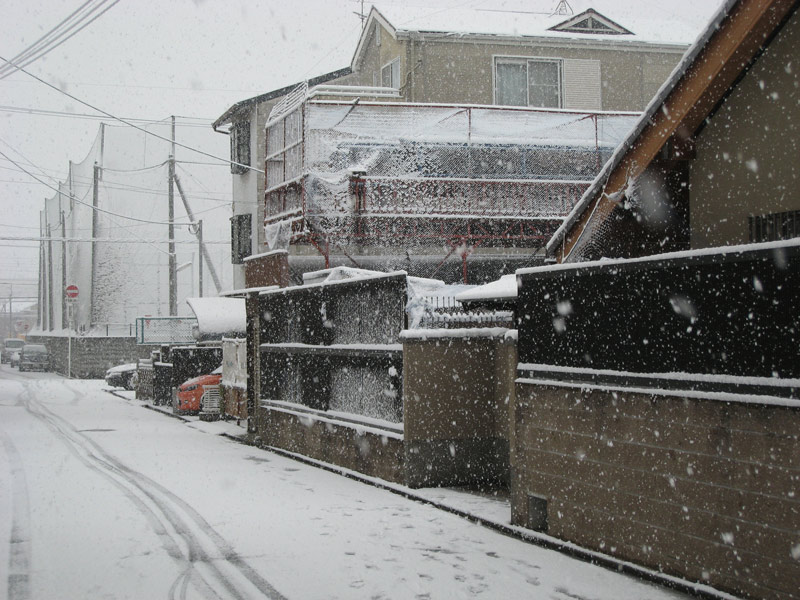
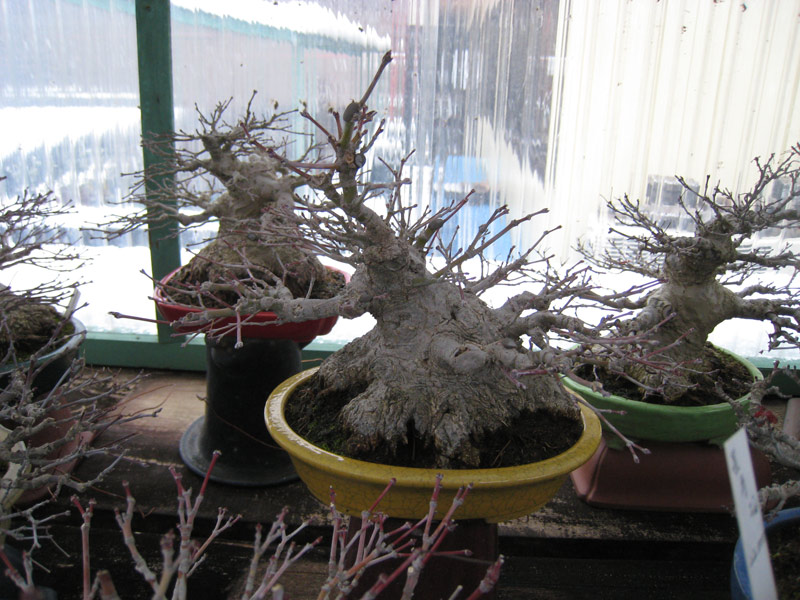
The day i chose to visit this trip was also not ideal. Kyoto received a huge dump of snow during the corse of the day and as a result most of the bonsai were shut up in enclosures protecting them from the cold. I did get to see a few of the bonsai but I think a 3rd trip will have to be in order to see the nursery in the full.


Snow fell heavily all day and by the evening around 20cm had fallen. According to the owner of the nursery this was quite unusual for Kyoto.

The fromt gate. Kojou-en is located in amoungst many residential buildings. It can be a little hard to locate the first time.


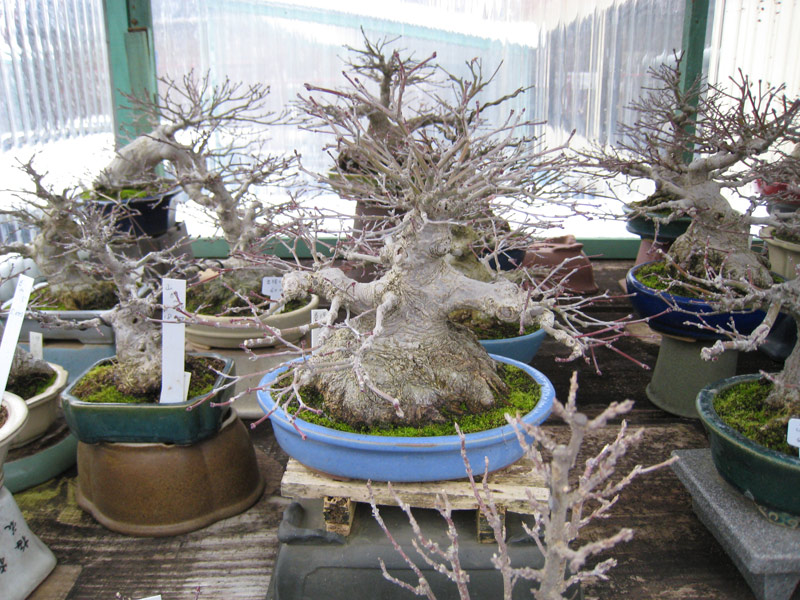
Kojou-en is known for its shohin bonsai, in fact there were no bonsai other than shohin in the nursery. They also had a nice range of shohin pots that were also for sale.


Some of the nice shohin that I was able to photograph.

Huge bases in tiny pots.

More bonsai sheltering inside their winter enclosures.


Kojou-en is well worth the visit and it is easily included in a Kyoto sight-seeing day. I will definitely be back to take it all in next time and hopefully my luck will be a little better than my last two visits.


If you would like to see more photos from this visit have a look HERE at my other blog.


The below pot is one i was generously given as a wedding gift during my last trip to Japan. I was presented with a small wooden Kiri wood box with a hand written inscription on the front.

The pot and box wrapped in a furoshiki cloth to protect it during its trip to Australia.

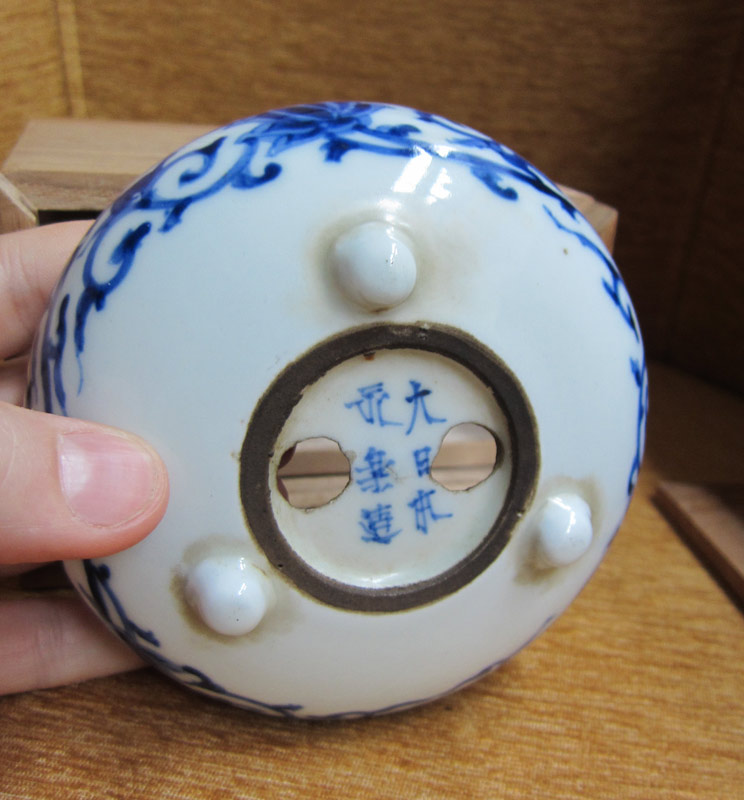
Inside was a porcelain pot. I took it out of its box and began to turn it over in my hands. It was clear that it had not begun its life as a bonsai container, but most probably started out as an incense burner. The two drainage holes in the bottom of the pot were definitely done some time after the pot had begun its life.

The pot and its Kiri box.

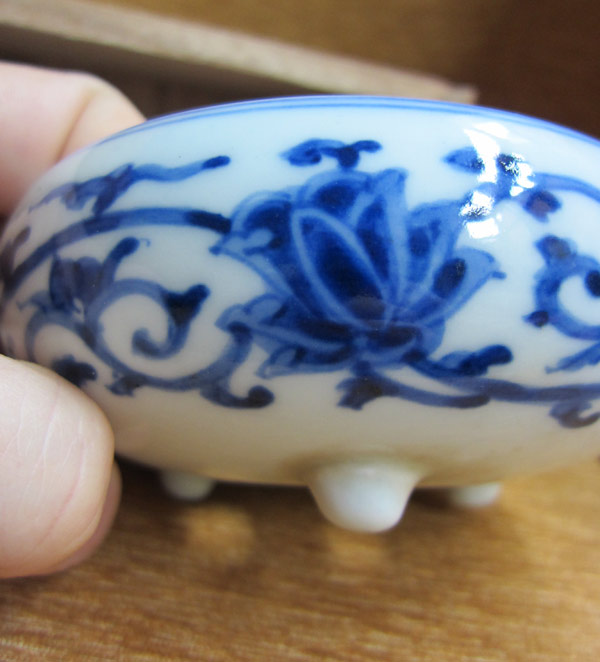
The walls of the pot are extremely fine and the painted design has a free quality to it.

A detail of the painted design.

I started to do some reasearch on the pot and came up with a website which dates it between 1868-1912. This puts it at around the 100 year old or older mark.

The quote relating to the dating is below:

It is generally accepted that marks that includes “Dai Nippon” in Japanese characters on the whole date to the Meiji (1868-1912) period, reflecting the greatly increased nationalism of that period. However, in stamped versions it also occurred on mass-produced export wares well into the 1930s. (Taken from HERE)

The marking on the bottom. You can see some patina forming which hints to the pots age.

I then had my wife translate the inscription on the front of the box to give a clue to the maker. She translated it as follows:

Top line: えいらく よしごろう (Eiraku Yoshigou)

bottom line: Type of pot ’round’

The person whom gave me the pot showed me the makers entries in these two books. (ONE, TWO) I have the books at home so i will have to sit down one night and find the entries again and see what information they can add.

I feel very lucky to own this pot and it reminds me every time i look at it of the friend who gave it to me. It was a perfect wedding gift (at least for me) and i think it will out last any rice cooker or toaster.

The tree below is one I worked on a couple of years ago. It is a large Shimpaku Juniper that had some great deadwood. When I was working on it, it was in the process of having some new roots grafted onto it. Because of this the styling was kept to just main branches, leaving the tips somewhat free so as not to stress the tree too much.

The tree before any work May 2009. There is a foam box that is holding soil for the grafts at the base. The layer was on the tree so that the deadwood would be brought closer to the soil surface and give the tree a more solid base.

After several hours wiring.

On my latest trip to Japan I re-visited Taisho-en and was reaquainted with this tree. The grafts had been a success and the tree had found a new home in a new bonsai pot.

It’s always nice to see trees you have worked on after some time apart. I get a similar feeling to that of  seeing an old friend. When I saw this tree in the nursery I took my time looking over it and revisiting the familiar curves and lines of the trunk and branches.

The tree as of January 2011. The angle of the tree is a little more upright now and the base appears much more solid now it is lower in the pot. If you look closely you can see a tuft of foliage at the base that is still attached to the root graft.

I wonder if we will cross paths again.

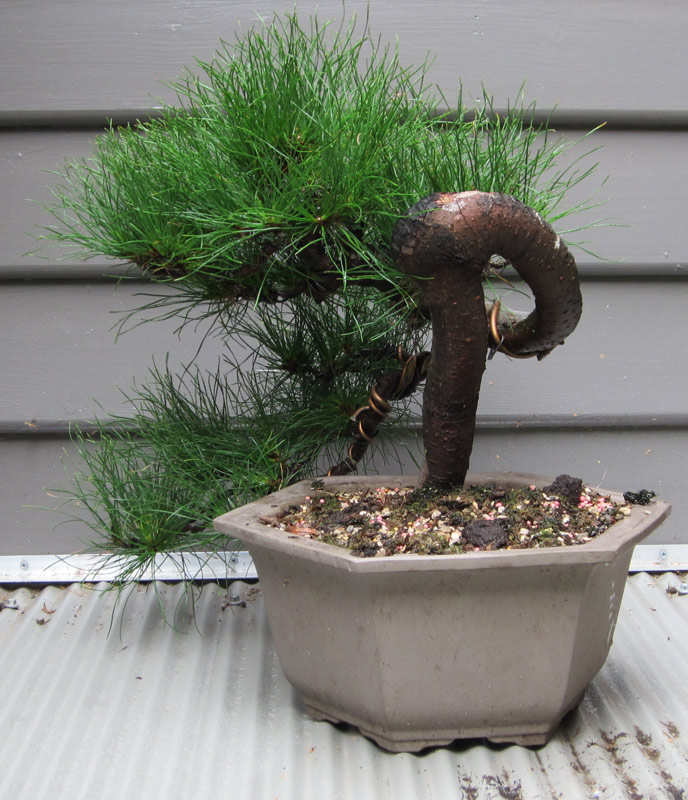
The following bonsai is one of the first trees I collected a number of years ago.

It is a radiata or Monterey pine (Pinus radiata). I quite like the species to work with but i am still trying to really get a grip on how to best grow and refine them. Perhaps i should make a future post on this subject.

Before it began its life as a bonsai it was located on the edge of a pine plantation where it had grown on a road batter. It had a very interesting curve in the trunk which was either from machinery running it over at some stage of its life or from it trying to seek the light through the long, tangled grass in which it was growing.

After collecting it took a couple of seasons for it to recover and become strong enough to be styled.

The tree before is life as a bonsai. It was needle plucked and readied for its first styling.

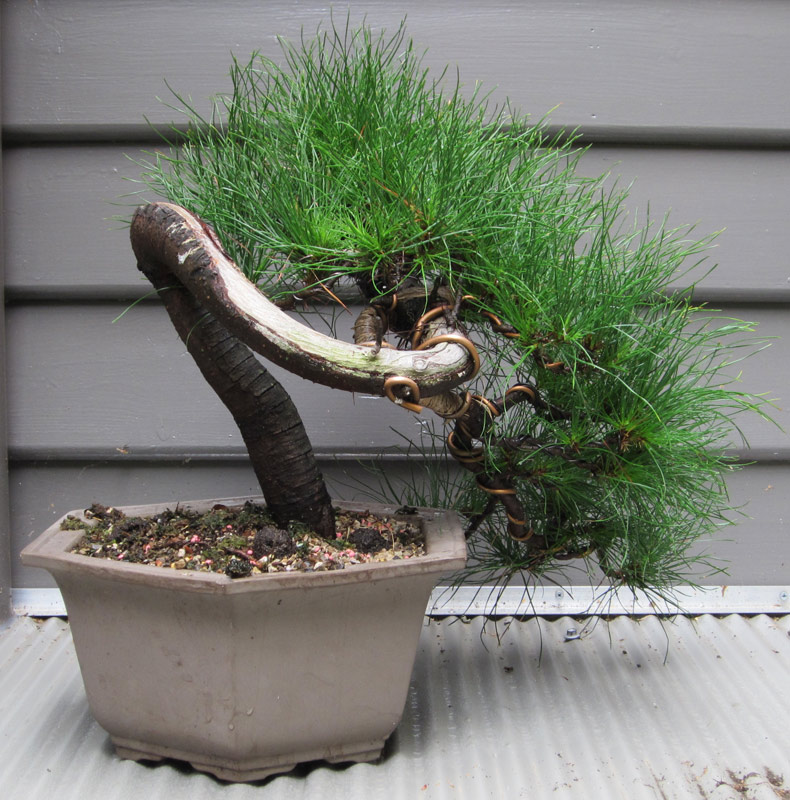
I styled is initially at a club night as part of a demonstration. At this time i wrapped the trunk in electrical tape as a substitute for raffia and put a second large bend in the trunk. The bend seemed quite severe to those watching at the time but the little pine bent easily. I then wired it fully and placed the foliage.

The first branch bent into position before the major bend was made.

A top view taken some time after the first styling. The dotted line shows the trunk line. The second bend is the one made during the first styling.

The tree recovered well and I lived with its style for some years while working on ramifying the branches. I didn’t mind the style but, I always thought there was something not quite right about it.

The bonsai was growing well after its first styling. It was un-wired and soon needed work.

The back side. I had often looked at it from this side and thought about a possible front.

The front after a re-wire. It was around this time that the shari seen in the next images started to develop.

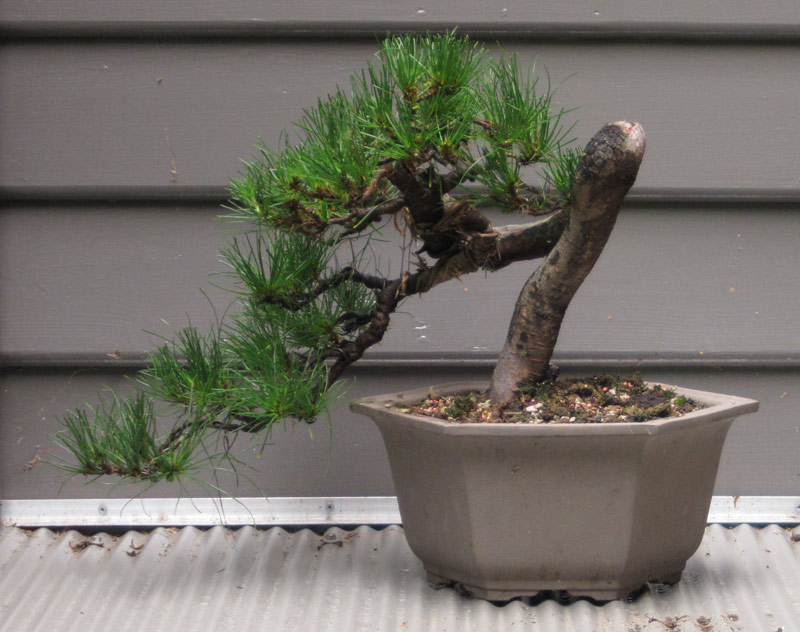
Even after a re-wire the style still was not sitting well with me so, i decided to take it to a critique session by a visiting Japanese Professional, Hirotoshi saito. He suggested that we do re-style and stand the tree up roughly 90 degrees. So, a few days later the tree was styled. It was quite a dramatic change but definitely one for the better.

The results after the second re-style.

That was back in July. The tree was very healthy and had grown strongly,  as a result there were multiple places where wire was cutting in.

The pine after its spring growth.

A side view.

The back. From this view you can get an idea of the extent of the shari that naturally developed. Hopefully i can extend this over time to the front of the lower trunk.

It was time for some work. I plucked and cut needles to allow more light and air into the interior of the tree and also removed most of the wire. I was happy to see that most of the branches had set in position.

The tree after the work.

The tree is far from finished and i will need to re-wire it again this winter. Pines with movement such as this are common in collected pines in europe but you rarely see them in Australia.

Hopefully if everything goes to plan it will have a bright future in its new upright style.

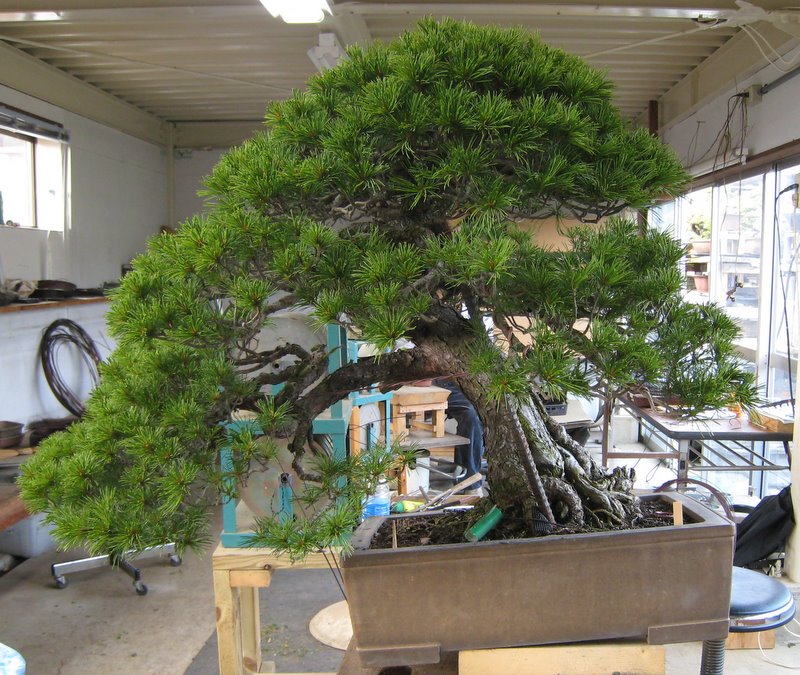
I just thought I would add a quick before and after of a large white pine I styled while at Taisho-en.

It one of the largest trees i have worked on to date. It had quite a good canopy of foliage to work with and some nice features such as the shari on the lower trunk and the interesting kink in the first branch.

It was a big undertaking and took the best part of two days to fully wire. The planting angle was changed and the foliage was adjusted to suit. Some heavy bending was needed to compact the first branch as can be seen from the reenforcing bar next to the trunk.

Before

Working on large trees is a little bit strange. You have to work very closely to the tree in order to apply wire and position branches but due to their size you cannot get a true understanding of how it looks in connection with the rest of the tree. When working on smaller sized trees often all it takes to see the tree in the whole is just leaning back in your chair.
When working on larger material you end up regularly walking a few paces away to look at what you have done in conjunction with the rest of the tree’s form.

After the work

You can get an idea of the size of this tree by looking at my fingers at the top of the blue screen. I was holding the screen above my head with arms close to full stretch.

The Gafu-ten exhibition in Kyoto was one of the first bonsai stops i made on this recent trip. Gafu-ten is held in the Miyakomesse Building, Kyoto. It is recognised as the highest level shohin bonsai exhibition in Japan. There are over 200 displays in the show and it also has an extensive sales area.

It was my first time to the exhibition and i was thoroughly looking forward to it. We arrived and were very fortunate to be given two free entry tickets by a very nice woman.

Me at the entrance

The exhibition was fantastic. The 200 displays were overwhelming. Although we spent the most part of a day at the exhibition it was not nearly enough time to take everything in completely. The level of trees on display was amazing and each tree was beautifully matched with some truly beautiful pots, stands etc.

Unfortunately the only places i could take pictures was at the entrance and in the sales area. I think i will probably have to buy the album as i would like to spend my time revisiting some of the displays that have stuck in my head.

After filtering through the exhibition we emerged in the sales area. We were there on the last day of the exhibition so i am guessing that the best items may have been sold but there was still a huge amount of things to buy, look at and wish for.

Many of the sales trees looked like they would not be out of place on the display benches.

More sale trees

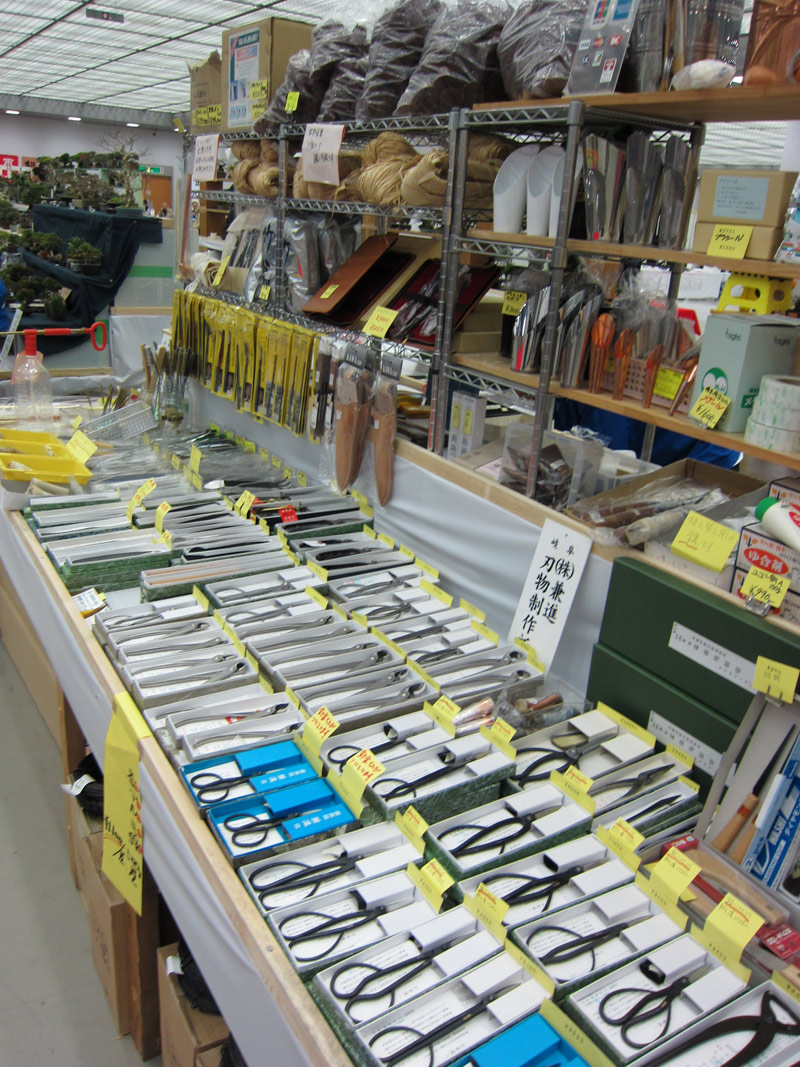
One of the few tool shops

I spent the afternoon browsing, buying and wishing i had a larger luggage allowance as well as snapping photos. If you are interested in the full gallery of pictures they are located HERE

I am back from a hectic 3 weeks in Japan.

Most of the other times i have been to Japan i have gone with the intention of cramming in as many bonsai related things as i could. This time was a little different. I went to Japan this time to get married. So needless to say, i had far less time to do bonsai things. That being said i did manage to fit some in.

I visited a few nurseries, the new Omiya bonsai museum and the Gafu-ten exhibition. It was getting close to the selection time for Kokufu-ten so most nurseries had there submissions out being prepared.

I would have liked to come home with a suitcase full of pots, but it was instead full of suits, shoes and my wife’s things (as she is relocating to Australia).

I did fit a few things in though, including some Bunzan and Juko pots as well as some tools and a stone that caught my eye. I was also very lucky to be given a very old pot in a kiri box.

Hopefully some of the things i brought back will become the topics of future posts. In the meantime while i sift through my pictures here is one from the sales area of Gafu-ten of to wet your appetites.

Gafu-ten sales area.

Hopefully by the end of the week i will have found time to make a full Gafu-ten post.

I am about to leave for Japan. My trees are being baby-sat and my camera is charged. I don’t know how often I will be able to post  while away, but even though this trip is not totally bonsai related I should have a whole lot of images to add to this blog and my bonsai in Japan blog when i return.

I will leave you with a picture I took last trip on the island of Miyajima. A red pine growing in what could only be described as the bunjin style.

A red pine growing on top of Mt Misen, Miyajima.

Merry Christmas everyone and see you all sometime in the New year.

Enter your email address to subscribe to this blog and receive notifications of new posts by email.

Join 678 other subscribers

Contact me

nichigobonsai***gmail.com

Note: to use email address, substitute *** with @