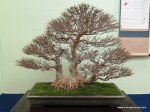
As expected there were some truely spectacular deciduous trees on display.
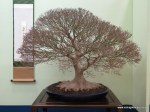


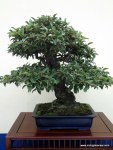


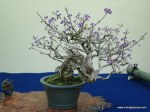
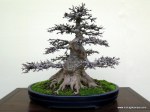
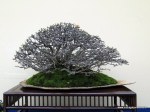


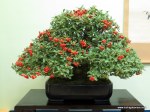
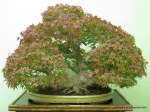

I have developed a healthy obsession with the dwarf flowering quince ‘Chojubai’. While looking over my photos this became very evident as I had taken photos of many of them even if they were merely being used as accents. I am sure that if you look over the below images you can see why I enjoy them so much.


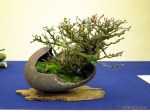

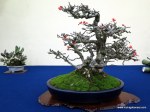
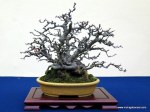


I am slowly making my way through processing all the pictures I took at the Taikan-ten last year and thought I would start things off on the blog with a couple of the shohin displays that were on offer at the exhibition. Over the coming weeks I will add more of the larger trees, accents and displays themselves as I process them.
Enjoy


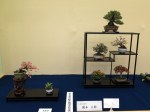


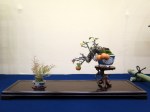

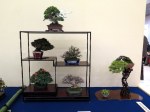


Well it has been a big year for me. I have spent it studying japanese full-time, while teaching, demonstrating and working on bonsai and client’s trees. This has all come with its challenges but all in all has been a great experience. On top of this, a couple of weeks ago I returned from a trip to Japan for both language immersion and bonsai which was the best way I could imagine to see out the last months of the year.
With all these things going on though it has not left much time for me to update the blog. Hopefully in the new year I will have more time to dedicate to posts and of course my own trees.
While I was in Japan I was lucky enough to visit the Taikan-ten exhibition. This time around they allowed photography by the general public so I was able to take many photos of the trees on display and as I process the images I will upload them over a series of posts. The show itself was a bit of a mixed bag with both extremely high quality trees which were sometimes next to trees that looked like they needed further work and developement. Of course the entire show was well worth the visit and as was the sales area.
For the time being I have included a teaser of future posts. Enjoy the photos and happy new year!
-
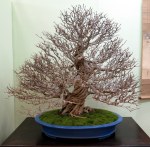
- Pomegranate
-
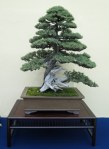
- Needle Juniper
-

- Quince
-

- Red pine
-
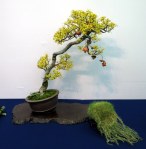
- A Pomegranate in an interesting pot….
-
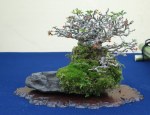
- Chojubai
-

- Maple
-

- White pine
-

- White beech
-
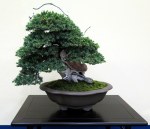
- Procumbens
At the moment I am studying japanese and I came across my first bonsai related exercise in my text-book and thought I’d share.

Not a bad informal upright by the looks of it…..
私はおじさんに怒られました。 – My uncle got angry at me.
I’m guessing it must have been a nice antique chinese pot to get smoke like that appearing!
This year I was lucky enough to have been invited to demonstrate and conduct workshops along side Robert Stevens at the Tops weekend that is hosted by the Illawarra Bonsai Society. I had always heard good things about the weekend and had been meaning to go for a number of years but it was not until I saw it for myself that I realised just what a great bonsai weekend it actually is.
Demonstrations, rolling workshops, suiseki daiza making, individuals working on their own trees and a good deal of socialising all makes for an outstanding weekend.

The view from above Stanwell
Add to that a fantastic venue and stunning location and you have a great event well worth the drive/flight/etc.

The view from breakfast across the valley.
As per usual, I took far less photos than I intended. As a result I only have a couple from my demonstration. The stock was from Bonsai South and i was quite surprised at the quality of stock available. There was a great range of ground grown material at reasonable prices.
I ended up choosing a juniper that I later found out was from the reject pile as it was a little wild and unusual. This is part of the reason I chose it. I enjoy a challenge and there was something about the material that kept me coming back to it.

Prior to any work.
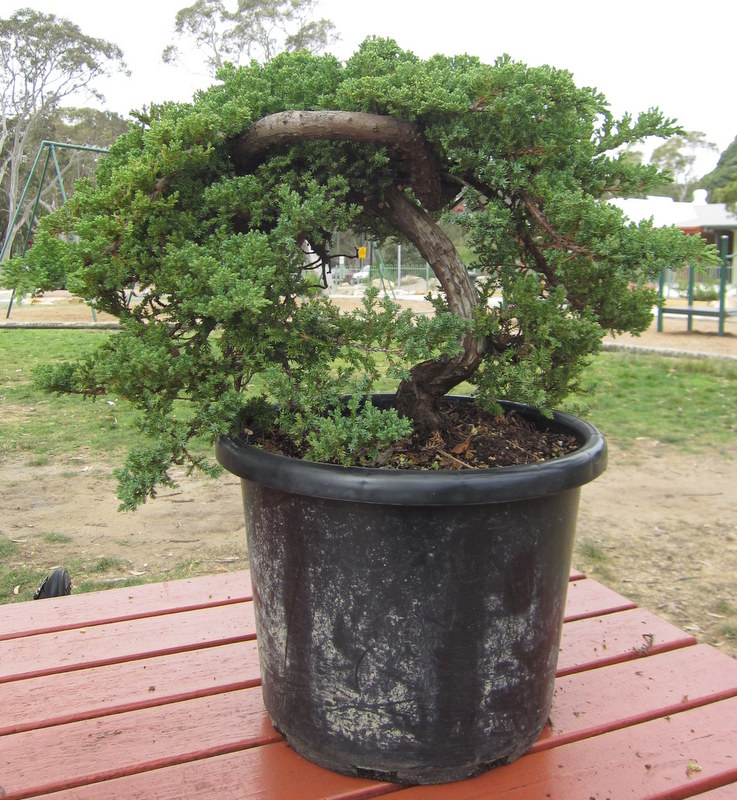
Prior to any work from the other side.
As is often the case, time was a little limited during the demonstration so the end result was a little rushed and only main wires were applied. That said, the basic shape was found and I think it should grow into an interesting tree in the future evne if i would have like to spend another couple of hours on it.
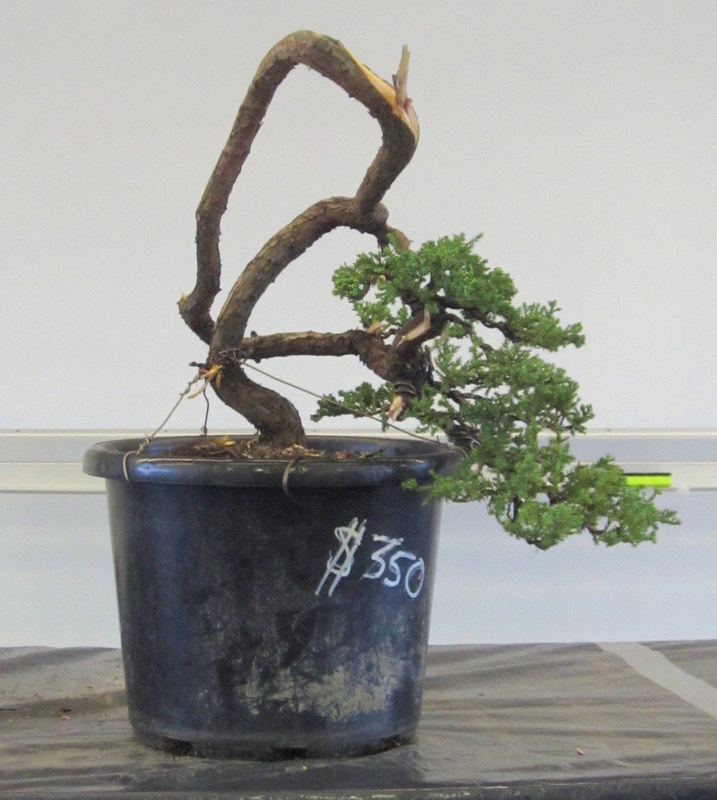
The “finished” result.
The tree was raffled later in the weekend and knowing who bought it I have a good feeling I will see the tree around the traps in the future. It will be interesting to see how it develops and matures.
I was fairly busy most of the weekend so I didn’t get much time to see Robert Stevens work but I was able to see two of his demonstrations.
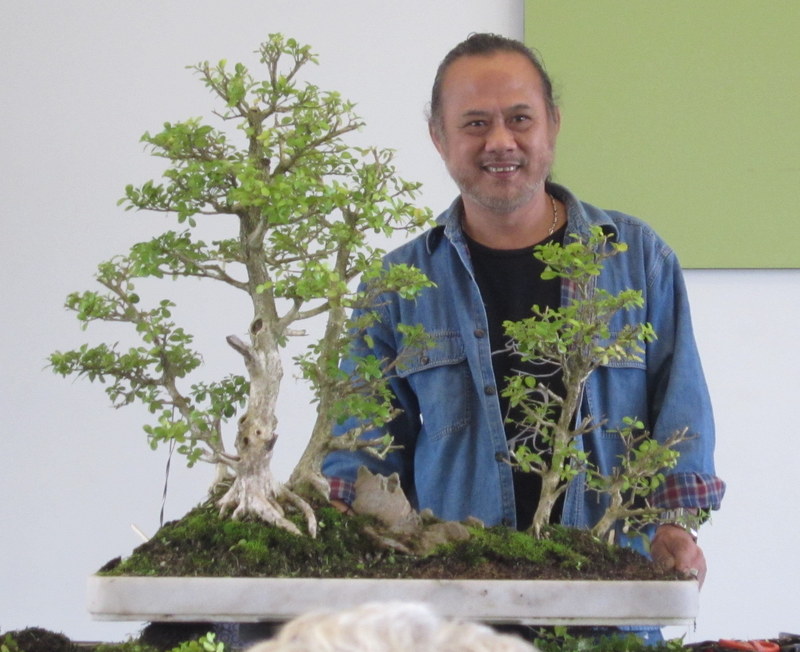
Robert at work on a buxus group.
Robert had some very interesting ways of approaching styling. The beauty of his approach is it can be applied to different aesthetics. I definitely took a few new things on board as I am sure most others that were watching did.
All in all I had a fantastic weekend. I caught up with old friends and made some new ones, all while talking, discussing, styling and working on bonsai.
For anyone who has ever thought about going but has not yet bit the bullet and gone, I would definitely recommend the weekend. I had a ball and I am sure anyone else interested in bonsai would also.
I am currently growing two species of Australian deciduous orchids. Both are known as ‘green hoods’ although they vary in habit a little from one another. I think they both show great promise as accent plants as they are interesting without being too bright or showy to take away from a tree they might be exhibited with.
Pterostylis curta is an upright form that sends up flower spines of about 20cm upon which small flowers sit.
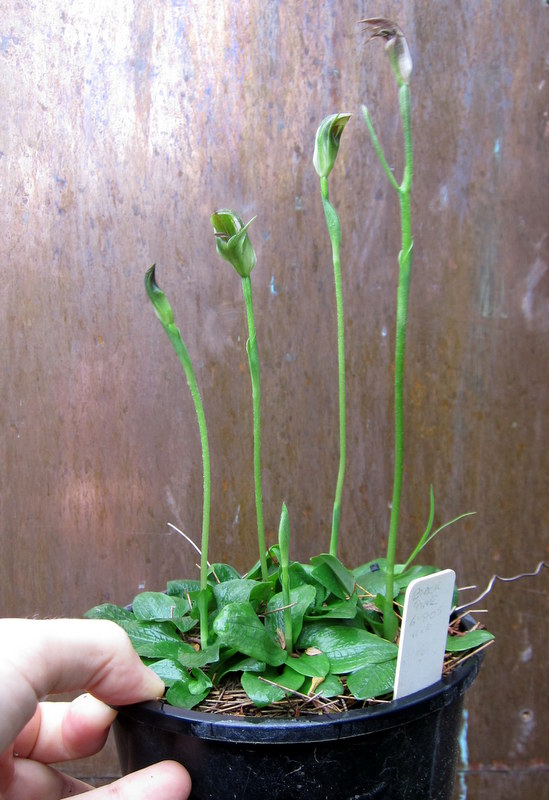
Pterostylis curta
Pterostylis nutans on the other hand sends up slightly shorted spines and has flowers that bow over or nod which is why they are also refered to as the nodding green hoods.

Pterostylis nutans
The best part about these orchids is how easy they are to care for. They are deciduous and require very little water over their growing season and none whilst they are dormant. They also reproduce easily and produce new bulbs each year which you can separate at re-potting time to make new plants. They seem very happy in pot culture which is another plus for the species.

Pterostylis nutans
Potted up they make interesting accents although once this pot fills with a few more tubers it will make for a better display.

Interesting shapes.

Close up they are very pretty.
You often find these orchids available at orchid shows and specialist nurseries, but as they reproduce so easily if you can find someone who has them chances are they will have some spare at re-potting time.
Well worth a look if you are after a native accent.
I have been busy re-potting in the last few weeks and finally managed to get around to doing a project tree that I have been growing for a couple of years. When I first acquired the tree I placed 6 or so root grafts onto the trunk. 3 took and 3 failed. Since then I have been meaning to replace the failed grafts but for what ever reason, every time I have had this tree out of its pot I havent been able to do the grafts.

The Arbortech and the faulty nebari in the back ground. You can see the two vertical scars from last attempt.
The first failures were all down to the fact that the channels that accepted the new shoots were too shallow. As the approach grafted seedlings thickened, they simple pushed away from the trunk instead of fusing. I originally cut the channels with a knife and was only able to cut so deep.
This years remedy was the Arbortech! I do very little machine carving but this tool does get a bit of work this time of year as it is excellent for cutting graft channels.
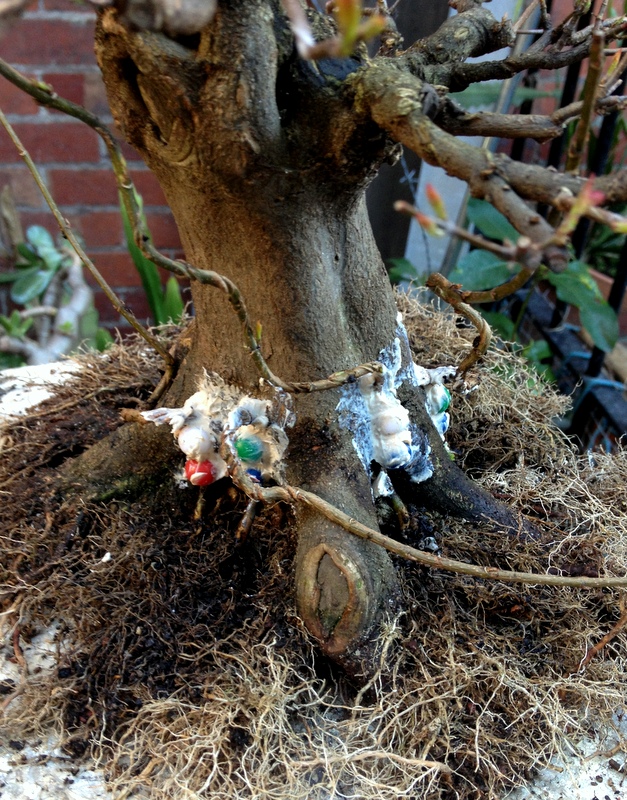
The four new grafts.
The process is dead simple. It is much the same as any other approach graft except instead of using a branch from the same tree you use seedlings as your grafting material.
The basic idea is that you cut a vertical channel in the trunk where you would like some new roots. You then insert a seedling into the channel and adjust it until the seedling’s roots are at the same level as the existing nebari. Then you fix the seedling into the channel (I used big map pins), seal it all up with cut paste and let it grow. Soon enough the seedling will thicken and fuse with the trunk. Cut off the top of the newly grafted seedling and you have new roots where there were previously none. For a better breakdown of the general theory see these two posts. Post 1, Post 2.
This year, the seedlings look a little strange as they are all from the batch of seedlings I bent the year before. Having said that, the bendy little trunks were very useful as I was able to use the first bend to create a good angle for the new roots to leave the trunk from.
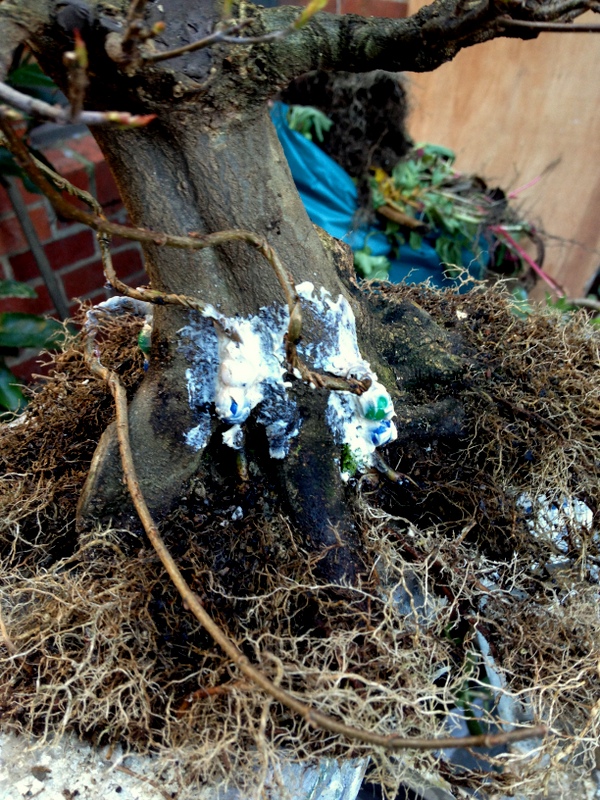
The bendy seedlings are care of a project I started last year.
The new grafts were generously coated in cut paste and then the whole lot was potted back into its training pot.
I imagine that by the end of this rapidly approaching summer the grafts should have taken and I will be able to shorten them back before then some time the following year cutting them flush with the trunk.
Hopefully I remember to take a few pictures along the way.
This year, Bonsai Northwest decided upon holding a winter exhibition. This is a bit of a rarity due to most Victorian shows being held in the spring or autumn. It was great to see many familiar trees out of leaf with the structure bear for all to see. I enjoy seeing trees that i have got to know over the years improve each time i see them come out for a show and this year was no exception.
Unfortunately the moody lighting didn’t translate very well into the photos I took with my cheap camera so I was only able to get a handful of non-blury shots which are below.
Enjoy.


Elm

Trident Maples

Japanese Black Pine

Trident Maple

Japanese Black Pine

Elm

A small Chinese Elm?

Desert Ash

A nice suiseki.

Japanese Maple

Chinese Elm

Chinese Elm ramification

Japanese Maple

Elm
I often hear people saying they wish they had access to good stock and or that they cant find any stock worth purchasing. Often the journey to find good stock can be difficult but there is definitely good stock available if you know where to look.
A couple of weekends ago I visited a friend on the outskirts of Melbourne to see how his ground grown stock had progressed this year.
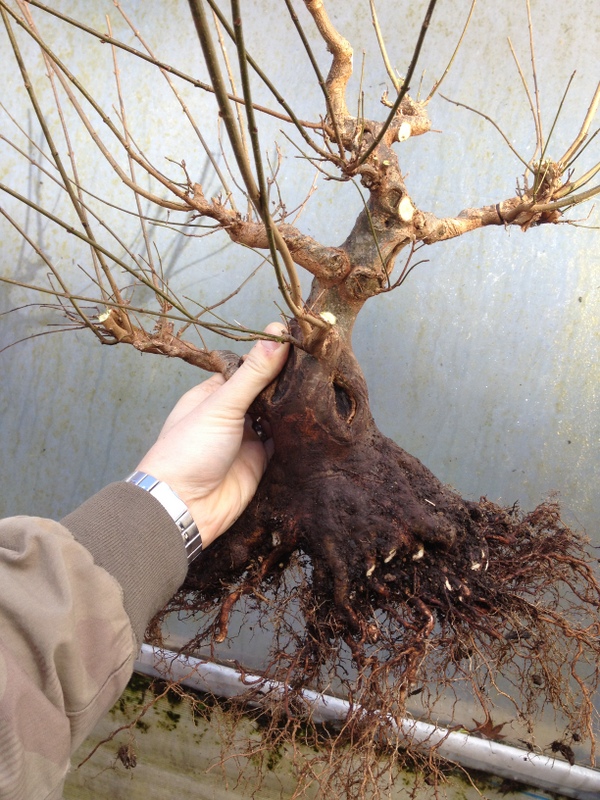
A trident slipped from the grow bed.
As you can see from the above picture, the stock was going very well indeed. There is no real secret about how to produce these results as they are a simple a matter of spending 10 years applying good technique and working the root bases each and every year.

Another great base.
Each year the trees have been dug up and cut back hard to encourage a fine, flat root system. Digging each year coupled with the excellent growing conditions in the grow beds results in good yearly top growth without roots getting too thick and creating faults. This makes for trunks with great base flare and very small scars which in many cases are healed in the ground.

A Japanese maple from the same beds.
When out of the ground, the most important cuts to the roots are in removing those that are downward growing and scarring the base of the trunk to further thicken the base; and with this stock, this has been done with great results. In fact, I was so impressed with the quality of the material I put my name on a couple that might come out of the ground in the next couple of years.
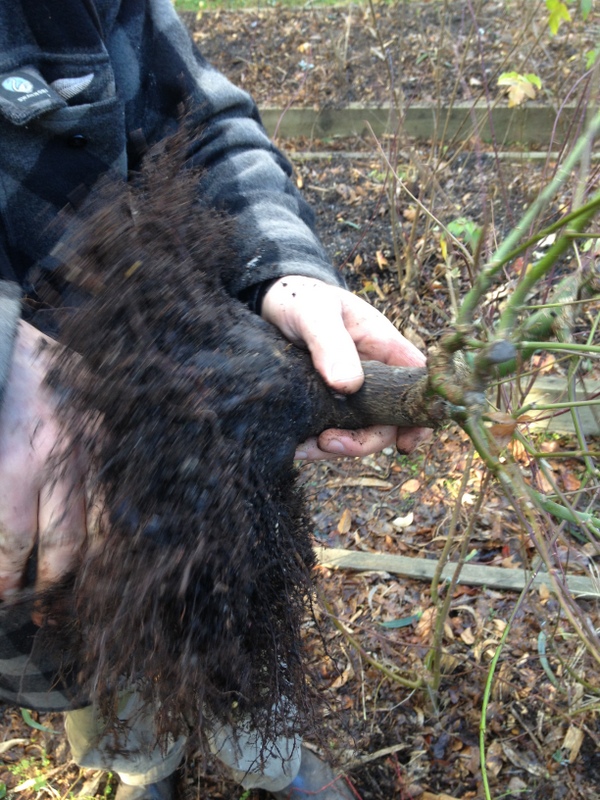
The roots on the underside of the trunk being removed.
For those not willing to spend 5 years working out the techniques and then a further 10 growing trunks luckily this grower also sells some of his stock.
His trident maples are available through Chojo Feature trees in Mount Evelyn. Jeff who runs the place is an extremely nice guy and I am sure could help out those interested in a trunk and or other bonsai related products.
 Nichigo Bonsai