This year I was lucky enough to be invited to demonstrate at the AABC/BCI national convention that was held on the Gold coast.

For the demonstration there were a few logistical difficulties on getting stock to work on from Melbourne (1700km away). I ended up buying a juniper over the phone from Sydney and then was lucky to have someone drive it up to Queensland for the convention for me. The down side of this was i didn’t really get to inspect the tree prior.

I flew up from Melbourne the day of the demo and arrived an hour or two before I had to start. I had requested some ‘interesting’ material and I was surely presented with a unique tree.

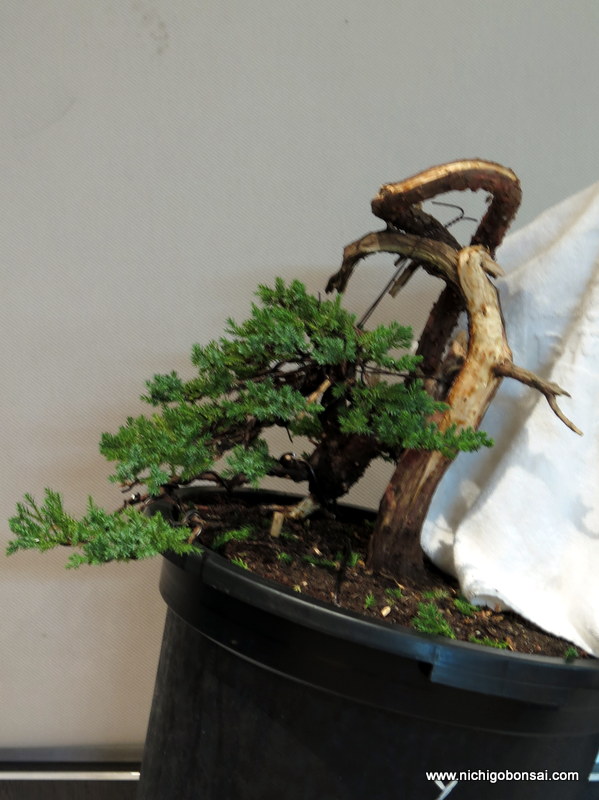
The mound of juniper.

The mound of juniper pre-work.

I spent the hour or so before I needed to be on stage cleaning out obviously dead growth and trying to get my head around the twists and turns of the trunk and where the foliage originated from.

After a busy session on stage next to Tony Bebb from Queensland and Chris Di Nola from Sydney, I managed to wrestle the tree into what I think is an interesting tree along side the other demonstration results.

After the demo.

After the demo.

After I had finished I had some time to reflect on the tree for a while and I decided that in hindsight the lower branch was probably not needed. I ended up leaving that decision up to the new owner. (as the tree was auctioned).

Branch gone?

Branch gone?

You may have noticed the towel in the above picture. It is covering a large branch and foliage that is earmarked to be removed in the future. In order to keep the tree growing strongly and able to recover quickly I left that  branch on rather than cut it off for an instant bonsai image.

At the end of the day the tree would have looked more finished for the demo if id removed the branch but the health of the tree would have been more at risk and the future development would have been more slow. If you leave more foliage on during major styling the tree recovers more quickly, has less chance of reverting to juvenile growth and will generally save you a lot of time in the trees journey from stock to show tree as the tree doesn’t go into a slowed down state while it recovers. A small sacrifice now leads to big gains down the track and being auctioned I didn’t want someone to go home with a dead tree.

Well as is often the case, life has been busy and the blog has suffered. I have been able to find some time today to write a string of posts that should be published over the next few weeks.

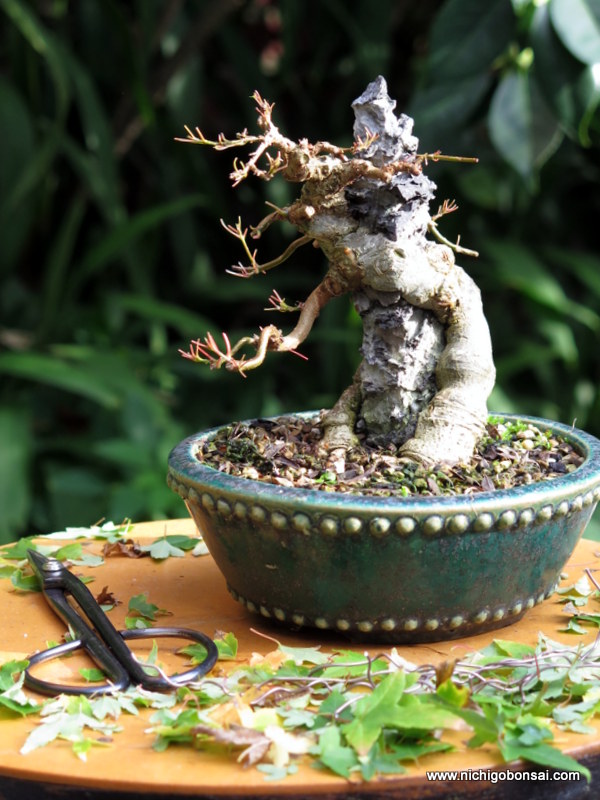
To kick things off, while going through my photos i found some before and after images of a small tree I have been playing with. The images are just a summer’s growth apart and seeing pictures like this reminds me of how good it is to capture your trees in images to track their developement. This tree I thought hadn’t really changed all that much but looking at the images you can see it has changed a lot from the start of the season.

Picture one shows the tree as I received it. It was imported from japan some time in the 1990’s when regulations were a little less strict and I managed to be in the right place at the right time and picked it up.

This is how i recieved the tree (althought i think for this photo i had just cut off a number of long branches)

This is how I received the tree (although I think for this photo I had just cut off a number of long sacrifice branches that had grown out)

Since it came into my collection I have potted it up and begun to build the branch structure. I had to graft on a branch (Third on the left) but now the basic structure is set and I am looking forward to ramifying it over the coming summer.

As the tree is now, ready for another years development.

As the tree is now, ready for another years development.

Probably next year it could go into a more suitable pot but for now the Koyou pot it is residing in isn’t too bad.

Where to from now? well I want to grow the first branch out a little longer and generally ramify up the tree a whole lot more. Buds are just starting to open and I cant wait to get started.

The following tree is a customer’s that is already well on its way as bonsai. The tree has had its first styling many years ago and is now at the development and refinment part of its life.
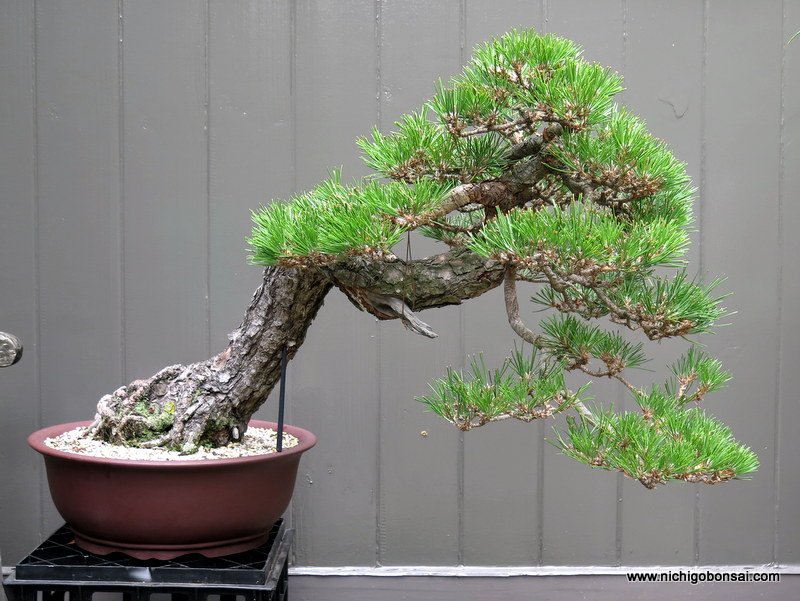
Before

Before

The tree had just been un-wired when I received it to work on and I set about re-applying wire to fine tune certain areas of the trees canopy.

Many areas in the canopy had borrowed foliage that had served it purpose and could be replaced with growth from better locations so a fair amount of branches were removed. I also focused in turning large singular pads into multiple, smaller layers to add some more detail to the tree.

After

After

Probably the largest change to the tree was removing a portion of the first left hand side branch to reveal the elbow in the trunk and small shari. I also lifted the first right hand side branch and generally compacted the foliage mass.

I think now the trunk appears much larger and the branch structure is now made up of more, smaller sized pads which add detail and give a sense of scale to the tree.

Although I have been told some people have an issue with the straight section of lower trunk, I really like the tree and don’t mind its irregular trunk. Perhaps in future re-pottings the owner could lower the planting level which might visually shorten the trunk line a little.

Overall a very nice tree that was a lot of fun to work on.

Another customer tree that has undergone needle work, candle selection and re-setting of the pads (tenaoshi). Unfortunately I didn’t realise the camera was in black and white mode for the after picture but you can see the results fairly well despite the lack of colour.

Before, looking bushy and healthy after a season of good growth.

Before, looking bushy and healthy after a season of good growth.

An film noir look at this bunjin tree after the work.

A film noir look at this bunjin tree after the work.

Not a dramatic change, merely some minor tweaks and re-setting of some candles that grew out of the silhouette. Over all a very nice tree that is ready for another year of development.

Tenaoshi (手し) is a japanese term for a what is a fairly un glamorous but necessary task. The character  ‘te’ (手) means hand and ‘naoshi’ (し) means to fix or repair so together they basically translate to fixing by hand. It’s a very logical description that describes the maintenance task of resetting and fixing the tree after a season’s growth.

As the tree grows often branches slowly lift their tips, and or the wind, passing people and or animals can displace branches despite being wired. To remedy this the artist should as part of their maintenance adjust the wiring and maybe even add some additional wire to new growth. Often this fixing by hand is combined with some light trimming (and needle work in the case of pines).

after a seasons growth

A customer’s white pine after a season’s growth.

As large changes in the before and after images are not really the aim, tenaoshi can seem like a bit of a tiresome task, but it is an important part of any seasonal bonsai routine and your trees will be much the worse for not doing it.

After some trimming, needle work and re-setting of foliage.

After some trimming, needle work and re-setting of foliage.

So next time you are out in your garden working on your trees, don’t simply wait until the tree needs re-wiring, adjust the wire that is currently on the tree to keep it looking and growing in the best form it can.

Been busy as per usual but I have managed time to fit in a couple of customer trees.

Below is a quick before and after of a black pine that needed teasing out of a sea of needles. A fun tree to style.

Before

Before

The after shot is a little lacking in quality but I am sure you get the idea.

After a day or so work.

After a day or so work.

As the days get cooler we slowly approach the time of year where I like to style conifers. This year is gearing up to be a big one for bonsai work as I have taken on a number of customers trees to be styled. Following on from the last Black Pine I worked on, I had the opportunity to work on a similar tree.

Before starting the work.

Before starting the work.

At least it looked similar before the work begun, but soon after the old needles were removed a new set of structural challenged presented themselves to be solved.

Old needles removed and ready for pruning and styling.

Old needles removed and ready for pruning and styling. (slightly rotated)

I decided to rotate the front slightly which brought up the issue of the first branch. That is it was now heading towards the rear of the tree so with the help of a screw in the trunk I was able to bend it forwards. This then set the base of the tree and the rest of the canopy could be built around it. The head was finally lowered and rounded out to create the final image.

After the work.

After the work.

Again this tree now needs a couple of years to grow into its new shape but even after the couple of weeks that passed between starting the job and finishing, new buds are beginning to form which should see this tree become show-able in the not too distant future.

While in Japan I worked on a number of trees which might make it to future posts.

One such tree was a bunjin style white pine that had been bought by the nursery as part of a larger collection. It had been styled by the previous owner but with far too thin wire so it was up to me to re-wire and find a new style for the tree. Oyakata gave me free rein on the tree and so I set about working.


As the tree began, styled by its previous owner.

As the tree began, styled by its previous owner.

So I stripped the old wire, pruned some branches and wired what was left. I then started to place branches and reached a stage where i wanted to cut off some branches that would take the tree past a point of no-return. So I called Oyakata from the garden to make sure he was going to be happy with my decisions.

My styling of the tree.

My styling of the tree.

It turns out what I had done was not to his liking and he proceeded to remake the branches and form a more upright tree.

The tree after Oyakata re-re-styled it.

The tree after Oyakata re-re-styled it.

And so that is how the tree stayed. After all it was not my tree and I certainly did the right thing by asking when I did.

That being said, did I like the end product? No, not really but I wasnt really happy with my version either. I can see why Oyakata styled it the way he did.

It is a little more regular and perhaps in that form is more easily sold (which is the name of the nursery game) and being of fairly low quality comparatively with the rest of the nursery Oyakata was probably hoping to get it sold quickly to make room for something more interesting.

Having said all that what was interesting about the exercise was to see a piece of material transformed into three totally different stylings by three different pairs of hands over the course of the day. Each person who styled it, from the previous owner, to me, finally to Oyakata saw something different in the material and I think it is that difference in how each of us treats our trees that keeps this art interesting and keeps me turning up to demonstrations, shows and events.

Perhaps this material much like all others has no one perfect way to be styled but instead many different forms that play to different tastes.

Things have been pretty busy since I got back from Japan. A new job, a pregnant wife and Autumn’s bonsai work just beginning haven’t left a lot of time for the blog.

On top of this, I have also been doing a fair amount of work on customer’s bonsai and their collections. Some of this work is routine seasonal maintenance, some of it teaching and then some of it is re-styling.

Before any work

Before any work

One such re-styling I completed recently was the black pine pictured above.  For Australia, the black pine had some good age to it and was starting to develop nice bark textures, but it’s canopy had grown into a solid blob over the years. My job was to find the tree within the blob. I had to prune a large number of branches out and define a better branch structure to set the tree up for it’s future. As a result a fair amount was cut off the tree but now the bones have been formed to grow a better structure upon.

After pruning and wiring.

After pruning and wiring.

One of the main changes, apart from separating the foliage into layers was to enhance the movement of the tree. This involved shortening the right side and lowering the head to accentuate the left movement of the main branch which made a huge difference to the appearance of the tree.

I think a re-pot into something more suitable and a year or two of candle pruning should see this tree fill into a very nice tree.

Part two.

Enter your email address to subscribe to this blog and receive notifications of new posts by email.

Join 689 other subscribers

Contact me

nichigobonsai***gmail.com

Note: to use email address, substitute *** with @