Life as always is busy but lately things have been flat-out. I have been juggling a two-year old,  full-time work, managing our house’s extension, working customer trees, digging/collecting material and also travelling Australia (Perth, Sydney, Canberra, Bendigo, Geelong and Brisbane) as an AABC tutor giving lectures, demonstrations and workshops. As a result the blog has suffered.

Hopefully I can kick start the blog in the coming months. I have a number of posts lined up and I am sure there will be things of interest to share as the growing season heats up.

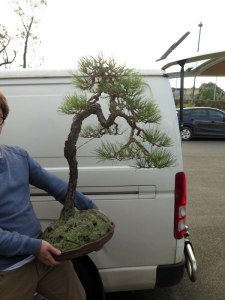
Today’s post is a small red pine that I worked for a good friend towards the start of winter.

It is rare to see red pines in Australia and particularly rare to see ones as good as this one. It underwent a fairly major transformation during the styling which in my opinion has set it up to be one of the best red pines of this size in the country (at least from those I have seen). It still needs a little filling out but it’s bones are set for it to grow into a really nice tree into the future.

img_6067a

The material prior to beginning. Nice colour and full growth which left a lot to work with.

img_6077a

The material prior to beginning. Nice colour and full growth which left a lot to work with.

Most of the work during the styling involved dividing the few branches up into multiple smaller pads that were in better scale and harmony to the size of the tree. Those were then used to accentuate the movement and direction of the trunk line.

There is still a number of areas that need to fill in with further ramification but I think it is certainly off to a great start.

After saying that red pines are rare in Australia my next post will be about another taller tree that is also of very high quality. Until then……..

For those interested i have been invited to participate in a short discussion about my thoughts on Bonsai, my experiences in Japan and the up coming workshops I am running in conjunction with my close friend Natasha.

IMG_4612a

An interesting tree I stumbled across recently.

IMG_1992

A synergy?

I am assuming the show will be download-able at some stage and I will supply a link if and when it becomes available via a future post. For those wanting to catch the show live, It will be broadcast on ABC local radio Central and Western Victoria at around 7am this Saturday.

Audio is available HERE

For those interested in the workshops, they will be aimed at teaching people to see and interpret the world through bonsai as an artistic medium rather than via a set of rigid rules. It will guide you through the process of reflecting on how we see the world, how we might become comfortable within this and how we might communicate this to others; An awakening through bonsai if you like which can and will be applied widely outside of bonsai.

Recently featured in Country Style magazine, her property, skirted by forest, will provide the perfect backdrop for learning and sharing ideas.

Another highlight of collaborating with Natasha is that the workshop will be teamed up with a beautiful 2 course kitchen garden lunch cooked from locally sourced, grown and foraged ingredients set in her stunning garden.  Natasha is an incredibly passionate, talented and welcoming host who is sure to make the day a very special one.

Further details can be found at her site: http://www.natashamorgan.com.au/

I have been doing a lot of thinking about bonsai lately. What it is, why we do it and how it relates to modern lives outside of a Japanese context.

While discussing this with my good friend Natasha Morgan, she invited me to run a couple of bonsai workshops of a different kind at her beautiful property, Oak and Monkey Puzzle in Spargo Creek near Daylesford to begin a wider discussion.

IMG_5329

One of the trees at Oak and Monkey Puzzle

The day long workshops will be aimed at teaching people to see and interpret the world through bonsai as an artistic medium rather than via a set of rigid rules. It will guide you through the process of reflecting on how we see the world, how we might become comfortable within this and how we might communicate this to others; An awakening through bonsai if you like which can and will be applied widely outside of bonsai.

Recently featured in Country Style magazine, her property, skirted by forest, will provide the perfect backdrop for learning and sharing ideas.

Another highlight of collaborating with Natasha is that the workshop will be teamed up with a beautiful 2 course kitchen garden lunch cooked from locally sourced, grown and foraged ingredients set in her stunning garden.  Natasha is an incredibly passionate, talented and welcoming host who is sure to make the day a very special one.

Further details can be found at her site: http://www.natashamorgan.com.au/

Be sure to have a look over what else she has been up to while you are there as she is passionate about people, collaboration, food and sharing ideas and skills and brings these all together in such a beautiful way.


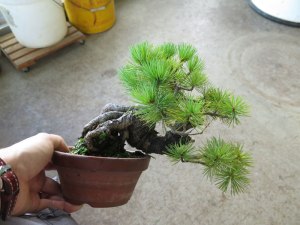
Just a quick post for today. I was going through some old holiday photos (mainly bonsai pics) and came across a small Japanese White Pine I had worked on in Japan.

I am really getting more and more into shohin sized trees. They are really challenging to grow well yet are easy to handle and take up much less bench space, which is a plus.

The challenge with this tree was to create enough detail in the foliage by means of multiple layers to give the illusion that it was in fact a much larger tree.

IMG_5338

Before

IMG_5370

After

Of course half the battle is starting with good stock which this little tree certainly falls into the category of.

Hopefully I can start producing some stock similar to this in the coming years.

While this tree has had a couple of mishaps since I last posted about it, Project Trident 02 has been slowly progressing.

You can read about its beginning HERE.

Since that post, I removed the air layers and have been trying to get as much growth in the grafts I could to help them fuse with the parent trunk. I did have a small failure with the first branch’s graft as i knocked it when moving the tree and broke it.

I re-did that graft and it seems both grafts are growing well now. So well in fact I have decided to go into the next phase of this material’s development.

As I am looking to make a smaller tree I will at some stage have to make a fairly large cut to shorten the main trunk.

IMG_59901

The newly taken graft on the left side of the trunk and the re-grafted branch lower on the right.

When making large cuts on bonsai, you should always have some sort of plan as to how you will heal/deal with the resulting wound. My plan with this tree is to heal the cut in phases.

What I plan to do with this tree is make half the cut now, use the growth on the main trunk above the cut to heal it and then sever the remaining half of the trunk. This should leave me with half the scar I would have otherwise .

IMG_59922

The first cut.

So I cut through half the trunk with a small saw and then cleaned up this cut with a sharp knife and sealed it all with cut paste.

IMG_59933

Cut paste applied.

The idea is that with the main trunk still attached, it will draw sap past the cut site and speed up the healing process. The more growth and sap that moves past a scar, the faster the scar rolls over the wound.

Once this is healed I will cut the other half and heal that side by growing out the branches and new apex of the remaining tree. For the rest of the season I will let the branches grow freely and feed the tree accordingly.

IMG_59964

A new back branch.

While I had the tools out I also grafted on a new back branch. With this branch in place the tree will be well on its way towards having its foliage changed to that with much better internode/ leaf quality. I will probably look to graft on one more branch onto and or around the scar that is created when I remove the rest of the main trunk. This should speed up the healing of the final scar.

I will be sure to post some updates as the scar heals.
One of the trees I worked on last year was an informal upright Mugo Pine. I think that it was originally received by its owner as essentially a piece of topiary. He then worked it over a few years into a bonsai form.

I was asked to wire the tree and refine its image.

The tree had a few issues that this round of work has tried to iron out but it will certainly benefit from further refinement as it progresses.

The trees branching was incredibly dense in part due to its previous life as topiary which had lead to a large mass of ramification. It was also compounded by the tendency of Mugo pines to have multiple shoots at each branch tip which further compounded the dense look.

150904_branch

Multiple growing tips on a typical shoot.

My first action was to remove unnecessary sub-branches and take many of the branches back to a much simpler structure which in turn reduced the foliage density. I also reduced the remaining shoots on the tips to two shoots which further reduced the density and allowed for light and air to reach into the inner structure to aid back budding.

150904_chopped

Some of the sub-branches removed from the first branch.

After the pruning work the aim of the styling was to break the large pads and masses of foliage into smaller pads to create a higher level of detail and structure.

150904_Before

The tree before the work.

I ended up removing close to 50% of the foliage which lead me to go a little bit easily on any heavy bending. Ultimately i would like to bend the thick first and second branches down a little more than they are currently and work on some of the dead stubs that were left long to die back slowly.

150904_After

The tree after.

All in all the tree has been improved and is growing nicely into its new form. Perhaps this coming winter it will be ready for a re-visit.

The blog has taken a bit of a back seat of late. I notice that my last post was from back in July last year! Things have been pretty busy since then with moving to a new city, starting a new job, renovating an old house and having a child all leaving me with very little time for bonsai related work.

That said I have been able to get the tools out from time to time and have been styling customers trees and working on my own trees as time has allowed.

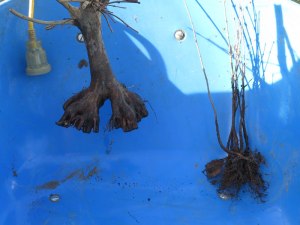
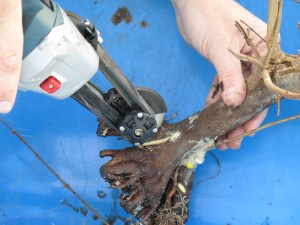
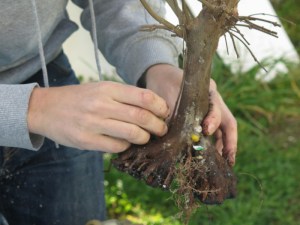
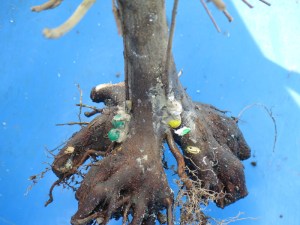
To kick off 2016 and start the blog off a fresh I thought a small photo essay of some grafting I did earlier this spring might be a good way to get things back into gear. The tree in question came from Shibui Bonsai and had just been lifted from the grow beds and showed the results of the early work Neil puts into these trees. It had a good start to build a really nice base upon so i decided to begin that process with some root grafting. Photos below:


IMG_5736

A trident Maple that was field grown with pretty good roots. There were a couple of gaps which I decided could be filled in with some approach grafts. You can see the small trident whips that were selected to be used for the grafts in the background.

IMG_5747

A trident Maple that was field grown with pretty good roots. There were a couple of gaps which I decided could be filled in with some approach grafts. You can see the small trident whips that were selected to be used for the grafts in the background.

IMG_5750

A trident Maple that was field grown with pretty good roots. There were a couple of gaps which I decided could be filled in with some approach grafts. You can see the small trident whips that were selected to be used for the grafts in the background.

IMG_5754

A trident Maple that was field grown with pretty good roots. There were a couple of gaps which I decided could be filled in with some approach grafts. You can see the small trident whips that were selected to be used for the grafts in the background.

IMG_5757

A trident Maple that was field grown with pretty good roots. There were a couple of gaps which I decided could be filled in with some approach grafts. You can see the small trident whips that were selected to be used for the grafts in the background.

IMG_4626

A trident Maple that was field grown with pretty good roots. There were a couple of gaps which I decided could be filled in with some approach grafts. You can see the small trident whips that were selected to be used for the grafts in the background.

Both my bonsai and personal life have been busy of late. I am fortunate that this year I have been invited to demonstrate and run workshops across Australia for local club, groups and the AABC National Convention.  On top of this travel I just begun winter styling of clients trees. It looks like I will have a fairly full book of client trees, workshops and demonstrations that combined with a young child, a house half way through renovations and a full-time job doesn’t leave a lot of time to work my own collections.

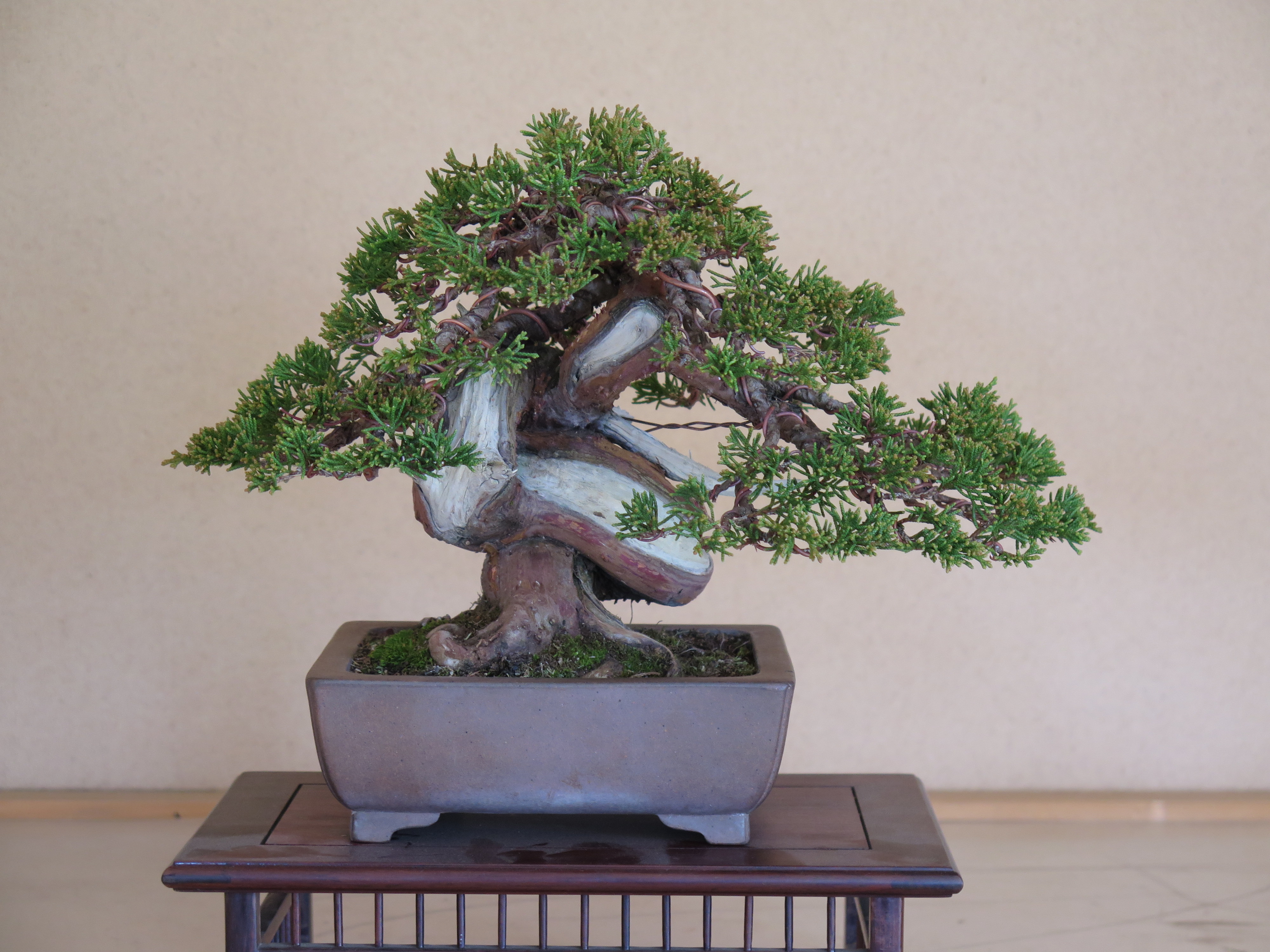
Today’s post is actually about a tree I worked on a year ago whilst in japan.

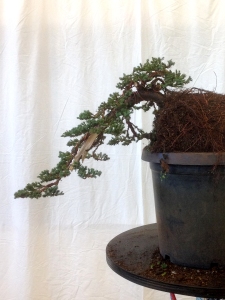
It was a small shimpaku juniper that Oyakata asked me to wire and style prior to taking it to auction the following day to be sold.

Prior to the work

Prior to the work

I initially wanted to tilt the tree to the right so that the first bend would come in contact with the soil giving the appearance of a much larger trunk but Oyakata didn’t want to re-pot as the auction was so close and as a result we utilised the existing angle and front.

It turned out to be a fairly straight forward re-style and Oyakata told me it sold well at the auction.

Post work.

Post work.

Looking back on trees like this it really gives me the incentive to start growing my own material to this standard. I now have a backyard big enough to experiment with a whole lot more stock so I am looking forward to starting this process off this year. Who knows, in ten years time I might have a whole lot of these ready for display………..

During my last trip to Japan I worked on what might be a very special maple. Oyakata brought it to me to cut back and wire in preparation for the following springs growth.

He said it was a very famous tree that had been sold, miss-treated, had gone backwards and was now back at the nursery to be re made under Oyakata’s care.

The tree in question.

The tree in question.

The tree had supposedly featured in the Gafu-ten special tree album “Miyabi” that recognised important shohin bonsai masterpieces and pots.

Of course, I quickly dug out the album and tried to locate the tree. But, it was not so easy.

The best match I could find was the tree below.

The same tree?

The same tree?

I am fairly sure this is the same tree although it has obviously changed a lot since that picture was taken. I am guessing it’s been about 10 years between the two pictures and many aspects are similar although many are also very different.

The base has obviously thickened considerably totally changing the proportions but you can just make out the link to the original form. Some of the original branches have also been lost, have thickened and or have seemed to have moved as the trunk has spread. all this make recognising the tree difficult. I am 90% sure its the same tree but of course there is a good chance I am wrong.

Any forensic bonsai detectives out there? Can you see the similarities? Is this the same tree?

After some work.

After some work.

The work itself was fairly straight forward. I tried to remove thick branch tips, pruned out other unnecessary branching and wired a rough structure. The usual work for a deciduous tree in this stage.

From the back.

From the back.

It’s nice to know that the tree is back on the path to one day being a great little shohin tree again. Looking over the above pics really makes you appreciate how much trees change over time and how you are forced to forever re-imagine them and adapt to mishaps as they develop and change. The nice thing about working with living things is their ability to be reworked and recovered which i think this tree is a good example of.

A year later.

A year later. Thanks for the pic Kelvin!

A friend sent me some photos of this tree during his recent trip that shows another year of ramification and a change in pot. The trunk looks thicker again! It’s amazing what a year can do and only makes you think of how great this tree could have  looked if it hadn’t gone backwards for a period of years after appearing in miyabi.

In today’s post I am hoping to explain one of the more difficult concepts of bonsai and or any art or design for that matter.  It is the concept of seeing.

But doesn’t everyone see? Well not exactly. I like to think that everyone ‘looks’ (except the blind) but not everyone ‘sees’.

What do I mean by that? Well, I like to think that seeing involves interpreting what it is that you are looking at in a meaningful way. For example; if you were to look at a truck, you mind would see the shape and tell your brain you were looking at a truck. But really what you are looking at is a combination of shapes and forms that are all put together to form what we know as a truck. Does it have four wheels, six, eight? Twin cab, single cab? Flat tray, refrigerated? Trucks come in a range of styles and shapes and to just write it off as a ‘truck’ is missing a lot of information.

Clear as mud?

I was going through my photos from my last trip to japan (almost a year ago today) and noticed a good example of me not being able to really see what was right in front of me.

While i was in japan I worked on the below white pine while studying at Taisho-en.

The original front

The original front

Firstly, I decided that from this aspect the larger root formed a very straight line which was much less obvious from the tree’s back side. So I decided on a front change.

The original back (new front)

The original back (new front)

So far the styling was going to plan. New front decided, check.

I then addressed the old first branch (which was now a back branch) by cutting it off.

Branch removed

Branch removed

This achieved a couple of things. Firstly it removed a large heavy branch which took away from the trunks size and secondly it compacted the tree which highlighted the trunk further.

Following the cut, I cleaned the foliage and branches, worked on the jin that the cut off branch had created and also introduced some shari to the new front of the tree. I added a bunch of wire and finally came up with an image I was happy with.

Where i thought the tree was finished.

Finished?

At which stage Oyakata strolled past and gave his review of the tree. I sat and listened and took on board what he was saying, nodding and agreeing with everything he was saying. Every point he made was spot on and I could see the issues the minute he mentioned them. I felt a little embarrassed I hadn’t picked them up myself as I had been staring at this tree for the best part of a day and hadn’t actually seen the errors that were right in front of my nose. My eye had got lazy and my work had suffered as a result.

After adjustments

After adjustments

Oyakata had made a couple of small changes that made big difference. He slightly adjusted the front angle which moved the back branch (between apex and first branch) into a position that gave some indentation to the outer silhouette. This broke up the rigid silhouette and made the canopy outline more interesting.

He also broke up the large mass of the apex by bringing some negative space into the apex foliage, exposing a section of trunk. This added layers of detail and changed the appearance and perceived scale of the tree.

He then slightly separated the bottom edges of the two pads on either side of the apex. Looking at the above image with this in mind, the separation could be enhanced to create some more dynamism in the future.

Now nothing that Oyakata did was earth shattering. All his adjustments were quite simple design changes that I already should have known. The issue was that I had stopped looking at the tree analytically and rather had got caught up in the over all form.

It probably had something to do with it being the end of the day and perhaps i might have picked up these changes had I come back to the workshop fresh in the morning but it is an important reminder to not just look at your trees. You should look analytically so that you really ‘see’ what is going on.

I am sure you all have trees on your benches that you look at every day, who’s form and structure you have become accustomed to and have stopped looking for improvement in. We all do it and it is one of the major contributing factors as to why an artists bonsai stagnate.

Small changes can have big effects, so get out there and really try to ‘see’ what you are looking at. Challenge what is in front of you and always look for improvement.

Most skills in bonsai can be learnt in a short time frame but developing your eye and keeping it active and critical, especially in regards to your own work, and this requires constant work over a long time frame.

Enter your email address to subscribe to this blog and receive notifications of new posts by email.

Join 688 other subscribers

Contact me

nichigobonsai***gmail.com

Note: to use email address, substitute *** with @