You are currently browsing the tag archive for the ‘Australian Bonsai’ tag.
On the 2nd of February 2013, the National Bonsai and Penjing Collection of Australia (NBPCA) opened at the newly custom-built premises within the National Arboretum, Canberra. I was lucky enough to attend the opening but unlucky in that my camera battery failed shortly after arriving.
The NBPCA at its new location really is not just a step forward for Bonsai in Australia but a giant leap. The promotion of Australian bonsai Artists, their work and Australian native bonsai species at such a public location can only help build bonsai momentum around the country. The collection itself consist of around 85 trees on display in a custom-built facility. Over the course of the day the display was packed with visitors which is hopefully a sign of things to come.
Now I could talk about all the merits of the collection and its new building but I guess I will save that for a future post and let the photos do the talking for now. I am only posting a few pics as I recommend that everyone gets down to Canberra and has a look for themselves. It is well worth the visit.
Some of the pics I was able to take prior to the battery going flat are below.
-

- The Crowd early on in the day
-
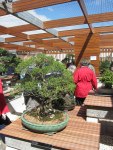
- Filling up with visitors
-
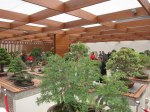
- The view over a forest
-
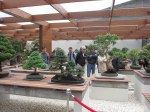
- Visitors viewing the collection
-

- Willow leaf Fig
-

- Fig
-

- Callistemon
-

- Cedar
-
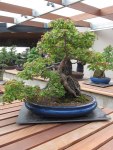
- Trident Maple
-

- English Elm
-

- Some of the many trees
-

- Chinese Elm
-

- Trident Maple
-

- Casuarina
-

- English Elm
-

- Olive
-

- Juniper
-
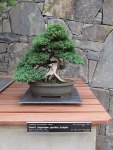
- Juniper
As you may or may not be aware, I have recently undergone surgery on my right wrist. Being right-handed, this has put a fair dent in my bonsai plans of late.
A few nights ago after work I decided to do something about it and tried wiring up a small juniper.

Before the work
I have been working on this tree for a few years now, slowly chasing the foliage in closer to the trunk and replacing leggy growth with tighter growth. I decided that it was about due for its first styling so that I could create the bones to grow and fill in the foliage upon.
Considering that my right arm was in a cast I think the wiring went ok. It’s not show ready but it never was going to be. It has a few more years before it is going to be anywhere near presentable.
I really wanted to get some fine sand paper into the bark to reveal the orange / red texture below the outer layers but the cast proved too clumsy. Something to look forward to once the pins from the wrist are removed after the next operation.
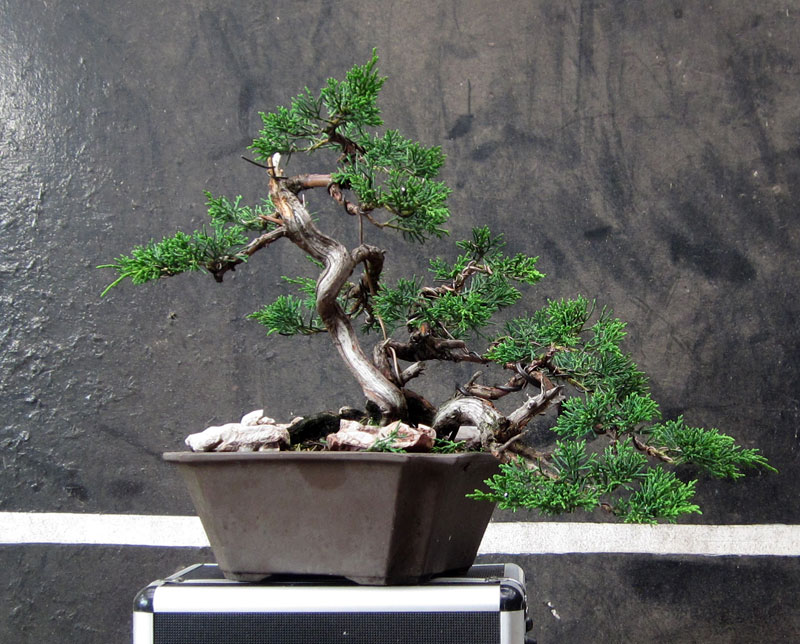
The little shimpaku from the front.
I find that when wiring junipers and particularly shimpaku, that preparation is key to a good result. Pruning unwanted growth and thinning what remains so that you end up with an evenly dense canopy not only makes the end result look better but it also makes for more balanced growth and an easier job while wiring.

As seen from the right

and from the back side
All in all I am pretty happy with the results considering that most of the wiring was done one-handed. I guess it just goes to show that interesting trunk movement is half the battle. That being said, the tree is only just beginning its journey as bonsai and should see many future wirings to come.
This post follows the progression of 6 months in the life of a Procumbens juniper. Last June i did a demonstration for a local club, Bonsai Northwest Inc. As most of my trees had been worked and I had very little left to do on them it was decided that we purchased some stock for the demo. While digging through all the stock at ‘Baloc Bonsai’ I came across this juniper.
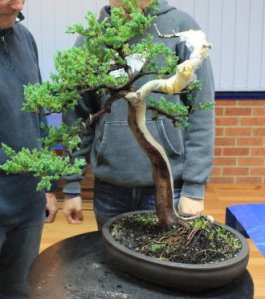
The Juniper before the demonstration but after a bit of a cleanup.
Having looked over the tree for a day or so before hand while it was in my garden I came up with a plan for improvement. From the tree’s original front the foliage mass was not close to the trunk, I thought with a little work I could compact the foliage mass into a denser crown.
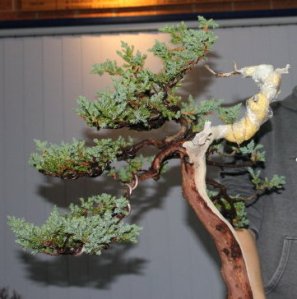
The foliage from the original front.
I also thought I could change the front and make use of a more interesting trunk and jin line. This plan created a few issues that I had to deal with in order to complete the re-styling. First was the trunk angle. From the original the trunk needed to be stood up around 30 degrees, which in turn placed most of the foliage pointing out towards the back of the tree.
Most of the bending of the larger branches was completed with the help of a bending jack as seen in the photo.

Jack in place prior to bending.
The other issue was that from the new front the jin did not compliment the movement of the tree so this was bent by means of what is essentially steam bending. I wrapped the jin in wet towels and plastic sandwich film over night to moisten the jin and then used a small gas torch to heat up and soften the wood fibres so that it could be bent into a new direction.

After the jin was repositioned and main branch bent into position.
The next step was compacting the foliage to form the crown and subsequaint branches. This was done with a combination of guy-wires and heavy wiring. The below picture shows the result. A small towel covered some branching that was to be removed once the tree had back budded in that area.
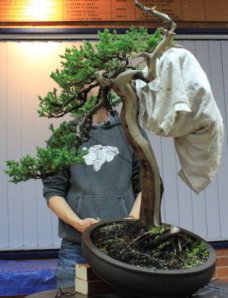
The result at the end of the demo.
If you look from the original front you can see how the foliage has been moved from its original positions to compliment the new front.

The re-styling from the original front.
Since the demo I re-potted the tree into a new container at the new planting angle. It grew out well in early spring with plenty of back-bedding and fresh growth. It was time to work on the foliage.

After some strong spring growth.
All this new growth provided me with the chance to cut out some of the leggy old growth and replace it with more compact fresh shoots.

A leggy branch with tired looking foliage.
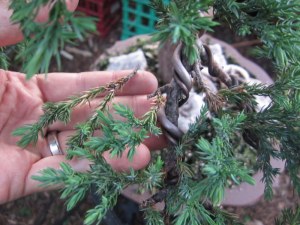
The branch cut back so the fresh shoot at its base can replace it.
In this way I was able to improve and remove some of the poorer condition and leggy foliage. I cut more out of the strong areas and left a little more in the weaker areas to balance the growth of the tree.
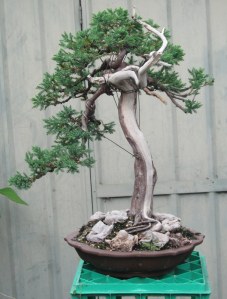
After the cut back.
I was also able to remove one of the branches on the right side and hopefully in a few months I will be also able to cut back the other right hand branches.
There are a few other thing I want to do, such as lowering the planting position, define the live veins, and work on the shari texture, but for the time being those things can wait.
What the tree desperately needs now is a full wiring, I want to further compact the apex and better form up the crown and branches but unfortunately that will have to wait until my wrist heals. Hopefully I will be able to do it in a few more months. In the mean time I will keep feeding it heavily and keep replacing old growth with new healthy growth so when it does come time to wire, the tree is ready.
As I managed to get some time to work on my trees this last weekend, I though it was a good opportunity to do some grafting before my black pines woke up too much. I like to do grafting on black pines just before they start moving in spring. For bud grafting this is important as once the sap starts to move in a big way any cuts made to hold grafts tend to flood with sap before placing the scion which makes them a little less successful. Approach grafts on the other hand are a little more forgiving but if I can I try to do them around the same time so that the burst of energy that comes with the first flush of candles extending goes into healing the graft site.

The graft site will be at the base of the thick bare section of trunk.
I have decided to graft this tree as it has a rather large bare section of trunk. If I can graft a new leader to the base of this I can build a much smaller and more compact tree with the new graft’s growth. Obviously this will be a longer term project but I figure why go down a long road just to end up at a mediocre tree. If this graft takes and the tree develops as I imagine it will be a far greater result in the future than had I just persevered with the existing structure.

The start of the process, a cut in the trunk.
The first step is to create a cut for the graft branch to sit inside. I like to make the cut about 1/4 smaller than the branch that is going to be inserted into it. I start by making the cut with a small saw. I try to make the cut so that it is wider at the rear of the cut than at the front edge. usually this takes two cuts, one slightly slanted upwards and a second slightly downwards. This flared cut will help the scion branch to lock into the cut.
Once I have made the first pass with the saw I clean up the cut with a knife so that I have clean and neat surfaces upon which the graft can be placed.
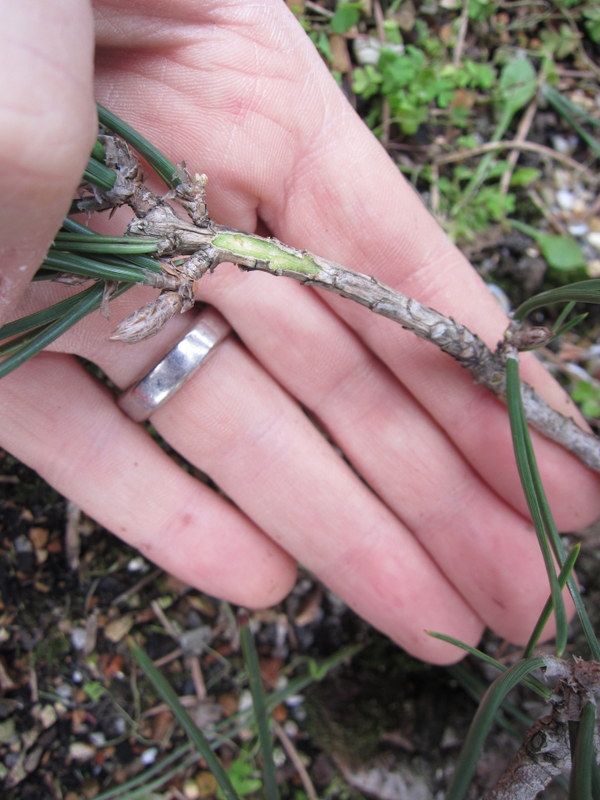
Some bark removed from the graft branch.
Next I remove a small slither of bark from either side of the scion branch. Make sure that you check where to make these cuts prior to getting the knife out as it is important that these cut surfaces line up with the cut surfaces you made with the saw. I usually find that the knife cute that clean up the saw cuts combined with the cuts on the scion branch tend to eliminate the 1/4 under size that was initially cut with the saw.
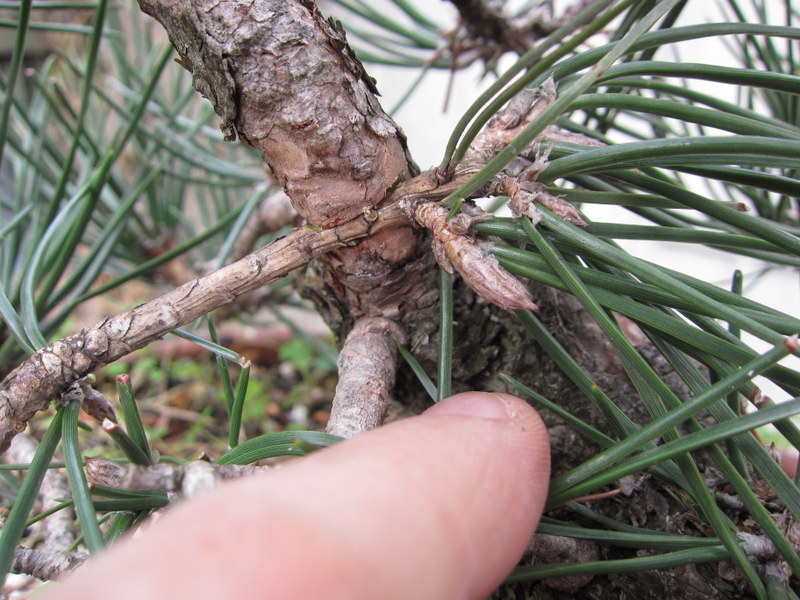
The graft made.
The Scion branch can now be inserted into the cut in the trunk. The fit should be snug and tight. Small adjustments might be needed to be made to the channel in the trunk to make sure things are all snug. If the channel is on the large side it is best to chock the scion branch so that it contacts firmly with the lower surface of the channel cut. (I use small twigs as chocks.) As sap runs from the roots up, contacting the lower surface will ensure that the graft has a better chance of taking than had it only contacted the upper surface. Either way, the scion should be firmly touching at least one cut surface on the channel in the trunk.
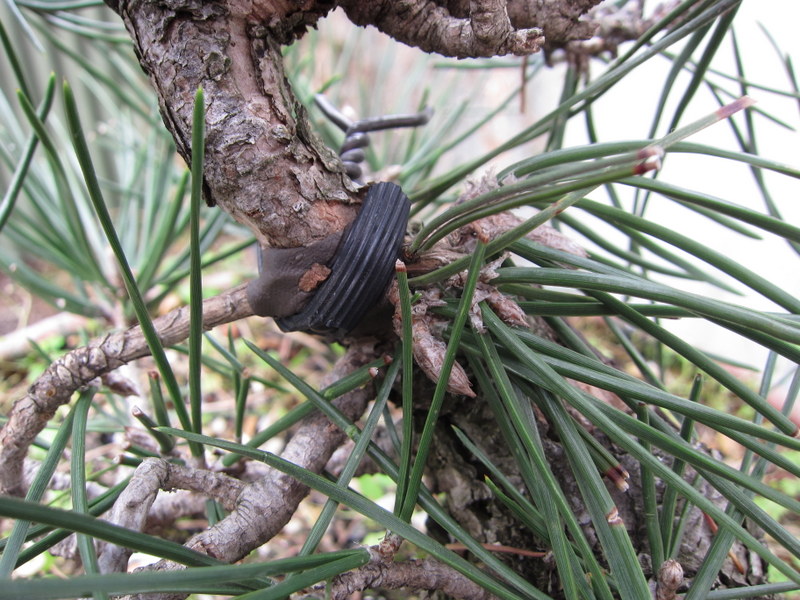
Sealed and held tightly in place.
Finally you simply seal the graft union and hold the scion firmly in place so that it cannot move and disturb the graft before it has had a chance to take.
The speed at which the graft takes will depend on the amount of growth you allow to occur on the scion branch and above the graft site. Obviously the more the trunk and scion branch grow and expand the more chance the graft has of taking. I would hazard a guess that this graft will be taken by the end of this coming seasons growth. Having said that I will probably cut off the growth above it in stages so it may be two seasons before I actually sever the scion branch from its original source.
Re-potting this year has been a rushed affair where I have been doing it when ever I have time. Mostly this seems to be under garden lights after work. Spring seems to be a little early this year which hasn’t helped as the schedule has had to be brought forward. Having said that, I have nearly got through all my trees. I have a handful left to do that I hope to get done this coming weekend.
As i have been in a rush there hasn’t been much time (or good light) to take many pics. Most of the re-potting I have been doing has been fairly un-interesting anyway and mainly just renewing of soil and replacing the trees into the pots that they came from.
One tree I did get to do during daylight hours was a trident maple. The pics i took were with my phone to see how that would work out and as you will see they are fine in good light (see the buds pic) and not so great when the light was getting low when i had finished re-potting the tree.
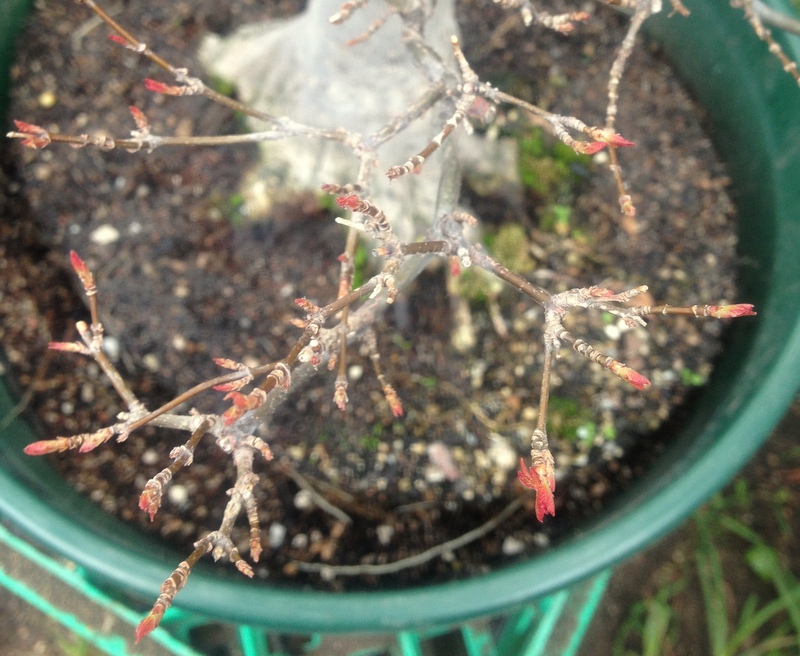
Buds starting to move
I talked about this tree with Boon while he was in Melbourne and also Hirotoshi saito. They both thought that the tree should be rotated slightly to the right. I had been tossing up whether or not to do this for some time before speaking to them but their advice made me decide to go ahead and try it. I am glad I did. A small tweak such as this 15 degree turn makes a lot of difference.
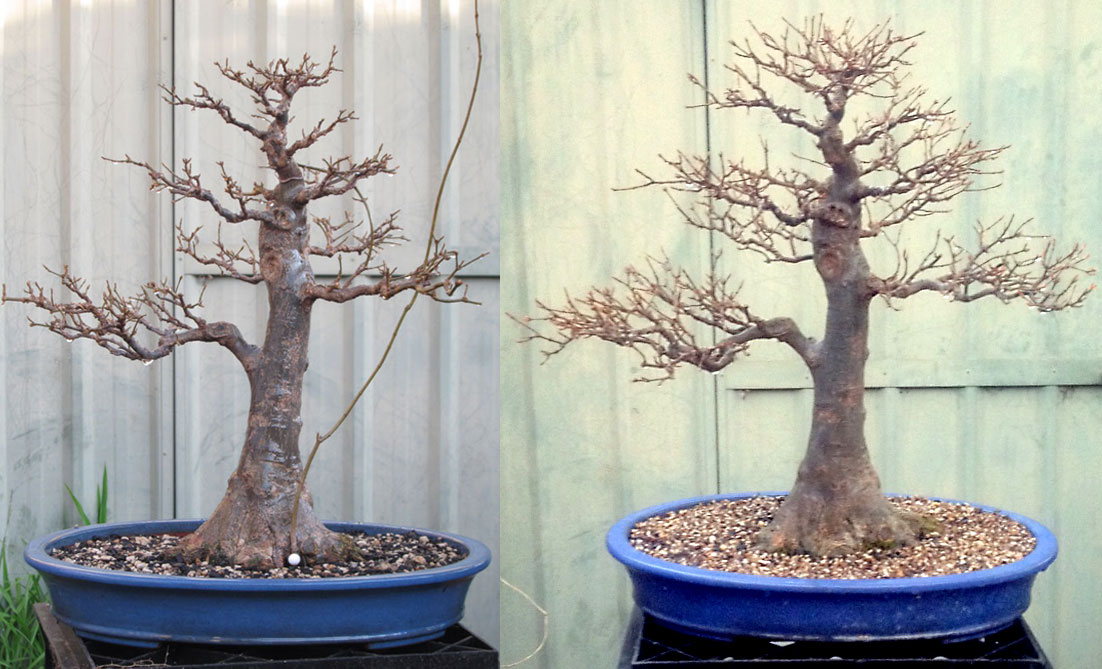
Left: the tree in August 2011. Right: the same tree, August 2012.
The reason I had been debating whether or not to make this change lay in the nebari. In the 2011 picture you can see that the nebari’s spread has a somewhat flat side to it which was facing the front. When it was rotated this formed an angle which is a little strange although there are a few good results of this change. First the slight thickening about 2/3rds of the way up disappears and there is more movement in the trunk. Also the branching is better from this new front.
I also tilted the tree forward a little. this moved the root ball a little and raised the soil in the rear of the pot a bit. I will correct this next re-potting once the roots re-establish themselves in the new position. I think i will also try to move the tree a little more to the right, i shifted it a bit this year but having seen the photos i think it could move over some more.
If you are interested in more of the re-potting process you can see the pics from last year HERE.
I have just got back from a weekend at a friends place, Shibui Bonsai. Shibui Bonsai is located in North east victoria about 3 and a bit hours from Melbourne and specialise in ground grown stock. I try to head up each year to help Neil (the owner) dig a few rows of tree out of the ground. Neil grows a range of species and this year we dug Tridents, Chinese Elm, Japanese black Pine, and Japanese Maple. In some of the other rows Neil had Chinese Quince, Shimpaku and a range of other desirable bonsai species that will probably come out after another season.

Matt swinging a shovel while Neil prunes the dug trees.
Having been up over a number of years now it has been great to see how trees develop over time. As trees are dug and pruned, they are sorted into those that might need to go back in the ground for another year and those that are ready to begin their life as bonsai. The digging went quickly this year as the trees had only been in the ground for a season and as a result didn’t have many large roots. The trident maples had really nice compact root-balls and as did the black pines which was a nice result and should make for them establishing into training pots much more quickly.

A batch of root over rock tridents, root and top pruned waiting to be potted up.
At this time of year Neil likes to dig the trees, prune them and then heal them back into a growing trench where they will happily sit dormant until they are potted up in a few weeks time.
Once potted up they spend around a year re-establishing themselves in the new pot before becoming available for sale.
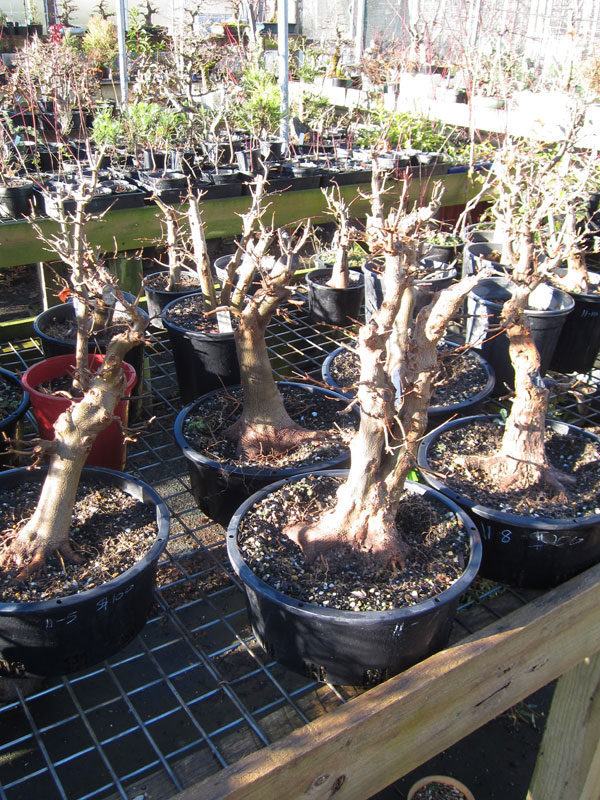
Last years Tridents on the sale benches.

Some larger tridents.
Once we had finished the day’s digging we went for a drive into the local forest to have a look at a few things of interest. We checked out the old gold diggings while looking for native orchids in amongst the leaf litter. I think some of the native orchids would make excellent accents. Neil pointed out a few of the colony forming species as the most suitable and easy to grow. It is illegal to collect them from the wild but luckily they are available from local growers if you can hunt them down. I will definitely be keeping my eyes out for a few in the future.

The beautiful white trunks of the Brittle Gum.
I always enjoy heading up to Neil’s place. It’s a beautiful part of the country and it just happens to have an excellent grower there as well.
If you are interested in visiting Neil’s Nursery I believe you can via prior arrangement. His details are found on his website: http://shibuibonsai.com.au/ For those that can’t make the drive to his place, he does also sell regularly as local club shows and will be at the Bonsai society of victoria’s show this October.
Prior to the recent AABC convention, I was asked to style an established Japanese white pine that had reached a stage where it needed some work to get it back on track.
It had been worked on a number of years ago during a workshop held by Hirotoshi Saito where the second trunk was bent upwards from what was a heavy first branch. Since then the tree has grown out with the occasional branch guyed down from time to time and with some trimming to keep the growth somewhat compact. What the tree was desperately needing was a full wiring and styling.

As the tree arrived in my garden.
I cut a good amount of branches off and had to do some heavy bending to move the apex from leaning towards the back to leaning forward. Most of the work was sorting out branch structure and setting basic branch positions to prevent thickening in areas that you might not want it in the future and providing structure for the tree to grow into.

Some of the removed branches.

After a couple of days wiring.
The tree will really benefit from a couple of years growth to fill out some areas such as the apex, but it now has a solid base structure to build upon further in the future.
The graft in this trees case is quite noticeable at the moment but I think that once the white pines park begins to crackle it should start to blend in much more. How long will that take? Who knows. I think 10 years would start to see the process beginning.
You don’t see many White pines in Australia and particularly of this size. It will be a good tree to keep an eye on as it progresses in the coming years.
While I am going through my photos from the convention I thought I might share a few of the bonsai that were on display. The below pics are only a selection of the trees that were on display as I didn’t have the time I thought I might to take photos of the full exhibition. Enjoy.
-
- Chinese Elm
-
- Chinese Elm
-
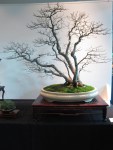
- English Elm
-

- Banksia
-

- Radiata Pine, Trident Maple
-

- Plum
-

- Radiata Pines
-
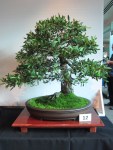
- Calistamon
-
- Banksia
-

- Washington Thorn??
-

- Juniper
-

- Chinese Elm
-

- Trident Maples
-

- Olive
-

- Cedars?
-
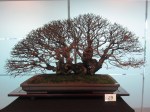
- English Elm
-

- Japanese Black Pine
-
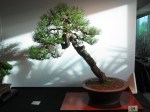
- Maritime Pine
-

- Chinese Elm, Trident Maple
-
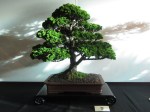
- Shimpaku
-

- Radiata Pine
-

- Alder??
-

- Radiata Pine
-
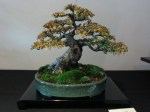
- Chinese Elm
-

- Needle Juniper
-

- English Elm
It has been a busy couple of weeks. Autumn has begun and with it a range of seasonal tasks. I have been madly plucking Japanese black and Red pine needles. Here in Melbourne we have a convention coming up for which I have to prepare a few trees so I tried to get my needle work out of the way early on.
It took a long time this year. What hadn’t really dawned on me until now was that needle pruning takes more and more time each year. Now this is not a bad thing, its more a by-product of a successful technique. As ramification increases, so does the amount of needles you have to remove. Where last year I was removing needles from one candle there are now two candles at that location that need needles removed from them. Not only are there more needles to pluck, but also the space you have to pluck them in becomes more and more cramped forcing you to use tweezers to negotiate the cramped conditions.
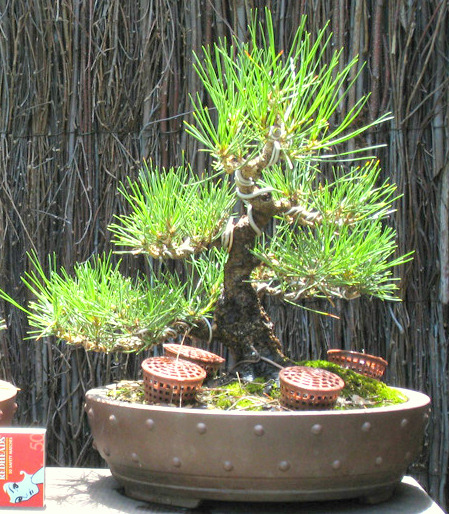
2008

2009

2012

2012 after needle plucking.
The above tree has wholly been grown in Australia and has come great leaps and bounds since I learnt how to properly care for it during my first trip to Japan. It is becoming a nice little tree although it is not perfect and it bears the marks of many of my early mistakes. That being said it has taught me a lot and although I have though about selling it on a couple of occasions I think now I would find it a little hard to part with. After all I have invested a huge amount of time into it.
Perhaps this is something to keep in mind when deciding on how large your collection should grow. How much time do you have, and will this time be enough to maintain your trees to a high level? Bearing in mind that as your trees improve and refine, in turn their maintenance times increase. I really enjoy growing pines but I am very aware of the time I have to spend on them each year. Needle plucking, pruning, wiring and candle work all add up. On a tree that is starting to get refined I am guessing I would be sending 6-10 hours on each of them over the year. When you add up all the pines you grow and then the time you spend on them, combined with the tasks you have for all other species you grow you begin to realise that there is a limit to how many trees you can look after to a high level. I lean towards keeping a smaller collection that is well maintained rather than a larger collection that doesn’t get the attention it deserves. That said it is hard to turn down a good tree.
Amongst the display trees that I saw at collectors corner (which can be seen HERE and HERE) I noticed that a large percentage of the display trees were Pinus Radiata. In fact the first tree that greets you once you enter the nursery is a big old Radiata.
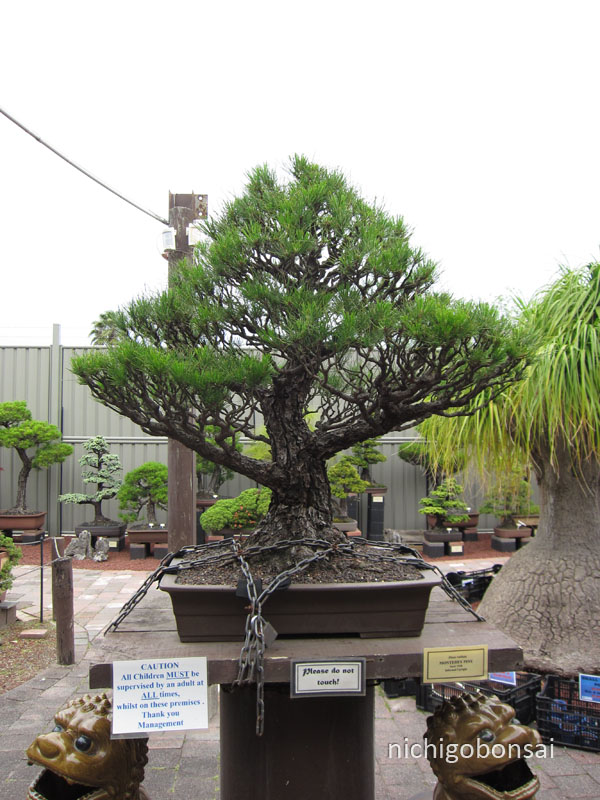
The welcome tree
This tree has been in possession of the nursery for a number of years and has always been an impressive bonsai. So impressive it seems it needs to be chained down!

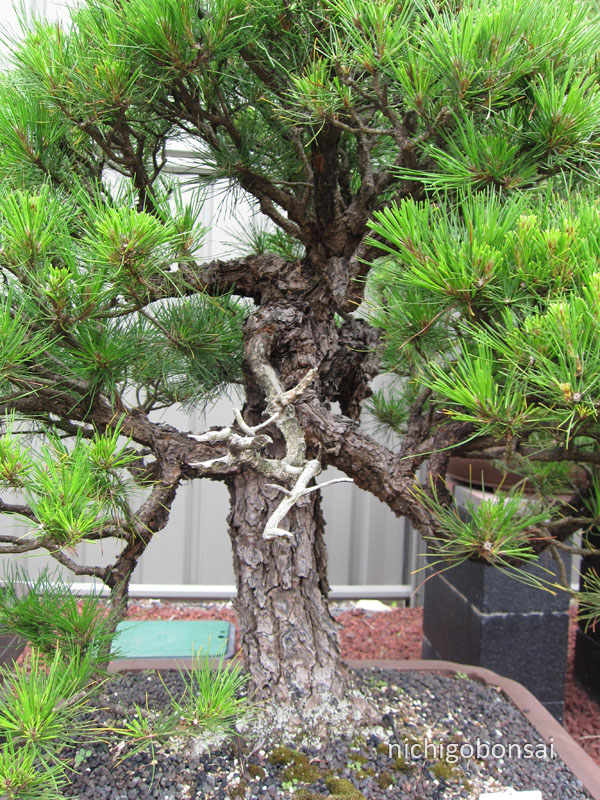
Old bark
The old bark that the tree exhibits is beautiful and the crackled plates of bark seem in a good scale with the rest of the bonsai.
Now why does this tree have a post of its own? Well I thought that this bonsai was a good example of some of the problems that these old radiatas face. From a distance the tree seems to be full of foliage but upon closer inspection a different story is told.

A main branch
As you can see from the above image the foliage is only on the tips of long leggy branches. This is a problem. The tree has no inner buds and no fine inner branches to cut back to. What this means is that the outline of the tree can never be reduced without the aid of grafting as at least from what i have found and the experiences of other local growers with the species, Radiata’s dont bud onto old wood well.
What does this mean for this tree? Well I think it needs a major re-working. It is always nice to project the future onto trees so I will have a quick go at making a list of the things I think needs doing short of feeding aggressively, watering etc.
- The branches have all grown upward. The first port of call would be to correct this by doing some heavy bending on each of the main branches, bending them down to just below horizontal.
- Wire all the sub branches and prune growth back where possible. This would have a two-fold effect. Bringing the foliage down would allow for light to get into the inner areas of the tree as well as taking the dominance out of the tips. A tip that is pointed upwards will always grow strongly from the tip. If it is horizontal it is more likely to bud along its length.
- Feed feed feed. If you are to hope of getting budding on old wood you will need a healthy, strongly growing bonsai.
- I would then look at grafting opportunities to start re-introducing growth into inner areas of the branch structure.
I think with a work routine something like the above the tree could be vastly improved. A nice tree as it is (Age tends to excuse many faults) but I think it could be better. If it were ever to come up for sale I am sure I could find room for it at my place.
After seeing this tree I began to think if these problems are some that I might be facing with my Radiatas in the future. Hopefully through regular styling I can avoid the upward branch problems but I am a little concerned about the lack of back budding. Hopefully one day I will unlock the key to this dilemma. Perhaps in this case it is a result of a thick canopy shading out inner growth?I think the above tree had just been heavily thinned as my memory of it in previous visits was of a much denser canopy.
Either way, in the mean time I will keep on experimenting with my trees and keep dreaming about other people’s trees that I would love to own. One such tree that caught my eye at the nursery was the pine below. Again another Radiata.

Interesting?
Interesting or ugly?
I keep finding myself being drawn to trees with problems. I think I enjoy both looking at these bonsai that challenge the rigid frameworks some people use and also love to work on them to try to use those awkward features to form a design that works in a classical sense.
The heart of the problem or the heart of the opportunity?
Again I think the age displayed by this tree excuses a lot of the faults and in a way the faults in branch placement almost add to the ancient feeling the tree exhibits. Would I change things? Most probably yes, but I would like to live with the tree for a long while first to get to know each of its quirks.
Again I think with some creative styling and a total wiring this could become a very interesting tree. Another I could easily make room for at home.
It is interesting to note that this tree also seems full of foliage from a far but on closer inspection it is actually quite leggy and bare on the interior. Now I am not sure if this is a result of age or whether this is due to too thick a canopy being kept that has shaded the interior, killing the inner shoots. Hopefully it was a lack of light and not just the result of the species growth habits. If it is just a lack of light I can rectify this on my own trees.
Well i hope you have enjoyed these trees as much as I did. I always like to see old radiatas. I like to look into them and see if they will give away any hints that may lead to a future technique or method for getting them to back bud on old wood. Perhaps I will never find it, but I will definitely enjoy looking for it.
On that note, does any one out there have old radiata or Monterey pines? How do you grow them? have they ended up leggy? I would love to hear from you. Please comment below or email me at the address on the left of my website.
 Nichigo Bonsai