You are currently browsing the tag archive for the ‘Australian Bonsai’ tag.
Been busy as per usual but I have managed time to fit in a couple of customer trees.
Below is a quick before and after of a black pine that needed teasing out of a sea of needles. A fun tree to style.
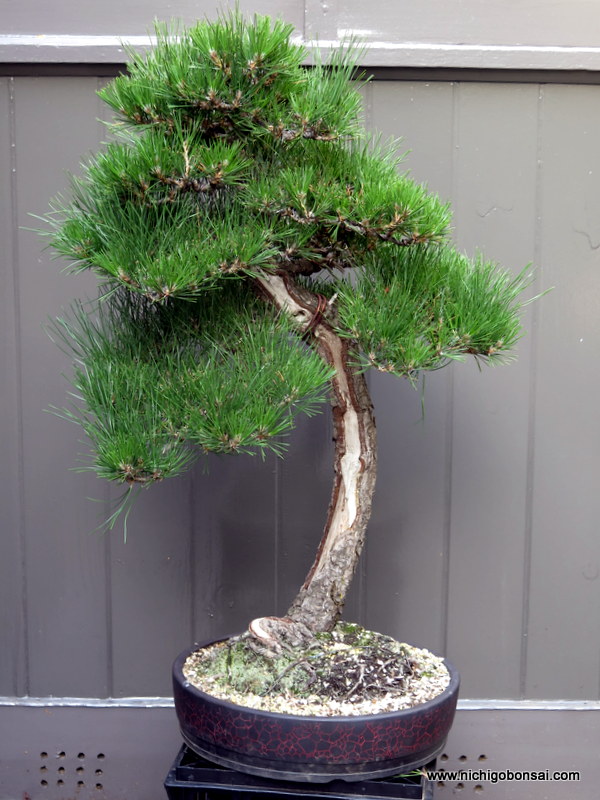
Before
The after shot is a little lacking in quality but I am sure you get the idea.

After a day or so work.
As the days get cooler we slowly approach the time of year where I like to style conifers. This year is gearing up to be a big one for bonsai work as I have taken on a number of customers trees to be styled. Following on from the last Black Pine I worked on, I had the opportunity to work on a similar tree.
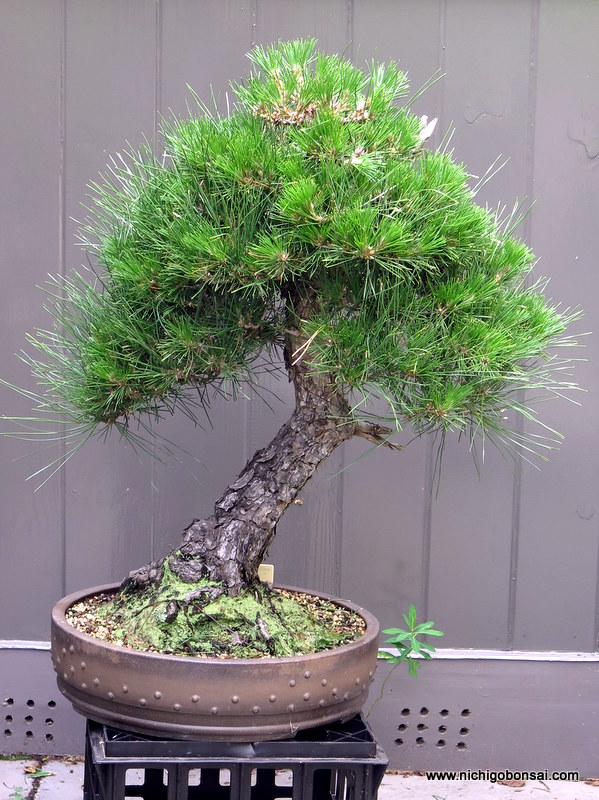
Before starting the work.
At least it looked similar before the work begun, but soon after the old needles were removed a new set of structural challenged presented themselves to be solved.

Old needles removed and ready for pruning and styling. (slightly rotated)
I decided to rotate the front slightly which brought up the issue of the first branch. That is it was now heading towards the rear of the tree so with the help of a screw in the trunk I was able to bend it forwards. This then set the base of the tree and the rest of the canopy could be built around it. The head was finally lowered and rounded out to create the final image.

After the work.
Again this tree now needs a couple of years to grow into its new shape but even after the couple of weeks that passed between starting the job and finishing, new buds are beginning to form which should see this tree become show-able in the not too distant future.
Things have been pretty busy since I got back from Japan. A new job, a pregnant wife and Autumn’s bonsai work just beginning haven’t left a lot of time for the blog.
On top of this, I have also been doing a fair amount of work on customer’s bonsai and their collections. Some of this work is routine seasonal maintenance, some of it teaching and then some of it is re-styling.

Before any work
One such re-styling I completed recently was the black pine pictured above. For Australia, the black pine had some good age to it and was starting to develop nice bark textures, but it’s canopy had grown into a solid blob over the years. My job was to find the tree within the blob. I had to prune a large number of branches out and define a better branch structure to set the tree up for it’s future. As a result a fair amount was cut off the tree but now the bones have been formed to grow a better structure upon.

After pruning and wiring.
One of the main changes, apart from separating the foliage into layers was to enhance the movement of the tree. This involved shortening the right side and lowering the head to accentuate the left movement of the main branch which made a huge difference to the appearance of the tree.
I think a re-pot into something more suitable and a year or two of candle pruning should see this tree fill into a very nice tree.
I have been busy re-potting in the last few weeks and finally managed to get around to doing a project tree that I have been growing for a couple of years. When I first acquired the tree I placed 6 or so root grafts onto the trunk. 3 took and 3 failed. Since then I have been meaning to replace the failed grafts but for what ever reason, every time I have had this tree out of its pot I havent been able to do the grafts.

The Arbortech and the faulty nebari in the back ground. You can see the two vertical scars from last attempt.
The first failures were all down to the fact that the channels that accepted the new shoots were too shallow. As the approach grafted seedlings thickened, they simple pushed away from the trunk instead of fusing. I originally cut the channels with a knife and was only able to cut so deep.
This years remedy was the Arbortech! I do very little machine carving but this tool does get a bit of work this time of year as it is excellent for cutting graft channels.
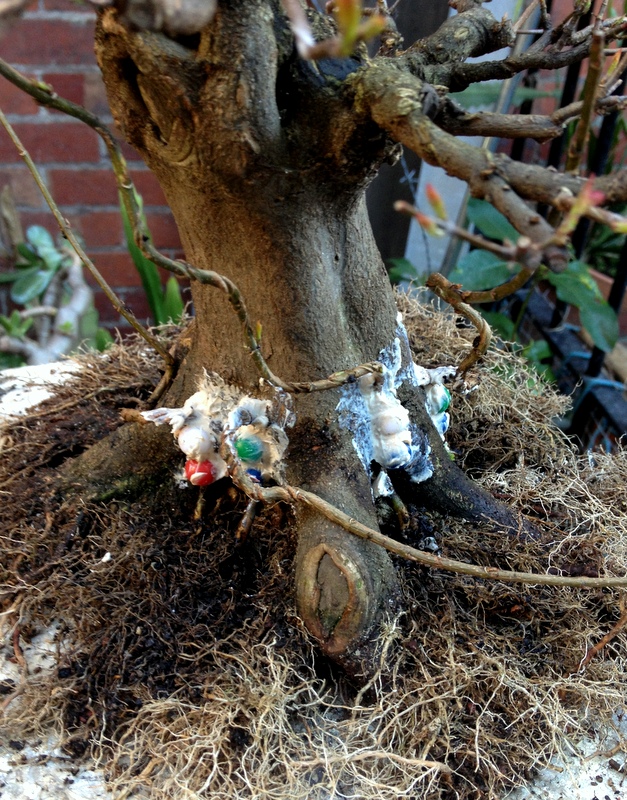
The four new grafts.
The process is dead simple. It is much the same as any other approach graft except instead of using a branch from the same tree you use seedlings as your grafting material.
The basic idea is that you cut a vertical channel in the trunk where you would like some new roots. You then insert a seedling into the channel and adjust it until the seedling’s roots are at the same level as the existing nebari. Then you fix the seedling into the channel (I used big map pins), seal it all up with cut paste and let it grow. Soon enough the seedling will thicken and fuse with the trunk. Cut off the top of the newly grafted seedling and you have new roots where there were previously none. For a better breakdown of the general theory see these two posts. Post 1, Post 2.
This year, the seedlings look a little strange as they are all from the batch of seedlings I bent the year before. Having said that, the bendy little trunks were very useful as I was able to use the first bend to create a good angle for the new roots to leave the trunk from.
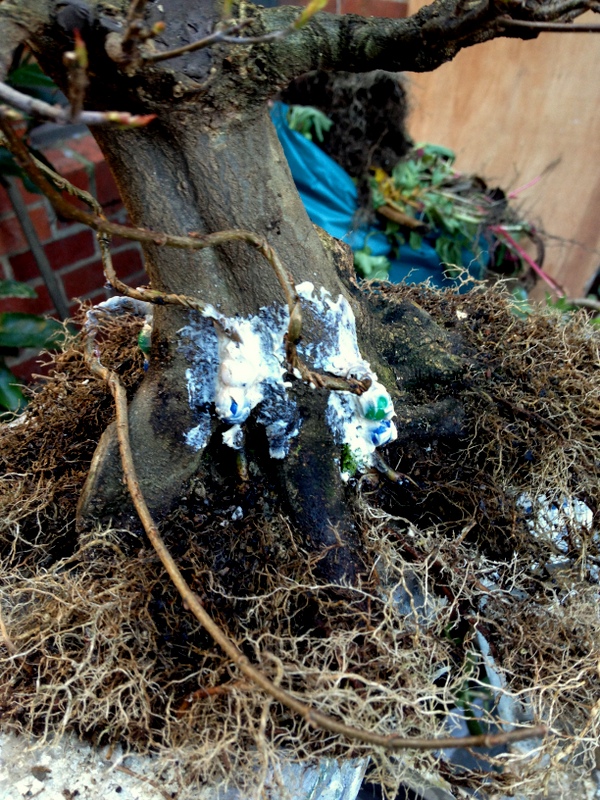
The bendy seedlings are care of a project I started last year.
The new grafts were generously coated in cut paste and then the whole lot was potted back into its training pot.
I imagine that by the end of this rapidly approaching summer the grafts should have taken and I will be able to shorten them back before then some time the following year cutting them flush with the trunk.
Hopefully I remember to take a few pictures along the way.
This year, Bonsai Northwest decided upon holding a winter exhibition. This is a bit of a rarity due to most Victorian shows being held in the spring or autumn. It was great to see many familiar trees out of leaf with the structure bear for all to see. I enjoy seeing trees that i have got to know over the years improve each time i see them come out for a show and this year was no exception.
Unfortunately the moody lighting didn’t translate very well into the photos I took with my cheap camera so I was only able to get a handful of non-blury shots which are below.
Enjoy.


Elm

Trident Maples

Japanese Black Pine

Trident Maple

Japanese Black Pine

Elm

A small Chinese Elm?

Desert Ash

A nice suiseki.

Japanese Maple

Chinese Elm

Chinese Elm ramification

Japanese Maple

Elm
I often hear people saying they wish they had access to good stock and or that they cant find any stock worth purchasing. Often the journey to find good stock can be difficult but there is definitely good stock available if you know where to look.
A couple of weekends ago I visited a friend on the outskirts of Melbourne to see how his ground grown stock had progressed this year.
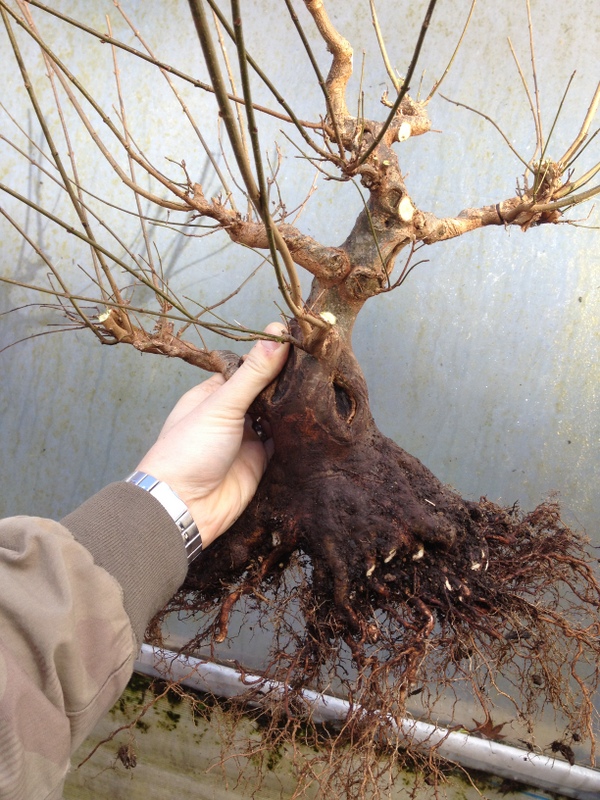
A trident slipped from the grow bed.
As you can see from the above picture, the stock was going very well indeed. There is no real secret about how to produce these results as they are a simple a matter of spending 10 years applying good technique and working the root bases each and every year.

Another great base.
Each year the trees have been dug up and cut back hard to encourage a fine, flat root system. Digging each year coupled with the excellent growing conditions in the grow beds results in good yearly top growth without roots getting too thick and creating faults. This makes for trunks with great base flare and very small scars which in many cases are healed in the ground.

A Japanese maple from the same beds.
When out of the ground, the most important cuts to the roots are in removing those that are downward growing and scarring the base of the trunk to further thicken the base; and with this stock, this has been done with great results. In fact, I was so impressed with the quality of the material I put my name on a couple that might come out of the ground in the next couple of years.
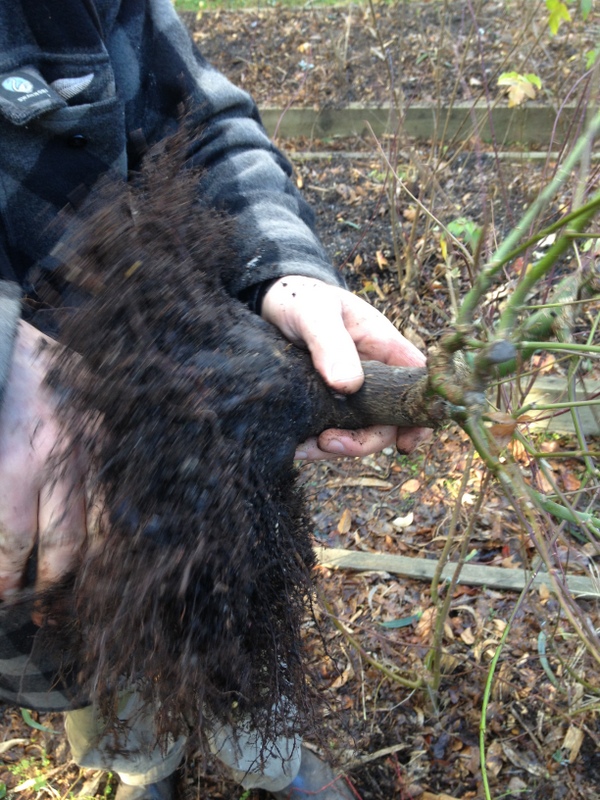
The roots on the underside of the trunk being removed.
For those not willing to spend 5 years working out the techniques and then a further 10 growing trunks luckily this grower also sells some of his stock.
His trident maples are available through Chojo Feature trees in Mount Evelyn. Jeff who runs the place is an extremely nice guy and I am sure could help out those interested in a trunk and or other bonsai related products.
I have been trying to keep my collection from growing any larger with mixed success over the last few months. What makes it especially hard is when you help friends dig stock out of their growing rows at their nursery.
This years visit to Shibui Bonsai was much like last years in that a lot of nice stock was dug (which I am sure a lot will be featured in the coming seasons catalogue). Although a lot caught my eye, I was well-behaved and none of the ground grown stock came home. That is not to say I didn’t bring anything back to the benches…….
For a while now I have been meaning to grow some small twisted mini’s to use as accents in 3 point displays. On the benches at Shibui, Neil had a range of interesting little chinese elm root cuttings that I thought would be perfect for the project so I brought one home.

The cutting out of its original pot
Today I wired the cutting to enhance some existing curves and then re-potted into a much smaller container in which I plan to start to grow a small crown from.
Often working out how to secure a small tree into a small pot which only has one drainage hole can be difficult but I have found the method shown below works well.

tie-in wire secured to a larger wire.
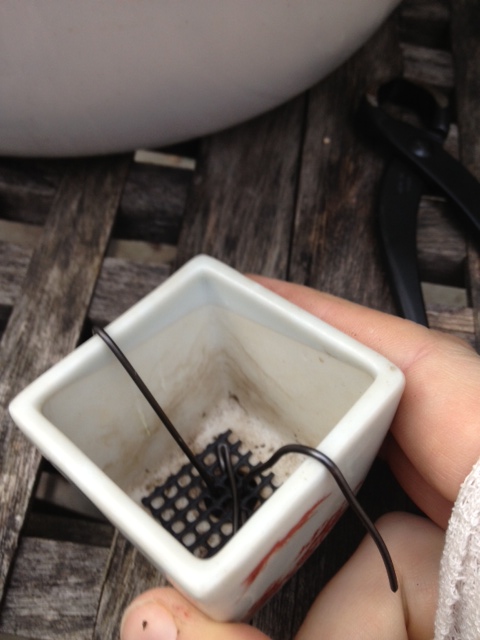
Mesh installed and tie in wires ready to accept the tree.
The pot itself is by no means a museum piece but it is a well made Marufuji production pot. Being a little on the large side will serve it well to help the tree establish some new ramification. Once I am happy with how the ramification is progressing I will look for a more suitable pot anywhere up to half the size of the current container.

The roots were reduced accordingly.
For such a small cutting the tree had grown a number of large roots all of which I removed and or shortened to fit into its new home.
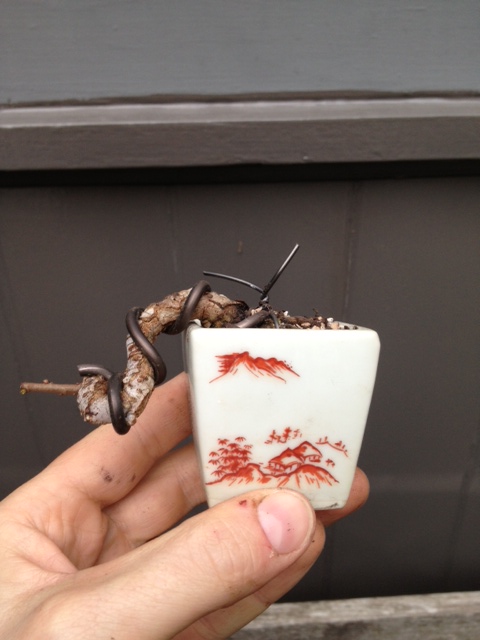
Potted up but before I trimmed the tie in wires.
After half an hours work the tree had found its new planting angle and its new pot. It is by no means a masterpiece but I think once I can develop some ramification it could make an interesting companion to a larger tree.
I think this little tree will make a nice addition to the collection in the coming years and being so small it shouldnt effect the space I have too much. In fact I probably have a whole lot of room for trees of this size.
As the season rolls on I am slowly getting to the end of my needle work which in turn will mark the time to begin preparing the deciduous trees for winter.
The tree below is another that has been slowly developing over the years and with another wiring and another years candle pruning I think it will be close to exhibit-able.
The tree has appeared on the blog before HERE where you can see the progress it has made and the ramification it has gained. It also makes obvious just how much it needs a re-wire.

Before the work

After a the needle plucking.
Yet another of my trees that desperately needs a re-wire, it will have to get into line behind all the others that I plan on doing this winter.
This weekend gone by I got some time to do some needle work on a few more trees. One of which has featured on this blog before. It’s a bit of a strange tree and people either like it, or want to cut off the first branch. I like the first branch and as a result i haven’t cut it off just yet and actually now the tree is filling in a little bit more I am beginning to like it more than I did at first.
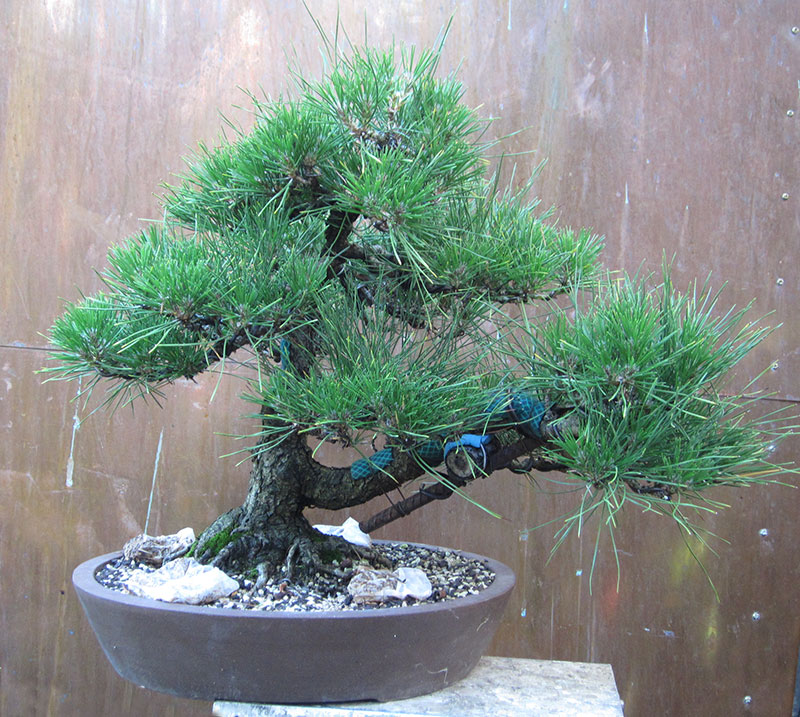
Looking a little shaggy
Probably the part of blogging I am enjoying the most is how it has forced me to catalogue my trees as they progress. If you look at this tree 2 years ago HERE you can see that the tree has really improved over that short time. Looking at it day to day on the benches it is easy to lose perspective and feel like the tree is not progressing. It is only when you see a picture from a year or two ago that you realise just how much it has changed.

Needles removed revealing nice, new, short growth.
I am very happy with the progress I have achieved with it over the last couple of years and hopefully if I can keep this momentum up for a few more the tree will be well on the way to being exhibit-able.
I doubt if this tree is ever going to be everyone’s cup of tea but I think that it is now on a path where it will grow into a convincing image.
Its been a good year for growth in my garden which is always a bit of a double edged sword. A good seasons growth means that all your trees will have progressed and built further to their structure, ramification etc. but with lots of growth comes lots of maintenance.
With my pines this work takes longer and longer times. As the trees ramify the number of shoots double each year in turn doubling the time it takes to maintain them. As trees become more dense fingers can no longer reach areas of the branching so tweezers are employed which again can slow things down a little.
Here in Australia we are beginning to slip into autumn and it is time to shoot prune the second flush of growth and do needle work on the pine’s remaining growth.
The first tree off the bench was THIS little black pine.

Before the work.
Finally it is beginning to look like it belongs in a bonsai pot. you can see in the before picture how nicely the needle length has come down compared to the long needles attached to candles that were not pruned in spring due to them being weak. These weak candles now have strong buds at their tips getting ready for next springs flush.

After removing old needles.
After a few hours work things begin to look a whole lot neater. The new length of the needles is much more suited to the trees size and over all the tree is beginning to look more in proportion. Next step is a re-wire which I hope to complete some time this winter and then a re-pot into something a bit nicer.

