You are currently browsing the category archive for the ‘Bonsai Maintenence’ category.
I have been busy re-potting in the last few weeks and finally managed to get around to doing a project tree that I have been growing for a couple of years. When I first acquired the tree I placed 6 or so root grafts onto the trunk. 3 took and 3 failed. Since then I have been meaning to replace the failed grafts but for what ever reason, every time I have had this tree out of its pot I havent been able to do the grafts.

The Arbortech and the faulty nebari in the back ground. You can see the two vertical scars from last attempt.
The first failures were all down to the fact that the channels that accepted the new shoots were too shallow. As the approach grafted seedlings thickened, they simple pushed away from the trunk instead of fusing. I originally cut the channels with a knife and was only able to cut so deep.
This years remedy was the Arbortech! I do very little machine carving but this tool does get a bit of work this time of year as it is excellent for cutting graft channels.
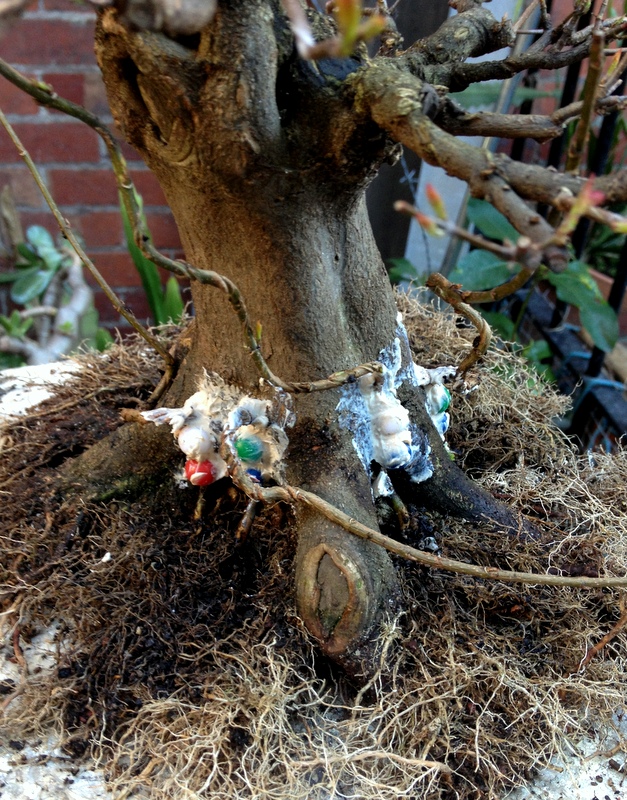
The four new grafts.
The process is dead simple. It is much the same as any other approach graft except instead of using a branch from the same tree you use seedlings as your grafting material.
The basic idea is that you cut a vertical channel in the trunk where you would like some new roots. You then insert a seedling into the channel and adjust it until the seedling’s roots are at the same level as the existing nebari. Then you fix the seedling into the channel (I used big map pins), seal it all up with cut paste and let it grow. Soon enough the seedling will thicken and fuse with the trunk. Cut off the top of the newly grafted seedling and you have new roots where there were previously none. For a better breakdown of the general theory see these two posts. Post 1, Post 2.
This year, the seedlings look a little strange as they are all from the batch of seedlings I bent the year before. Having said that, the bendy little trunks were very useful as I was able to use the first bend to create a good angle for the new roots to leave the trunk from.
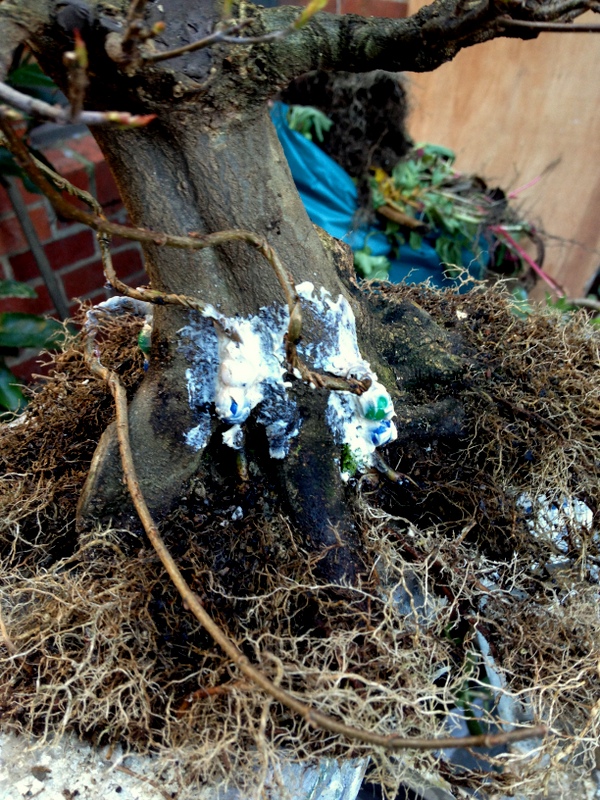
The bendy seedlings are care of a project I started last year.
The new grafts were generously coated in cut paste and then the whole lot was potted back into its training pot.
I imagine that by the end of this rapidly approaching summer the grafts should have taken and I will be able to shorten them back before then some time the following year cutting them flush with the trunk.
Hopefully I remember to take a few pictures along the way.
I have been trying to keep my collection from growing any larger with mixed success over the last few months. What makes it especially hard is when you help friends dig stock out of their growing rows at their nursery.
This years visit to Shibui Bonsai was much like last years in that a lot of nice stock was dug (which I am sure a lot will be featured in the coming seasons catalogue). Although a lot caught my eye, I was well-behaved and none of the ground grown stock came home. That is not to say I didn’t bring anything back to the benches…….
For a while now I have been meaning to grow some small twisted mini’s to use as accents in 3 point displays. On the benches at Shibui, Neil had a range of interesting little chinese elm root cuttings that I thought would be perfect for the project so I brought one home.

The cutting out of its original pot
Today I wired the cutting to enhance some existing curves and then re-potted into a much smaller container in which I plan to start to grow a small crown from.
Often working out how to secure a small tree into a small pot which only has one drainage hole can be difficult but I have found the method shown below works well.

tie-in wire secured to a larger wire.
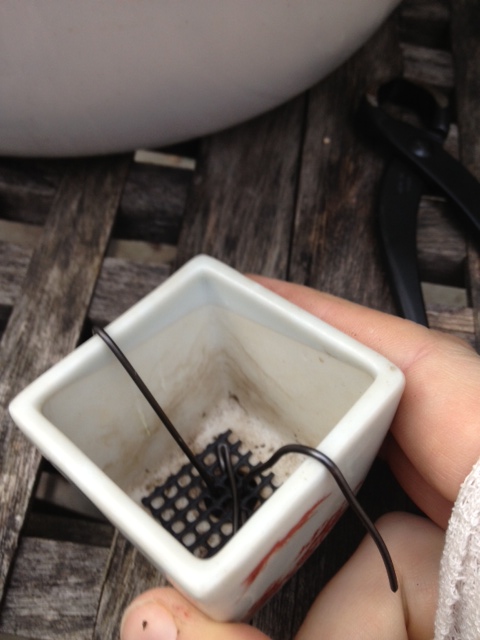
Mesh installed and tie in wires ready to accept the tree.
The pot itself is by no means a museum piece but it is a well made Marufuji production pot. Being a little on the large side will serve it well to help the tree establish some new ramification. Once I am happy with how the ramification is progressing I will look for a more suitable pot anywhere up to half the size of the current container.

The roots were reduced accordingly.
For such a small cutting the tree had grown a number of large roots all of which I removed and or shortened to fit into its new home.
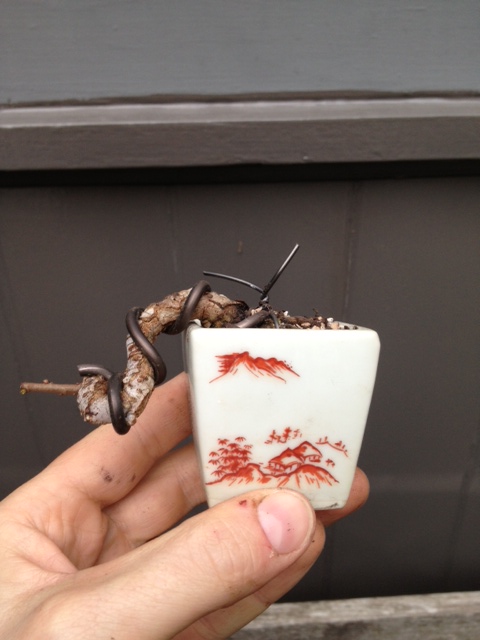
Potted up but before I trimmed the tie in wires.
After half an hours work the tree had found its new planting angle and its new pot. It is by no means a masterpiece but I think once I can develop some ramification it could make an interesting companion to a larger tree.
I think this little tree will make a nice addition to the collection in the coming years and being so small it shouldnt effect the space I have too much. In fact I probably have a whole lot of room for trees of this size.
As the season rolls on I am slowly getting to the end of my needle work which in turn will mark the time to begin preparing the deciduous trees for winter.
The tree below is another that has been slowly developing over the years and with another wiring and another years candle pruning I think it will be close to exhibit-able.
The tree has appeared on the blog before HERE where you can see the progress it has made and the ramification it has gained. It also makes obvious just how much it needs a re-wire.

Before the work

After a the needle plucking.
Yet another of my trees that desperately needs a re-wire, it will have to get into line behind all the others that I plan on doing this winter.
This weekend gone by I got some time to do some needle work on a few more trees. One of which has featured on this blog before. It’s a bit of a strange tree and people either like it, or want to cut off the first branch. I like the first branch and as a result i haven’t cut it off just yet and actually now the tree is filling in a little bit more I am beginning to like it more than I did at first.
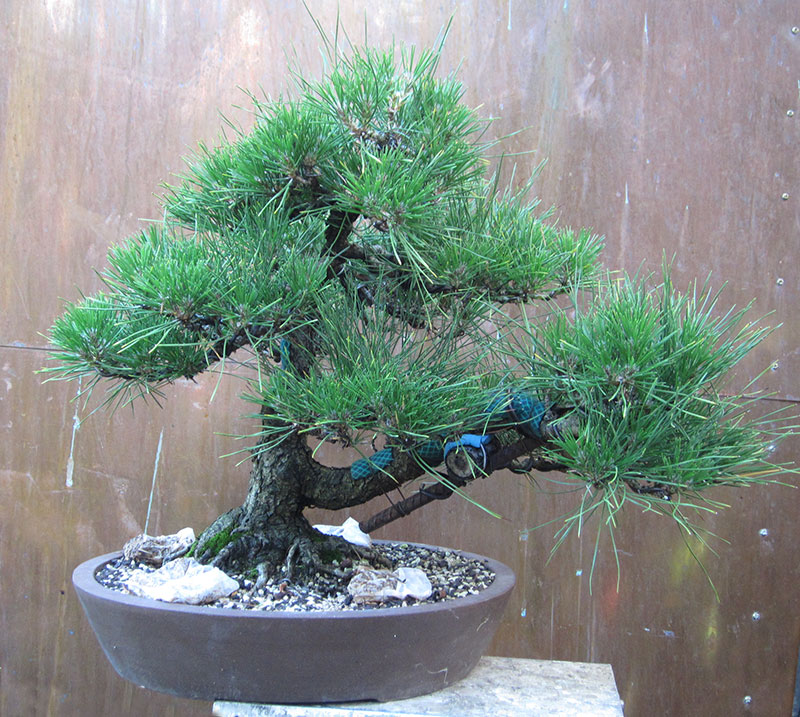
Looking a little shaggy
Probably the part of blogging I am enjoying the most is how it has forced me to catalogue my trees as they progress. If you look at this tree 2 years ago HERE you can see that the tree has really improved over that short time. Looking at it day to day on the benches it is easy to lose perspective and feel like the tree is not progressing. It is only when you see a picture from a year or two ago that you realise just how much it has changed.

Needles removed revealing nice, new, short growth.
I am very happy with the progress I have achieved with it over the last couple of years and hopefully if I can keep this momentum up for a few more the tree will be well on the way to being exhibit-able.
I doubt if this tree is ever going to be everyone’s cup of tea but I think that it is now on a path where it will grow into a convincing image.
Its been a good year for growth in my garden which is always a bit of a double edged sword. A good seasons growth means that all your trees will have progressed and built further to their structure, ramification etc. but with lots of growth comes lots of maintenance.
With my pines this work takes longer and longer times. As the trees ramify the number of shoots double each year in turn doubling the time it takes to maintain them. As trees become more dense fingers can no longer reach areas of the branching so tweezers are employed which again can slow things down a little.
Here in Australia we are beginning to slip into autumn and it is time to shoot prune the second flush of growth and do needle work on the pine’s remaining growth.
The first tree off the bench was THIS little black pine.

Before the work.
Finally it is beginning to look like it belongs in a bonsai pot. you can see in the before picture how nicely the needle length has come down compared to the long needles attached to candles that were not pruned in spring due to them being weak. These weak candles now have strong buds at their tips getting ready for next springs flush.

After removing old needles.
After a few hours work things begin to look a whole lot neater. The new length of the needles is much more suited to the trees size and over all the tree is beginning to look more in proportion. Next step is a re-wire which I hope to complete some time this winter and then a re-pot into something a bit nicer.
I have had a number of old deciduous trees go through my collection over the years. Often they arrive in various states of neglect or dis-repair due to ageing owners, lack of interest or lack of knowledge. What has been interesting is the results of this lack of technique and or application.
I think most people are aware of what they should be doing. Most beginner books say something along the lines of “cut all downward growing roots off to form a flat root-base”. In essence that is correct. But why?
- Is it to get the roots to fit in shallow containers? Partly yes.
- Is it to encourage a flaring nebari? Partly yes.
There is one more reason that is rarely discussed or talked about when talking about root work.
What we want roots to do in a bonsai container is counter intuitive to the plant we are growing. We want a shallow root system close to the soil surface. This area of the soil profile is horticulturally the worst place in the pot to grow roots, and here in lies the problem.
The top few centimetres of soil are those most likely to experience temperature changes and drying out, both of which are no good for roots. Yet this is the area of soil we need them to occupy to form a good shallow root-base.
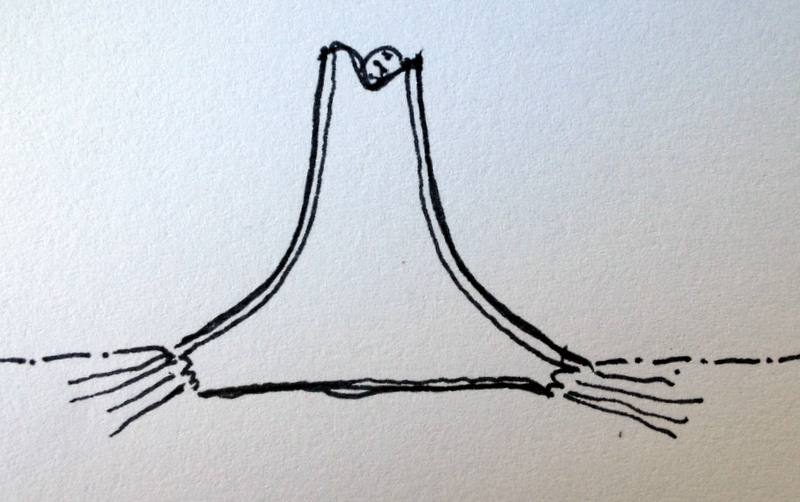
Correctly pruned root base
The above image is a vertical slice through the center of a well-formed nebari.The hairs on either side are roots and the triangluar shape is the nebari and lower trunk.
Idealy you want roots on the outside radius of the root base so that as the tree grows the nebari slowly gets larger. These roots however are occupying a zone that is not ideal for them. In order to keep them active in this zone you must force them to stay there.
To do that you remove all downward growing roots. These roots are more protected under the trunk and head straight for the cooler more temperature and moisture stable soils lower down in the pot. If you leave them on year after year the bonsai will preference these downward growing roots which are in better horticultural locations and the roots you actually want to keep around the edge of the nebari will slowly start to die back.
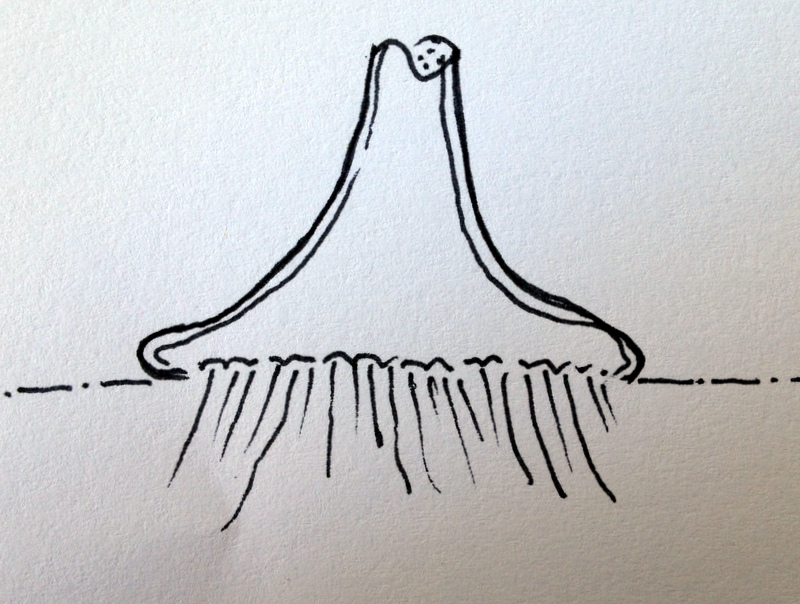
Incorrectly pruned root base result.
What you end up with is something like the above drawing (this shows a tree which had a well-developed nebari and was then incorrectly maintained). All the roots on the edge have died back and only roots underneath the trunk are growing. Now the nebari will not grow in size around the edges but instead grow underneath the trunk and slowly make the root base less and less shallow requiring deeper and deeper pots to house it.
These downward growing roots often push the trunk up and show the edges of the nebari so that it appears somewhat like a blob of melted candle wax. Not ideal. Not natural.
If left in this state for a long time the edges of the nebari can begin to develop areas of dieback that will often spread from the edge of the nebari up toward the trunk. All in all a bad result.
So if you have deciduous trees that are beginning to form nice root bases be sure to ALWAYS take off the downward growing roots. It is not just to fit the tree into the pot but it is mainly to ensure your roots grow where you need them to and this will keep your nebari developing correctly well into the future.
I am continuously telling myself I have enough trees and that I need to reduce the collection. Well, that only works so well, much like the tree that is the topic of this post, bonsai keep finding their way into my backyard.

The maple, October 2012.
I saw this maple at a local show last year and while talking with the owner, he let me know that it may be for sale sometime in the future. To cut a long story short, I bought the tree early this year and it has since sat on my benches while I got to know it.
A few things drew me to the tree initially. The tree had age. Old grey bark is a sign that the tree has been around for a long while and cannot be achieved via short cuts. The nebari was another feature that drew me to it as it was really starting to flare nicely at the soil level. This is a really nice feature that can only get better with future work as I develop the rest of the tree.
Since it arrived in the garden, I have fed it, watered it and tried to work out what my plan for its future might be. It has responded well and even survived a large gum tree branch falling onto it. It took two people to lift the branch off but luckily all the trees under it survived with only a couple of small broken branches. Very lucky.
Today I decided that I would start the tree’s re-styling. I first cleaned the nebari and removed the surface moss. For this I used an old tooth bush and clean water. Old tooth brushes really come in handy for this type of work. I then cut off the heavy apex and replaced it with a small branch below.
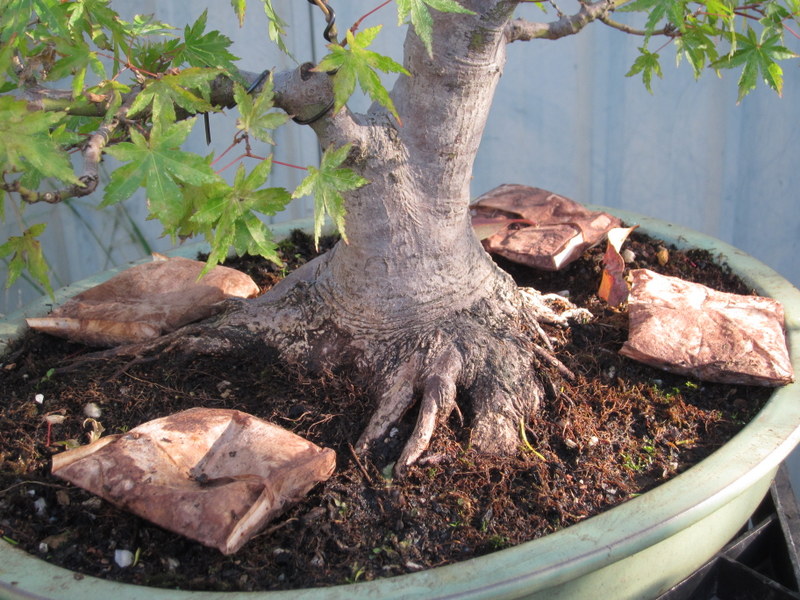
The cleaned nebari

The apex pruned back and a small branch below wired into place.
On a couple of the larger cuts I trialed using two cut pastes at once. First I applied a liquid paste from a tube. I like this type of cut-paste but it tends to soften and wash off during extended periods of rain which is why I applied a second layer of cut-paste putty over the top as a waterproof layer. I also like the putty on it own but I find it sometimes dries out too quickly and or doesn’t seal as well as the liquid tube style pastes. Hopefully this will give me the best of both worlds.

Another double cut-paste pruning cut.
I know there are those out there who don’t believe in the use of cut-paste and are quietly smiling away to them selves at my overkill, but without starting a debate on the issue, I have tried using cut-paste and not using cut-paste and at least where I am living it seems using it gives better results than simply leaving the wound to its own devices.
After removing the apex it was time to address the areas of the old branches that had thick growth at their tips and or sections where too many buds had been allowed to grow and knuckles had formed. When faced with this type of issue the only solution is to cut out the offending growth. It does seem like you are setting the progress of the tree back a little as you are removing some of the visual bulk of the branch but down the track you will end up with a branch with much better structure and a far superior winter image.

Thick twigs at the tips of the branches look heavy and take any idea of grace away from the branch structure.
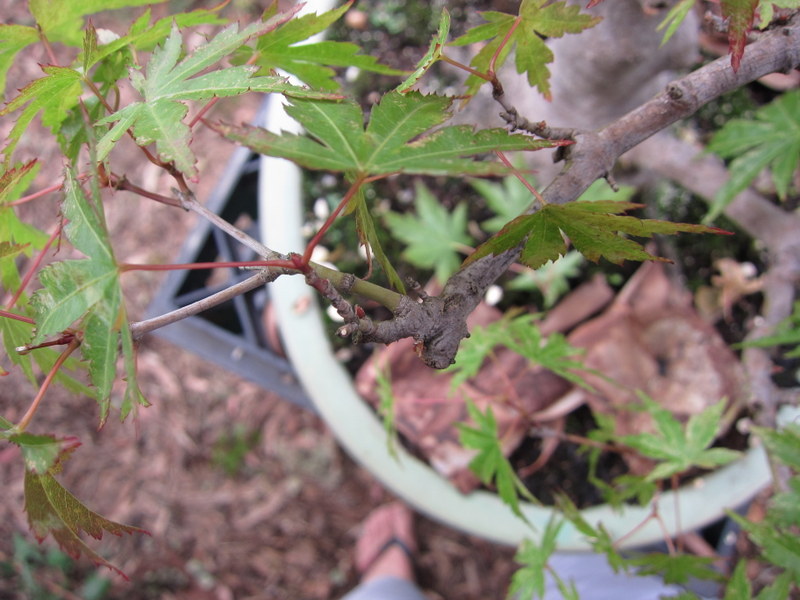
So I cut out the offending areas. I will re-build the fine tips with the back budding that the pruning will no doubt trigger.
Since the tree had been on a heavy feeding program it has begun to show results. Buds have already started to swell along the branches and the trunk which makes me confident that the pruning will continue to trigger new buds for future ramification. Interestingly some of the buds that woke up along the trunk were almost at soil level and on really old bark.

There are buds at the base of most branches or former branches.

Some buds low down on the trunk on old wood.

Buds at the base of a branch damaged by the falling gum tree branch.

More buds.
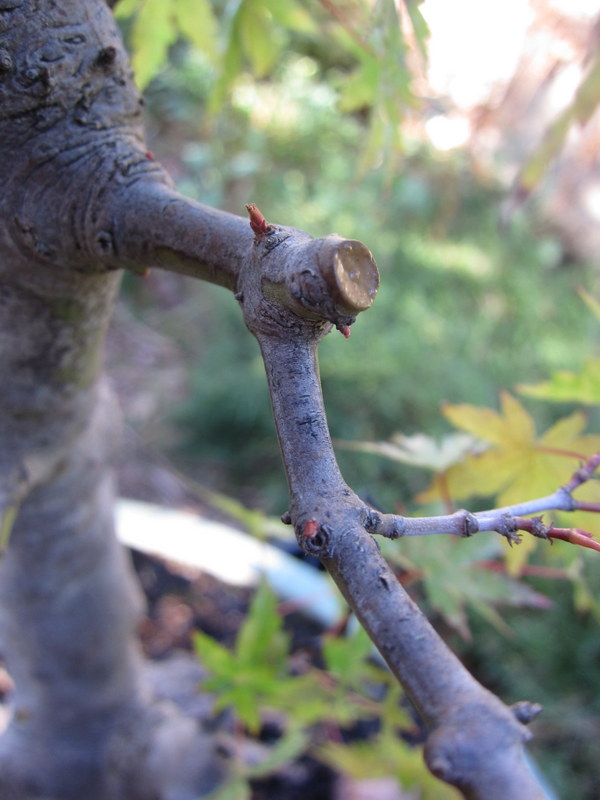
It’s easy to prune large branches when you know they will be easily replaced by buds at the base.
I think the tree had previously been on a very low dose and or no dose feeding program. This meant that when I started to flood it with fertiliser it literally started jumping out of its skin (or bark) with back-budding. I imagine next season this will only be amplified once it is re-potted into a fresh mix and the compacted roots get some space and start to run a little.
After correcting a few of the structural issues I had a think about the future style of the tree. I decided that the trunk line would be complimented nicely with a second trunk. As it turned out I had a small branch in just the right position at the base of the first branch to wire up into the new trunk. This will be left to grow free for the next few seasons to thicken and elongate.

A useful branch wired up into its new role as second trunk.
After doing work such as cleaning and structural corrections you get a good idea of the trees faults and features which makes for a nice way to ease into re-styling. In this case it made the decision of changing the front easy. The old front had a root that had grown across the root-ball and fused a long time ago creating a slightly awkward look when viewed from that side. The Back of the tree showed a much nicer nebari and the now left first branch exited the trunk from a much nicer angle. The newly wired up apex gives the appearance of much nicer taper and adds a little movement from this new front as well.

After the work. A little bare for now but the bones are all there to make a very nice tree in the future.
For now the tree will be fed and left alone until re-potting time early next spring. Then after the first flush of spring growth hardens off I plan to fully wire the tree and any new growth that has developed from the buds that are forming now. I am really looking forward to getting into the root-ball and seeing what it looks like under the soil and where I can make improvements. It has the start of a fantastic nebari and it will be fun taking it and the rest of the tree to the next level.
I have a ‘thing’ for clump styles. A few years ago I had the opportunity to purchase a flowering quince and upon seeing its clump form I bought it. Since purchasing it I have styled it a couple of times and experimented with a few different methods of growing it. It flowers profusely and easily but it seems to really resist ramifying, instead always wanting to grow only one bud per branch. This is a problem if you dream of densely ramified clumps.
I started out trying to use defoliation to force some back budding. This worked to a point but the tree quickly weakened and stopped pushing growth and although some back-budding occurred it still was very tip dominant.
I then used hard cutting back to try to stimulate some of the inner buds which worked toa point but again the terminal buds were mainly the only buds to burst.

After the clumps first styling
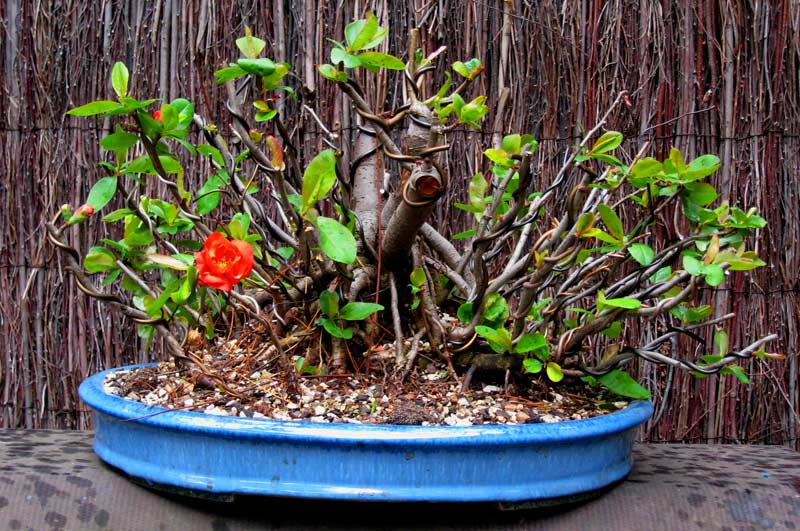
The first budding after styling
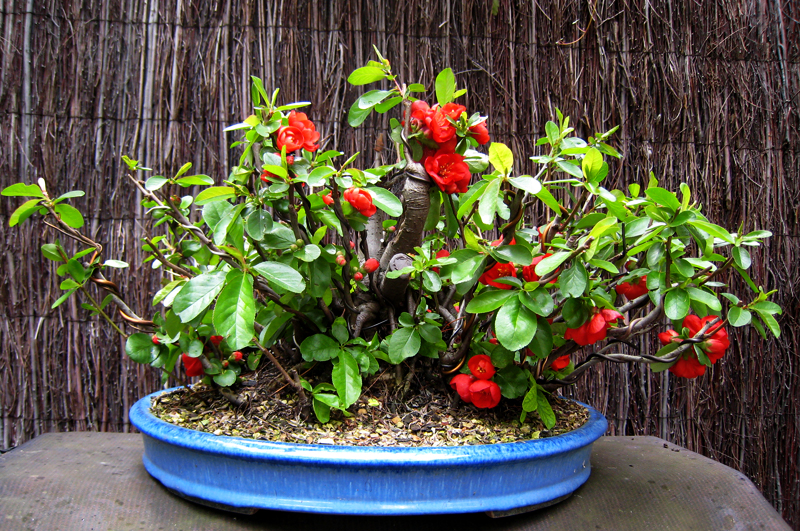
The beginning of a heavy flowering the following year. (now when I am trying to build branches I cut off flower buds)
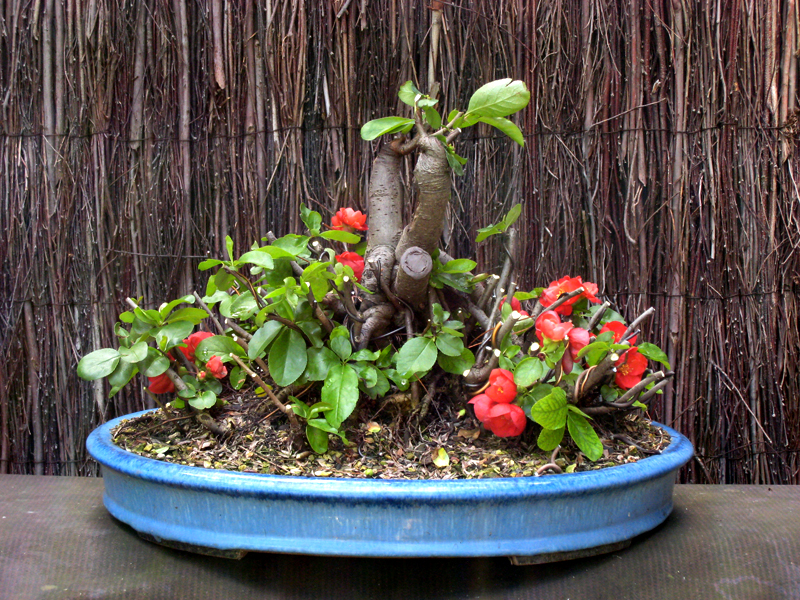
After a hard cutback.
This year I tried what I am calling partial defoliation. It seems to be working much better. The logic as I see it is that by removing most of the photosynthetic surface area but leaving some leaves to continue providing energy you force a budding but keep the tree much stronger than a full defoliation.
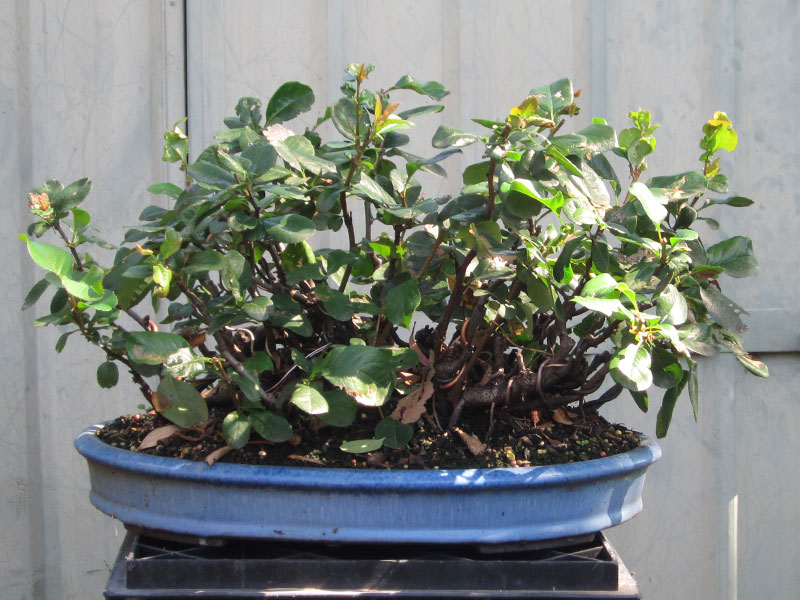
The central trunks became infested with borers so i removed them. This is the quince in full summer leaf.
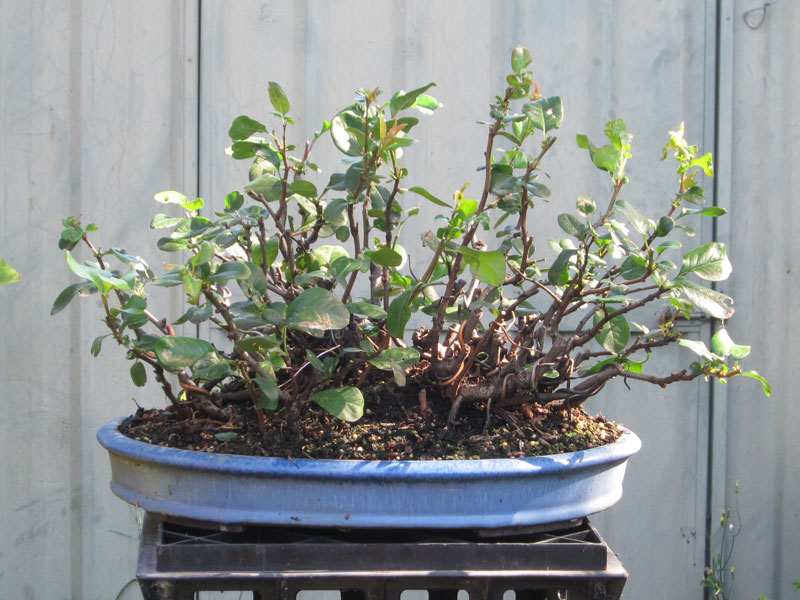
After the partial defoliation
The basic technique is to remove leaves at each clump of growth down to one leaf. This lets a whole lot of light into the inner buds and keeps sap flowing to the remaining leaves. The results are buds bursting nicely back into the inner canopy.
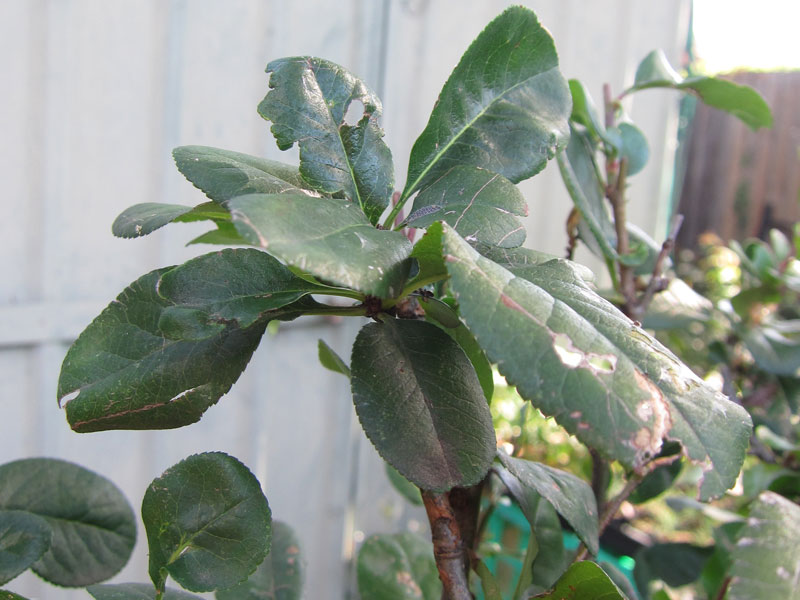
A clump of leaves

Leaves reduced

Some of the resulting budding

Some of the resulting budding
Now this tree is a fair way off being exhibited but hopefully with a few more seasons using this technique I will be able to dramatically increase the amount of ramification in this tree and get it into a much more presentable state.
As you may or may not be aware, I have recently undergone surgery on my right wrist. Being right-handed, this has put a fair dent in my bonsai plans of late.
A few nights ago after work I decided to do something about it and tried wiring up a small juniper.

Before the work
I have been working on this tree for a few years now, slowly chasing the foliage in closer to the trunk and replacing leggy growth with tighter growth. I decided that it was about due for its first styling so that I could create the bones to grow and fill in the foliage upon.
Considering that my right arm was in a cast I think the wiring went ok. It’s not show ready but it never was going to be. It has a few more years before it is going to be anywhere near presentable.
I really wanted to get some fine sand paper into the bark to reveal the orange / red texture below the outer layers but the cast proved too clumsy. Something to look forward to once the pins from the wrist are removed after the next operation.
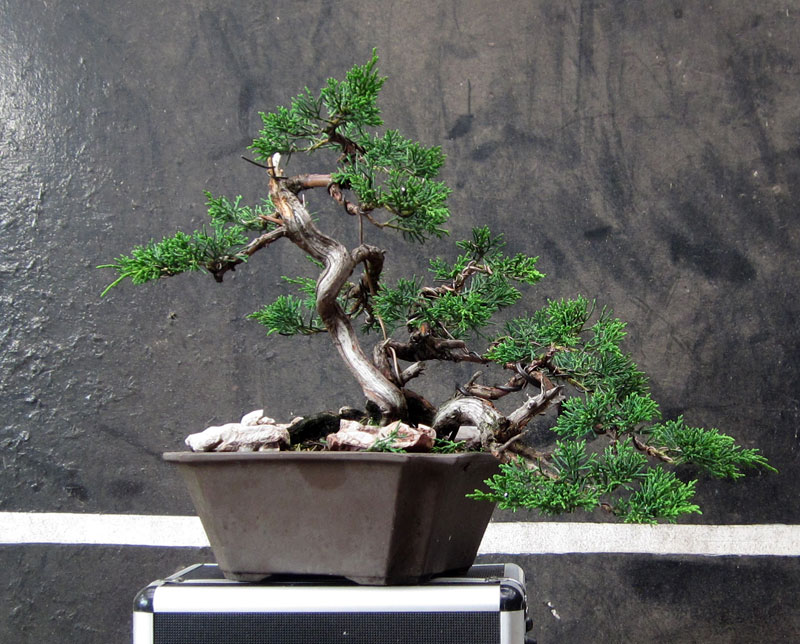
The little shimpaku from the front.
I find that when wiring junipers and particularly shimpaku, that preparation is key to a good result. Pruning unwanted growth and thinning what remains so that you end up with an evenly dense canopy not only makes the end result look better but it also makes for more balanced growth and an easier job while wiring.

As seen from the right

and from the back side
All in all I am pretty happy with the results considering that most of the wiring was done one-handed. I guess it just goes to show that interesting trunk movement is half the battle. That being said, the tree is only just beginning its journey as bonsai and should see many future wirings to come.
This post follows the progression of 6 months in the life of a Procumbens juniper. Last June i did a demonstration for a local club, Bonsai Northwest Inc. As most of my trees had been worked and I had very little left to do on them it was decided that we purchased some stock for the demo. While digging through all the stock at ‘Baloc Bonsai’ I came across this juniper.
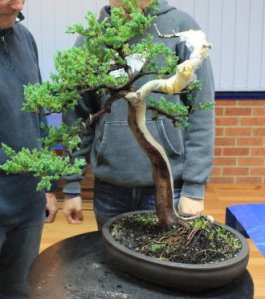
The Juniper before the demonstration but after a bit of a cleanup.
Having looked over the tree for a day or so before hand while it was in my garden I came up with a plan for improvement. From the tree’s original front the foliage mass was not close to the trunk, I thought with a little work I could compact the foliage mass into a denser crown.
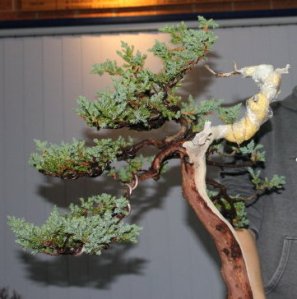
The foliage from the original front.
I also thought I could change the front and make use of a more interesting trunk and jin line. This plan created a few issues that I had to deal with in order to complete the re-styling. First was the trunk angle. From the original the trunk needed to be stood up around 30 degrees, which in turn placed most of the foliage pointing out towards the back of the tree.
Most of the bending of the larger branches was completed with the help of a bending jack as seen in the photo.

Jack in place prior to bending.
The other issue was that from the new front the jin did not compliment the movement of the tree so this was bent by means of what is essentially steam bending. I wrapped the jin in wet towels and plastic sandwich film over night to moisten the jin and then used a small gas torch to heat up and soften the wood fibres so that it could be bent into a new direction.

After the jin was repositioned and main branch bent into position.
The next step was compacting the foliage to form the crown and subsequaint branches. This was done with a combination of guy-wires and heavy wiring. The below picture shows the result. A small towel covered some branching that was to be removed once the tree had back budded in that area.
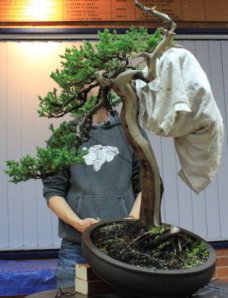
The result at the end of the demo.
If you look from the original front you can see how the foliage has been moved from its original positions to compliment the new front.

The re-styling from the original front.
Since the demo I re-potted the tree into a new container at the new planting angle. It grew out well in early spring with plenty of back-bedding and fresh growth. It was time to work on the foliage.

After some strong spring growth.
All this new growth provided me with the chance to cut out some of the leggy old growth and replace it with more compact fresh shoots.

A leggy branch with tired looking foliage.
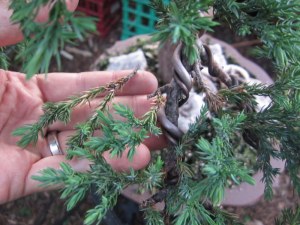
The branch cut back so the fresh shoot at its base can replace it.
In this way I was able to improve and remove some of the poorer condition and leggy foliage. I cut more out of the strong areas and left a little more in the weaker areas to balance the growth of the tree.
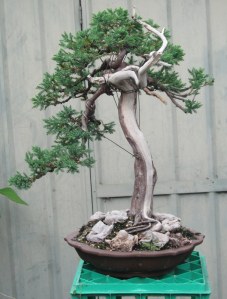
After the cut back.
I was also able to remove one of the branches on the right side and hopefully in a few months I will be also able to cut back the other right hand branches.
There are a few other thing I want to do, such as lowering the planting position, define the live veins, and work on the shari texture, but for the time being those things can wait.
What the tree desperately needs now is a full wiring, I want to further compact the apex and better form up the crown and branches but unfortunately that will have to wait until my wrist heals. Hopefully I will be able to do it in a few more months. In the mean time I will keep feeding it heavily and keep replacing old growth with new healthy growth so when it does come time to wire, the tree is ready.
 Nichigo Bonsai