You are currently browsing the tag archive for the ‘Australian Bonsai’ tag.
Spring is certainly around the corner and all my trees seem to know about it. They are for the most part starting to swell their buds. As a result I have been re-potting. I re-potted one of my trident maples a couple of days ago to get it ready for the springs growth and thought I would share some pics of the process.
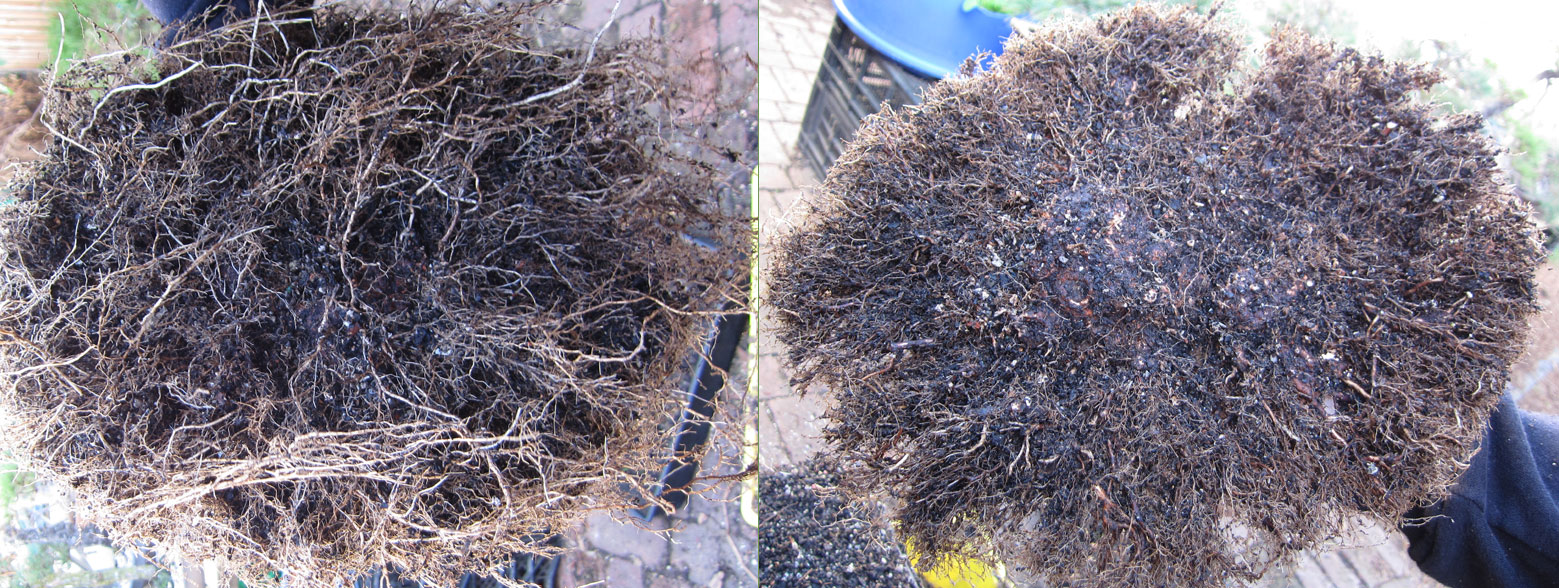
The bottom side of the rootball before and after the work.

Surface roots combed out.
Once the roots are all in order you can continue to pot up the tree. In this case it went back into the same pot.
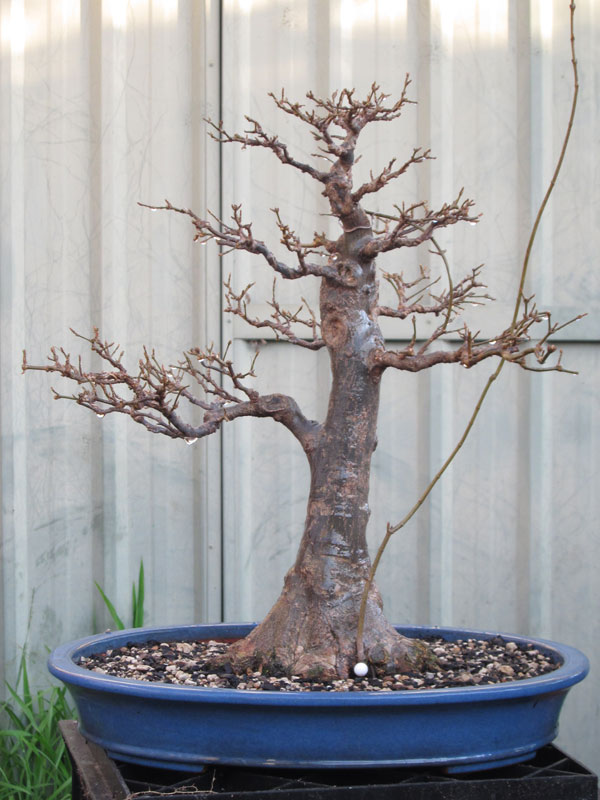
Re-potted.
Another year and another re-potting…..
The longer I am involved with bonsai the more my tastes change and develop.
Below is a Japanese black pine that I have been growing for a couple of years. It’s not a classic beauty but I was drawn to its strangeness and the challenges it presented in regards to styling it. I enjoy the challenge of difficult material. Quite often you have to think outside the square a little in order to get a pleasing result and often the bonsai that are transformed from this unusual material often posses something that makes you look twice at them and linger to explore their curves, movement and styling.

Before the work.
Now this tree had been styled once before, but I had never been entirely happy with the result. I had styled the first branch as just that, a branch. initially this branch was a sacrifice branch, grown to thicken the trunk and when I came to style the tree there was something about it that appealed to me. I had spent all the time since then looking at the tree on my benches trying to work out why it didn’t quite sit right with my eye. I realised this was a simple question for most people because I had many people suggest to just cut it off. I thought about that this time around but decided that I could have another shot at things and try to make the bonsai work with the large first branch.
My new approach was to style the branch more like a trunk. I guess the idea is that the main branch got so strong that it started to turn up and form a trunk in its own right.
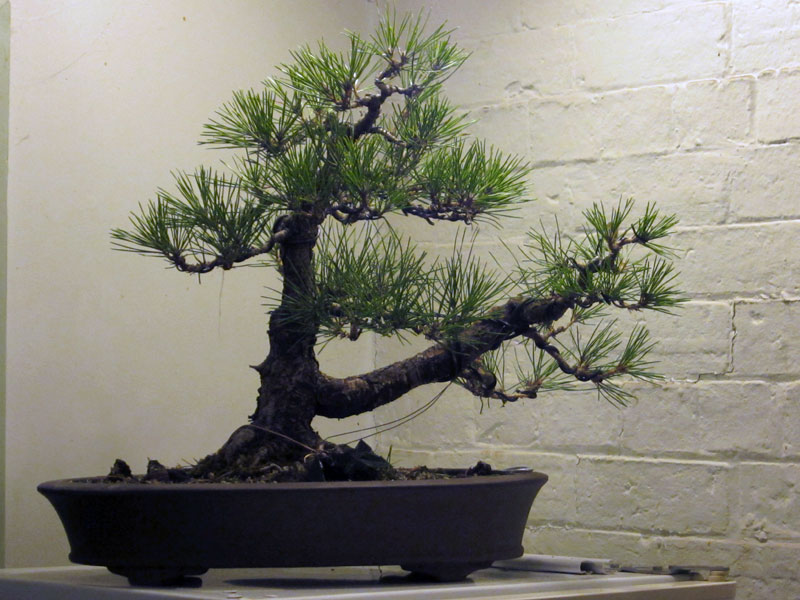
After a quick wire and the addition of a couple of guy wires.
Now as you are probably aware by looking at the above photo that this bonsai has a long way to go but at least now I feel this new structure is something that the tree can grow into and fill out to form an interesting, convincing bonsai.
Now I am sure that I will get suggestions for the rest of this trees life to cut off the first branch. As this tree is, it doesn’t fit the normal image of bonsai.
I have often found that the bonsai that are a little out of the ordinary are the ones that I end up remembering and that I return to at shows to have a second look at.
Just for interest purposes I photoshopped the branch off.
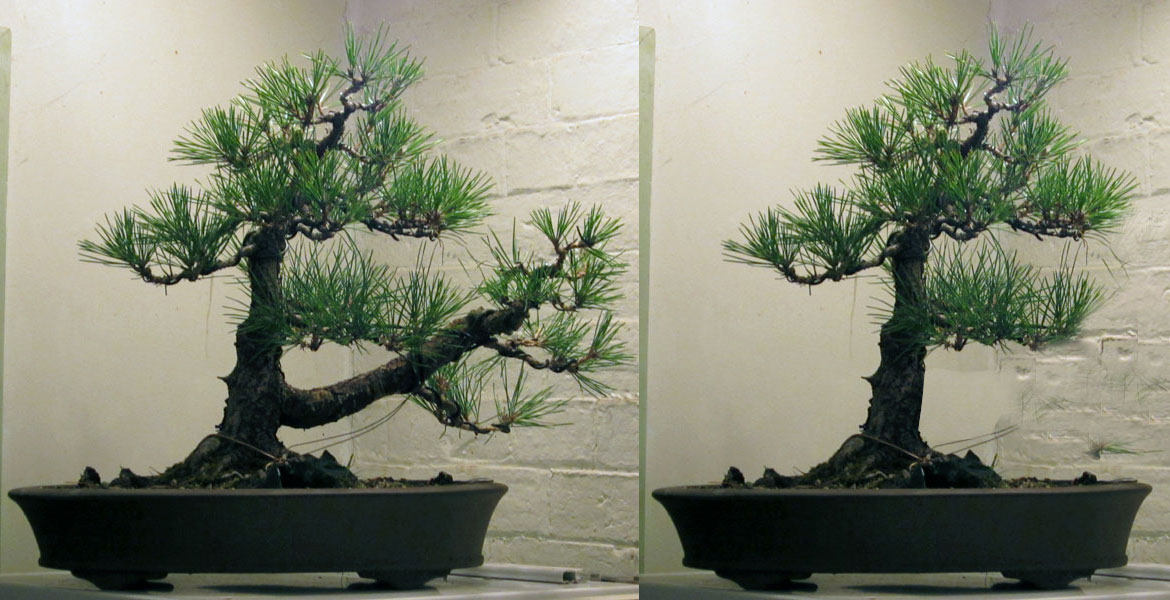
The offending branch virtually removed.
Looking at the above comparison it becomes obvious that this is not the right direction to take this pine in at the moment. The removed branch would reveal a straight trunk and leave behind a mediocre branch and canopy structure. If I was to cut off the branch I cannot see the tree staying in my collection for long.
Winter is a hard time for me and my bonsai. For the most part, when I arrive home from work it is dark and cold. This makes working on my trees something I only tend to do on weekends. That being said I did get motivated one night after work to do some pruning on my Trident Maple (seen here and here).
Tridents grow quite quickly and within a year they can put on a lot of twiggy growth. A lot of this growth is not suitable to build future ramification on so it must be pruned off. Quite often it seems like you are taking two steps forward and one step back but the removal of twigs that are not formed correctly will ultimately make for a better bonsai in the long run.

Before and after pruning. The red lines show approximately where I made cuts.
At this point in this trees life I am looking to start to build fine twigs. Most of the vigorous growth over the last year has helped to form secondary branches but it has grown with internode gaps that are too long for the tips of a branch. As a result I have pruned to remove these long internodes, reduced all branch divisions to two and generally tried to form a better structure within the branch.
A lot of my trees were grown a little too quickly and as a result their branches do not have as good a structure as they might. I am now cutting a fair amount of those branches back and trying to correct the structural problems. One of the main problems I have in my trees is that the branches do not have a main branch line with sub branches but instead have several main lines. This makes the branches look full very quickly but in the long-term you do not get the taper and look you would if the branch was grown otherwise. It all comes back to pruning. Sometimes you have to set a tree back a little in order for it to progress.

The tree before and after. (poor lighting care of my kitchen.)
This tree will be re-potted in the coming months and may also have its branches fine tuned a little with some wire which should then make it ready for the start of spring.
Right now Melbourne is deep within the throes of winter, in fact, judging by the temps we are right in the middle of it. It seems that my quince has other ideas. It has been steadily waking up and has just started producing new growth as if it is spring time.
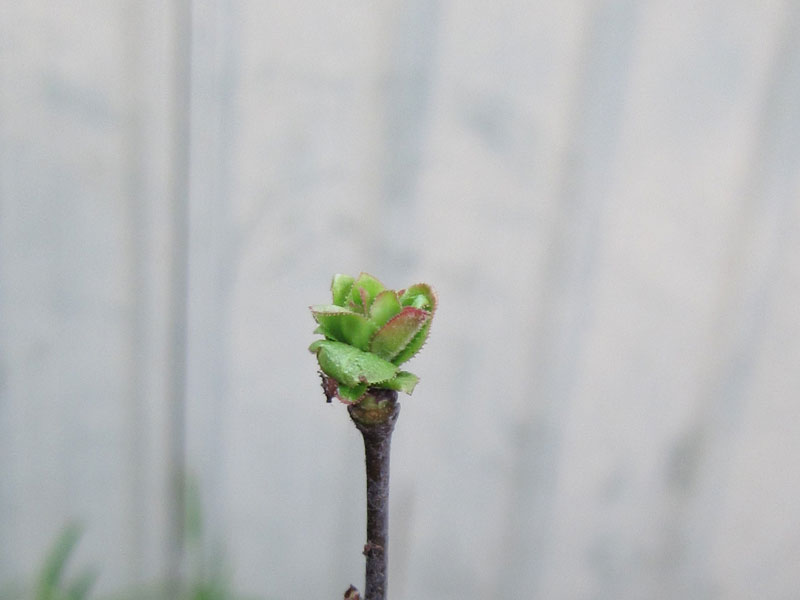
New Growth.
As a result I have had to re-pot. This is the second re-potting I have given it since I have owned it and was pleasantly surprised by the root-mass I found after the hard treatment it received after its first re-potting.
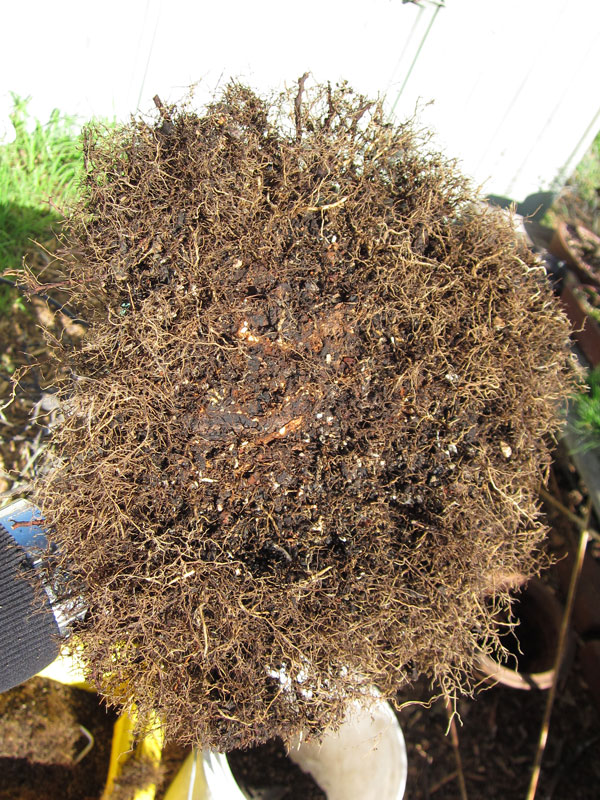
Looking at the roots from beneath. You can see that the roots that were growing downwards have been removed leaving an almost solid wooden base..
The tree went back into the same pot is was in previously. One thing you may notice is that a lot of my trees are in green pots. There is a reason for this. Where I live most pots of this age were in green tones. Around that time there was a local grower that hated blue pots and as a result of his experience and influence this lead to very few blue pots being bought during this time. As a result all my pots (which have mostly been bought second hand from other local members) are mostly green.
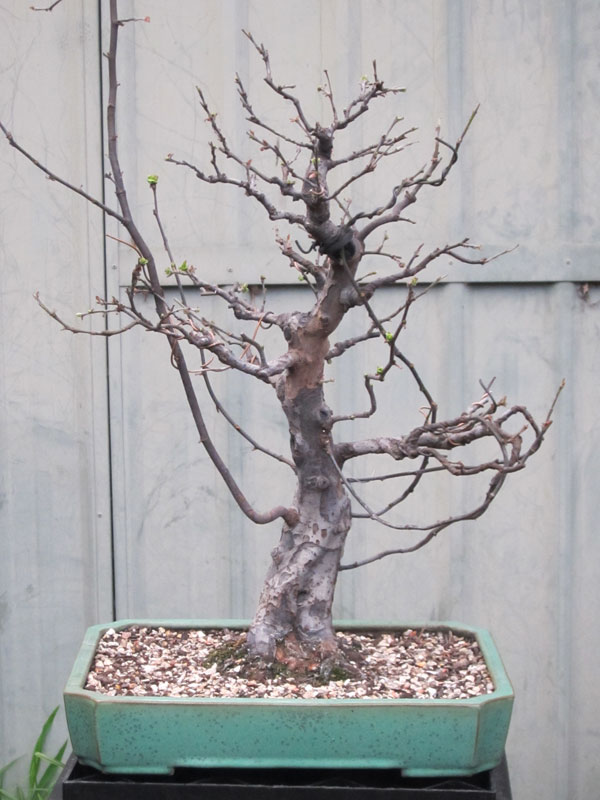
The tree re-potted.
I have not yet seen flowers on this tree. Hopefully this year I will get a few. I am not sure if this tree is mature enough to flower or not, or for that matter how old a quince has to be before flowering. If anyone reading this has an idea please post in the comments.

New buds.
A lot of people have told me that the quince is an early riser and recently I was reading through some old Bonsai Today magazines where in one article they suggested re-potting in autumn due to the early growth and flowering. I think I will give that a go next year.
I have begun to re-pot some of my deciduous bonsai. I like to re-pot my pines closer to spring time so I do my deciduous species a little earlier in order to leave plenty of time for the conifers.
The tree in today’s post is an English Elm (Ulmus procera). I picked it up at a local bonsai show last year. I have always liked clump style bonsai and am always on the lookout for suitable stock (which is quite hard to find). When I saw this little clump I quickly grabbed it.

The Elm after a year in my care.
Since owning it, I have fed, pruned and wired a little. It proved to be a very strong grower so I defoliated 3 times during the growing season. After the 3rd time it did not bud out as strongly as I would have liked which means I will only do two defoliations this coming season.
As the tree had been in a rather large terracotta pot it had developed a large rootball, as a result a fair amount had to be pruned off in order to get it into a bonsai pot.

The underside of the rootball showing the cuts where some lager roots were removed.
This re-potting I concentrated on removing all downward growing roots. This lead to a large percentage of the rootball being removed. Although Elms are strong trees I thought that I would not prune the surface roots as much as I might otherwise due to the large amount I had already removed from the rootball.
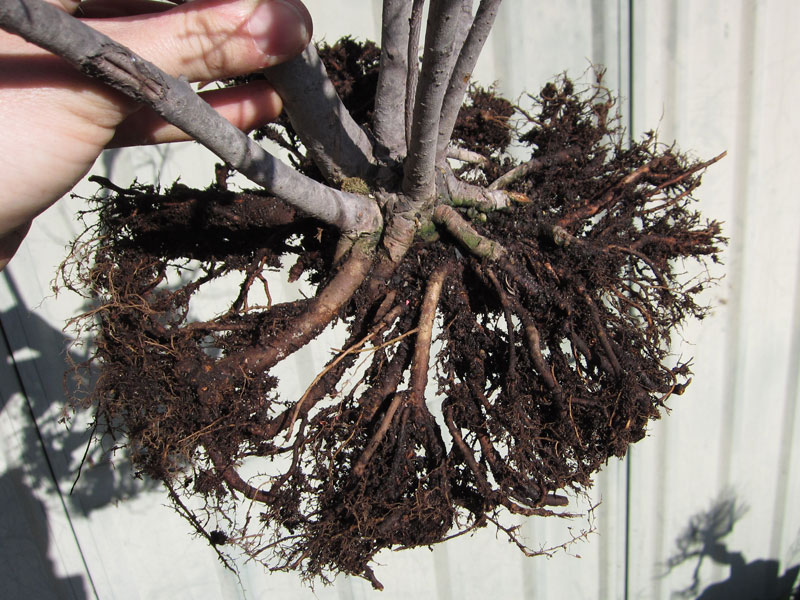
The surface roots.
As you can see from the above image there are a number of large un-tapered roots. In the next re-potting I will be looking to reduce these roots to introduce some taper and delicacy to the rootbase. For the time being though, these roots will help the tree recover from the loss of the larger part of its previous rootmass.
If you read my post “Two pots” you will be familiar with the two pot options I had for this tree.

The two pots I had to choose from.
Although I like both choices I ended up chosing the left hand pot. What i found interesting was how each pot gave the tree a different feeling. The left pot (Yamafusa ) gave the tree a more spreading feeling while I felt that the right pot (Ina Genzou ) made the clump appear much taller. The beauty of liking both the pot/tree combinations is that I will happily alternate which pot I use in future re-pottings to give the clump a new feel each year.

The prepared pot (minus tie-in wires)
For its size the Yamafusa pot had a good number of drainage holes, each of which needed mesh screening to prevent the soil media falling out and to prevent some of the larger pests getting in.
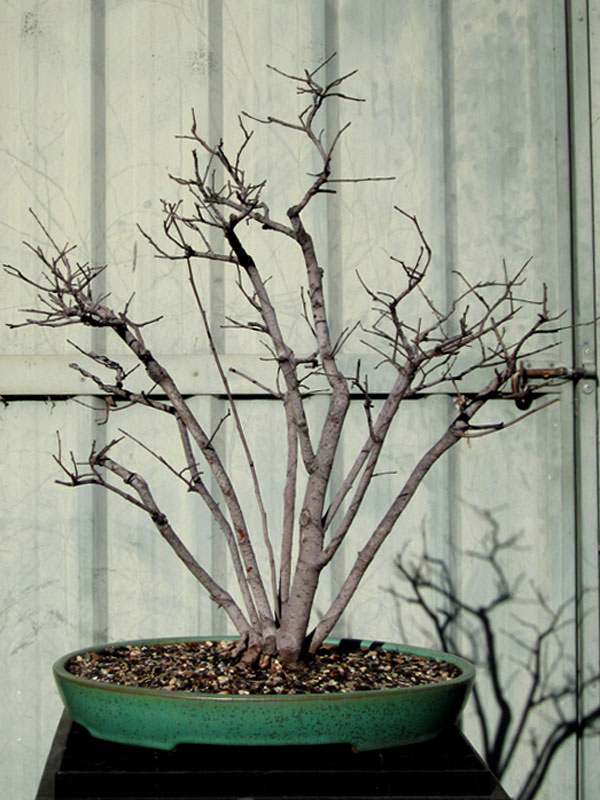
The potted Elm.
The Elm was then tied in firmly and soil worked in around the rootball. I feel the pot is a good fit to the clump and the green of the pot should work very well with the yellow autumn colours I hope to get next year. This clump has a long way to go before it is a good bonsai but it is now firmly on its way. Hopefully heavy feeding combined with defoliation will add a fair amount of twiggyness and branching to the tree to further enhance its image.
I am still slowly working through my collection and preparing for winter. This weekend this Chinese elm was cleaned up along with a couple of other trees.
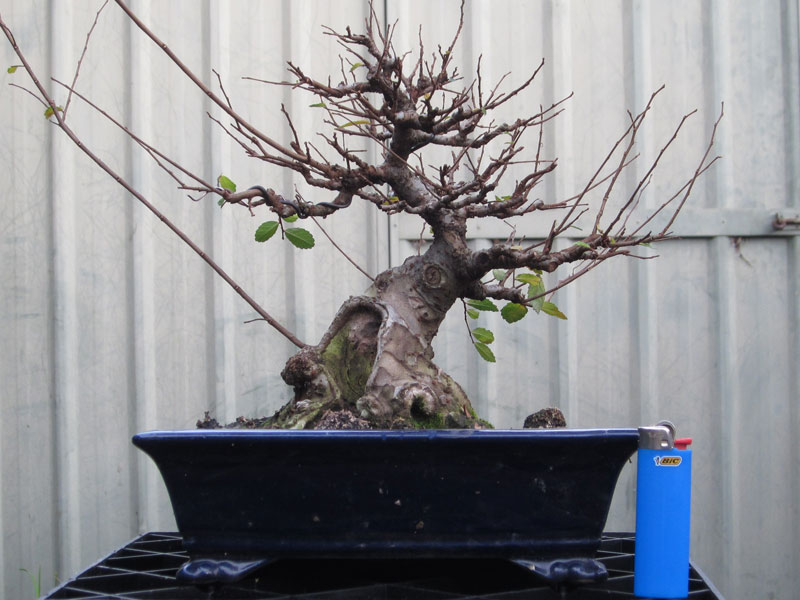
Before the work.
The tree I worked on had recently undergone a re-style. Upon re-potting last year I also decided to change front slightly. This required a bit of pruning. As I began to prune I realised that the initial branch structure had been grown too quickly and lazily on my part. Many branches were too thick, had little taper and had messy structure. I decided that the change in front would also be a good time to re-structure the ramification so I pruned hard.

The same tree a year or two ago prior to re-styling.
Re-styling an established tree can be a hard step to take but ultimately having this tree go backwards for a couple of years will mean that in the future it will be a much better tree. Luckily chinese elms are strong growers and rebuilding the ramification should be a fairly quick process.
The work I did this time around was mainly removing leaves that had not yet fallen off and cleaning the trunk of moss and also cleaning up the soil surface.

The soil and trunk need a clean up.
Keeping your bonsai clean of moss and fallen leaves and other debris achieves a few things. First, it makes the tree look better which I always find makes me take better care of it. I also find that doing work that makes you look closely at your trees you become more familiar with them and it often reveals what future work will need to be done in coming seasons. The last thing a good clean often does is it reduces the hiding places for pest insects and places for their eggs.

A large caterpillar that was living under the moss growing on the trunk.
After a general clean I pruned the long growth and then sprayed with lime sulphur.

After the work.
All the tree needs now is a wiring and a re-pot sometime prior to spring. I am toying with the idea of lengthening the canopy on the left side and possibly growing a low branch from the left side of the hollow. I guess I will grow one and see how it goes next season, i can always cut it off if it doesnt work out.
I am pretty happy with the pot it is in at the moment. I was never really 100% on the last oval pot and feel this one suits it a lot better.
The pot is a production Reiho. Reiho is one of my favorite production potters from Tokoname. Although the photos don’t really capture it, the pot really changes moods depending on the sun. Sometimes in low light it looks almost black, and then in full sun it turns to an almost ultra marine blue. you can kind of see it by comparing the colour in the first pic with that of the soil surface photos. Hopefully next season I will get some good colour on the tree so I can see the yellow leaves set off against the dark blue fo the pot.
The tree below is another that was heavily infested with pests. It was infested with Whitefly which in turn had led to sooty mould. Again, in the last garden it was growing in it was almost impossible to control the fly as every time I would spray the tree it would be re-infested a couple of days later.
As a result of the infestation each leaf that was on the tree had a hundred or more eggs laid underneath it. Because of this I wanted to defoliate just before leaf drop so I was able to collect all the leaves and destroy them.

The Quince before defoliation. You can see how damaged the leaves are from the whitefly.
This is my only quince and since I have owned it I have fallen in love with the species. It grows strongly, approach grafts easily, and buds back well. It also shows great colour in autumn (should you not defoliate it too early such as I did this year) and also gives a display of flowers followed by fruit. The bark is also very attractive. When you add up all these positives you get a species that makes a great bonsai candidate.

After removing the infested leaves.
As you can see from the above image, the tree is still very much in the developement stages. I am in the process of approach grafting a number of branches onto the trunk and am also trying to develop a new first branch. The second branch is where most of the whips for the approach grafts are taken from, which explains the looped twigs. This last summer I was able to graft 4 new branches but 3 still need a little more growth before they can be cut from their parent branch. This coming season I hope to graft a couple more.
For those of you wondering what pot the quince is in, it is a pot by Yamafusa. Yamafusa although not really high-end, is one of my favorite tokoname potters. Their green glazes are very beautiful and suit a wode range of deciduous trees and although at the cheaper end of the price scale their pots are great quality.
After I defoliated this Quince I also sprayed with lime sulphur in the same way i did with my trident maple. Hopefully this will kill any remaining insects and leave it pest free come spring. Fingers crossed.
This year has seen some dramatic changes to my bonsai. The most major of these was moving house and gaining some backyard space. My trees previously were kept in amongst a lush garden. On one hand this was good in that my bonsai were quite sheltered and there was a good micro climate in which to grow amongst. The down side was that I could never really rid my trees of pests as once the garden was infected everything was. As a result my trees ended up with a number of pest problems. Now I have moved I hope to rid them of these problems, which brings me to the subject of this post, my Trident Maple.
Earlier this spring I defoliated the maple and posted the results HERE. I repeated this defoliation process twice more during the season and was rewarded with much increased ramification.
As it began to change into its Autumn colours I set about doing the final defoliation. Usually I would leave the leaves on a little longer in order to see the full range of colours they would turn but I wanted to remove them before they dropped so I could dispose of them along with any insect eggs that may have been laid on them.
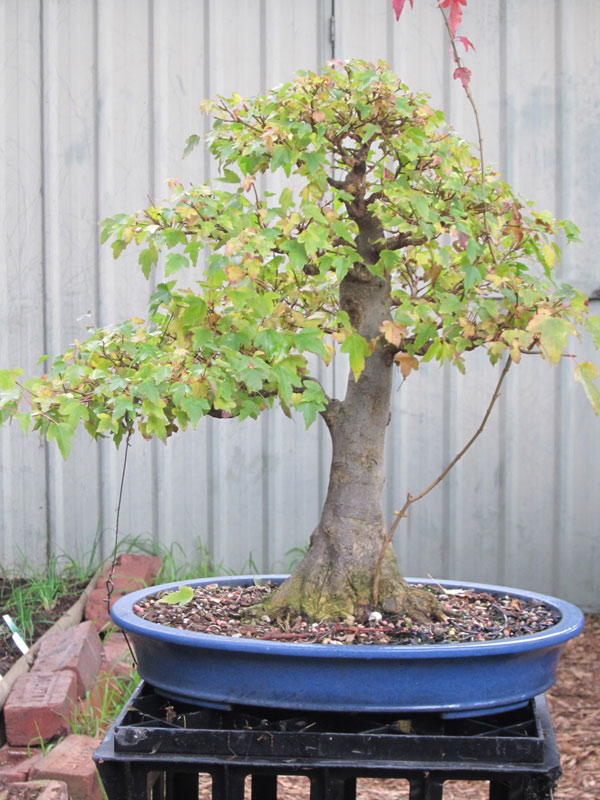
The trident at the beginning of autumn just beginning to show signs of it changing colour.

Starting to turn
I removed all the leaves which revealed the structure of the branches and all the new ramification. All the leaves that were removed were put into the household garbage to ensure that any eggs on them would not end up anywhere near my bonsai.

Defoliated.
Once the tree was naked I was able to carefully look over the tree to assess the amount of pruning that would be required. I wanted to spray the tree with lime sulphur to kill any remaining pests so I did not prune at this stage. I don’t like the idea of lime sulphur getting into fresh cuts. I am not sure if it is actually a problem or not but I choose to avoid it where I can.
What I did prune off was some insect eggs. I found what I first thought were fungal blooms on dead twigs.

If you look closely you can see the small white tufts of damage.
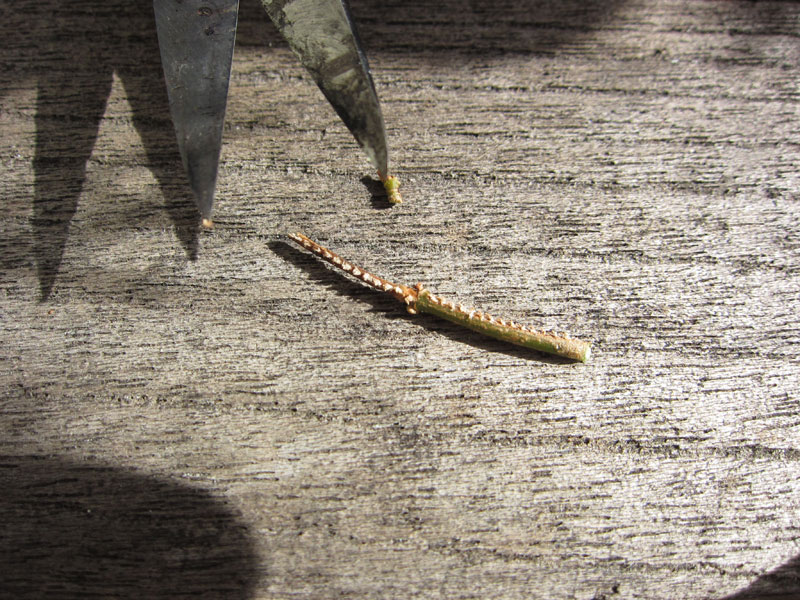
A close up of a damaged twig
Upon further investigation I realised that the tufts lead to a hollow channel within the twig which was filled with eggs around 0.5mm in size. I did a quick search on the net and realised they were the eggs of Passion Hoppers which lay their eggs in channels they make within small twigs. The twigs die soon after the eggs are laid so cutting the twig off and destroying it is a good way to tackle them.
I then went over the tree with a pair of scissors and removed every twig I could find that exhibited signs of damage.
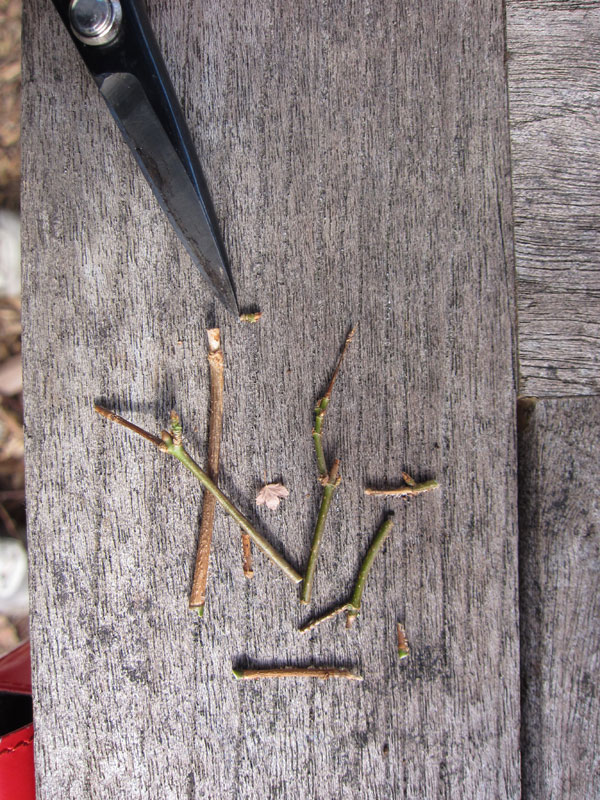
A pile of some of the damaged twigs.
After removing what I can only guess was hundreds of insect eggs I sprayed the tree with a diluted solution of lime sulphur to prepare the bonsai for winter.
It was a satisfying days work. I hope that the work will pay off next season with a dramatic reduction of insects in my collection. Fingers crossed.
This last weekend I went down to Footscray and had a look at the Bonsai Northwest Inc.’s annual show. This year there had been a change in venue to the Footscray community arts centre which turned out to be a great success. The exhibition space was skirted in black curtains which provided a great backdrop for the trees.
Having been involved in the Victorian scene for a while now it is good to see that every year the quality of both trees and displays are on the rise.
All those who exhibited and worked on setting up the venue should be proud of their work, the exhibition looked fantastic. Hopefully this year is a sign of things to come in the future and also a hint of the quality we might expect at next years AABC convention which is being hosted by this club.
I did manage to get some photos but unfortunately my camera struggled with the lighting as it is a small point and shoot. Some of those pictures are below:
-
- The view upon walking in the entry. What a great venue!
-

- More of the display.
-
- Evergreen Alder
-
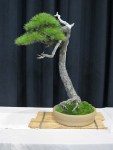
- A radiata pine
-

- A wild looking chinese elm.
-

- Another pyracantha covered in berries.
-
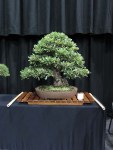
- A large banksia. (Australian Native)
-

- A large formal upright radiata
-
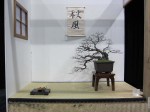
- The tokonoma. English elm, fallen leaf and Scroll painted by a member.
-

- The english elm close up.
-
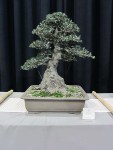
- Olive
-
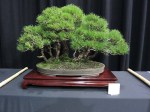
- A radiata pine group.
-

- A pyracantha with a heavey crop of fruit.
-

- One of the heavest crops of berries i have seen.
It’s that time of the year again.
It’s a time of the year that I both look forward to and dread. Once you amass a certain number of pines you begin to realise just how much time you need to set aside to give each tree its seasonal maintenance. This year, I have moved house and as a result some of the trees I would have normally have worked on earlier in the month were left until now, so the back log of tasks compounded the time I needed to spend on them. That being said, once I began the work I really enjoyed getting to see just how each tree had been growing over the season. When you thin needles you get to inspect very closely every branch of the tree and evaluate each new bud, needle and twig. You really get to know your trees while doing these tasks.
Why do you thin needles? You should thin needles at this time of year for a few reasons.
- By removing last season needles you let more light and air into the canopy which in turn encourages back-budding.
- By removing some of this seasons needles on strong areas you are able to balance strength across the tree foliage.
- By removing surplus needles you also reduce the amount of places that insects and other pests are able to hide.
I like to think that needle reduction for pines works a little like defoliation does for deciduous trees. I figure that the pine realises it suddenly has less foliage and as a result sets new buds which will grow the following spring to replace the needles that you removed. As pines cannot simply grow new needles they have to throw new buds. Most of these new buds will be dormant buds back within the canopy. These are the buds you want. This back-budding is what will give you foliage to cut back to in the future and which will prevent branches becoming leggy.
This year I have left a few more pairs of needles then I usually may on some trees as I plan to re-pot them come spring and figure they could benefit from the extra strength more needles will provide.

A Formal upright Black Pine in the making. This image was taken prior to beginning needle thinning.

The same tree after thinning. It is still very much in developement but after a few years of work i hope to have a more complete looking tree.

This is another JBP from the same batch as the above pine. It has developed much better than the above pine. It avoided many of the mistakes the other tree had to endure as i was learning. Photo was taken before thinning.

The same tree after thinning. It needs the apex developed but otherwise is on the right track. I am also planning to graft a back branch or two into the upper section this spring which may be the topic of a future post.
I also thinned my large Radiata. I again left more needles on it that i usually might for two reasons. The first reason is because I will be re-potting it this spring and I want it to be strong. The second reason is because I am experimenting with leaving more foliage on it much like you would on a white pine. We will have to see how that works out.

A Radiata branch prior to thinning.

And the same foliage after a light thinning.
 Nichigo Bonsai