Another quick update for the trees shown in THIS post.
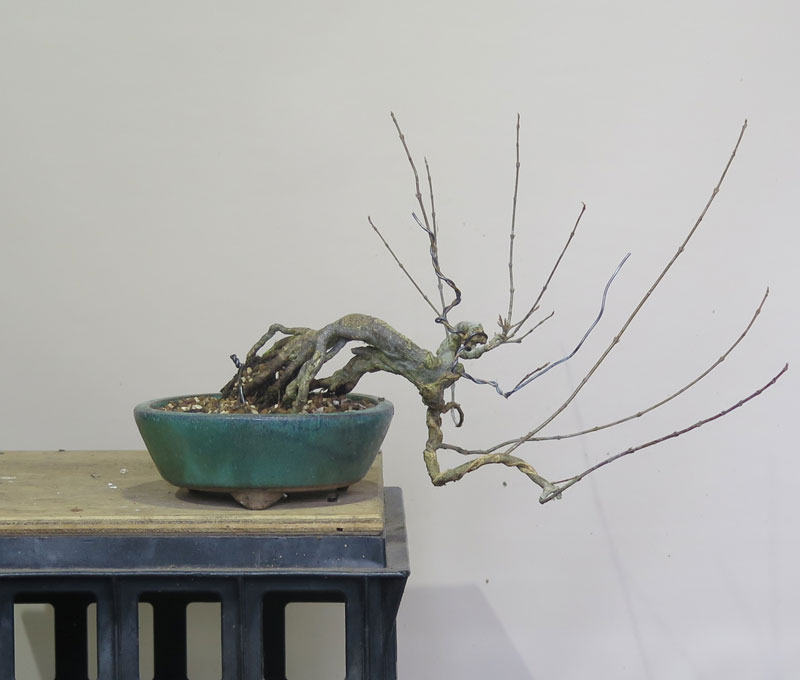
Everything is slowly improving year in year out and I am becoming particularly fond of the one in the Bikou pot. This tree was one of the original Chojubai in the country (a cutting from one of the plants imported in the 90’s).. It belonged to the late Richard Salvado, a friend and proponent of mini and shohin bonsai in Australia at a time when big trees were all the rage.
He originally found chojubai in someone’s backyard, planted as an accent in an imported tree. He took a cutting (which i think out survived the original specimen) and later spread the variety to those who were interested. He was ahead of the curve in regard to the small bonsai craze and its a nice memento of him and his broader influence.
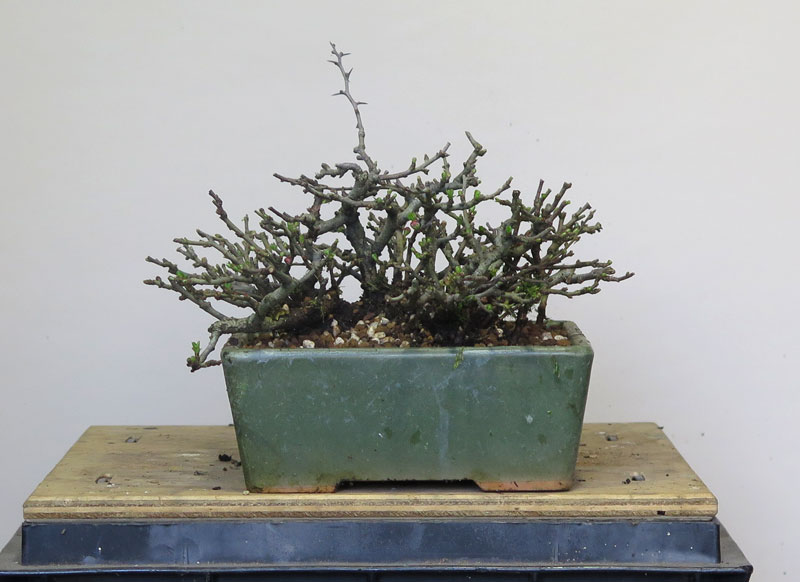
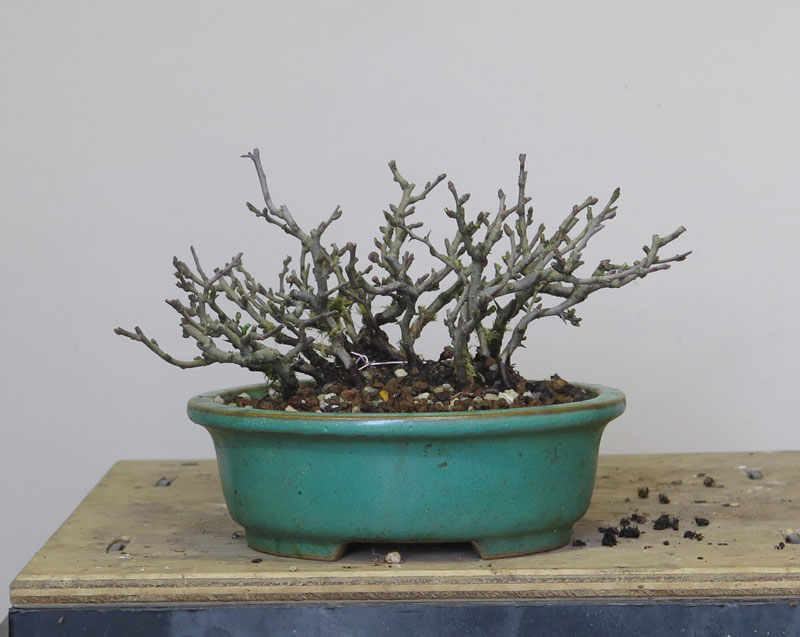
This group was split in half and stretched out a bit into a larger clump. Pot Reiho.Probably due for a re-wire but this clump is slowly improving year in year out. Pot Yamafusa.This tree has had a fair amount of re-styling over the last growing season. It needs another wiring. The red flower really matches the pot well! Pot Bikou.A pic from last summer just after i had made some styling changes. It has come a long way if you compare to the last time i posted it.
Wow, it’s been a while since last posted. Life has been busy but bonsai has been still been ticking away in the background (mostly after dark / kids bed time). At the moment, re-potting is in full swing with the first warm days hinting at springs approach.
I re-potted it into a new shaped container which i think suits it more and gives it a little more root room, which in turn i hope converts to a season of healthy foliage growth to further fill out the silhouette.
2022 on the left and 2023 of the right. The grafts certainly seem to have taken well and are now thriving! I think i can comfortably say this is a (grafted) Itoigawa juniper now.
I have a bunch more re-potting posts to come which should give updates to some previously featured as well as some new to the blog trees. Until then……
It seems a consistent theme is me not updating my blog. Well, it’s been a long time between posts again so figured I should make an update…..
I’ve been fairly active doing various things within the garden and have recently been involved in a local bonsai gathering with some bonsai mates which has spurred my passion for bonsai along again.
During one of these catch up’s I brought along and worked on the tree features in this post. It has featured on the blog before (2012) as per the post below. That said, it has changed quite dramatically since then.
I was never entirely happy with the procumbens foliage on this tree. It could be made to look good but it grew quickly and needed a lot of up-keep to maintain at its best. So I decided to graft it with Itoigawa.
It turns out that this was a long process from which I’ve learnt a few things.
Probably the biggest take away was the size of the scions to use. I had originally used small pieces of scion foliage on the belief they would perspire less and therefore have a higher chance of success. This was the case and they were successful, but they took forever to build up enough strength to grow into something I could think about styling and or cutting the original foliage back to (think several years post graft success).
The next round of grafting I used much larger whips as scions. (probably in the 150-200mm long range.) I found that the extra foliage, almost immediately, built up strength and vigor and as a result could be utilised in much shorter time frames post grafting.
It took me a few years to learn these lessons so the ‘changing of clothes’ process took a lot longer than it might have otherwise. That said, I am now using these learnings on other trees and benefiting from the previous errors. You will see from the image below, I am growing out some whips on this tree to be used as grafts on other stock.
To cut a long story short, I finally got around to doing a structural styling on the new foliage on this tree and I am pretty happy with where it stands. It has a lot of growing to do to fill out and develop secondary and tertiary structure but its now on a good path.
The first styling
The questions remains though, is this a procumbens juniper (sonare) or an itoigawa?
The last few weeks have been pretty interesting. Our area has been under covid lock-down limiting movement and socialising and shortly after, a family member was exposed to a covid positive person at a local shopping location and we had to put the whole family into 14 day isolation where we couldn’t leave our property. Luckily we all tested negative but we still needed to complete the 14 day period of isolation…
Without being able to get out to exercise and walk off some of the kids energy we have been trying to come up with ways to occupy them (and ourselves).
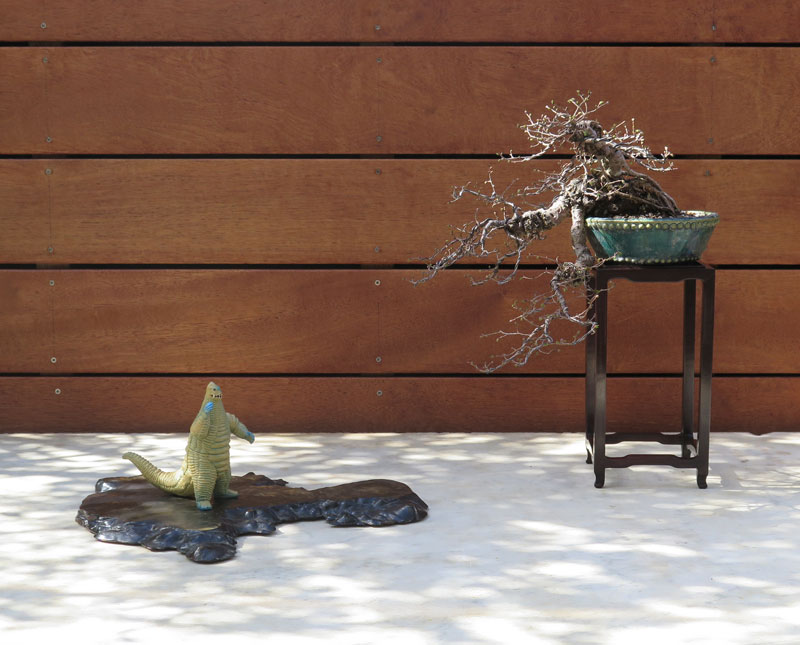
Bonsai has been a good distraction and my daughter wanted to help out so we grabbed some things lying around the house and messed around with a few versions of a bonsai display. Its a pretty modern interpretation with a couple of monsters from ‘Ultraman’ showing up but was a fun exercise to do together and really all the same considerations around placement, scale and colour / texture remain.
I was hoping to use some of the other coloured figures but my daughter is going through a dragon phase so switching them out was out of the question.
Any way, they were a bit of fun and killed some time, I hope you enjoy them. Let me know in the comments your favorite version.
I’ve gown Pinus Radiata (Monterey pines) on and off over the years and have somewhat of a love hate relationship with the species. They have several good points and are readily available as escapees from the several large plantations close to home. They have great characteristics such as good bark, fast growth and seemingly high survival rate when collecting but………. That said, their foliage can be ‘scrappy’ and there seems to be a big difference between older examples and more modern plantation escapees which I think is due to the genetic selection of the forestry stock and how it has changed over the years. These younger trees seem to have much more twisty and messy needle formations and growth patterns compared to older stock examples.
Near home is one of the first radiata stock trees that was selected for a parent or mother tree of much of the forestry stock at the time (planted in the 1880’s). From what I understand this tree was used early on but is no longer a parent, as better examples were grown, bred and fine tuned.
That said i have been digging various specimens again with the idea of grafting them over to white pine or perhaps red pine to make use of the great bark but also get good foliage characteristics. Well, at least that was the plan…..
While out exercising the family in one of the local forests, I came across this radiata witches broom located not too high up in the canopy. I found another of these a couple of years ago, but while waiting for the right season to graft, the plot of trees was logged, losing my opportunity.
This one I should have a lot more time up my sleeve to try to get some material off it to propagate as the trees it is growing in amongst are much younger and likely 10 years away from harvest.
What are witches brooms I hear you ask? Essentially they are a form of damage to a tree (virus, insect or otherwise) that change the genetics of a particular area of growth on a tree often resulting in a dense twiggy dwarf section of growth. Often these areas can be propagated (via layer, grafting or cutting etc.) to retain these characteristics and create new versions of the parent stock.
The witches broom
This broom was showing dense growth and shorter more compact and neat needles so I am hopeful it may be a good candidate to replace scrappy radiata foliage with and still keep it in the family so to speak. Time will tell I suppose.
Who knows it could turn out to be a good new bonsai stock option. Many famous dwarf cultivars started as witches brooms; for example, yatsubusa Japanese black pine came from a witch’s broom on a kotobuki black pine.
ON A SIDE NOTE: Has anyone had much success grafting radiata pines (Monterey pines)? What species did you try? I’d be really keen to here about your experiences in the comments!
Chojubai are one of my favorite species. Very easy to grow and propagate and providing you are looking to grow small clumps, they can be developed very quickly.
The trees in this post were essentially grown from a number of cuttings all struck in one pot. They have established good root systems and are now growing into nice clump style bonsai. They have a long way to go and ideally I’d like the canopy to perhaps double in size but the bones are there for some nice trees.
This tree is a little over potted as it had spent the last year in a much smaller pot and i am looking to build it’s strength this season.
First bonsai pot for this clump
Only a year or two from cuttings. Again the first bonsai pot for this tree.
The first tree was from a close friend who passed away. He had grown it from a cutting that came from a plant that was originally imported in the early 1990’s along with some impressive maples by a prominent Victorian grower. It sat in isolation in this collection for years before we realised what it was and how lucky we were to have it in Australia. Since that point it found its way into the hands of several growers who have propagated it and distributed it so that it will stay available to the Australian bonsai community going forward.
The great thing about growing these is every time you prune you end up with a pile of cuttings which in turn become new bonsai. If you don’t have one, they are fairly well available in Australia and at least at Victorian shows, I often have seen them for sale on club tables.
With all they have going for them; Small leaves, tiny profuse red flowers and fast growth rate everyone should be growing this species!
For those that already grow them, there is an argument for repotting them in summer which is another interesting option. Michael Hagedorn has a good series of articles on Chojubai over on his blog for those interested including going into detail into the repotting in summer technique (CLICK HERE).
So I have a number of trees that are very much projects which are finding their ways into bonsai containers for the first time. I thought it was worth posting them as much as a record for myself to catalogue their progress on the blog. They are all fairly rough but have some promise. Enjoy.
A small trident that I inherited from a friend who passed away. It was all much the same as its current form although much longer/larger. I cut it back hard to the interesting base and am slowly re-growing the branching and canopy.
Another inherited tree, this clump is a collection of old branches I air layered from a larger tree that I am in the process of re-growing. Horrible overly bright pot, I know.
Details in each tree’s picture caption.
A trident on a rock…..
The above trident is one i picked up from Neil at Shibui Bonsai. I was attracted to it for the ‘loop the loop’ root on the front of the rock which was a little unusual. I have since been growing the branches and trunk-line to try to have some of this twisty and bendy movement.
You can see where the trunk was originally cut at the first branch. The scar has almost completely healed over and should continue to smooth out over the coming years.
Neil grows some great (if not the best in Australia) root over rock trees and has pretty much perfected the technique to get the tree to tightly clasp the rock. Check out his page (link above) as he often has interesting things for sale as the new ground grown stock is dug and prepared for sale.
Today’s work was a fairly simple repotting into a lovely Koyo pot. I really love these pots and am always happy to use them with my trees.
Repotted and ready for spring
The tree is probably ready for a re-wire but as English elms are one of the later trees to leaf out I will try to squeeze that in between repotting my remaining trees and bud burst.
I really like this lumpy little tree. its a bit ugly and has some strange bumps but I think that they all add to its character. I recently sold its brother to a friend so i will likely be hanging onto this tree for a long time.
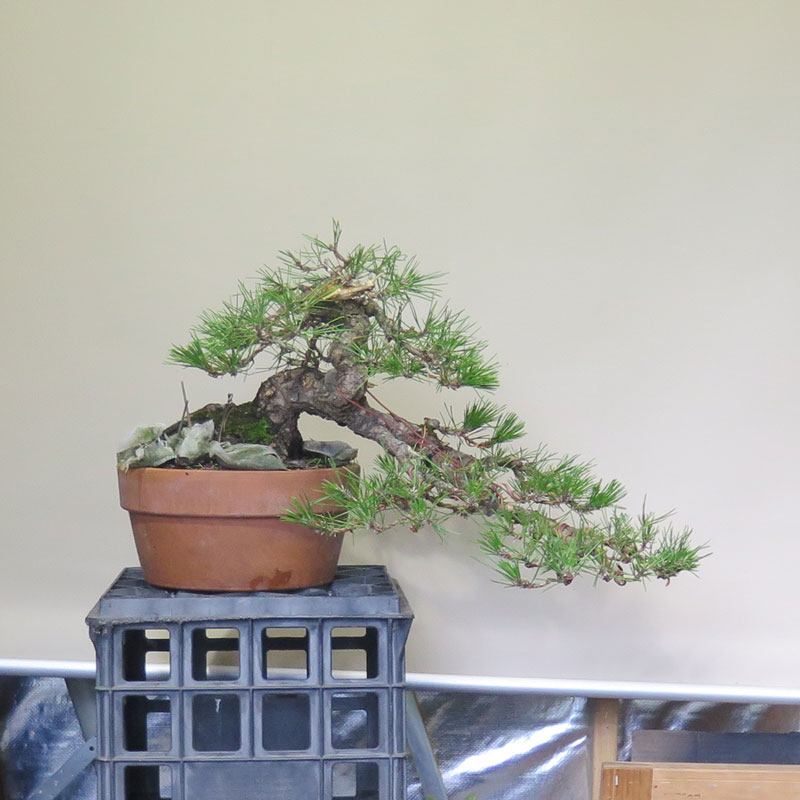
Another quick update on a tree I recently styled. The below pine has really started to shape up post styling and I figured it was time to get it out of the terracotta grow pot and into a bonsai container.
I potted it up in the pot from the tree in the last post which was the only spare pot I had that roughly came close to fitting the tree. Its not a bad match but I will see if I can locate a better pot for it in the next couple of years (square perhaps??).
Before (after styling)
……..And repotted.
Interesting to note the foliage colour seems much darker since the restyling photos, hopefully an effect of the water change and health returning to my trees. This tree has a long way to go but it seems that its future is back on track.
Pretty simple work all in all just a change in pot. It’s not a perfect fit but I don’t mind it all the same. before and after below:
Before potting….
And after a change of pot….
It will be interesting to see how this tree goes after the re-pot. It is in a fresh mix and this year I am potting most of my collection in Akadama, pumice and scoria in fairly equal proportions. I haven’t used this mix before but have heard good things so I am looking forward to seeing how it performs. Should be an interesting 12 months.








 Nichigo Bonsai