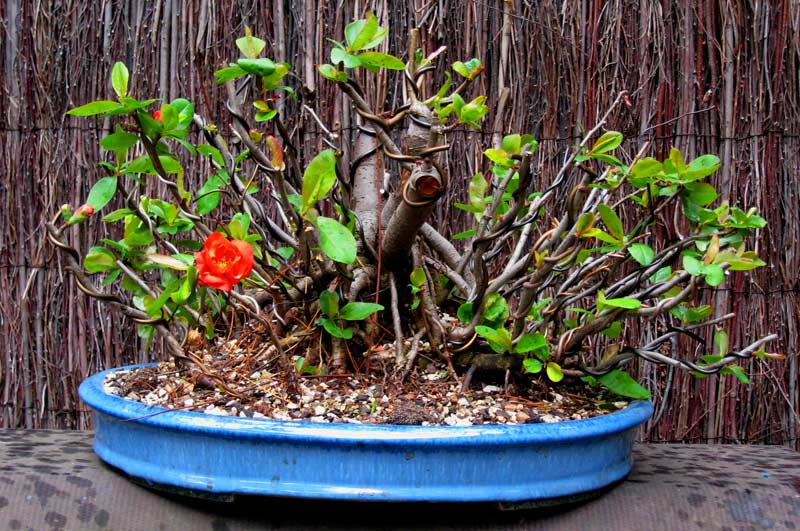
I have a ‘thing’ for clump styles. A few years ago I had the opportunity to purchase a flowering quince and upon seeing its clump form I bought it. Since purchasing it I have styled it a couple of times and experimented with a few different methods of growing it. It flowers profusely and easily but it seems to really resist ramifying, instead always wanting to grow only one bud per branch. This is a problem if you dream of densely ramified clumps.

I started out trying to use defoliation to force some back budding. This worked to a point but the tree quickly weakened and stopped pushing growth and although some back-budding occurred it still was very tip dominant.

I then used hard cutting back to try to stimulate some of the inner buds which worked toa point but again the terminal buds were mainly the only buds to burst.

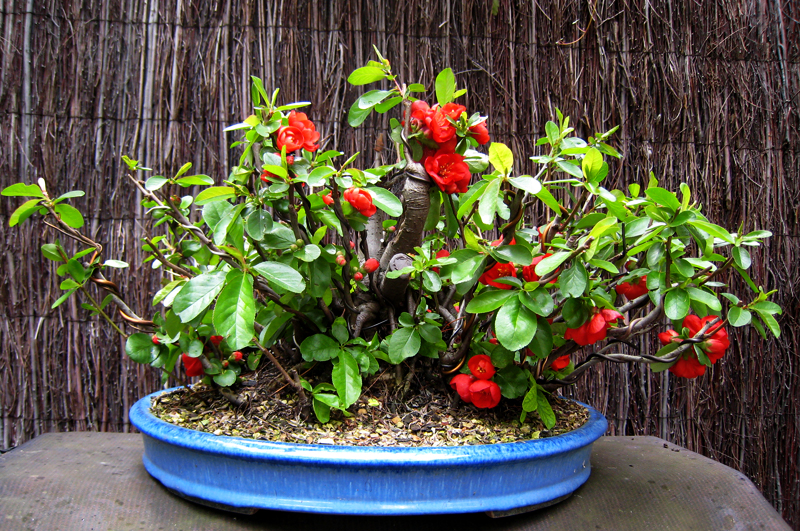
After the clumps first styling

After the clumps first styling

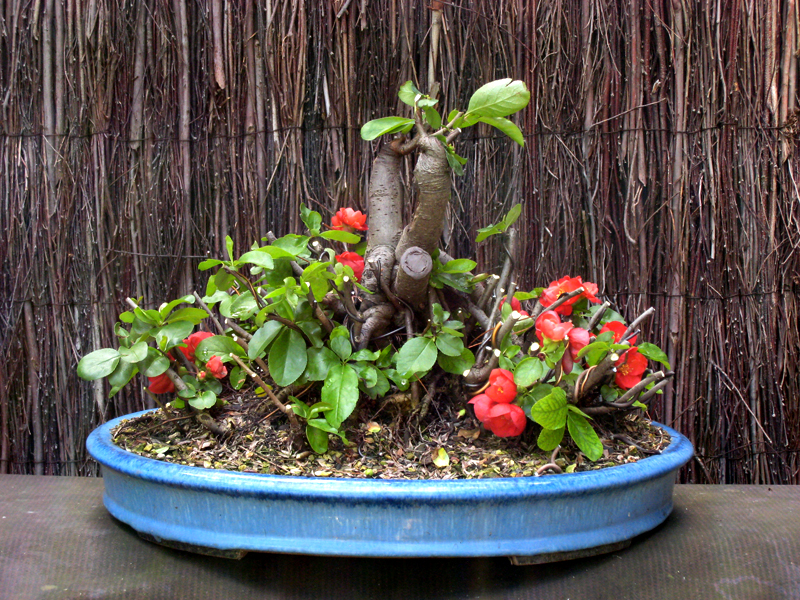
The first budding after styling

The first budding after styling

The beginning of a heavy flowering. (now when i am trying to build branches i cut off flower buds)

The beginning of a heavy flowering the following year. (now when I am trying to build branches I cut off flower buds)

After a hard cutback.

After a hard cutback.

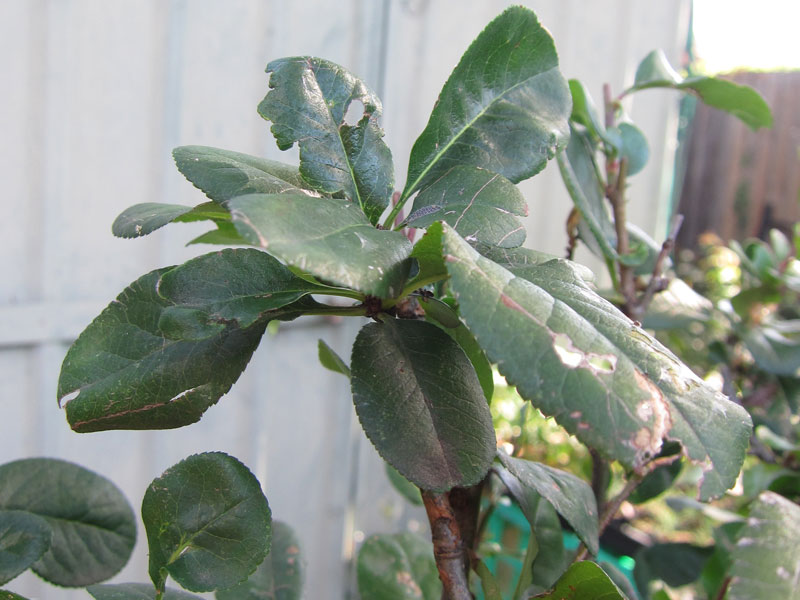
This year I tried what I am calling partial defoliation. It seems to be working much better. The logic as I see it is that by removing most of the photosynthetic surface area but leaving some leaves to continue providing energy you force a budding but keep the tree much stronger than a full defoliation.

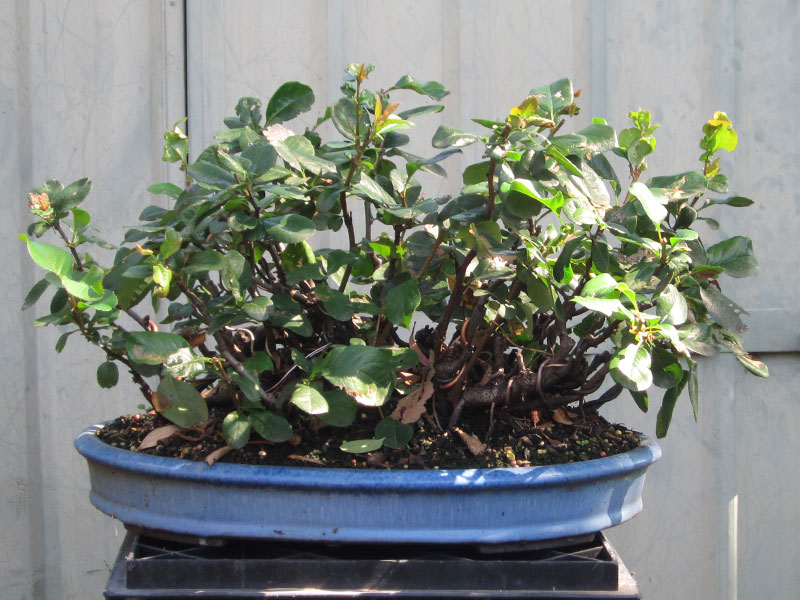
The central trunks became infested with borers so i removed them. This is the quince in full summer leaf.

The central trunks became infested with borers so i removed them. This is the quince in full summer leaf.

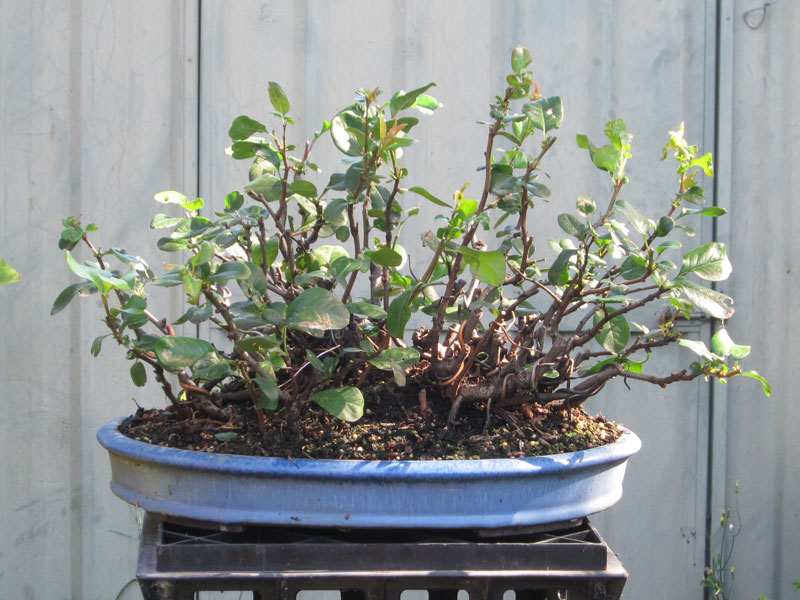
After the partial defoliation

After the partial defoliation

The basic technique is to remove leaves at each clump of growth down to one leaf. This lets a whole lot of light into the inner buds and keeps sap flowing to the remaining leaves. The results are buds bursting nicely back into the inner canopy.

A clump of leaves

A clump of leaves

Leaves reduced

Leaves reduced

Some of the resulting budding

Some of the resulting budding

Some of the resulting budding

Some of the resulting budding

Now this tree is a fair way off being exhibited but hopefully with a few more seasons using this technique I will be able to dramatically increase the amount of ramification in this tree and get it into a much more presentable state.

Sometimes things elsewhere look better than what you might have at your own disposal. This can do two things. One is you can become inspired and in turn try to improve your situation, or you can feel defeated and do nothing and long for what is over the proverbial fence.

In terms of Australian bonsai we sometimes look over our fence (or ocean) and long for the material of Japan or the yamadori of America or Europe. Sometimes this inspires but a lot of the time due to Australia’s strict quarantine laws (making importing near impossible) and the fact that most native collectible material is protected by law it instills a feeling of giving up or accepting second best. Myself, after returning from a trip from Japan, have looked over my collection and felt as if I was so far behind that I might as well sell up and take up stamp collecting when comparing my trees to Japan’s masterpieces and fantastic stock.

I have done my share of moaning and complaining about what is available (or perhaps more importantly not available) but complaining doesn’t solve the problem.

Australia doesn’t have juniper and pines as our native flora and those species we do have that do make good bonsai are often protected from collecting by law. This combined with an import ban on most bonsai species puts the us on the back foot when it comes to yamadori. The best chances we have at material even vaguely similar is digging from gardens.

So where does this leave us? We need to start growing more of our own. Taiwan produces ground grown or farmed junipers that for all intents and purposes look the same as their yamadori counterparts. Japan produces tons of quality raw material in a massive range of species that ensures that there is always a healthy base of material being produced for future excellent bonsai.

Growing material is not difficult, it just takes a little time. Most of this time is best invested early on in a plant’s life when it is young and flexible. 5 minutes to do some root pruning and another 5 minutes to wire the trunk for shape and you have the foundations for something interesting that has the potential to turn into an excellent bonsai.

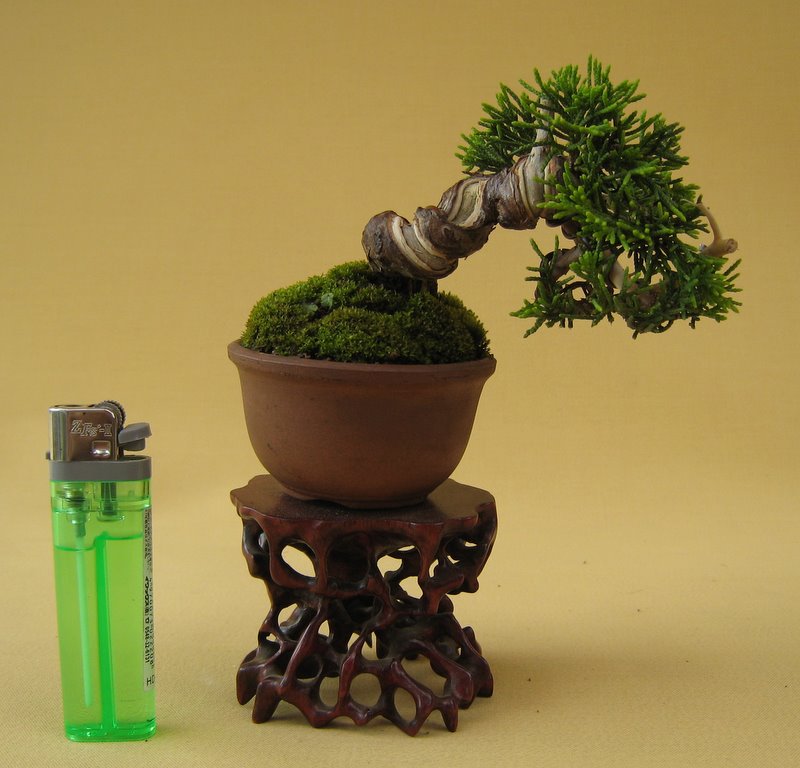
A tiny shimpaku

A tiny shimpaku

The above Juniper came from a grower in Shizuoka. While I was studying at the nursery we went on many stock buying trips and this tree was from one such trip. The grower was not a professional nursery man but rather a home grower. The rooftop over his small garden shed had been turned into a small stock production area. He grew stock and traded it with the nursery for pots and other trees, supplies etc. What surprised me was that this was a guy living minutes away from a nursery that sold stock and trees I could only dream of here in Australia, yet with all this stock at his disposal he still was growing his own, excellent material.

If every grower in Australia, grew 5-10 good stock plants a year we would have so much good stock we wouldn’t know what to do with it all.

This year I have finally decided to stop complaining about the lack of stock and making excuses about my lack of space and have planted 60 Trident maples and 60 Japanese Black Pines as a test batch. For some reason I had been making excuses over the last few years as to why I couldn’t get this process started. My backyard was too small, I didn’t have the time and I wanted to keep my collection at a small size etc.

This year I decided that I could make room in my backyard, the time I needed was not all that much and that I could sell a good percentage of the stock once matured to keep the collections size down and to add some money to the bonsai bank.

I decided that because space in my garden was at a premium, I would grow small bonsai stock. I don’t have a ground growing area so I also had to be able to grow in pots. Growing small-sized bonsai made this an easy proposition.

What I was hoping to achieve was similar to stock i had seen produced in Japan.
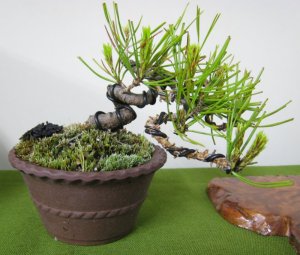
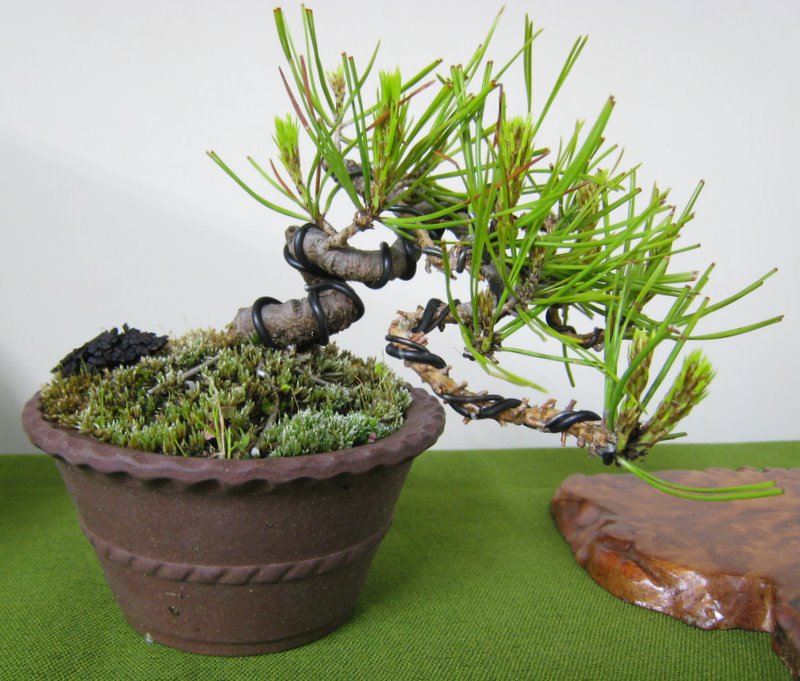
A Pine wired into an interesting shape.

A Pine wired into an interesting shape. I am pretty sure that I can produce stock similar to the above pine from seed in 2-4 years.

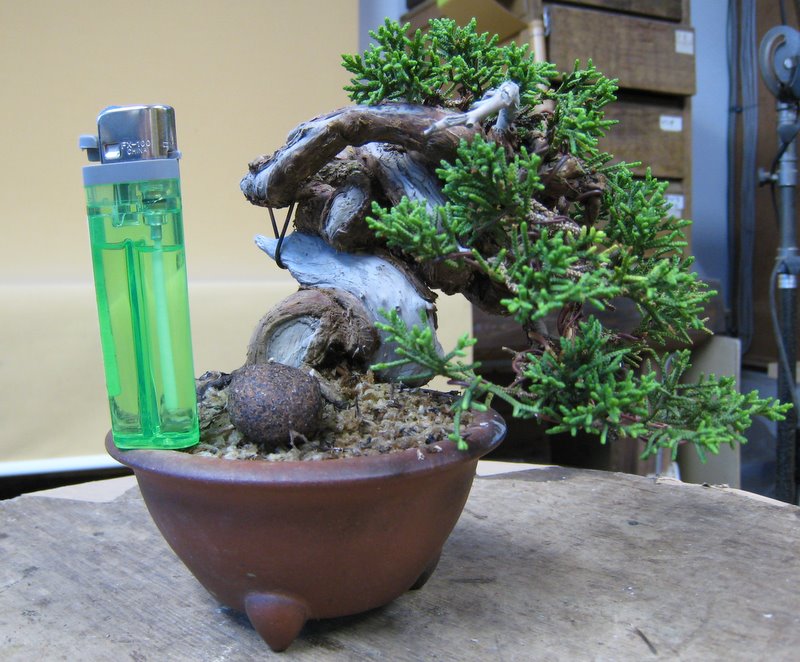
A juniper grown from cutting could save a year or two compared from starting from seed.

A juniper grown from cutting could save a year or two compared from starting from seed. Junipers might be a little slower than some species but they do make very impressive small bonsai and are worthwhile to grow.

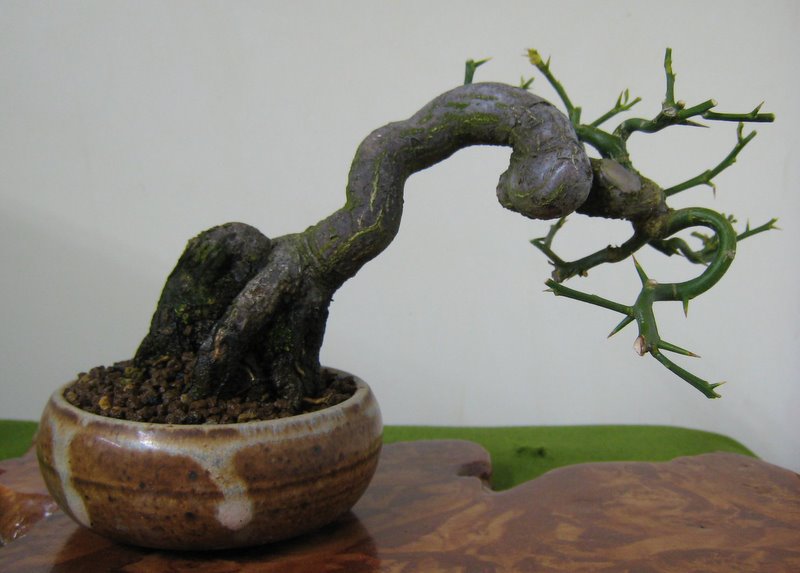
A small kumquat.

A small kumquat. You don’t immediately think of deciduous or leaf species when you imagine twisted bonsai but they also make convincing and interesting choices for this type of bonsai.

Using the above trees as my base inspiration, I decided for my test batch I would grow a mix of half deciduous and half conifer so I had some variation in the final bonsai. As I didn’t have any juniper cuttings, I struck some Japanese Black pine and Trident maple seed and potted them up individually.
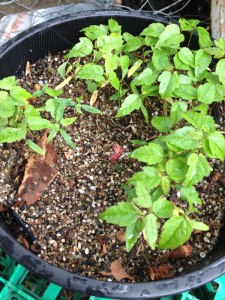
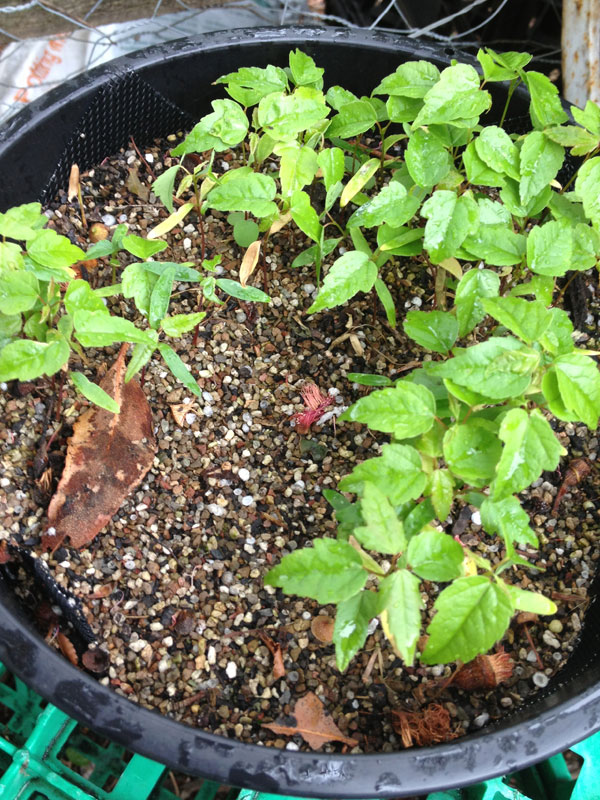
Trident Maple seedlings as germinated.
Trident Maple seedlings as germinated.

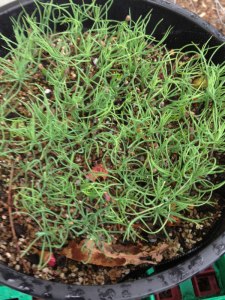
Japanese Black Pine seedlings as germinated.

Japanese Black Pine seedlings as germinated.

The removal of tap roots (encouraging lateral roots).

The removal of tap roots (encouraging lateral roots).

Potted up seedling
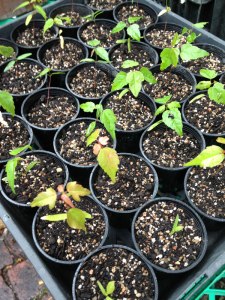
Potted up seedling

A tray of 30 seedlings. These seedlings need to re-establish and put on some growth before wiring.

A tray of 30 seedlings. These seedlings need to re-establish and put on some growth before wiring.

Pretty simple so far. The time spent on each plant to this point ran to the 5 minute mark (a generous estimation). Not a lot of time considering how much time will be invested in the future with watering, pruning and re-potting etc.

After the seedlings have established and put on some growth I got some movement into them.

This should take another couple of minutes per tree. The process is pretty standard really, insert the wire into the soil at about a 45 degree angle until it hits the side/ bottom of the pot. Then wire the trunk making sure that the wire is applied in even coils. Then you simply bend the trunk.
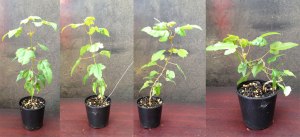
Wiring the seedlings.

Wiring the seedlings.

The bends you put in the trunk should be tight and irregular. As the tree thickens the bends will soften in appearance so over exaggerate the bends at this stage. I try not to think about the final form of the tree at this stage rather I like to combine interesting kinks and twists and make each seedling different to the next. This means that come styling time I will have a range of shapes and styles to play with. I have also found that if you try to create styles at this stage you limit yourself somewhat. The more random you can make the trunks the more natural they seem. The times I have thought about their final form I ended up with many similar trees.

They should now be fed and left to thicken for a year or two. Once the wire cuts in I will un-wire and depending on how the bends have set, I may re-wire again.

Once i have them at pencil to finger thick I will start thinking about creating branching and small canopys. This should ensure that in a few years time I will have a lot of interesting stock to play with.

Hopefully this post inspires a few people to have a go themselves. You don’t need a lot of space, ground or time and the rewards in a few years from such a small investment should be well worth your efforts.
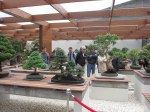
On the 2nd of February 2013, the National Bonsai and Penjing Collection of Australia (NBPCA) opened at the newly custom-built premises within the National Arboretum, Canberra. I was lucky enough to attend the opening but unlucky in that my camera battery failed shortly after arriving.

The NBPCA at its new location really is not just a step forward for Bonsai in Australia but a giant leap. The promotion of Australian bonsai Artists, their work and Australian native bonsai species at such a public location can only help build bonsai momentum around the country. The collection itself consist of around 85 trees on display in a custom-built facility. Over the course of the day the display was packed with visitors which is hopefully a sign of things to come.

Now I could talk about all the merits of the collection and its new building but I guess I will save that for a future post and let the photos do the talking for now. I am only posting a few pics as I recommend that everyone gets down to Canberra and has a look for themselves. It is well worth the visit.

Some of the pics I was able to take prior to the battery going flat are below.

As you may or may not be aware, I have recently undergone surgery on my right wrist. Being right-handed, this has put a fair dent in my bonsai plans of late.

A few nights ago after work I decided to do something about it and tried wiring up a small juniper.

Before the work

Before the work

I have been working on this tree for a few years now, slowly chasing the foliage in closer to the trunk and replacing leggy growth with tighter growth. I decided that it was about due for its first styling so that I could create the bones to grow and fill in the foliage upon.

Considering that my right arm was in a cast I think the wiring went ok. It’s not show ready but it never was going to be. It has a few more years before it is going to be anywhere near presentable.

I really wanted to get some fine sand paper into the bark to reveal the orange / red texture below the outer layers but the cast proved too clumsy. Something to look forward to once the pins from the wrist are removed after the next operation.

The little shimpaku from the front.

The little shimpaku from the front.

I find that when wiring junipers and particularly shimpaku, that preparation is key to a good result. Pruning unwanted growth and thinning what remains so that you end up with an evenly dense canopy not only makes the end result look better but it also makes for more balanced growth and an easier job while wiring.

As seen from the right

As seen from the right

and from the back side

and from the back side

All in all I am pretty happy with the results considering that most of the wiring was done one-handed. I guess it just goes to show that interesting trunk movement is half the battle. That being said, the tree is only just beginning its journey as bonsai and should see many future wirings to come.


This post follows the progression of 6 months in the life of a Procumbens juniper. Last June i did a demonstration for a local club, Bonsai Northwest Inc. As most of my trees had been worked and I had very little left to do on them it was decided that we purchased some stock for the demo. While digging through all the stock at ‘Baloc Bonsai’ I came across this juniper.

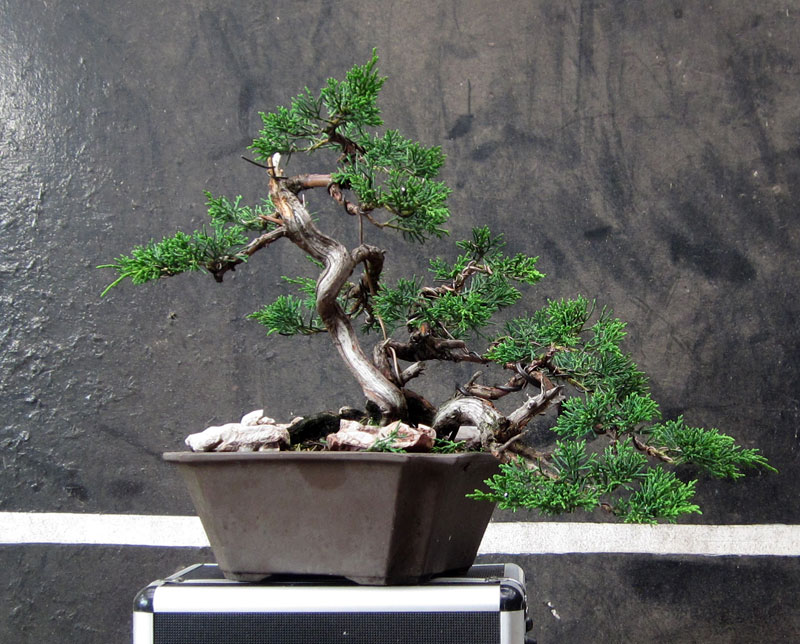
The Juniper before the demonstration

The Juniper before the demonstration but after a bit of a cleanup.

Having looked over the tree for a day or so before hand while it was in my garden I came up with a plan for improvement. From the tree’s original front the foliage mass was not close to the trunk, I thought with  a little work I could compact the foliage mass into a denser crown.

The foliage from the original front.

The foliage from the original front.

I also thought I could change the front and make use of a more interesting trunk and jin line. This plan created a few issues that I had to deal with in order to complete the re-styling. First was the trunk angle. From the original the trunk needed to be stood up around 30 degrees, which in turn placed most of the foliage pointing out towards the back of the tree.

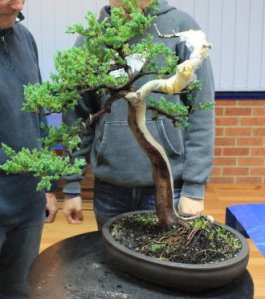
Most of the bending of the larger branches was completed with the help of a bending jack as seen in the photo.

Jack in place prior to bending.

Jack in place prior to bending.

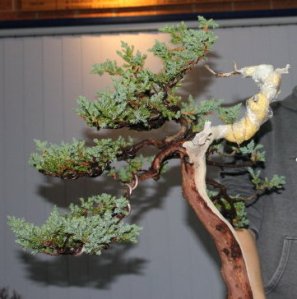
The other issue was that from the new front the jin did not compliment the movement of the tree so this was bent by means of what is essentially steam bending. I wrapped the jin in wet towels and plastic sandwich film over night to moisten the jin and then used a small gas torch to heat up and soften the wood fibres so that it could be bent into a new direction.

After the jin was re-possitioned and main branch bent into possition.

After the jin was repositioned and main branch bent into position.

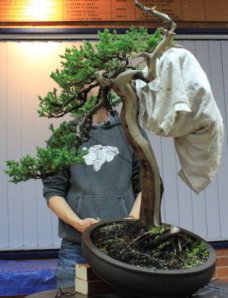
The next step was compacting the foliage to form the crown and subsequaint branches. This was done with a combination of guy-wires and heavy wiring. The below picture shows the result. A small towel covered some branching that was to be removed once the tree had back budded in that area.

The result at the end of the demo.

The result at the end of the demo.

If you look from the original front you can see how the foliage has been moved from its original positions to compliment the new front.

The re-styling from the original front.

The re-styling from the original front.

Since the demo I re-potted the tree into a new container at the new planting angle. It grew out well in early spring with plenty of back-bedding and fresh growth. It was time to work on the foliage.

After some strong spring growth.

After some strong spring growth.

All this new growth provided me with the chance to cut out some of the leggy old growth and replace it with more compact fresh shoots.
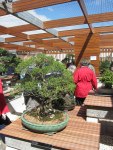
A leggy branch with tired looking foliage.

A leggy branch with tired looking foliage.

The branch cut back so the fresh shoot at its base can replace it.

The branch cut back so the fresh shoot at its base can replace it.

In this way I was able to improve and remove some of the poorer condition and leggy foliage. I cut more out of the strong areas and left a little more in the weaker areas to balance the growth of the tree.

After the cut back.

After the cut back.

I was also able to remove one of the branches on the right side and hopefully in a few months I will be also able to cut back the other right hand branches.
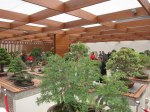
There are a few other thing I want to do, such as lowering the planting position, define the live veins, and work on the shari texture, but for the time being those things can wait.
What the tree desperately needs now is a full wiring, I want to further compact the apex and better form up the crown and branches but unfortunately that will have to wait until my wrist heals. Hopefully I will be able to do it in a few more months.  In the mean time I will keep feeding it heavily and keep replacing old growth with new healthy growth so when it does come time to wire, the tree is ready.

Things have been a little slow on the blog of late. I have been busy with work and have just had a wrist re-construction on my dominant hand. It is slowing me down but I have a bit of time off work now to recover from the surgery so hopefully I can get  a few posts written.

My wrapped up hand.

My wrapped up hand.

As for my bonsai, they havent slowed down a bit.  My new fertiliser regime seems to be working as I have a whole lot of healthy growth.

A well fed pine.

A well fed pine.

The problem this time of the year is finding room to add more fertiliser. Most of my pines have their soil surfaces pretty much covered. I will be starting to replace the older fert bags with new ones in the coming weeks.

With all this feeding I have got strong healthy pines with lots of new growth. All this new growth will be coming off in a few weeks once de-candling time arrives. I am still not sure how this will work one-handed but I should be able to get it done one way or another. I will make sure I have a few pics taken to document the process, in the mean time I will try to get a few things done around the yard and get a few posts uploaded.


One of the other locations Tony took me was Bonsai Northside. Bonsai Northside is one of Brisbane’s local nurseries and they stock a really good range of everything bonsai from starter stock, pots, tools to finished trees. The owner Tess was kind enough to let me take a few pics to share so if you are ever out that way head down and have a look.

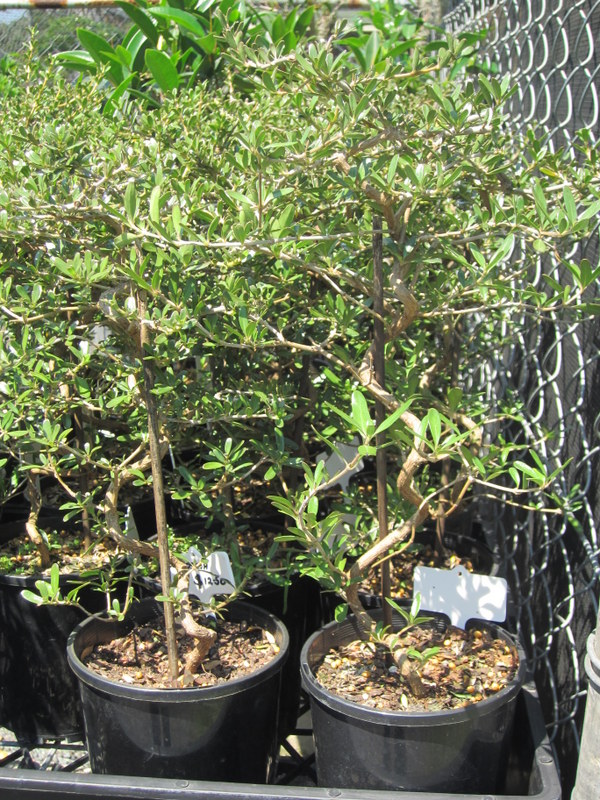
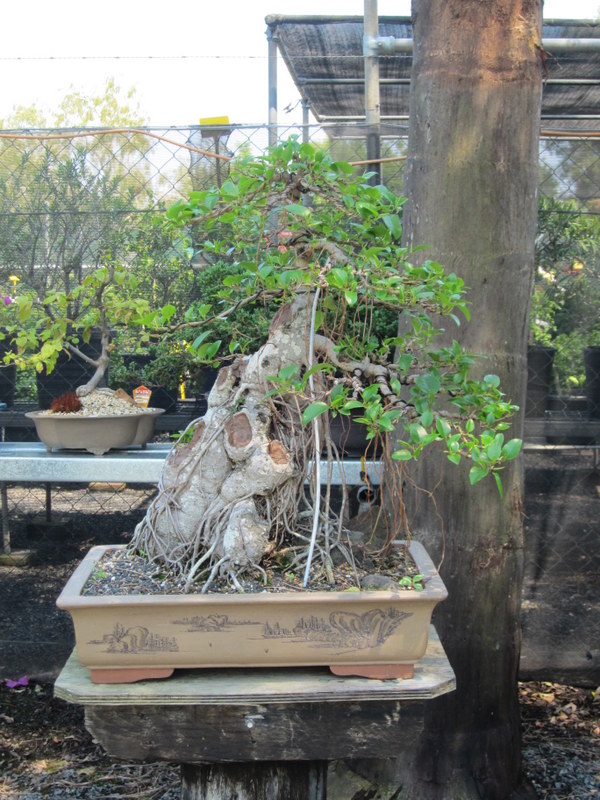
There are some seriously massive Bougainvillea on display as well as some other really nice trees. Not sure if you can get a real idea of the size of some of the trees from the below pics or not though but trust me some were HUGE!

As you can imagine when you grow a large amount of bonsai over a long period of time you come up with many interesting techniques to deal with the changing conditions.

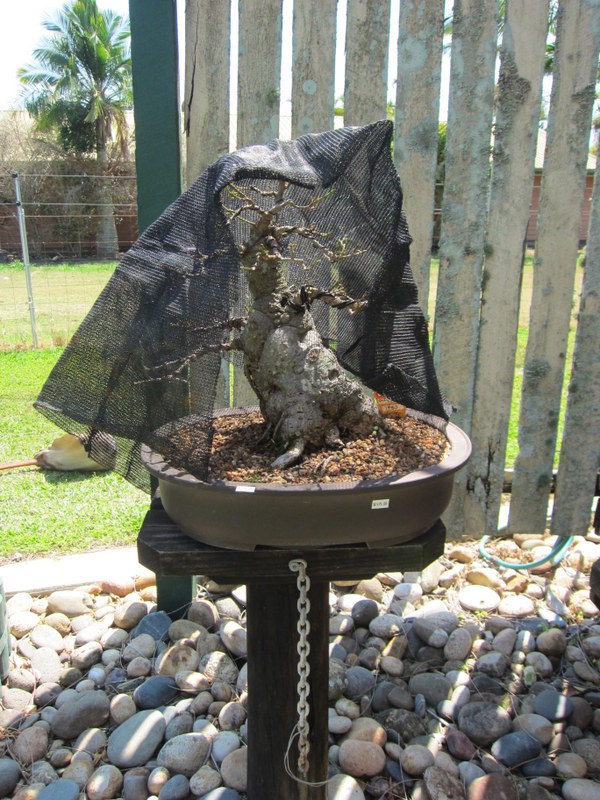
One such technique that seems to be more specific to hotter regions such as Brisbane that the owner, Tess talked about was the shading of fig trunks that have recently been defoliated. Tess showed me a couple of examples of figs that had died back on the trunk after having their trunks exposed to full, hot sun after defoliation. She had come up with a number of ways to shelter freshly defoliated figs from the sun that ranged from moving them to shady areas and or making covers for them such as the one below which I think was made from fly screen. Admittedly i dont grow figs down here in Melbourne but its an interesting technique none the less incase i do decide to grow one. The sun can be very hot down here too and i can see the logic in shading trunk that would otherwise be covered by foliage.

A defoliated fig hiding from the sun.

Bonsai Northside was a great place to visit and chat about bonsai at. One of the nice points of the nursery was just how well-kept and neat the place was which really set of the display trees.

Well worth a visit if you are in the area.

A couple more pics below:

I haven’t been posting much lately as I have been flat-out with work, life and bonsai. The work and life parts are not that interesting to write about but some of the bonsai things are!

Like their beer or not, Queensland is a fun place with some great bonsai and bonsai people!

A couple of weeks ago I was invited by the Bonsai Society of Queensland to conduct some workshops and do a demonstration up in Brisbane. I headed up for a couple of days and was kindly hosted by Tony (have a look at his blog: A Bonsai Journey). Before the demo day he kindly showed me some of the bonsai sights around Brissy.

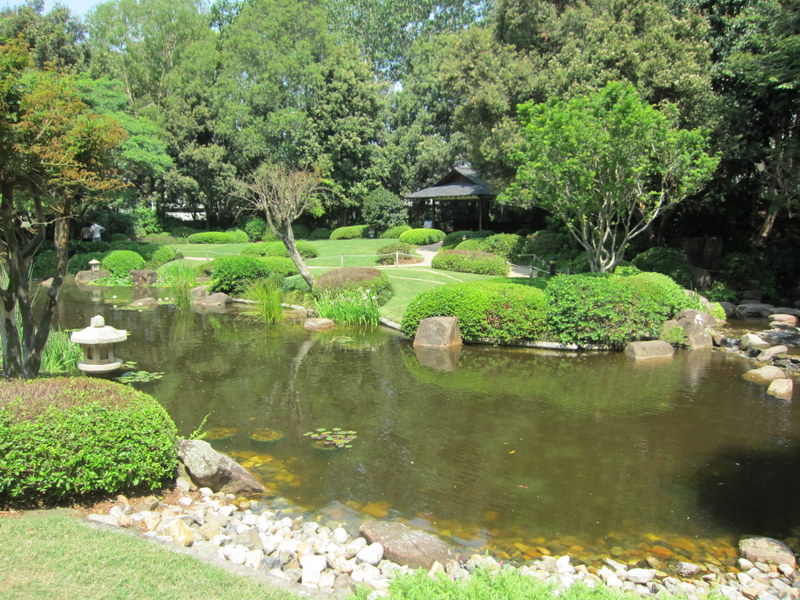
One of the stops was the botanic gardens where they have an exceptional Japanese garden.

The very well maintained Japanese garden

I was surprised at just how ‘Japanese’ this garden looked. If I had seen photos alone I would have guessed it was in Japan. In Australia we have a number of Japanese Gardens but often they are maintained to take on a western look some how. Not the case in Brisbane.

Something you don’t see in every Japanese garden, Water Dragons.

One thing you dont often see in Japanese gardens are Water Dragons. There were hundreds of them. Around every bend you would either find one sun-baking or rustling in the undergrowth.

A view across the lake.

The gardens were built by a Japanese Landscape Architect for the 1988 world Expo and were later moved to this location. An amazing feat because the gardens look as if they have always been there and really fit the surrounding landscape well.

One of the only pines in the garden.

Probably the only hint that this garden was not in Japan was the pines. They were a little under manicured compared to most of those I have seen in Japan.

Another view across the lake.

Once we had strolled through the garden the real destination of our visit revealed itself, the bonsai collection.

Under construction.

Unfortunately the bonsai collection was undergoing some renovations when we arrived so we had to sneak to the back of house area for a peak at the collection of bonsai.

All locked up.

A shot through the fence.

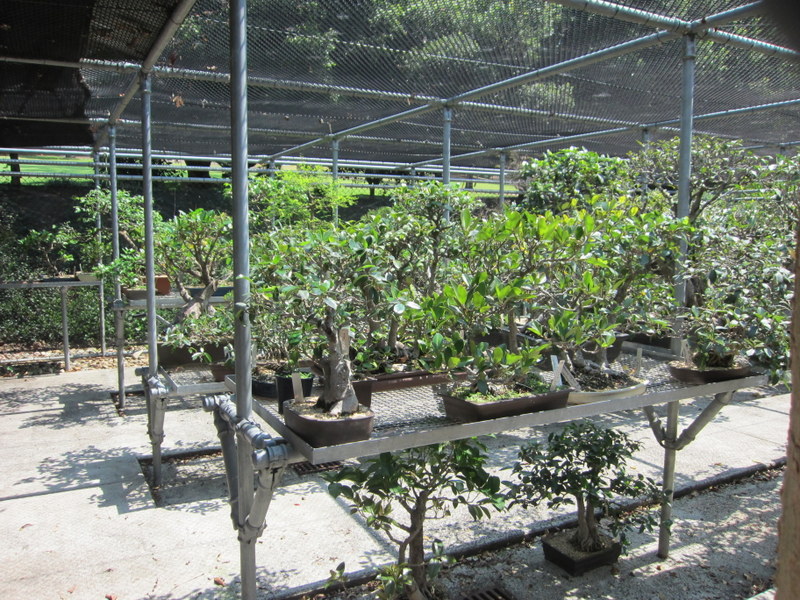
Unfortunately the collection was well locked up which prevented us from doing much more than looking through the cyclone fencing. The collection consisted mainly of old figs that perhaps could have done with a little of the maintenance that the garden next door received.  Hopefully the renovation of the collection building will generate some new interest in the bonsai which may get them some more love so that they really shine against the new walls.

I look forward to visiting again some time in the future and seeing how they look against the revamped building.

For anyone traveling through Brisbane the botanic gardens are well worth a look. The Japanese Garden is fantastic and once the bonsai house is finished the collection will also be worth a visit, not to mention the Water Dragons and rest of the gardens.


I have slowly been trying to get all my trees into good quality pots. By good quality I mean Japanese, old chinese and or hand-made western potters pots.

When I started bonsai I couldn’t see the point of spending money on good pots. Australia is flooded with cheap pots that are made out of China and I couldn’t see why you would bother spending 3, 4, 5 or more times what a cheap chinese pot cost on a Japanese or other container.  I would much rather have spent the money on trees or tools. After all pot is a pot right? Not really, not all pots are created equal.

Take the two pots below. The first is a cheap Chinese pot i picked up a month or so ago. I needed a pot for a pine i was re-potting and didn’t have time to get anything of better quality. So I went to a local nursery that had a good range of cheap pots. Below is the pot I used. As you can see, after only a months use it is already weeping white ‘stuff’ from the clay.

A Cheap Chinese pot

If you compare it to a Japanese production pot such as the one below you will see that there is no issues with white ‘stuff’ on the Japanese one. These two pots are beside one another on the bench and both have Japanese black pines in them. If the white deposit was from the water I use it would be on all my pots but this cheap chinese pot is the only one showing these signs. What is most worrying is that this white stuff began weeping out of the pot during the first week of use. If it is on the outside of the pot I am sure it is also weeping through on the inside as well.

A production Japanese pot.

I talked to an importer at a local show about this issue. His family run pottery kilns in China and he imports their pots. He said there was a range of quality coming out of China at the moment. The best stuff goes to Japan and the rest goes to Europe, America and here. He said that to make the pots cheaper things are added to the clays to make them go further and reduce costs. Now im not a chemist, but……. I believe it’s these additives or impurities that you can see weeping out of the pot surface above.  The white deposit is definitely not something I want to see on my pots that is for sure.

But when it comes to pots, materials are only the beginning of the differences. There are many differences that in my mind make using better quality pots well worth while. Now I am not saying that every cheap or Chinese pot will give you issues. I have a few cheaper Chinese pots that I like a lot but there are definitely a lot of bad, poorly made pots out amongst the few good cheap ones.

Hopefully in the next couple of posts I can begin to show some of the other differences that make quality win out over a cheap price. It has taken me a while to appreciate good pots and hopefully I can share some of the things I have learnt along the way.

Balance of growth and strength is a concept that should be applied to all your bonsai. Weakness should be supported and strength should be held back to result in an even growth pattern across your trees. Maintaining balance ensures that inner buds survive and that exterior growth does not get to course. It’s what I think is one of the most important factors to take into account when growing bonsai.

What I have been noticing lately in my garden is that a few trees are out of balance. Pines readily let you know areas that are strong or weak. During spring, candles that grow long are strong, and those that remain short are weak. Pretty simple. In my gardens case, I have re-potted most of my pines this year and some trees are reacting differently to others.

Strong growth

The bonsai above has started to extend its candles. They are about 50mm long and are beginning to form their needles.

Weaker growth.

The second picture taken on the same day of a tree beside the first shows the much weaker growth. there are some healthy candles but overall this tree is much weaker than the first. The candles are extending very slowly and the needles have not yet started to form.

Although both trees have a couple more months of growth before de-candling time, i have found that often the early growth is a good sign of the state of the tree and rarely do weak candles become strong enough to de-candle over the course of the spring.

What does this mean? Well identifying balance issues between trees can help you decide wether or not you will do certain task to particular trees or not.

For example, this year I will de-candle the first tree while leaving the second to grow freely and build up strength.  By identifying overall strength this will allow you to identify weak trees and exclude them from stressful techniques such as de-candling, styling etc. that may further weaken the tree and or even kill it.

So go out and have a look over your trees, look for areas of in-balance and look for trees that are not as healthy as the others. That way when you apply techniques across your collection this season you can be sure that you will be furthering their developement rather than hindering it.

Enter your email address to subscribe to this blog and receive notifications of new posts by email.

Join 678 other subscribers

Contact me

nichigobonsai***gmail.com

Note: to use email address, substitute *** with @