This post follows the progression of 6 months in the life of a Procumbens juniper. Last June i did a demonstration for a local club, Bonsai Northwest Inc. As most of my trees had been worked and I had very little left to do on them it was decided that we purchased some stock for the demo. While digging through all the stock at ‘Baloc Bonsai’ I came across this juniper.
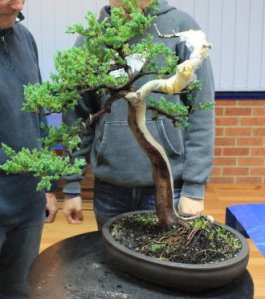
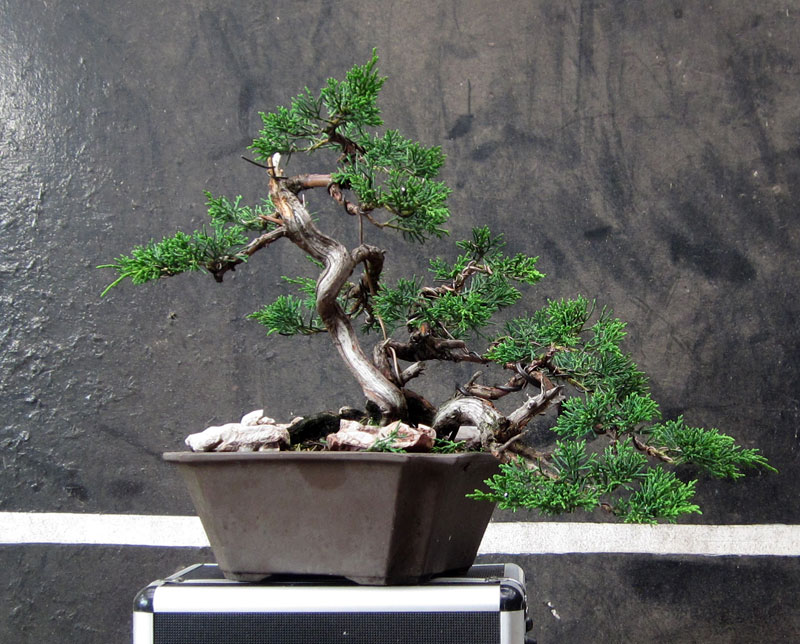
The Juniper before the demonstration

The Juniper before the demonstration but after a bit of a cleanup.

Having looked over the tree for a day or so before hand while it was in my garden I came up with a plan for improvement. From the tree’s original front the foliage mass was not close to the trunk, I thought with  a little work I could compact the foliage mass into a denser crown.
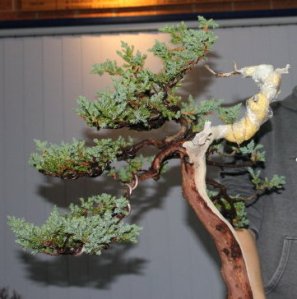
The foliage from the original front.

The foliage from the original front.

I also thought I could change the front and make use of a more interesting trunk and jin line. This plan created a few issues that I had to deal with in order to complete the re-styling. First was the trunk angle. From the original the trunk needed to be stood up around 30 degrees, which in turn placed most of the foliage pointing out towards the back of the tree.

Most of the bending of the larger branches was completed with the help of a bending jack as seen in the photo.

Jack in place prior to bending.

Jack in place prior to bending.

The other issue was that from the new front the jin did not compliment the movement of the tree so this was bent by means of what is essentially steam bending. I wrapped the jin in wet towels and plastic sandwich film over night to moisten the jin and then used a small gas torch to heat up and soften the wood fibres so that it could be bent into a new direction.

After the jin was re-possitioned and main branch bent into possition.

After the jin was repositioned and main branch bent into position.

The next step was compacting the foliage to form the crown and subsequaint branches. This was done with a combination of guy-wires and heavy wiring. The below picture shows the result. A small towel covered some branching that was to be removed once the tree had back budded in that area.
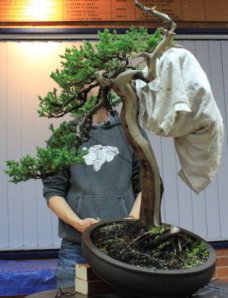
The result at the end of the demo.

The result at the end of the demo.

If you look from the original front you can see how the foliage has been moved from its original positions to compliment the new front.

The re-styling from the original front.

The re-styling from the original front.

Since the demo I re-potted the tree into a new container at the new planting angle. It grew out well in early spring with plenty of back-bedding and fresh growth. It was time to work on the foliage.

After some strong spring growth.

After some strong spring growth.

All this new growth provided me with the chance to cut out some of the leggy old growth and replace it with more compact fresh shoots.

A leggy branch with tired looking foliage.
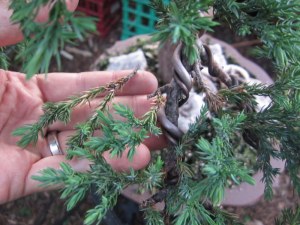
A leggy branch with tired looking foliage.

The branch cut back so the fresh shoot at its base can replace it.

The branch cut back so the fresh shoot at its base can replace it.

In this way I was able to improve and remove some of the poorer condition and leggy foliage. I cut more out of the strong areas and left a little more in the weaker areas to balance the growth of the tree.
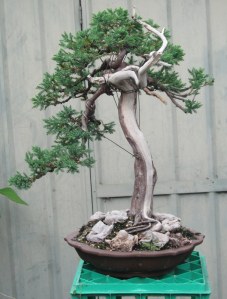
After the cut back.

After the cut back.

I was also able to remove one of the branches on the right side and hopefully in a few months I will be also able to cut back the other right hand branches.

There are a few other thing I want to do, such as lowering the planting position, define the live veins, and work on the shari texture, but for the time being those things can wait.

What the tree desperately needs now is a full wiring, I want to further compact the apex and better form up the crown and branches but unfortunately that will have to wait until my wrist heals. Hopefully I will be able to do it in a few more months.  In the mean time I will keep feeding it heavily and keep replacing old growth with new healthy growth so when it does come time to wire, the tree is ready.
Things have been a little slow on the blog of late. I have been busy with work and have just had a wrist re-construction on my dominant hand. It is slowing me down but I have a bit of time off work now to recover from the surgery so hopefully I can get  a few posts written.

My wrapped up hand.

My wrapped up hand.

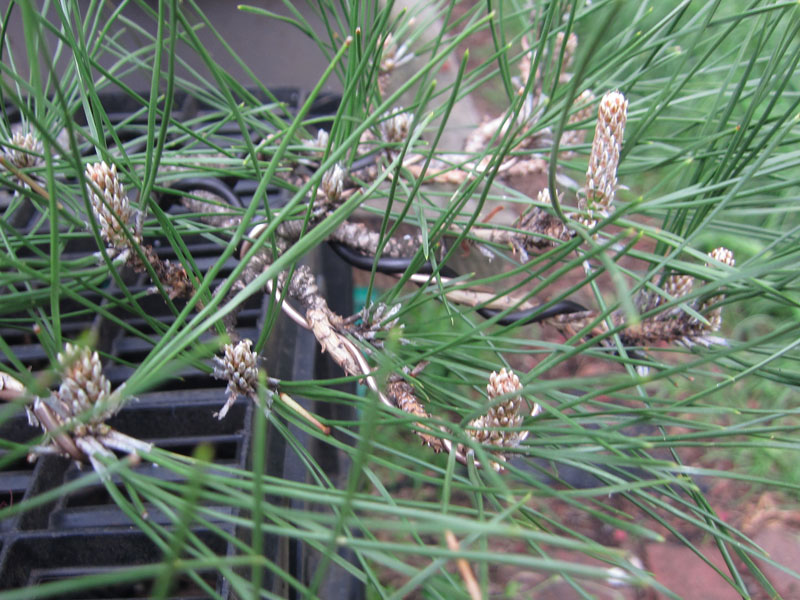
As for my bonsai, they havent slowed down a bit.  My new fertiliser regime seems to be working as I have a whole lot of healthy growth.

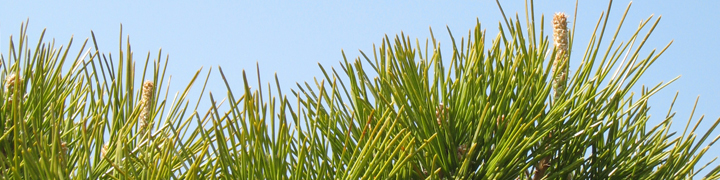
A well fed pine.

A well fed pine.

The problem this time of the year is finding room to add more fertiliser. Most of my pines have their soil surfaces pretty much covered. I will be starting to replace the older fert bags with new ones in the coming weeks.

With all this feeding I have got strong healthy pines with lots of new growth. All this new growth will be coming off in a few weeks once de-candling time arrives. I am still not sure how this will work one-handed but I should be able to get it done one way or another. I will make sure I have a few pics taken to document the process, in the mean time I will try to get a few things done around the yard and get a few posts uploaded.


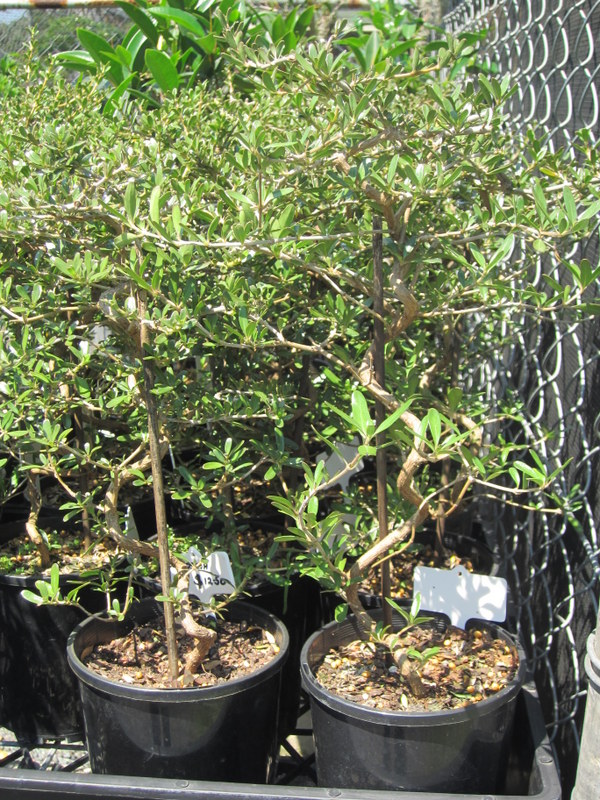
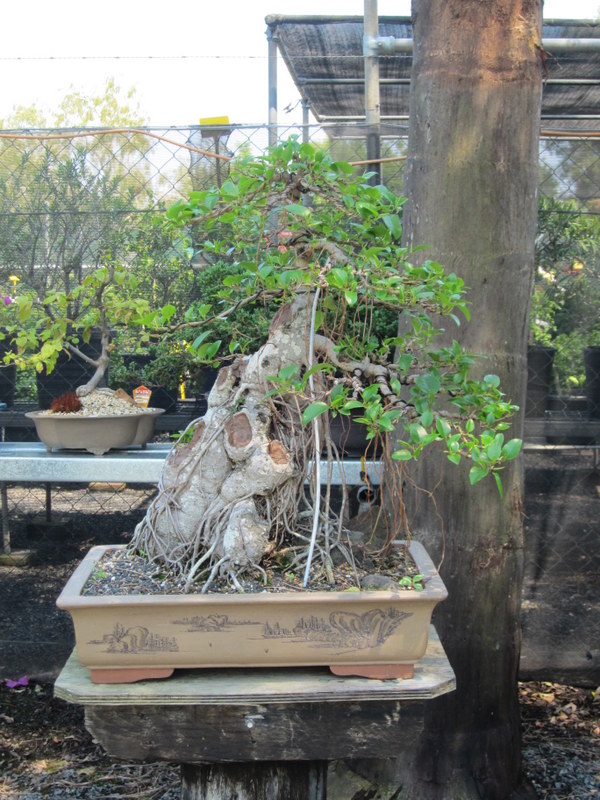
One of the other locations Tony took me was Bonsai Northside. Bonsai Northside is one of Brisbane’s local nurseries and they stock a really good range of everything bonsai from starter stock, pots, tools to finished trees. The owner Tess was kind enough to let me take a few pics to share so if you are ever out that way head down and have a look.

There are some seriously massive Bougainvillea on display as well as some other really nice trees. Not sure if you can get a real idea of the size of some of the trees from the below pics or not though but trust me some were HUGE!

As you can imagine when you grow a large amount of bonsai over a long period of time you come up with many interesting techniques to deal with the changing conditions.

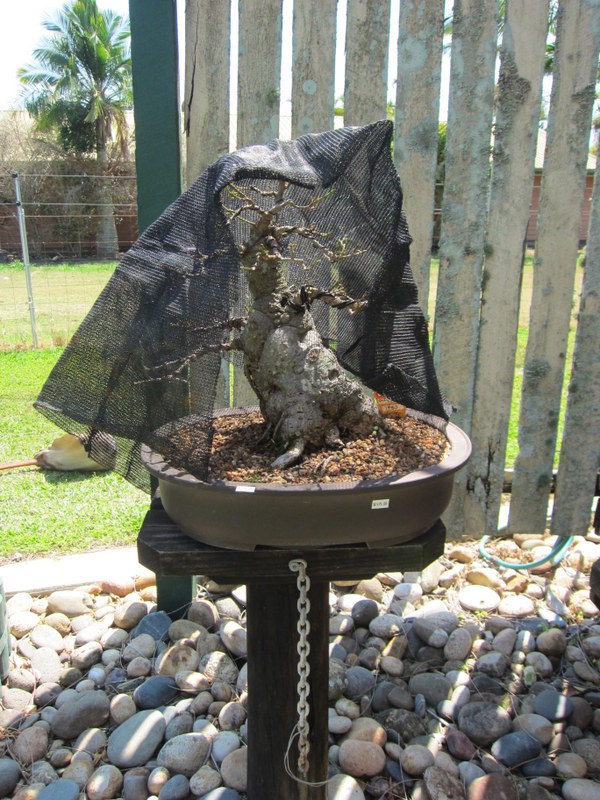
One such technique that seems to be more specific to hotter regions such as Brisbane that the owner, Tess talked about was the shading of fig trunks that have recently been defoliated. Tess showed me a couple of examples of figs that had died back on the trunk after having their trunks exposed to full, hot sun after defoliation. She had come up with a number of ways to shelter freshly defoliated figs from the sun that ranged from moving them to shady areas and or making covers for them such as the one below which I think was made from fly screen. Admittedly i dont grow figs down here in Melbourne but its an interesting technique none the less incase i do decide to grow one. The sun can be very hot down here too and i can see the logic in shading trunk that would otherwise be covered by foliage.

A defoliated fig hiding from the sun.

Bonsai Northside was a great place to visit and chat about bonsai at. One of the nice points of the nursery was just how well-kept and neat the place was which really set of the display trees.

Well worth a visit if you are in the area.

A couple more pics below:

I haven’t been posting much lately as I have been flat-out with work, life and bonsai. The work and life parts are not that interesting to write about but some of the bonsai things are!

Like their beer or not, Queensland is a fun place with some great bonsai and bonsai people!

A couple of weeks ago I was invited by the Bonsai Society of Queensland to conduct some workshops and do a demonstration up in Brisbane. I headed up for a couple of days and was kindly hosted by Tony (have a look at his blog: A Bonsai Journey). Before the demo day he kindly showed me some of the bonsai sights around Brissy.

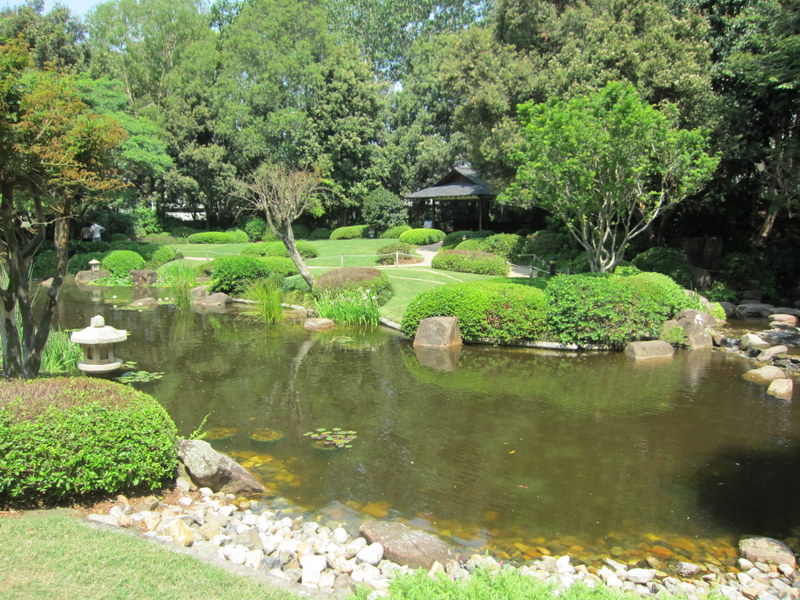
One of the stops was the botanic gardens where they have an exceptional Japanese garden.

The very well maintained Japanese garden

I was surprised at just how ‘Japanese’ this garden looked. If I had seen photos alone I would have guessed it was in Japan. In Australia we have a number of Japanese Gardens but often they are maintained to take on a western look some how. Not the case in Brisbane.

Something you don’t see in every Japanese garden, Water Dragons.

One thing you dont often see in Japanese gardens are Water Dragons. There were hundreds of them. Around every bend you would either find one sun-baking or rustling in the undergrowth.

A view across the lake.

The gardens were built by a Japanese Landscape Architect for the 1988 world Expo and were later moved to this location. An amazing feat because the gardens look as if they have always been there and really fit the surrounding landscape well.

One of the only pines in the garden.

Probably the only hint that this garden was not in Japan was the pines. They were a little under manicured compared to most of those I have seen in Japan.

Another view across the lake.

Once we had strolled through the garden the real destination of our visit revealed itself, the bonsai collection.

Under construction.

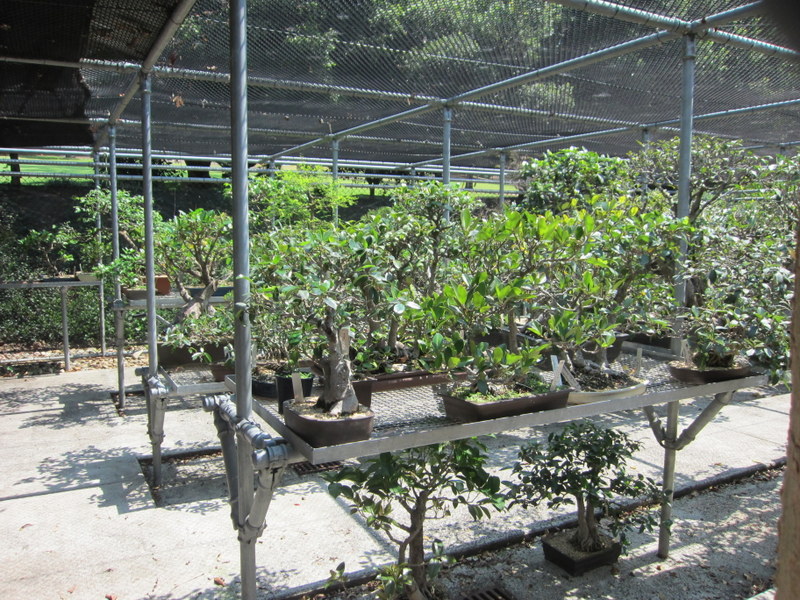
Unfortunately the bonsai collection was undergoing some renovations when we arrived so we had to sneak to the back of house area for a peak at the collection of bonsai.

All locked up.

A shot through the fence.

Unfortunately the collection was well locked up which prevented us from doing much more than looking through the cyclone fencing. The collection consisted mainly of old figs that perhaps could have done with a little of the maintenance that the garden next door received.  Hopefully the renovation of the collection building will generate some new interest in the bonsai which may get them some more love so that they really shine against the new walls.

I look forward to visiting again some time in the future and seeing how they look against the revamped building.

For anyone traveling through Brisbane the botanic gardens are well worth a look. The Japanese Garden is fantastic and once the bonsai house is finished the collection will also be worth a visit, not to mention the Water Dragons and rest of the gardens.


I have slowly been trying to get all my trees into good quality pots. By good quality I mean Japanese, old chinese and or hand-made western potters pots.

When I started bonsai I couldn’t see the point of spending money on good pots. Australia is flooded with cheap pots that are made out of China and I couldn’t see why you would bother spending 3, 4, 5 or more times what a cheap chinese pot cost on a Japanese or other container.  I would much rather have spent the money on trees or tools. After all pot is a pot right? Not really, not all pots are created equal.

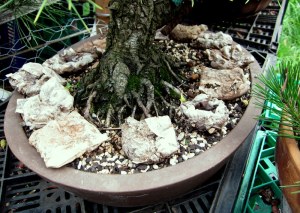
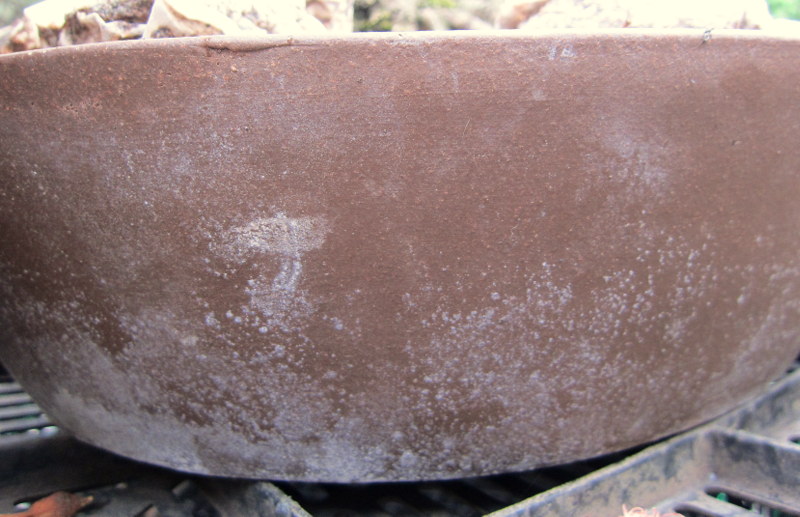
Take the two pots below. The first is a cheap Chinese pot i picked up a month or so ago. I needed a pot for a pine i was re-potting and didn’t have time to get anything of better quality. So I went to a local nursery that had a good range of cheap pots. Below is the pot I used. As you can see, after only a months use it is already weeping white ‘stuff’ from the clay.

A Cheap Chinese pot

If you compare it to a Japanese production pot such as the one below you will see that there is no issues with white ‘stuff’ on the Japanese one. These two pots are beside one another on the bench and both have Japanese black pines in them. If the white deposit was from the water I use it would be on all my pots but this cheap chinese pot is the only one showing these signs. What is most worrying is that this white stuff began weeping out of the pot during the first week of use. If it is on the outside of the pot I am sure it is also weeping through on the inside as well.

A production Japanese pot.

I talked to an importer at a local show about this issue. His family run pottery kilns in China and he imports their pots. He said there was a range of quality coming out of China at the moment. The best stuff goes to Japan and the rest goes to Europe, America and here. He said that to make the pots cheaper things are added to the clays to make them go further and reduce costs. Now im not a chemist, but……. I believe it’s these additives or impurities that you can see weeping out of the pot surface above.  The white deposit is definitely not something I want to see on my pots that is for sure.

But when it comes to pots, materials are only the beginning of the differences. There are many differences that in my mind make using better quality pots well worth while. Now I am not saying that every cheap or Chinese pot will give you issues. I have a few cheaper Chinese pots that I like a lot but there are definitely a lot of bad, poorly made pots out amongst the few good cheap ones.

Hopefully in the next couple of posts I can begin to show some of the other differences that make quality win out over a cheap price. It has taken me a while to appreciate good pots and hopefully I can share some of the things I have learnt along the way.

Balance of growth and strength is a concept that should be applied to all your bonsai. Weakness should be supported and strength should be held back to result in an even growth pattern across your trees. Maintaining balance ensures that inner buds survive and that exterior growth does not get to course. It’s what I think is one of the most important factors to take into account when growing bonsai.

What I have been noticing lately in my garden is that a few trees are out of balance. Pines readily let you know areas that are strong or weak. During spring, candles that grow long are strong, and those that remain short are weak. Pretty simple. In my gardens case, I have re-potted most of my pines this year and some trees are reacting differently to others.

Strong growth

The bonsai above has started to extend its candles. They are about 50mm long and are beginning to form their needles.

Weaker growth.

The second picture taken on the same day of a tree beside the first shows the much weaker growth. there are some healthy candles but overall this tree is much weaker than the first. The candles are extending very slowly and the needles have not yet started to form.

Although both trees have a couple more months of growth before de-candling time, i have found that often the early growth is a good sign of the state of the tree and rarely do weak candles become strong enough to de-candle over the course of the spring.

What does this mean? Well identifying balance issues between trees can help you decide wether or not you will do certain task to particular trees or not.

For example, this year I will de-candle the first tree while leaving the second to grow freely and build up strength.  By identifying overall strength this will allow you to identify weak trees and exclude them from stressful techniques such as de-candling, styling etc. that may further weaken the tree and or even kill it.

So go out and have a look over your trees, look for areas of in-balance and look for trees that are not as healthy as the others. That way when you apply techniques across your collection this season you can be sure that you will be furthering their developement rather than hindering it.

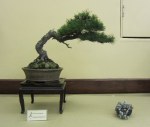
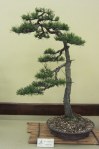
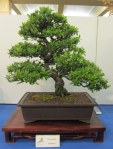
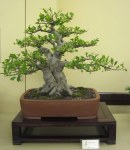
Just a quick post with some pictures from this years Bonsai Society Victoria show. Unfortunately the lighting was hard to take photos under so only a select few of my pics were good enough to upload. I will have to try to remember to bring a tripod next year.  Anyway, i hope you enjoy the trees.

It’s spring in my garden and I am enjoying watching my trees wake up from their winters rest.

One thing that I noticed was that I seem to have two distinct types of trident maple in my yard.

Left: Red new growth. Right: Green new growth.

The above photo shows the differences nicely. Some of my trees leaf out with red new growth that slowly goes green, where as the other tridents new growth is green from the start.

The trees with red new growth tend to form better ramification as a rule where as the green new growth trees it is a bit more course and they are less likely to form fine growth. I know another local grower, Neil of Shibui bonsai has had made similar observations. He was saying that the red growth trees formed good ramification where as the green growth trees trunks and roots tended to be better.

Does anyone have any experiences similar to this? I am pretty sure they are from the same seed source but I guess they could be from different places? Maybe just seed variation?

Is this a common observation across the globe? I would be keen to hear people’s thoughts. Please comment below.

Most years i make fertiliser cakes from a range of ingredients (usually what is cheap or on special when it comes time to buy them) although the cakes that I have previously made have never really lived up to expectations.

For those that have used the fertiliser cakes in Japan I am sure you would have noticed an interesting thing. When the cakes have been on the soil surface for a few days they begin to get a white felt like mould on the underside and begin to omit a pleasant fermenting kind of smell.  When I worked with Mario Komsta, he always got excited when he saw this mould as it was a sign the cake was breaking down and feeding the bonsai.

The cakes I have been using here in Australia have never got the mould that those in Japan got. I put this down to a couple of things. Firstly climate. Japan gets a whole lot of rain over their summer where as here in Australia we are usually hot and dry for most of the summer. The problem I was having with my cakes was that they were drying out and were then hard to re-wet and get them breaking down again. Japan was always so humid over summer that the cakes once wet stayed moist and were able to break down.

To try to combat that this year I am trying using my ingredients loose inside tea bags. The idea is that they will be much easier to re-wet each watering and hopefully break down much more quickly and hence feed my trees better.

Tea bags, for making your own tea blend bags and a pair of scissors I need to re-profile.

I found a cheap supplier of tea bags in the form of a Japanese 100yen shop called ‘Daiso’ which has just opened a couple of stores in Melbourne. $2.80 for 100 bags.

The mix I am using this year is fairly basic:

  • Cottonseed meal – 5 part
  • Blood and bone meal (including trace elements) – 5 part
  • garden lime – 1 parts.

Filled bags.

The process of making the fertiliser bags is fairly easy and mess free. I fill the bags with a large spoon full of my mix and fold the bag shut. The cakes are now pretty much ready to go on the trees,  but I do one more step prior to putting them on my bonsai.

Soaking in fish emulsion.

I soak the filled bags in a fish emulsion solution to fully wet the ingredients and add a bit of extra fish emulsion kick to them.

Bags on the bonsai.

Once on the soil I like to place a small dimple in the top of the bag/mix so that every time I water, a small amount of water pools on the surface of the fertiliser and helps to re-wet it.

Now it’s not the most attractive solution but it does have a few extra benefits out side of easy re-wetting. Firstly because all the ingredients are contained in the tea bag this stops a lot of the loose material clogging up the soil surface and hindering drainage. Then they are also very easy to remove and replace at de-candling time which is also a plus in my book. Possibly the biggest side benifit is there is no smell while making the cakes using this method, and no smell means no complaining neighbors and stinky backyard. Also not having to dry cakes means you can make them early in the season before the weather heats up to drying temps.

I look forward to seeing if i get the white mould and the working fertiliser smell……. fingers crossed!


As I managed to get some time to work on my trees this last weekend,  I though it was a good opportunity to do some grafting before my black pines woke up too much. I like to do grafting on black pines just before they start moving in spring. For bud grafting this is important as once the sap starts to move in a big way any cuts made to hold grafts tend to flood with sap before placing the scion which makes them a little less successful. Approach grafts on the other hand are a little more forgiving but if I can I try to do them around the same time so that the burst of energy that comes with the first flush of candles extending goes into healing the graft site.

The graft site will be at the base of the thick bare section of trunk.

I have decided to graft this tree as it has a rather large bare section of trunk. If I can graft a new leader to the base of this I can build a much smaller and more compact tree with the new graft’s growth. Obviously this will be a longer term project but I figure why go down a long road just to end up at a mediocre tree. If this graft takes and the tree develops as I imagine it will be a far greater result in the future than had I just persevered with the existing structure.

The start of the process, a cut in the trunk.

The first step is to create a cut for the graft branch to sit inside. I like to make the cut about 1/4 smaller than the branch that is going to be inserted into it. I start by making the cut with a small saw. I try to make the cut so that it is wider at the rear of the cut than at the front edge. usually this takes two cuts, one slightly slanted upwards and a second slightly downwards. This flared cut will help the scion branch to lock into the cut.

Once I have made the first pass with the saw I clean up the cut with a knife so that I have clean and neat surfaces upon which the graft can be placed.

Some bark removed from the graft branch.

Next I remove a small slither of bark from either side of the scion branch. Make sure that you check where to make these cuts prior to getting the knife out as it is important that these cut surfaces line up with the cut surfaces you made with the saw. I usually find that the knife cute that clean up the saw cuts combined with the cuts on the scion branch tend to eliminate the 1/4 under size that was initially cut with the saw.

The graft made.

The Scion branch can now be inserted into the cut in the trunk. The fit should be snug and tight. Small adjustments might be needed to be made to the channel in the trunk to make sure things are all snug. If the channel is on the large side it is best to chock the scion branch so that it contacts firmly with the lower surface of the channel cut. (I use small twigs as chocks.) As sap runs from the roots up, contacting the lower surface will ensure that the graft has a better chance of taking than had it only contacted the upper surface. Either way, the scion should be firmly touching at least one cut surface on the channel in the trunk.

Sealed and held tightly in place.

Finally you simply seal the graft union and hold the scion firmly in place so that it cannot move and disturb the graft before it has had a chance to take.

The speed at which the graft takes will depend on the amount of growth you allow to occur on the scion branch and above the graft site. Obviously the more the trunk and scion branch grow and expand the more chance the graft has of taking. I would hazard a guess that this graft will be taken by the end of this coming seasons growth. Having said that I will probably cut off the growth above it in stages so it may be two seasons before I actually sever the scion branch from its original source.

Enter your email address to subscribe to this blog and receive notifications of new posts by email.

Join 688 other subscribers

Contact me

nichigobonsai***gmail.com

Note: to use email address, substitute *** with @