You are currently browsing the tag archive for the ‘Styling’ tag.
Both my bonsai and personal life have been busy of late. I am fortunate that this year I have been invited to demonstrate and run workshops across Australia for local club, groups and the AABC National Convention. On top of this travel I just begun winter styling of clients trees. It looks like I will have a fairly full book of client trees, workshops and demonstrations that combined with a young child, a house half way through renovations and a full-time job doesn’t leave a lot of time to work my own collections.
Today’s post is actually about a tree I worked on a year ago whilst in japan.
It was a small shimpaku juniper that Oyakata asked me to wire and style prior to taking it to auction the following day to be sold.

Prior to the work
I initially wanted to tilt the tree to the right so that the first bend would come in contact with the soil giving the appearance of a much larger trunk but Oyakata didn’t want to re-pot as the auction was so close and as a result we utilised the existing angle and front.
It turned out to be a fairly straight forward re-style and Oyakata told me it sold well at the auction.
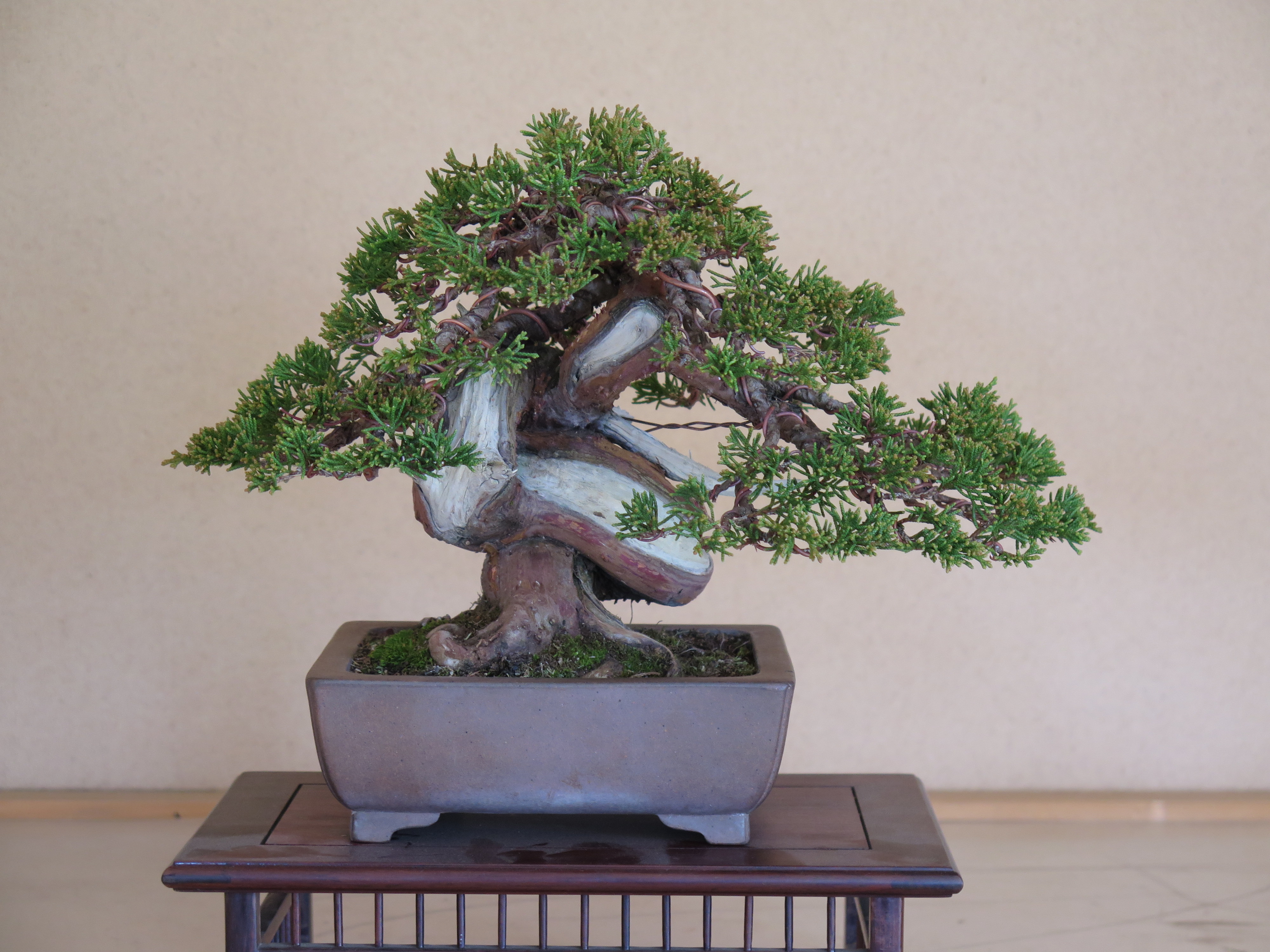
Post work.
Looking back on trees like this it really gives me the incentive to start growing my own material to this standard. I now have a backyard big enough to experiment with a whole lot more stock so I am looking forward to starting this process off this year. Who knows, in ten years time I might have a whole lot of these ready for display………..
Been busy as per usual but I have managed time to fit in a couple of customer trees.
Below is a quick before and after of a black pine that needed teasing out of a sea of needles. A fun tree to style.
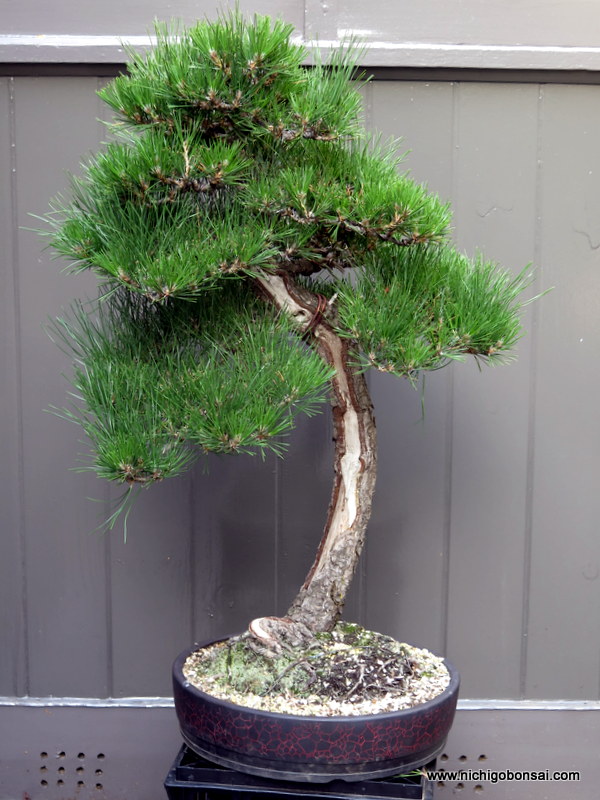
Before
The after shot is a little lacking in quality but I am sure you get the idea.

After a day or so work.
As the days get cooler we slowly approach the time of year where I like to style conifers. This year is gearing up to be a big one for bonsai work as I have taken on a number of customers trees to be styled. Following on from the last Black Pine I worked on, I had the opportunity to work on a similar tree.
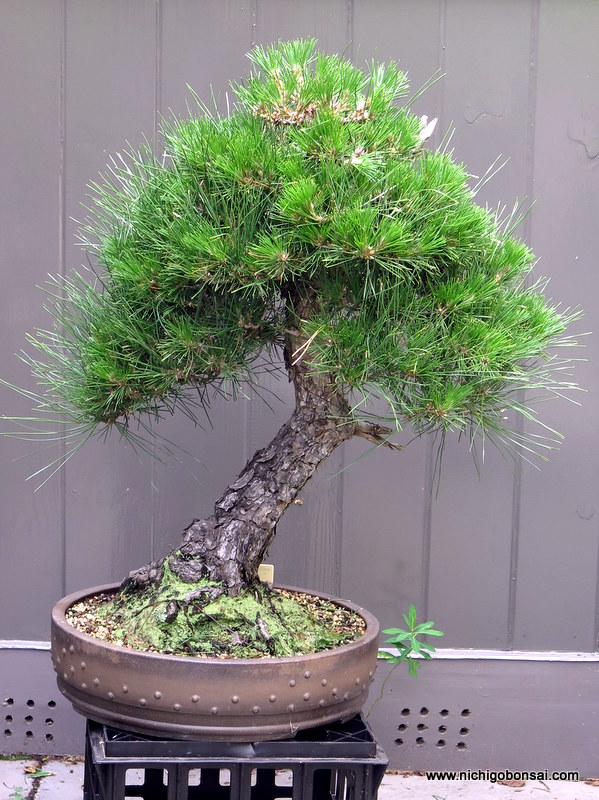
Before starting the work.
At least it looked similar before the work begun, but soon after the old needles were removed a new set of structural challenged presented themselves to be solved.

Old needles removed and ready for pruning and styling. (slightly rotated)
I decided to rotate the front slightly which brought up the issue of the first branch. That is it was now heading towards the rear of the tree so with the help of a screw in the trunk I was able to bend it forwards. This then set the base of the tree and the rest of the canopy could be built around it. The head was finally lowered and rounded out to create the final image.

After the work.
Again this tree now needs a couple of years to grow into its new shape but even after the couple of weeks that passed between starting the job and finishing, new buds are beginning to form which should see this tree become show-able in the not too distant future.
While in Japan I worked on a number of trees which might make it to future posts.
One such tree was a bunjin style white pine that had been bought by the nursery as part of a larger collection. It had been styled by the previous owner but with far too thin wire so it was up to me to re-wire and find a new style for the tree. Oyakata gave me free rein on the tree and so I set about working.

As the tree began, styled by its previous owner.
So I stripped the old wire, pruned some branches and wired what was left. I then started to place branches and reached a stage where i wanted to cut off some branches that would take the tree past a point of no-return. So I called Oyakata from the garden to make sure he was going to be happy with my decisions.

My styling of the tree.
It turns out what I had done was not to his liking and he proceeded to remake the branches and form a more upright tree.

The tree after Oyakata re-re-styled it.
And so that is how the tree stayed. After all it was not my tree and I certainly did the right thing by asking when I did.
That being said, did I like the end product? No, not really but I wasnt really happy with my version either. I can see why Oyakata styled it the way he did.
It is a little more regular and perhaps in that form is more easily sold (which is the name of the nursery game) and being of fairly low quality comparatively with the rest of the nursery Oyakata was probably hoping to get it sold quickly to make room for something more interesting.
Having said all that what was interesting about the exercise was to see a piece of material transformed into three totally different stylings by three different pairs of hands over the course of the day. Each person who styled it, from the previous owner, to me, finally to Oyakata saw something different in the material and I think it is that difference in how each of us treats our trees that keeps this art interesting and keeps me turning up to demonstrations, shows and events.
Perhaps this material much like all others has no one perfect way to be styled but instead many different forms that play to different tastes.
Things have been pretty busy since I got back from Japan. A new job, a pregnant wife and Autumn’s bonsai work just beginning haven’t left a lot of time for the blog.
On top of this, I have also been doing a fair amount of work on customer’s bonsai and their collections. Some of this work is routine seasonal maintenance, some of it teaching and then some of it is re-styling.

Before any work
One such re-styling I completed recently was the black pine pictured above. For Australia, the black pine had some good age to it and was starting to develop nice bark textures, but it’s canopy had grown into a solid blob over the years. My job was to find the tree within the blob. I had to prune a large number of branches out and define a better branch structure to set the tree up for it’s future. As a result a fair amount was cut off the tree but now the bones have been formed to grow a better structure upon.

After pruning and wiring.
One of the main changes, apart from separating the foliage into layers was to enhance the movement of the tree. This involved shortening the right side and lowering the head to accentuate the left movement of the main branch which made a huge difference to the appearance of the tree.
I think a re-pot into something more suitable and a year or two of candle pruning should see this tree fill into a very nice tree.
As you may or may not be aware, I have recently undergone surgery on my right wrist. Being right-handed, this has put a fair dent in my bonsai plans of late.
A few nights ago after work I decided to do something about it and tried wiring up a small juniper.

Before the work
I have been working on this tree for a few years now, slowly chasing the foliage in closer to the trunk and replacing leggy growth with tighter growth. I decided that it was about due for its first styling so that I could create the bones to grow and fill in the foliage upon.
Considering that my right arm was in a cast I think the wiring went ok. It’s not show ready but it never was going to be. It has a few more years before it is going to be anywhere near presentable.
I really wanted to get some fine sand paper into the bark to reveal the orange / red texture below the outer layers but the cast proved too clumsy. Something to look forward to once the pins from the wrist are removed after the next operation.
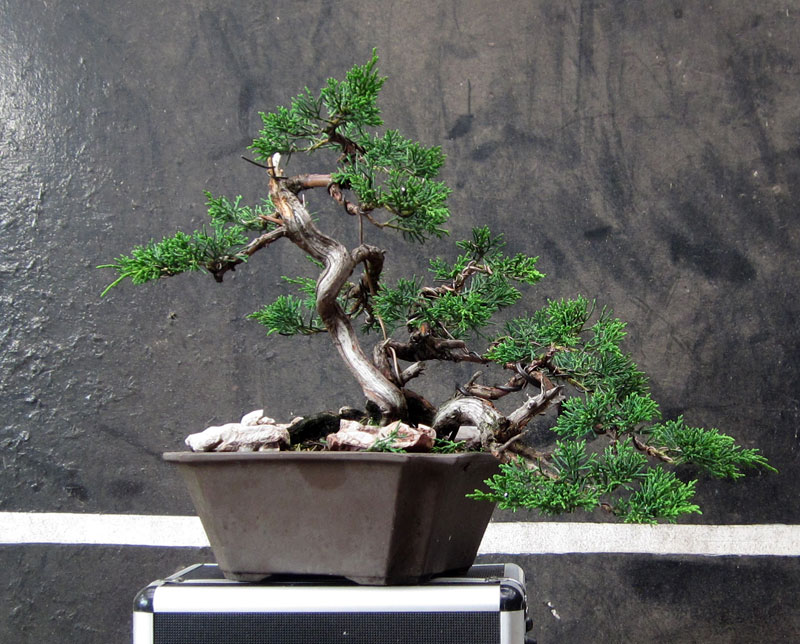
The little shimpaku from the front.
I find that when wiring junipers and particularly shimpaku, that preparation is key to a good result. Pruning unwanted growth and thinning what remains so that you end up with an evenly dense canopy not only makes the end result look better but it also makes for more balanced growth and an easier job while wiring.

As seen from the right

and from the back side
All in all I am pretty happy with the results considering that most of the wiring was done one-handed. I guess it just goes to show that interesting trunk movement is half the battle. That being said, the tree is only just beginning its journey as bonsai and should see many future wirings to come.
The tree below is one I worked on a couple of years ago. It is a large Shimpaku Juniper that had some great deadwood. When I was working on it, it was in the process of having some new roots grafted onto it. Because of this the styling was kept to just main branches, leaving the tips somewhat free so as not to stress the tree too much.
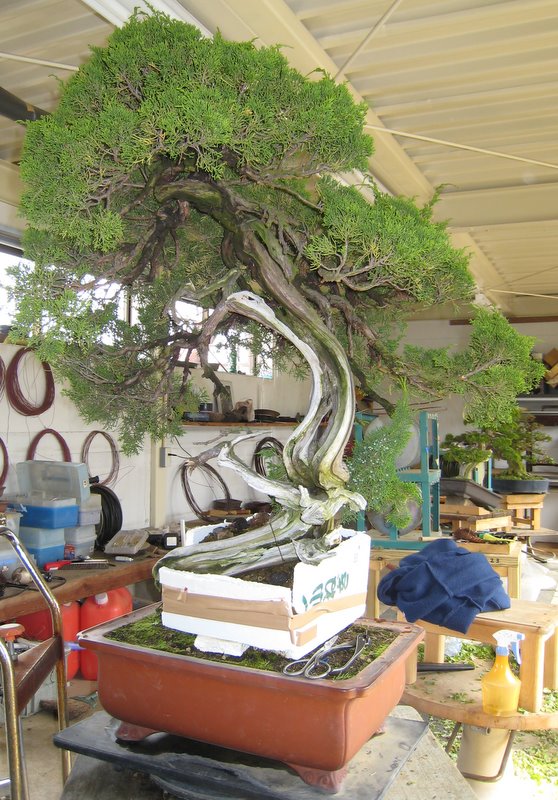
The tree before any work May 2009. There is a foam box that is holding soil for the grafts at the base. The layer was on the tree so that the deadwood would be brought closer to the soil surface and give the tree a more solid base.

After several hours wiring.
On my latest trip to Japan I re-visited Taisho-en and was reaquainted with this tree. The grafts had been a success and the tree had found a new home in a new bonsai pot.
It’s always nice to see trees you have worked on after some time apart. I get a similar feeling to that of seeing an old friend. When I saw this tree in the nursery I took my time looking over it and revisiting the familiar curves and lines of the trunk and branches.

The tree as of January 2011. The angle of the tree is a little more upright now and the base appears much more solid now it is lower in the pot. If you look closely you can see a tuft of foliage at the base that is still attached to the root graft.
I wonder if we will cross paths again.
The following bonsai is one of the first trees I collected a number of years ago.
It is a radiata or Monterey pine (Pinus radiata). I quite like the species to work with but i am still trying to really get a grip on how to best grow and refine them. Perhaps i should make a future post on this subject.
Before it began its life as a bonsai it was located on the edge of a pine plantation where it had grown on a road batter. It had a very interesting curve in the trunk which was either from machinery running it over at some stage of its life or from it trying to seek the light through the long, tangled grass in which it was growing.
After collecting it took a couple of seasons for it to recover and become strong enough to be styled.

The tree before is life as a bonsai. It was needle plucked and readied for its first styling.
I styled is initially at a club night as part of a demonstration. At this time i wrapped the trunk in electrical tape as a substitute for raffia and put a second large bend in the trunk. The bend seemed quite severe to those watching at the time but the little pine bent easily. I then wired it fully and placed the foliage.

The first branch bent into position before the major bend was made.

A top view taken some time after the first styling. The dotted line shows the trunk line. The second bend is the one made during the first styling.
The tree recovered well and I lived with its style for some years while working on ramifying the branches. I didn’t mind the style but, I always thought there was something not quite right about it.

The bonsai was growing well after its first styling. It was un-wired and soon needed work.

The back side. I had often looked at it from this side and thought about a possible front.

The front after a re-wire. It was around this time that the shari seen in the next images started to develop.
Even after a re-wire the style still was not sitting well with me so, i decided to take it to a critique session by a visiting Japanese Professional, Hirotoshi saito. He suggested that we do re-style and stand the tree up roughly 90 degrees. So, a few days later the tree was styled. It was quite a dramatic change but definitely one for the better.

The results after the second re-style.
That was back in July. The tree was very healthy and had grown strongly, as a result there were multiple places where wire was cutting in.

The pine after its spring growth.
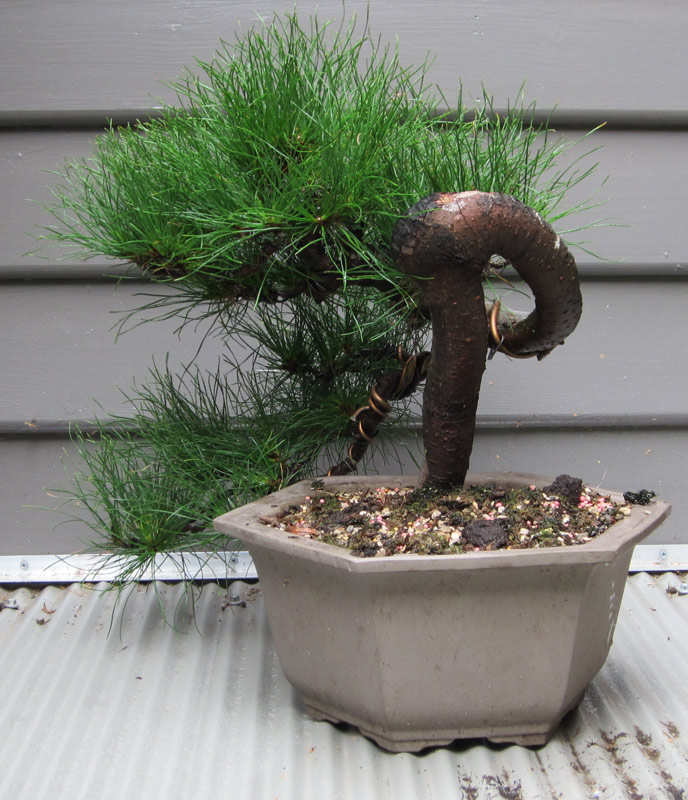
A side view.
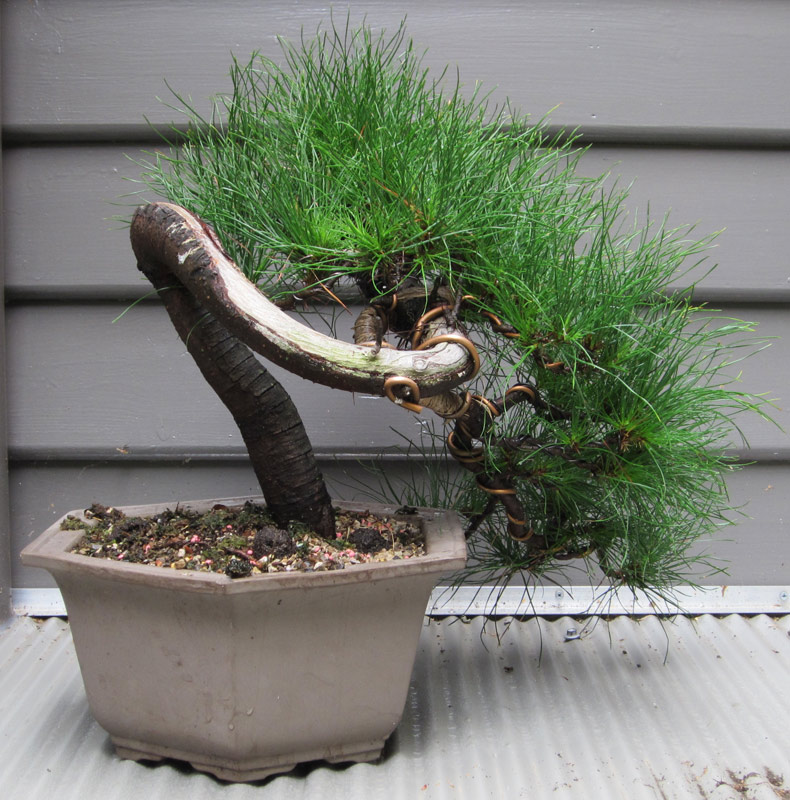
The back. From this view you can get an idea of the extent of the shari that naturally developed. Hopefully i can extend this over time to the front of the lower trunk.
It was time for some work. I plucked and cut needles to allow more light and air into the interior of the tree and also removed most of the wire. I was happy to see that most of the branches had set in position.
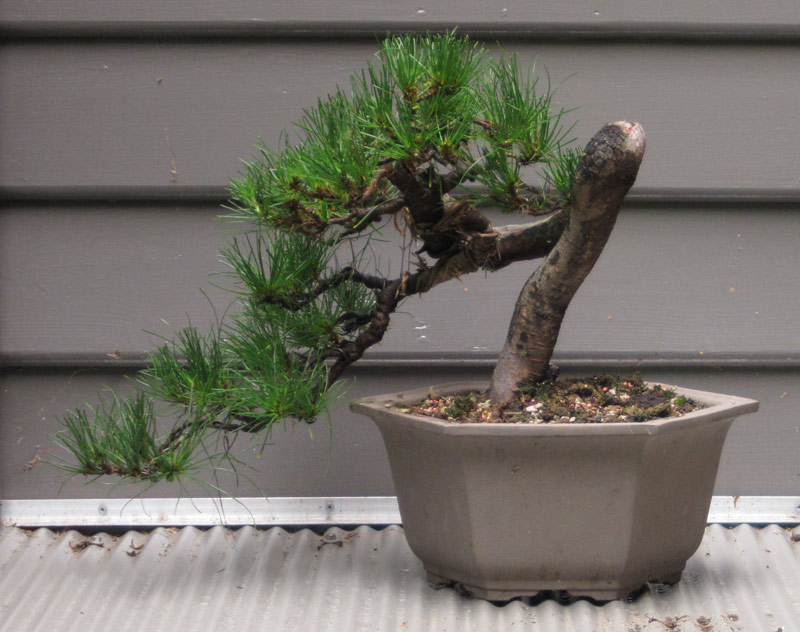
The tree after the work.
The tree is far from finished and i will need to re-wire it again this winter. Pines with movement such as this are common in collected pines in europe but you rarely see them in Australia.
Hopefully if everything goes to plan it will have a bright future in its new upright style.
I just thought I would add a quick before and after of a large white pine I styled while at Taisho-en.
It one of the largest trees i have worked on to date. It had quite a good canopy of foliage to work with and some nice features such as the shari on the lower trunk and the interesting kink in the first branch.
It was a big undertaking and took the best part of two days to fully wire. The planting angle was changed and the foliage was adjusted to suit. Some heavy bending was needed to compact the first branch as can be seen from the reenforcing bar next to the trunk.
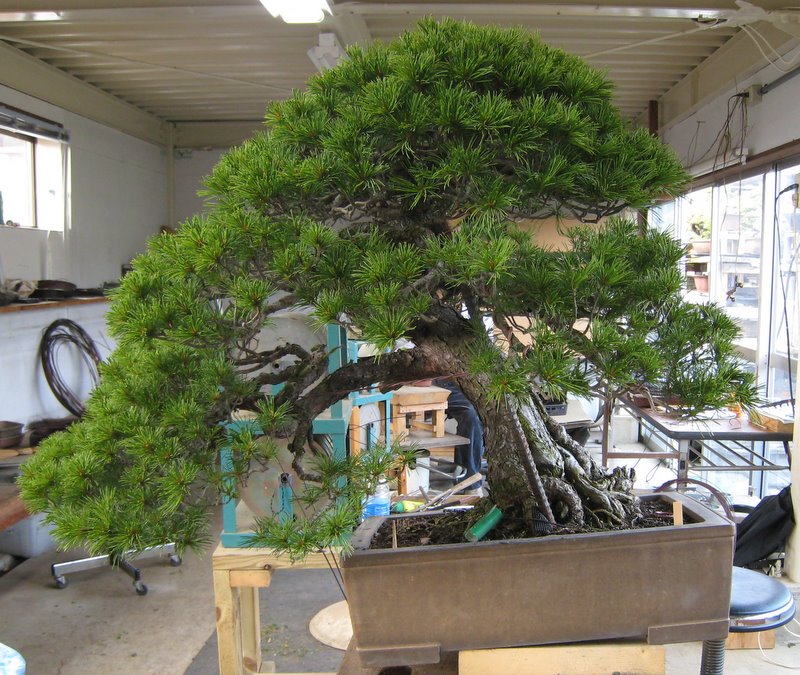
Before
Working on large trees is a little bit strange. You have to work very closely to the tree in order to apply wire and position branches but due to their size you cannot get a true understanding of how it looks in connection with the rest of the tree. When working on smaller sized trees often all it takes to see the tree in the whole is just leaning back in your chair.
When working on larger material you end up regularly walking a few paces away to look at what you have done in conjunction with the rest of the tree’s form.

After the work
You can get an idea of the size of this tree by looking at my fingers at the top of the blue screen. I was holding the screen above my head with arms close to full stretch.
The tree in this post was another i worked on while in Japan. It arrived at the nursery one day and was in need of a re-think and re-style.
The major change was to stand it up.

Before the work.
I first wired the tree, keeping the small second trunk and then re-potted it into its new upright position.
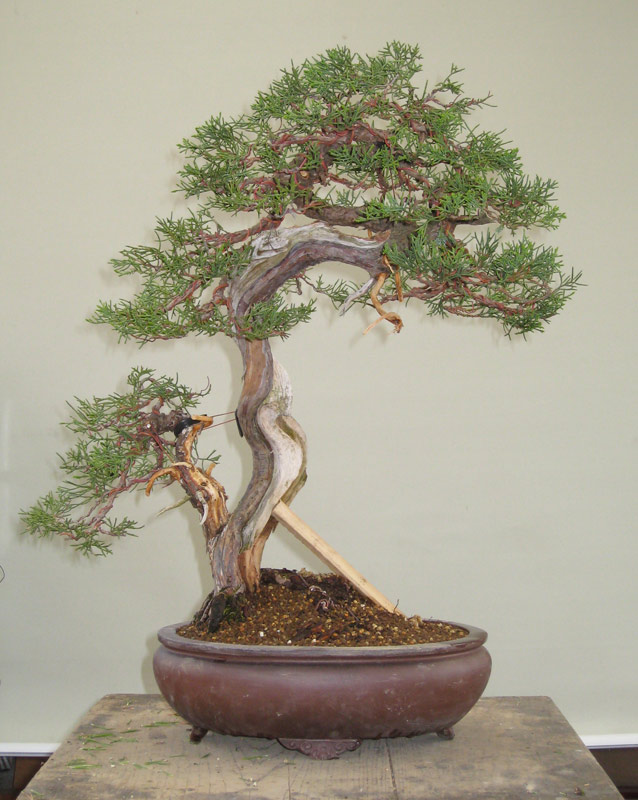
After the work
As the tree had its angle changed so dramatically it needed time to re-establish a new rootball that could support it in its new position. In the mean time a bamboo prop was used to take the weight of the tree while the rootball became stable enough to support itself.
Unfortunately some of the lower shari had been buried in the previous potting angle and as a result had rotted. I feel that the base would have appeared much more impressive had it still had deadwood at its base.
It was a nice tree to work on, but at the time i guess it got lost amongst all the other high quality trees in the nursery.
This was by no means a top tree but looking back at it now I would kill to work on material such as this in Australia.
I guess I will have to sharpen the shovel and keep an eye open for urban junipers in friends gardens.
 Nichigo Bonsai