You are currently browsing the category archive for the ‘Bonsai Maintenence’ category.
This year i finally feel like my pines are thriving after a long period of mediocre growth. This bad growth was due to a number of factors including:
- water pH Issues – Solved by moving to rain water.
- soil mix – I have recently moved to Akadama, Pumice and Scoria and believe this is a good improvement.
- fertiliser regime – This year i am using a two part hydroponic fertiliser and am applying weekly, and;
- strange seasonal variation – We have been in an ‘El-nina’ phase which resulted in cool wet years which even threw my tomato crops off kilter amongst other things
Most of the pines have been grown out last year and skipped de-candling to build their strength and from the below pics you can see they are responding well this year.

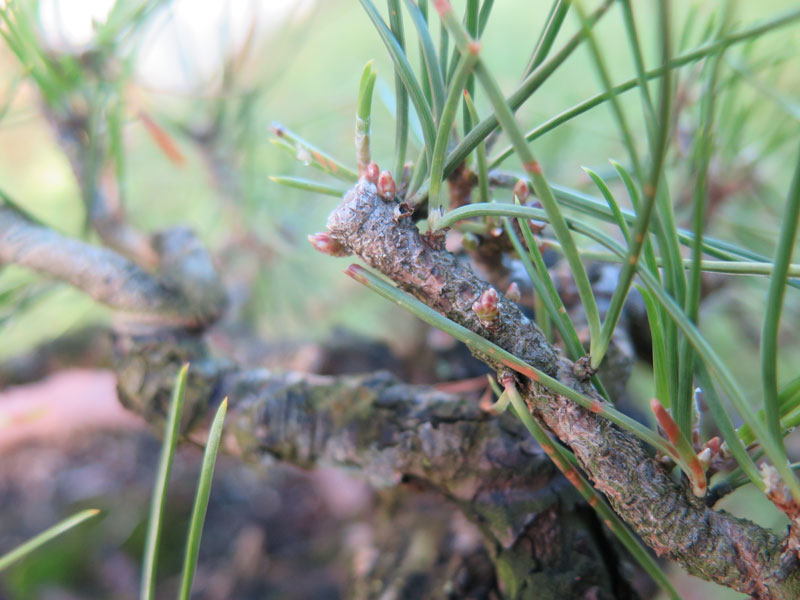
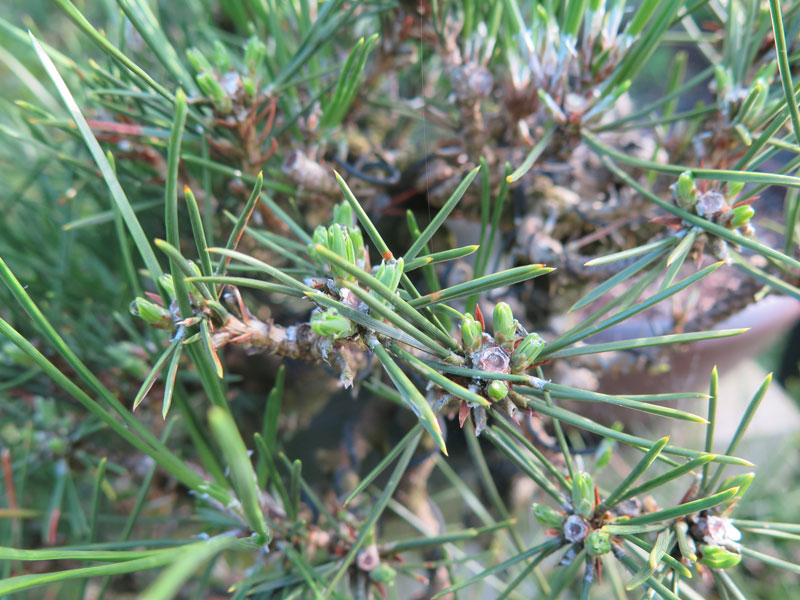
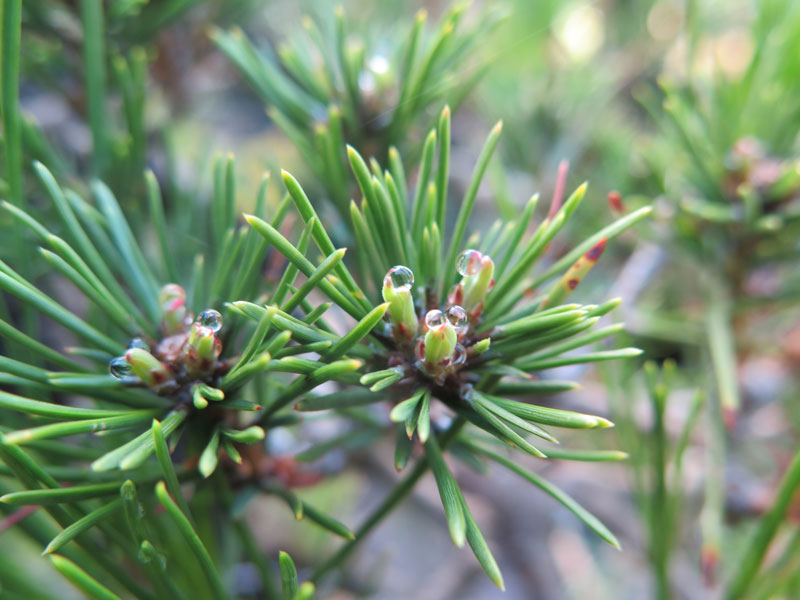

The Radiata is a fairly new addition to my garden after not having one for a while. I am treating it more like a Japanese White pine in regards to foliage management and so far am seeing good results. The process is essentially:
- Grow out the spring flush.
- once it stops extending, prune back leaving some of the new candle’s growth.
- New shoots form and grow out
- Thin needles
- Prune back new shoots to two and reduce length as per Step 2.
- Repeat.
I am guessing i will get 2 or 3 flushes per year using this method. So far needles have not come down in size much but as i build more canopy i assume this will slowly reduce the length.
I probably also need to play around with feeding timing but at the moment i am focused on building branching so am feeding heavily. A post for another day.
With some down time over the Christmas holidays, I finally got around to re-styling THIS TREE. It had been growing mostly untouched for a couple of years and had well and truly outgrown its former style.

As it had been left to grow a lot of the growth had become leggy and a lack of routine thinning had left fewer amounts of interior growth than i would have liked.
To get started, I began by pruning. I thinned and removed heavy and unneeded branching, upward and downward growing sub branches, thinned the foliage and generally cleaned up the structure.

As I worked I also started to play around with new front angles and didn’t mind it from a slightly counter clockwise rotated position.

I began to wire as I pruned so i could get a better sense of what branches I needed and what could be cut off. All was going well until i made an error. I wasn’t paying enough attention and when I cut off one of the branches in the top of the tree it was difficult to see from my angle that there were two branches in the branch cutters jaws…….. and as a result, i cut the key branch on the right side off.


Well, what was done was done so I continued wiring and worked a front that was much closer to the original. I was pretty annoyed with myself but there wasn’t a whole lot I could do. All in all everything was not lost but i was kicking myself for making such an avoidable mistake.

The ‘finished’ result is a good place to be for now. The styling is pretty sparse due to how much foliage and branching i removed but the trunk and deadwood are now very much more prominent.

You can probably see that the wiring I applied is only on major branches and sub branches. As this is a restyling, I will need to develop the foliage over the next 12 months or so to fill in and tighten up to this new style, so I didn’t bother fine wiring and hence the slightly scrappy appearance.

As the canopy fills in i think i will further fine tune the front. As you can see from the above image that original front is not bad but i still think i prefer the one i ended up with that is slightly rotated anticlockwise. We will see if this changes as i grow some of the branches and get some more width to things (something that i wouldn’t have to wait for if i hadn’t cut off that key branch!)
It is interesting comparing this and my other small Kishu to the itoigawa i have. It is certainly more difficult keeping these kishu small and compact compared to the itoigawa. That said, the branching stays much finer on these so i guess you have to take the good with the bad.
Next post might be an update on one of my itoigawa trees…. we will see.
Just a quick post today tracking a task I do on the semi regular to develop the junipers that have deadwood and shari features.

Above is yet another of my trees in desperate need of a wire. While I didn’t wire it today, iI did do a little thinning of the foliage in preparation for summer growth and a future styling. The main task i completed however, was the widening of the shari’s on the tree.
If you’re interested in seeing the tree 10 years ago, HERE’S it’s first post.
I do this task every couple of years to slowly reduce the sizes of the live veins which speeds up trunk thickening (or more like widening) and develops the shari’s texture.
The technique it’s self is fairly straight forward and involves removing a couple of mm of bark along the edges of the shari. It is a fairly safe process as you have to be pretty unlucky for the branches above to be reliant on the narrow strip of bark but it does pay to make sure that you are not removing all of the bark from directly below branches.

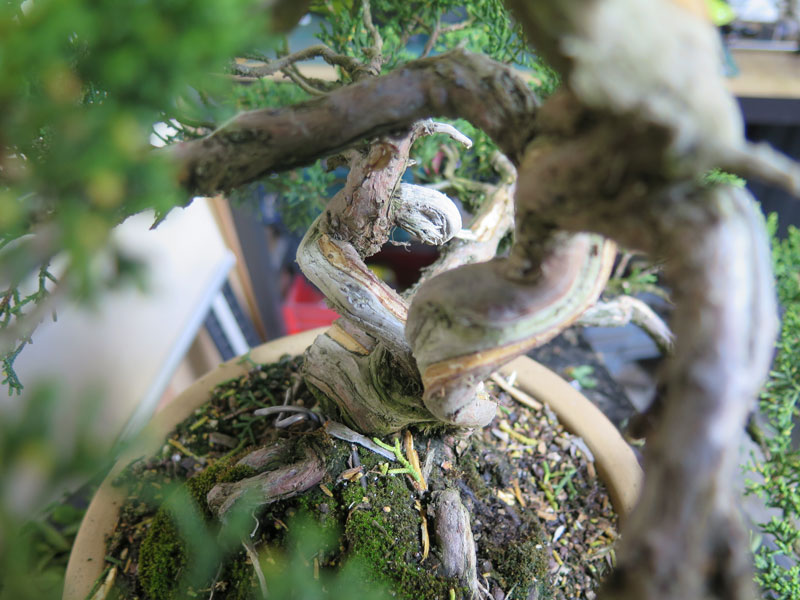

You can see the freshly exposed shari in the images above.
By reducing the size of the live vein you direct the same amount of sap (to supply the foliage above) through a thinner section of bark and as a result it tends to thicken in this area much more quickly compared to a larger area of bark supporting a similar amount of foliage. If you then have live veins on each side of the trunk they will grow outwards and appear to thicken the trunk much more quickly (if only in one side to side dimension.)
The other benefit of doing this technique over time is that you get a great texture on the shari areas. As you expose these new areas of shari, you are exposing younger heart wood and as a result you get lines appearing between the younger and older area of shari. You can see this quite clearly in the images above where there is a year or two age difference between each line. You can end up with an almost finger print like pattern on the shari with no need for carving and its a fairly effortless way to achieve a nice texture.
This is a maple I have been working on for some years and you might have seen on the blog before (2021 update, and 2013 update).
It came into the workshop recently (where i forgot to take before pics) and I gave it a structural prune. It really needs a full re-wire but overall I am pretty happy with the branch structure and development.

If you compare the tree now to some of the previous posts you can see quite a bit of development but then again i think I first started working this tree in 2013 so 10 years have passed so i would expect some change (and perhaps more development).
It had been somewhat neglected the last little while and particularly last year where it was overdue for re-potting and i ran out of time to do it.

As a result in the heat of summer I had some root issues and the tree suffered some die-back on the nebari. It was not a good result and entirely my fault. Well, lesson learnt and now i will have to spend the next few years healing the scar and will consider wrapping the roots in a towel or cloth to give some sun protection on our hottest parts of the year.
The tree still has a way to go but each time i work on it i can see the improvements. I am looking forward to giving it a full re-wire this Autumn.
A number of years ago we visited Onomichi in southern Japan as a bit of a side trip during a family visit to Japan. I fell in love with the town for some reason. While i cant really put my finger on it, something just ‘clicked’. Its ocean setting, industrial history, creative new industries side by side with their traditional counterparts and of course the amazing shimanami kaido (well worth riding the bike trail if you are so inclined), the hilly landscape, querky old buildings, yellow trains etc all played their part I suppose.
While staying there, we walked to the peak of one of the small hills in the area and managed to stumble across this red pine.
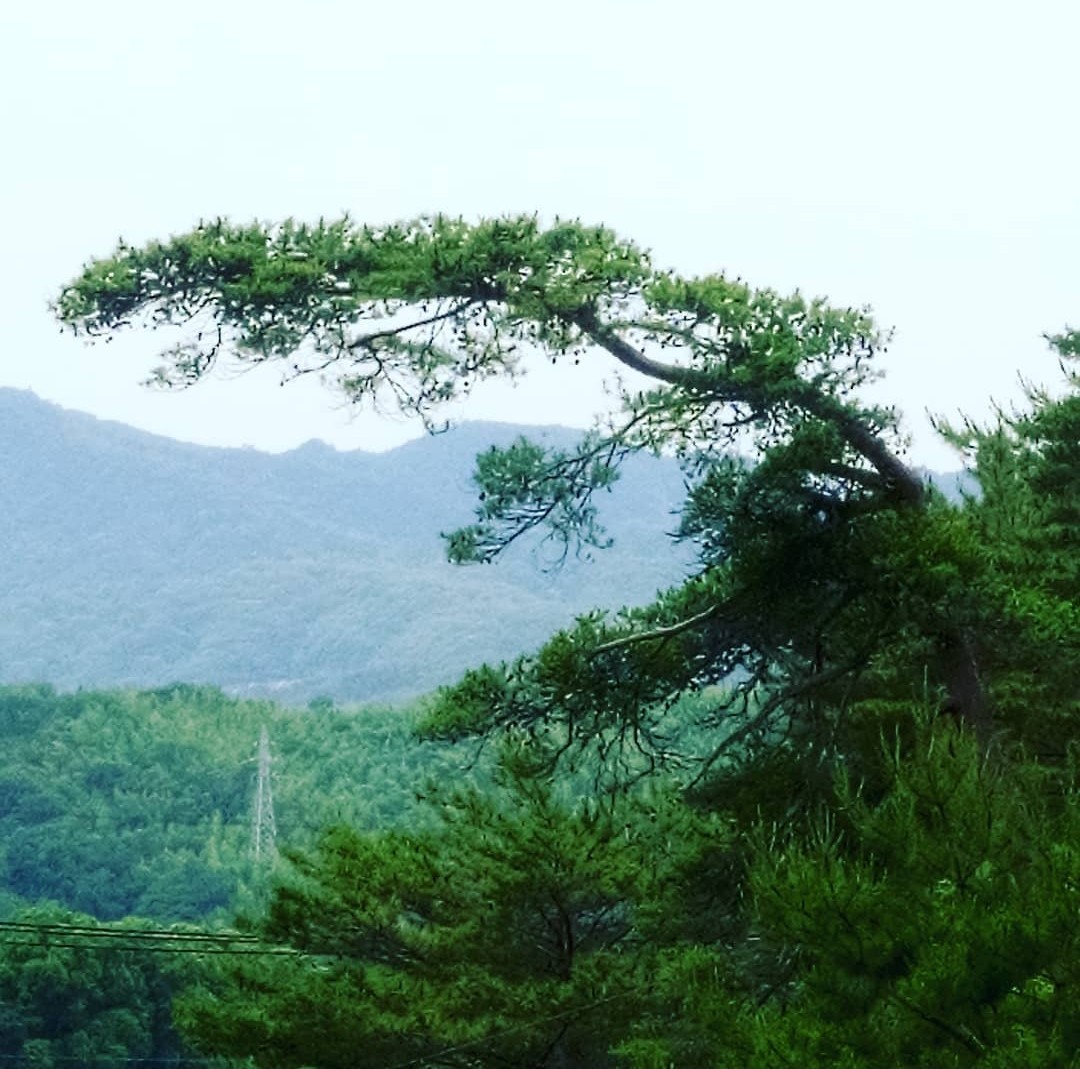
I really liked it, and again, while i cant really put a finger on why i liked it, it again ‘clicked’.
…….Cut to this week, I am looking through some travel pic and stumble upon the above red pine again. As fate would have it I was also trying to think of what to do with one of my black pines.
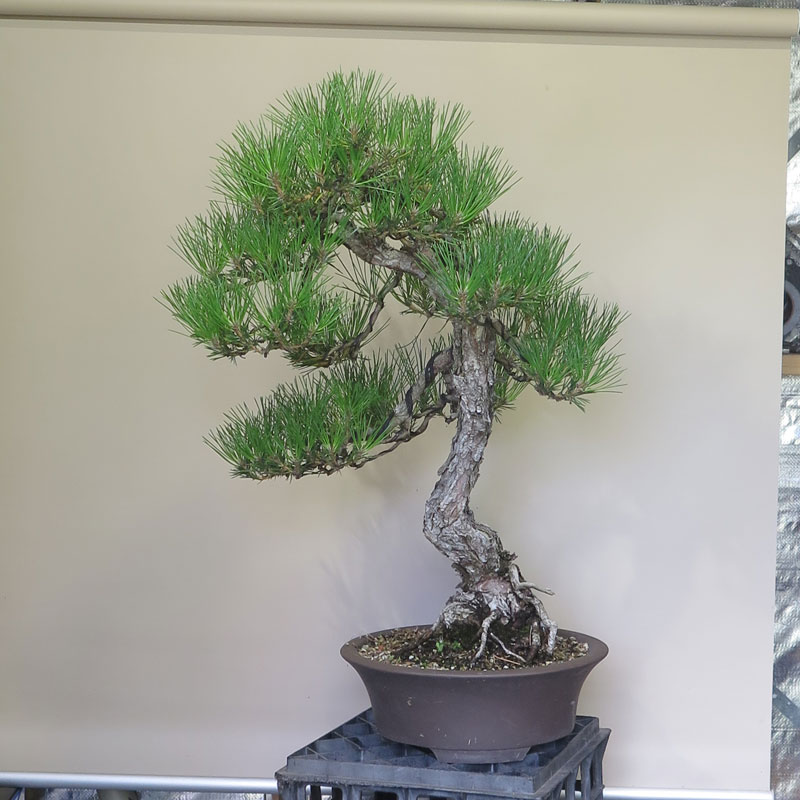
I had another tree that was styled very similarly and I was never quite sure that my collection was large enough to have two very similarly (and kinda of poorly) styled trees, so I would often catch myself staring at this black pine trying to figure out what i could do with it.
When I came across the Onomichi pine picture I had a light-bulb moment and wondered if i could capture the ‘vibe’ of this pine in the (now desperately needing styling) black pine on the benches.
…….. Now vibe is an interesting concept. Bonsai is a whole lot of different things to a whole lot of different people and that’s OK. In fact i think the myriad of different ideas and approaches is what makes it interesting.
For me, i am not really about making miniaturised, scale models of trees. I think what i like to do is try to capture the feeling of trees and or what my sub-conscious is drawn to in trees. It might be an element of a tree (canopy shape, branch movement, strange feature) a feeling that you get (hugeness, ancient-ness, calmness etc) or just somehow trying to reinterpret the spirit of a tree that i am drawn to. I amso am drawn to graphic shapes in the trees i style which is probably from my Landscape Architecture background. I think in summary I’d call it capturing the ‘Vibe’.
So One night I set myself up in my workshop and set about working towards imparting some of the spirit of the Onomichi pine into my black pine.

I’d anticipated a restyling at some point and had pruned and thinned back the foliage last autumn. The tree had been let grow freely the previous season and i think the above image reflects how desperately it needed work!
Now it’s probably on the late side of timing regarding styling black pines. We are entering an El’nino weather phase and the growing season has arrived much earlier than usual so i was caught a little off guard. Candles are extending so i had to be super careful when wiring so as not to break any but think I got away with it.
The process was fairly simple, I chucked on some tunes and switched between looking at the original Onomichi pine image and trying to impart some of it’s ‘vibe’ into the black pine. It was a fun exercise although I’m not sure how successful it was. You are always limited by the material in front of you so of course the end result is not a mirror image but it certainly has turned out being styled in a way i wouldn’t normally have approached the tree.

I quite like the end result but something still bothers me about it.
I think I am going to put it in a spot i can look at it each day and try to work out whats not quite right about it and tweak it over a period of the next few weeks (or leave it as is potentially).
It was a good exercise to go through and I’d recommend it for those with favorite trees and bonsai that share the basic structure. I had to actively go against my baseline styling urges in a number of instances and I learned a lot by doing that that will likely be part of my future work.
As far as the tree’s merit as a bonsai…………. the jury is still out…….. It’s certainly a more interesting tree compared to what I started with and the fact it will now trigger memories of a great family holiday and a favorite place I think will cement it place on my benches for many years to come.
This pine was one I dug (liberated) locally. Essentially a weed in our native forests i was happy to stumble across this one with it’s strange movement and old bark.
It has taken a number of years to get it out of the heavy old clay it grew in and into a better soil mix.
Last year i stripped off the site soil and put it into a shallow bonsai pot (all i had).


This year i put it into a much more suitable container (thanks again Ken). It should be able to stay in here for a few years as it establishes a dense root ball. Once it’s solidly rooted i will hopefully be able to remove the support sticks.
I may post an update once i see if the grafts live or die. The variety of pine is the same as THIS one, so i think i should have a decent chance of grafting success. Fingers crossed.
This is a tree i have been working on for a couple of years.
It was given to me by a good friend (thanks Kris) who was clearing out in preparation for a house move. At the time, it was a mass of foliage and while having some good movement, had been grown as a stock plant with many whips being grown long then later wired and then finally air-layered off as separate trees. It worked really well as a method of producing stock and also did a great job of thickening the trunk on this tree but it was in need of some direction.
I used it as a demo tree at Bonsai Society Victoria in October 2022 for it’s first styling. Unfortunately i don’t have any pics from that time but it underwent a basic program of branch and trunk line selection, reducing it from a huge mass of foliage down to its base structure.
It (and myself) were invited back in June this year (2023) to give it a second pass where i was able to massage things into a much more considered form.

The tree came up pretty well and was a good example to discuss changing the flow or direction of branches as i worked. Towards the end of the demo there was a lot of concern about the chances of ever getting it into a bonsai container as it was in a large growing pot………
Cut to a couple of weeks ago when i finally got around to re-potting it.
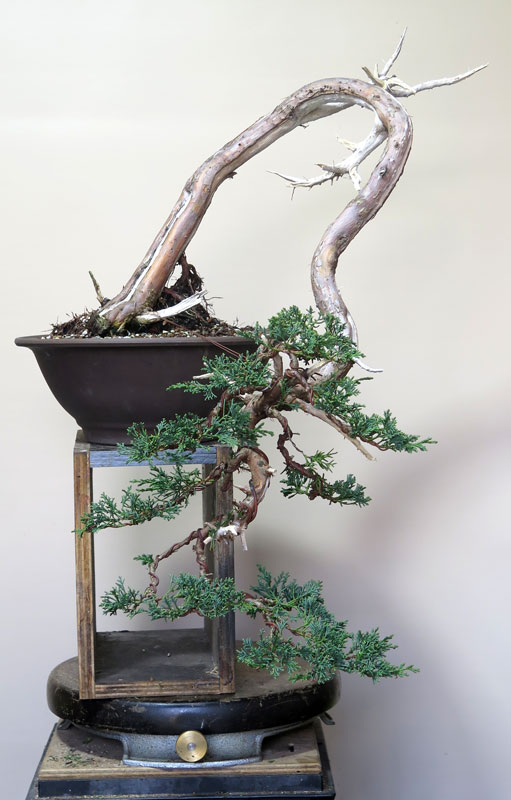
Another good friend gave me a pot that he thought would suit it (thanks Ken) and I went about reducing the root mass to a point where they would fit.
I also cut a shari on either side of the trunk to begin forming two live veins that will hopefully make the trunk much more interesting as it continues to develop. I will enlarge these each year until i am happy with them.
It’s a bit of a strange tree but i really like it. The only problem is it hangs down so far below the base of the pot that i will have to weld up a stand for it so it can fit comfortably on my benches.
A quick post to show this little juniper. This re-potting I have stood it up to reveal more of the fantastic trunk-line and will fully re-style it once it settles into the new pot and shows positive signs of growth.

Its a nice little tree that has been with me for a long time. Its not the ideal foliage for shohin as it is much more course than some others and gets ‘shaggy’ quickly. That said with the right amount of work it will be a nice tree.
Its new pot, is one i picked up last time i was in japan and i think suits the tree well. I love its grey tones and always think these colours go well with junipers.
Hopefully in a few months I will share the re-styling with you all. Until then……
This small olive was a gift from a friend who dug this lump of wood when digging a handful of single trunk trees. He thought this one would be right up my alley!
It’s the second year I am growing it. Last year I cut off all the original trunks and branches and let it recover from being ‘flat bottomed’ (essentially cutting it completely off at the roots and growing it like a giant cutting). During this re-potting i was pleased to see a good spread of surface roots all around the base of the cut, allowing for planting it into a very shallow container should I ever want to.
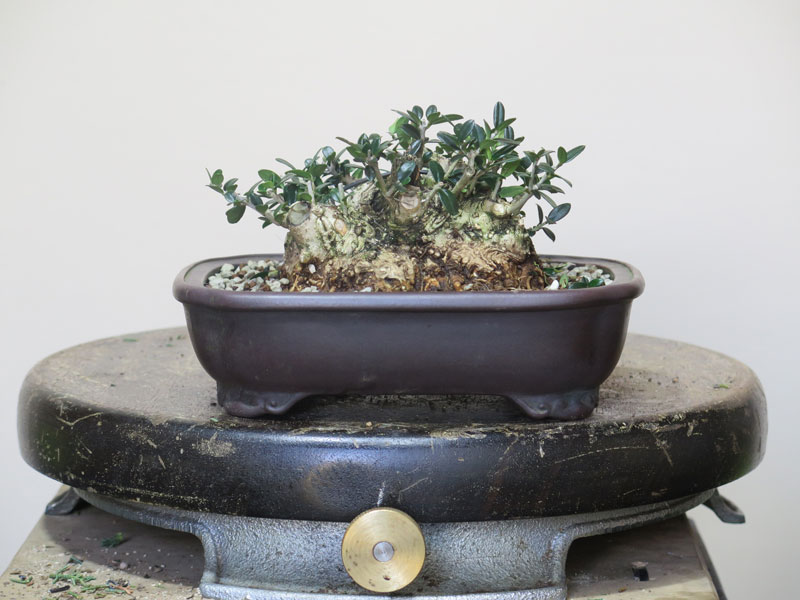
This year I will begin to start building some branch structure and filling it out. I’m starting to think I have a thing for clump style…………
Another quick update for the trees shown in THIS post.
Everything is slowly improving year in year out and I am becoming particularly fond of the one in the Bikou pot. This tree was one of the original Chojubai in the country (a cutting from one of the plants imported in the 90’s).. It belonged to the late Richard Salvado, a friend and proponent of mini and shohin bonsai in Australia at a time when big trees were all the rage.
He originally found chojubai in someone’s backyard, planted as an accent in an imported tree. He took a cutting (which i think out survived the original specimen) and later spread the variety to those who were interested. He was ahead of the curve in regard to the small bonsai craze and its a nice memento of him and his broader influence.


 Nichigo Bonsai