You are currently browsing the tag archive for the ‘Shimpaku’ tag.
This is a bit of a different post covering a tree that has found its way back into my collection lately.
I originally grew this as stock from a cutting and put some early bends into the trunk line. Soon after the wiring of the cutting i gave it to a friend who did the bulk of the work in forming it into a tree and growing it on.
As luck would have it, the tree recently found its way back into my collection.
Stupidly, i didn’t take any before pics, but when i received the tree i re-potted it, changing the angle a bit and fully wired the tree removing a branch or two in the process. All in all, building on my friends work, its forming into an interesting little tree!

Above: The tree post re-pot and styling.
But…….. it still has a while to go.
Normally a shimpaku of this thickness i would keep as stock and grow hard and fast to thicken the trunk and develop the shari’s and live veins. Luckily we cut shari’s into the trunk last year but i still need to focus on developing trunk thickness and continue to develop the sharis as things thicken.
This is somewhat difficult in a tree that i don’t really want to grow out of shape or get too much larger. What i want is to thicken the trunks and keep the tree’s foliage well managed.
The solution is………. Sacrifice branches.
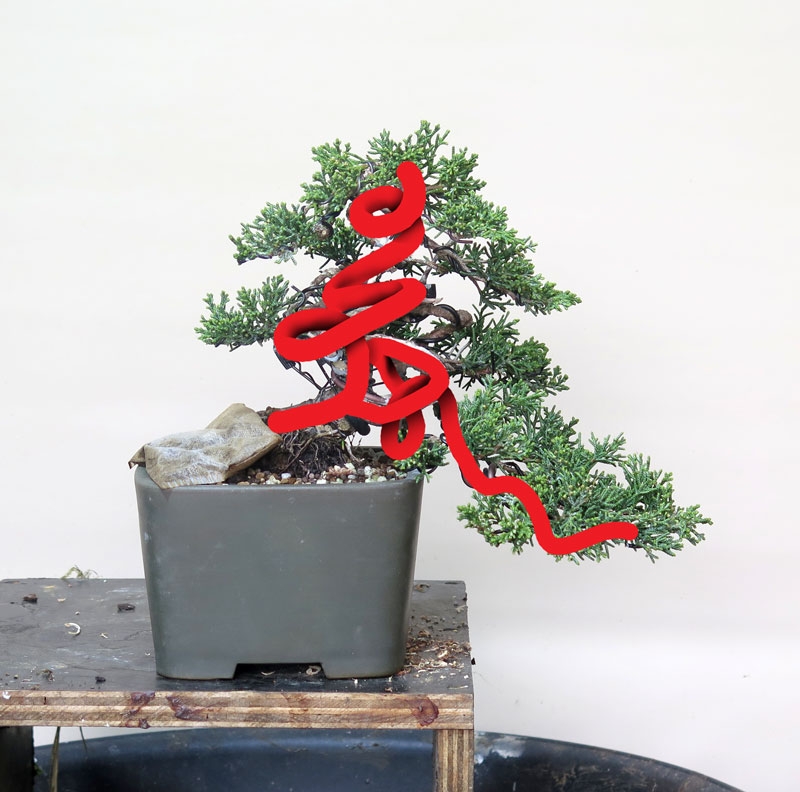
Above: The two main trunk/branch lines.
The tree is built off two main trunk lines as per the diagram above and ideally i would like to thicken both of these lines. To do this i will likely grow two sacrifice branches.

Above: likely locations of sacrifice branching (shown in pink).
I will locate two sacrifice branches (one per trunk line) but in slightly different locations. The sacrifice branch in the apex will be toward the top of the trunk line as i want the entire upright trunk to thicken.
The second sacrifice will be on the first branches trunk line, It will be located back from the first branch tip though, to avoid the branch holding the foliage from thickening too much, keeping it in scale with the other branches.

Above: the image in my head i am aiming for.
I will likely also wire the sacrifice branches into interesting shapes reinforcing the tree’s movement so i can use them as future jins.
To further facilitate this thickening i will be making a shari on the opposite side of the trunk to the shari’s we have already made. I’ve covered this a bit more in THIS post. I am hoping this speeds up the whole process quite a bit. Also keeping the majority of the foliage trimmed and compact should direct a lot of energy into the sacrifice branches which will be left un-pruned. Hopefully allowing them to grow quickly and do their work.
That said however, i do expect this process to take a number of years to get to the thickness level i am after.
Bonsai social media always seems to target the dramatic, the big restyles and the rapid changes, but for most of what we do in bonsai happens slowly over long time frames. Step by step making small adjustments and building on what was built prior to slowly but surely move toward a refined goal.
I have recently been doing such tasks and the below shimpaku is one such tree that ended up on my bench to be thinned in preparation for this season’s new growth.
It was styled in a demonstration back in 2021, taking rough stock and turning it into something that could easily be imagined as a bonsai. Here’s the last time it was on the blog.
The other day i brought the tree into the workshop and gave it another round of work to set it up for another year of development. Images below outline the recent work.
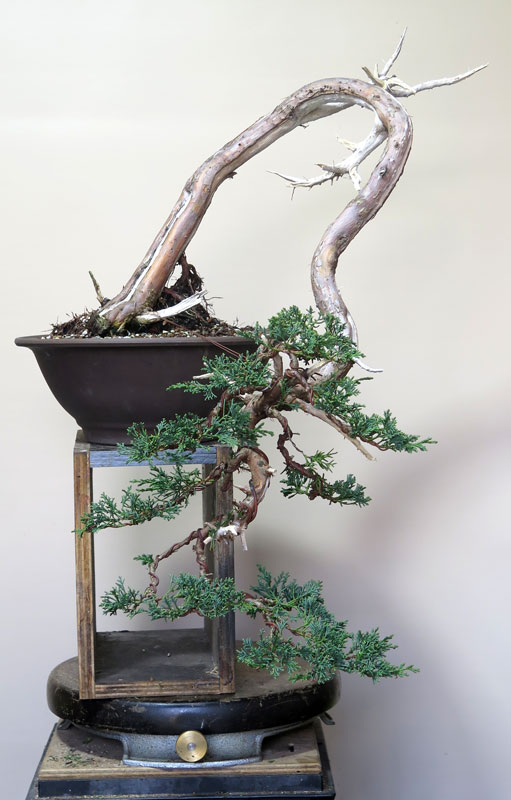
Above: The tree in 2023 after being re-potted from a nursery container into its first Bonsai container. Note the density of the foliage and the width of the live veins.

Above: The tree in 2024 prior to beginning the work. Since the 2023 photo, i have reduced the live vein width a little (5mm?) showing more of the shari. The tree has begun to fill out but the foliage is in need of a thin, reinforcing the branch structure by removing foliage and branches i don’t need and leaving that which i do.
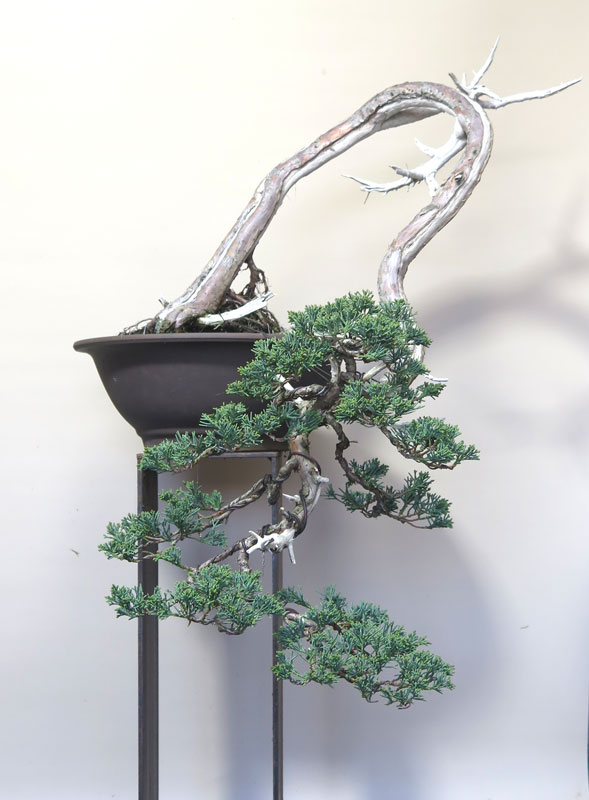
Above: the tree after the work. All that was done was some weeding and a thinning of the foliage. I am trying to get the branches to have an up turned profile showing some of the branch structure below the foliage clouds which i think is starting to develop. I did also adjust some of the wire and branches to help with this but for the most part only thinned. I had left a lot of extra branches on in 2023 so that that the foliage mass would recover and strengthen more quickly. Now that the tips i wanted to keep had grown strongly i was able to remove the excess. This will also leave some room for more growth and some light and air to get to the inner shoots.
There is still some juvenile shoots toward the rear of the tree so this season i will work on growing them out into adult scale foliage. I will also keep an eye on the live vein with the idea to reduce its width further.
You cannot see from these images but there are two live veins. One on each side of the trunk. This should setup the trunk to grow in only one axis and begin to flatten out like a board. Ideally i would like these live veins half their current width. I will slowly narrow them over a couple of years as the tree develops. Its a longer term process but something i will be managing over the coming years. I go into the process a bit more here if you’re interested.
All in all i am pretty happy with how this tree is progressing, it has a way to go but seems to be heading in the right direction.
What to do with boring stock? Good stock is out there but often hard to find or expensive. On the flip side, straight, untrained whips are available not only at bonsai nurseries but at almost every general nursery as well not to mention you probably have a number of neglected cuttings that you took years ago struggling along in the ‘ill get to it later’ area of your backyard.
Which gets me to today’s post. After going through the recent batch of stock that came into my garden these 3 plants were by far the least inspiring. Long, leggy, dead foliage and a general lack of interest in the trunks. Essentially material i would usually ignore if i was in the market for bonsai stock.

But material like this can be a good opportunity to begin something that ends up being interesting and potentially great, all at the work of your own hands.
The stock above is getting to the point where most people would give up on the idea of getting a tree with good movement out of the fairly stiff and straight trunk lines. But for certain species, and especially shimpaku juniper material like this can pose a good opportunity if found for the right price.
First you need to clean up the material.

I tend to remove dead shoots, competing trunk lines and thin the branching aiming for a general spread of branches at good intervals along the trunk. In the case of the trees above i also removed strong branches as well i want these to end up more on the Bunjin side of the style spectrum and therefore I only want short compact branches.
I then applied raffia to the trunks. I don’t often use rafia but due to the thickness of these whips and the tight bends i intended, applying the raffia was a worthwhile addition.
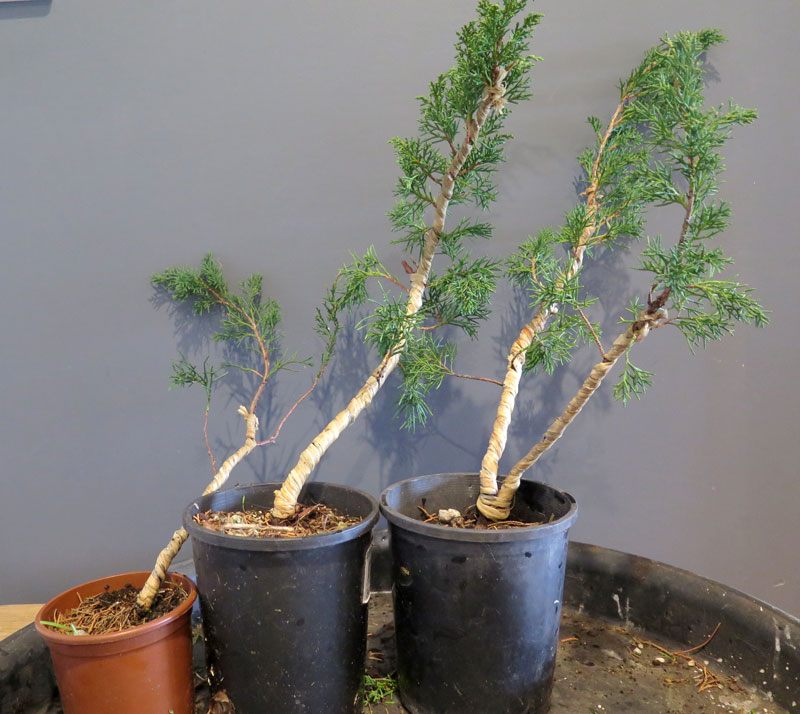
Wire goes on next, I ensure that the wire is coiled on in the same direction as the raffia beneath. This is done so that as i bend, i can also twist the wire in the same direction the rafia was applied in. Having the raffia and wire both tighten to the trunk hopefully provides support to the inner fibers, rather than these wrappings loosening off and allowing room for breakage.

I applied two wires up each trunk and spaced the wraps apart rather than doubled them up together. This provides more points of contact along the trunk and more support along the bends, hopefully further reducing the chances of breakage.
Now comes the fun part. The bending.

The trees were bent making sure to twist the trunks in the same direction that the wire and raffia had been applied, essentially tightening it all down against the trunk.

I also wanted to introduce this twisting for the next phase of the process that will happen after the bends have set, Shari.

As the bark on the tree also twists as the trunk and raffia and wire are twisted through the bends, the sap lines will twist and spiral around the trunkline. This means that removing bark along these sap lines will create sharis that also spiral around the trunk as it moves along its length. While you can on young stock force a twist in the live vein via cutting a spiral, the effect you get from twisting the trunk originally is far easier and i think a superior end result. A tree that has been twisted like this will also have the heart wood fibers twist and follow the twist of the shari making any carving via fiber pulling automatically follow the shari lines.

All in all a productive morning, turning some trees with no potential into material i am pretty excited to continue to develop into the future.
All the trees were bent pretty hard with some cracking and complaining heard from each one. I am not worried too much about their survival as they can tolerate this fairly easily and as this is the first time i have worked them i am not loosing much of a time investment if they fail. Nothing risked, nothing gained, and if you are going to do a high risk process on a bonsai it might as well be before it becomes valuable.
I hope the above inspires a few of you. The starting material for this technique can be found in most peoples backyards, most bonsai nurseries and every club sale day. You can grow these whips from cutting fairly quickly and easily also if you are struggling to find it in the wilds.
I would recommend everyone give it a go, its a very easy way to create good material at a very low cost. Why not make a heap and sell some on! People are always after twisty junipers and you will be helping to lift the average of quality stock in this country!
This post will likely be the first of many documenting this tree’s progress from stock through to ‘bonsai’ over the next few years.
I haven’t had a post like this for a long time because I have been actively reducing my collection to a more manageable size, which hasn’t seen much rough stock make it onto my benches. At the same time, the trees i have kept continue to develop and become refined which hasn’t really seen much rough development type work, until………..
Recently myself and a friend came across a large amount of stock which you will likely start to see show up on the blog as we develop it and progress it towards a higher level of refinement.
It’s actually a bit of a funny story really how we ended up with all this material.
A good mate Dave, (well his name is not Dave, i am using Dave to give him some anonymity, his name is actually Jeff) did a drastic cut back of his collection at the recent Bonsai Northwest show. He sold somewhere in the vicinity of 25 trees leaving his collection compact and manageable. Now Jeff didn’t want to expand his collection much beyond this level but he did want to add a single Juniper to the mix, something a little less refined than what he had previously sold so he had a project to work on and develop.
I respect Jeff’s general approach to bonsai. He has had previously a huge collection and has cut it back savagely on several occasions. I have asked him about this and he essentially came to realise that what he really enjoyed about the bonsai process was taking stock and refining it, styling it and making it into what would be accepted as a bonsai. From this point forward however, he got little enjoyment from the often mundane ongoing refinement and maintenance, so he now builds a collection, then sells of components of it and starts the process a fresh with new owners enjoying taking his creations deeper into the refinement phase. It takes a fair amount of self reflection and self honesty i think to come to such a realisation and then decide that its ok to select a component of the bonsai process that you enjoy and are good at to focus on, essentially being somewhat unique in your bonsai practice compared to the general community.
Anyway, i digress.
So Jeff had told me he wanted just one new juniper, and as fate would have it i had just visited another good friend Kris’s new garden where he had just put aside a bunch of junipers and pines he wanted to get rid of.
Kris is another grower I really respect. He is pretty humble and wouldn’t admit the following but he produces some really great stock and trees, all of which he has produced by reverse engineering Japanese photos of shohin bonsai and rough material. The stock he passed on to us was in the throw out pile so don’t use the below as examples of his work, but just know he has produced some amazingly good material over the years.
So to cut a long story short, after taking Jeff to get a single tree, we ended up leaving with 30 pieces of material and left a pile of pines to be picked up at a later stage.
Essentially that is how Jeff set out to get one tree and came back with 30.
Needless to say, you will be seeing a lot of this stock on the blog being worked and developed over the coming years.
Below is is one of the first I have worked, and have named ‘The Octopus’.
Like most of the stock, this is its first real styling since being wired for movement during its early creation. The material need to develop its foliage and trunk further so it will be grown as styled stock in development rather than go into a bonsai pot. As a result the ‘final’ image below looks scrappy and messy. This is somewhat intentional as all I want to achieve this styling is to establish some branch positioning and trunk lines. As they are setting in place, i will also work to tighten up and get back budding on the areas that will become future branch pads. During this process it can look unruly as health, vigor and growth are what i am targeting over neatness.
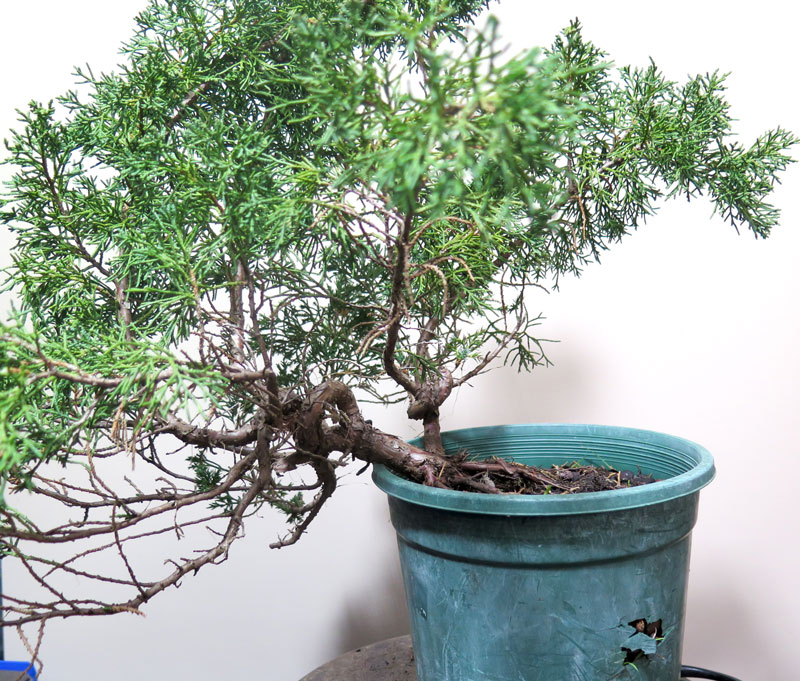
Typical of most stock that has been grown uninterrupted for a number of years, this tree was full of dead shoots, old pruning stubs and leggy foliage. Cleaning up that was the first priority which gave me a better understanding of the branches and trunk movement. For anyone overwhelmed or stuck on a piece of material i cannot recommend doing a basic foliage and trunk clean up enough. Doing this clean is how you get to know the material and you often discover features within the tree and get ideas for the styling moving forward.
Post cleanup, i began to introduce some shari into the two main trunk lines.
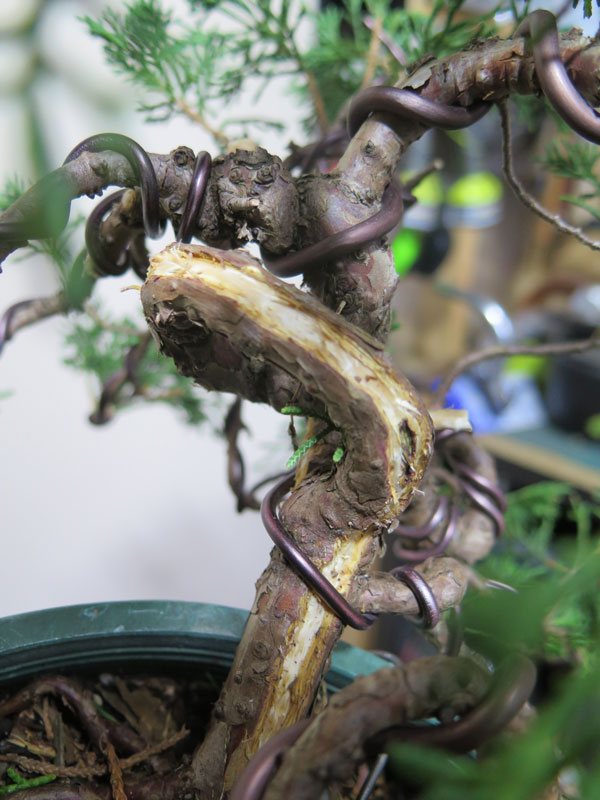

Above: The beginning of shari’s trying to follow the trunk movement.
The incorporation of shari into juniper bonsai are beneficial on a few levels.
Firstly from a design sense, the shari adds a great white contrast to the green foliage and orange trunk line acting almost as a highlight to draw your eye into the movement.
Secondly, by reducing the area of live trunk but maintaining a similar amount of foliage above forces the trunk to thicken the existing live areas at a rate faster than if the whole trunk was growing. You see this in live vein creating where the vein ‘muscles up’ and bulges as a large amount of sap and resources is channeled through a reduced area. This can be manipulated further by leaving the live areas of bark in spots you want to thicken, ie. a live vein either side of a trunk will only see the trunk expand in those directions, creating more side to side thickening than if a similar amount of growth was to occur on a fully live trunk. But i digress again……
At this point i hadn’t really thought about angles, fronts or trunk-lines so after some pondering and some wiring i shaped the tree into a strange composition that i quite liked. I aimed to continue the movement that Kris had formed early on and also establish some flow within the composition which in turn directed branching and the likes. As i said above i was really just looking to set main lines so the end result is a bit messy. Neatness and refinement will come in future years.
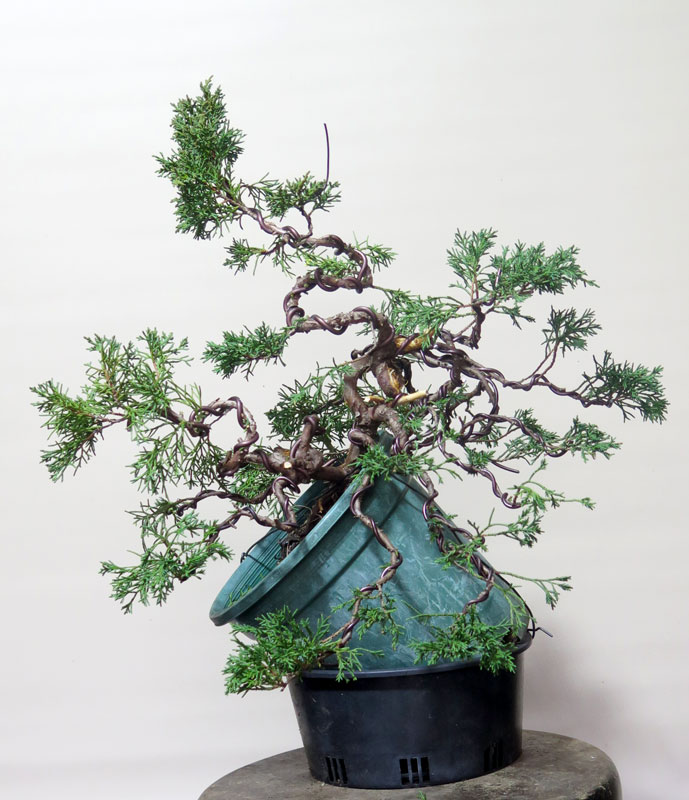
It’s certainly going to be an unusual one. you can see why i have decided to call it ‘The Octupus’ with its twisted limbs going out in all directions.

I think i have set a good base building on the early movement in the lower trunks. I have also done a bit of a bad rough sketch which is below to mostly remind me of the direction it is heading.

From here a lot of growing needs to happen which will likely see this tree staying in larger grow containers for at least a few more years. I really want to thicken the trunk lines while also developing shari’s and the live veins. This is something that simply takes time but i think i will be able to simultaneously work on the foliage pad as i go, hopefully minimising the overall development timeline.
Anyway, that’s all for today, keep an eye out for the other trees from this batch which i will post as i get them worked on.
Today’s post is a quick update on a tree that has been in the works for a number of years. I am not sure when I dug this originally but it was certainly a while ago, five years ago perhaps?
The juniper was originally a Sabina Juniper that came from a local school that was removing the garden bed in which it was planted. A good friend put me onto it and we both dug this and a couple of other similar trunks.

Once I had brought it back to some health from the original dig I set about grafting the foliage over to Itoigawa. While Sabina foliage is fine, after many years persevering and working on trees with sub par foliage i now look to grown trees with the best characteristics. With the amount of time you put into your bonsai i don’t want to be investing that time into a foliage characteristic that will always have down sides. Hence the grafting.
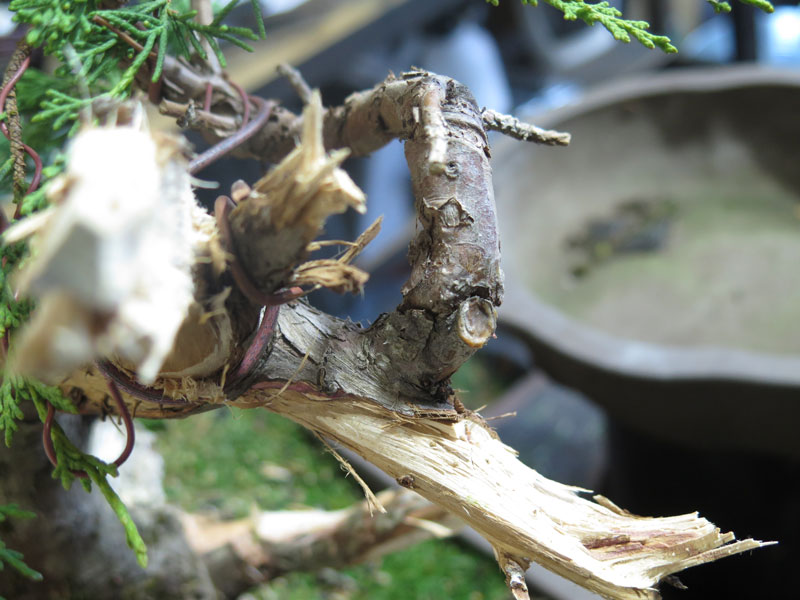
I ended up with two grafts that took and have been growing them out and strengthening them over the last couple of seasons prior to thinking about styling.
I finally got around to doing a rough first styling last night.

Obviously the tree has a long way to go, judging by the timelines with THIS tree, it will be another 2-3 years before this bonsai starts to properly take shape.
That said, it was good to get into this styling and set some structure that the future of the tree will grow upon.
As I worked my way through the basic pruning of the tree i decided to move the direction of the tree back towards the right hand side. As part of this re-directing of the movement of the trunk over to the right, i also began modifying the deadwood to reinforce this movement. I will also need to grow the top of the tree further over toward the right as the tree progresses.
The dead wood still needs a lot of work, i need to spend a bit more time going over the bark and finding the live veins and cleaning dead bark from the deadwood sections as well as continuing to carve the shari and jins.
For carving I very much prefer hand tools for this carving. Chisels, large slip-joint pliers, branch splitters and various other tools all get a good work out. It’s a much slower way of carving but I think it creates a much more natural end result.
The one electric tool I do use is a wire brush on either an angle grinder or drill to strip hard to remove bark and smooth out the fibers from the hand carving………. But carving techniques are probably a topic for another post.
I am looking forward to finishing stripping the old bark so I can get some lime sulphur onto the wood and begin to get the contrast between all the colours to develop. This winter i plan on spending some more time on the dead wood so will post an update when it is further refined.
I also need to start thinking about what pot to put it in. I have a trip to Japan later this year to visit family and will keep an eye out while I am there but I’m still not entirely sure what style to use. If you have any ideas or good examples I’d love to hear about it in the comments below.
Just a quick update on how this tree is developing. It was in the workshop recently for a cleanup (mainly as an excuse to play with THIS).
It is proving to be both a really useful and fun tool to use around the collection. It’s an amazingly quick way to clean up deadwood, remove built up muck, staining and compact dirt from trunks and roots and even stones. Ive had trident maples with dark staining on their lower trunks for years, this is the first season they are clean!! Its a tool that is well worth the investment if you have similar tasks in your own trees.

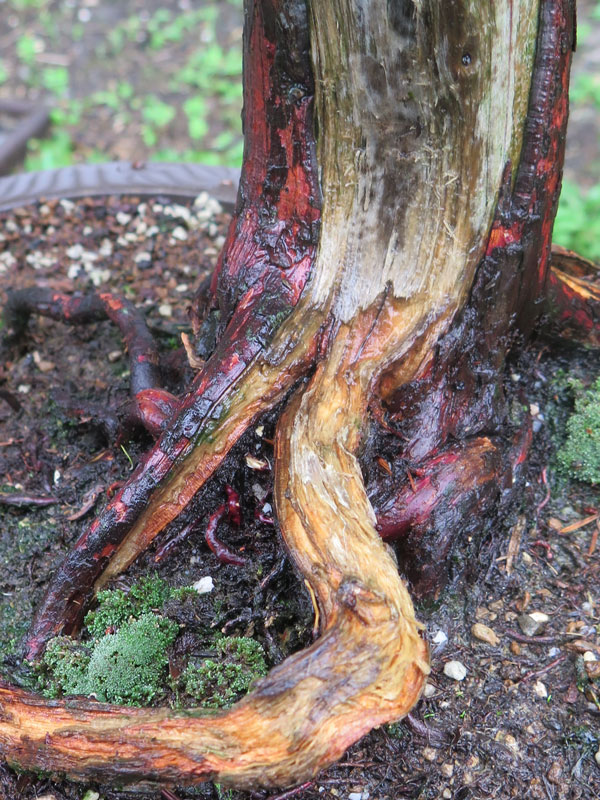
The above comparison shows what 2 minutes can do with one of these tools. You can probably also see that it has removed a lot of the rotten, punky deadwood in the process leaving behind the harder heartwood which has saved another task. All i will need to do is a final hand clean and we are ready for a new coat of lime sulphur.
I am going to also give this ‘Alchohol & Resin’ wood hardener a go this year and see how that works in some of the more prone to rot areas.
As for the tree itself, it is building momentum and developing quickly now and i am contemplating on displaying it at a local show mid next year if it continues to go from strength to strength and i can get all the foliage as developed as the lower first branches pads are.
Its an interesting tree to look at over time as per the images below:
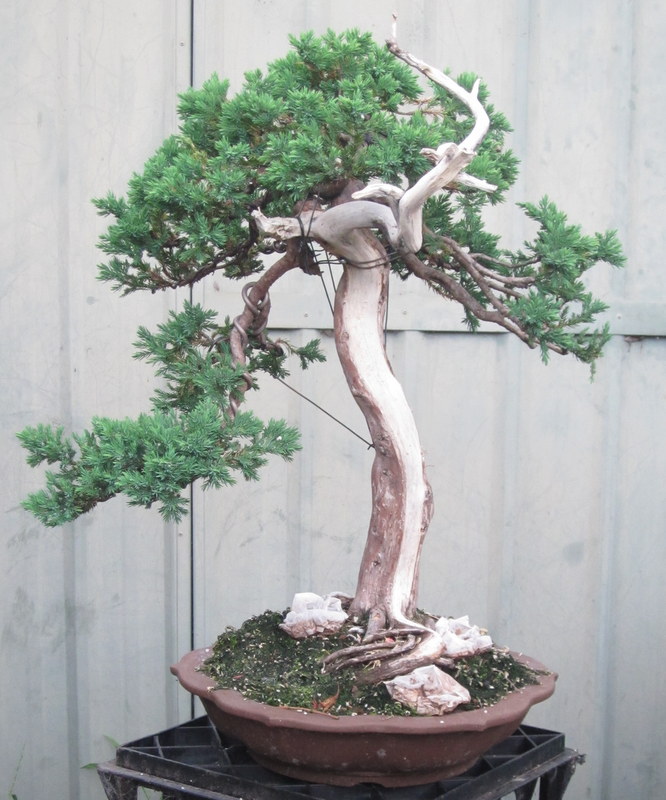


So back to the work, after a good cleaning the shari and deadwood was re-limesulphured and the bark somewhat cleaned up. Its growing into a nice tree.

While I had the tree on the bench i also thinned and shaped the live veins a little on the rear of the tree to further define them and ideally encourage them to ‘plump up’. Afterwards I gave the shari areas and jins a good fresh coat of lime sulphur and added some moss while I waited for things to dry. As I was applying the moss i also pulled and tied down the root on the left side that was hovering above the soil surface which I think was an easy improvement to make.

Next time this tree is on the bench I need to remove and likely re-wire the foliage and branching, but I am going to wait for things to fill in a little more before I do that, maybe next month’s task.
With some down time over the Christmas holidays, I finally got around to re-styling THIS TREE. It had been growing mostly untouched for a couple of years and had well and truly outgrown its former style.

As it had been left to grow a lot of the growth had become leggy and a lack of routine thinning had left fewer amounts of interior growth than i would have liked.
To get started, I began by pruning. I thinned and removed heavy and unneeded branching, upward and downward growing sub branches, thinned the foliage and generally cleaned up the structure.

As I worked I also started to play around with new front angles and didn’t mind it from a slightly counter clockwise rotated position.

I began to wire as I pruned so i could get a better sense of what branches I needed and what could be cut off. All was going well until i made an error. I wasn’t paying enough attention and when I cut off one of the branches in the top of the tree it was difficult to see from my angle that there were two branches in the branch cutters jaws…….. and as a result, i cut the key branch on the right side off.


Well, what was done was done so I continued wiring and worked a front that was much closer to the original. I was pretty annoyed with myself but there wasn’t a whole lot I could do. All in all everything was not lost but i was kicking myself for making such an avoidable mistake.

The ‘finished’ result is a good place to be for now. The styling is pretty sparse due to how much foliage and branching i removed but the trunk and deadwood are now very much more prominent.

You can probably see that the wiring I applied is only on major branches and sub branches. As this is a restyling, I will need to develop the foliage over the next 12 months or so to fill in and tighten up to this new style, so I didn’t bother fine wiring and hence the slightly scrappy appearance.

As the canopy fills in i think i will further fine tune the front. As you can see from the above image that original front is not bad but i still think i prefer the one i ended up with that is slightly rotated anticlockwise. We will see if this changes as i grow some of the branches and get some more width to things (something that i wouldn’t have to wait for if i hadn’t cut off that key branch!)
It is interesting comparing this and my other small Kishu to the itoigawa i have. It is certainly more difficult keeping these kishu small and compact compared to the itoigawa. That said, the branching stays much finer on these so i guess you have to take the good with the bad.
Next post might be an update on one of my itoigawa trees…. we will see.
Just a quick post today tracking a task I do on the semi regular to develop the junipers that have deadwood and shari features.

Above is yet another of my trees in desperate need of a wire. While I didn’t wire it today, iI did do a little thinning of the foliage in preparation for summer growth and a future styling. The main task i completed however, was the widening of the shari’s on the tree.
If you’re interested in seeing the tree 10 years ago, HERE’S it’s first post.
I do this task every couple of years to slowly reduce the sizes of the live veins which speeds up trunk thickening (or more like widening) and develops the shari’s texture.
The technique it’s self is fairly straight forward and involves removing a couple of mm of bark along the edges of the shari. It is a fairly safe process as you have to be pretty unlucky for the branches above to be reliant on the narrow strip of bark but it does pay to make sure that you are not removing all of the bark from directly below branches.

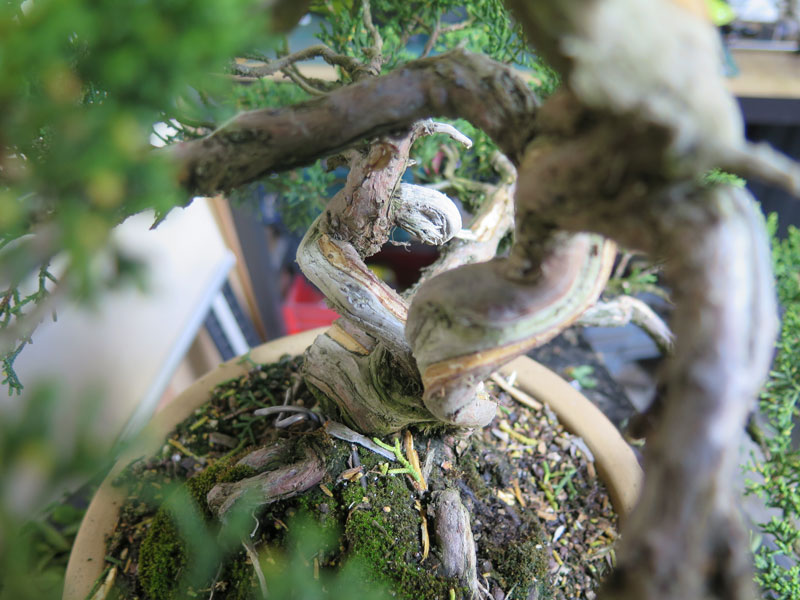

You can see the freshly exposed shari in the images above.
By reducing the size of the live vein you direct the same amount of sap (to supply the foliage above) through a thinner section of bark and as a result it tends to thicken in this area much more quickly compared to a larger area of bark supporting a similar amount of foliage. If you then have live veins on each side of the trunk they will grow outwards and appear to thicken the trunk much more quickly (if only in one side to side dimension.)
The other benefit of doing this technique over time is that you get a great texture on the shari areas. As you expose these new areas of shari, you are exposing younger heart wood and as a result you get lines appearing between the younger and older area of shari. You can see this quite clearly in the images above where there is a year or two age difference between each line. You can end up with an almost finger print like pattern on the shari with no need for carving and its a fairly effortless way to achieve a nice texture.
This is a tree i have been working on for a couple of years.
It was given to me by a good friend (thanks Kris) who was clearing out in preparation for a house move. At the time, it was a mass of foliage and while having some good movement, had been grown as a stock plant with many whips being grown long then later wired and then finally air-layered off as separate trees. It worked really well as a method of producing stock and also did a great job of thickening the trunk on this tree but it was in need of some direction.
I used it as a demo tree at Bonsai Society Victoria in October 2022 for it’s first styling. Unfortunately i don’t have any pics from that time but it underwent a basic program of branch and trunk line selection, reducing it from a huge mass of foliage down to its base structure.
It (and myself) were invited back in June this year (2023) to give it a second pass where i was able to massage things into a much more considered form.

The tree came up pretty well and was a good example to discuss changing the flow or direction of branches as i worked. Towards the end of the demo there was a lot of concern about the chances of ever getting it into a bonsai container as it was in a large growing pot………
Cut to a couple of weeks ago when i finally got around to re-potting it.
Another good friend gave me a pot that he thought would suit it (thanks Ken) and I went about reducing the root mass to a point where they would fit.
I also cut a shari on either side of the trunk to begin forming two live veins that will hopefully make the trunk much more interesting as it continues to develop. I will enlarge these each year until i am happy with them.
It’s a bit of a strange tree but i really like it. The only problem is it hangs down so far below the base of the pot that i will have to weld up a stand for it so it can fit comfortably on my benches.
A quick post to show this little juniper. This re-potting I have stood it up to reveal more of the fantastic trunk-line and will fully re-style it once it settles into the new pot and shows positive signs of growth.

Its a nice little tree that has been with me for a long time. Its not the ideal foliage for shohin as it is much more course than some others and gets ‘shaggy’ quickly. That said with the right amount of work it will be a nice tree.
Its new pot, is one i picked up last time i was in japan and i think suits the tree well. I love its grey tones and always think these colours go well with junipers.
Hopefully in a few months I will share the re-styling with you all. Until then……
 Nichigo Bonsai