You are currently browsing the tag archive for the ‘Bonsai technique’ tag.
During my recent trip to Japan i managed to visit Fuyo-en. Fuyo-en is a garden that always has a high number of quality bonsai. I was a little pine-ed out by this part of my trip so it was nice to spend some time with their amazing deciduous trees. I took a number of photos which can be found HERE.
What was also nice was to see some of the recent work that was going on around the garden.
The frist bonsai i noticed of interest was what I am guessing was a flowering apricot. It had recently been grafted in a number of places. I have read that these trees often need to have young wood grafted into areas of older wood to maintain vigour and keep the bonsai compact.
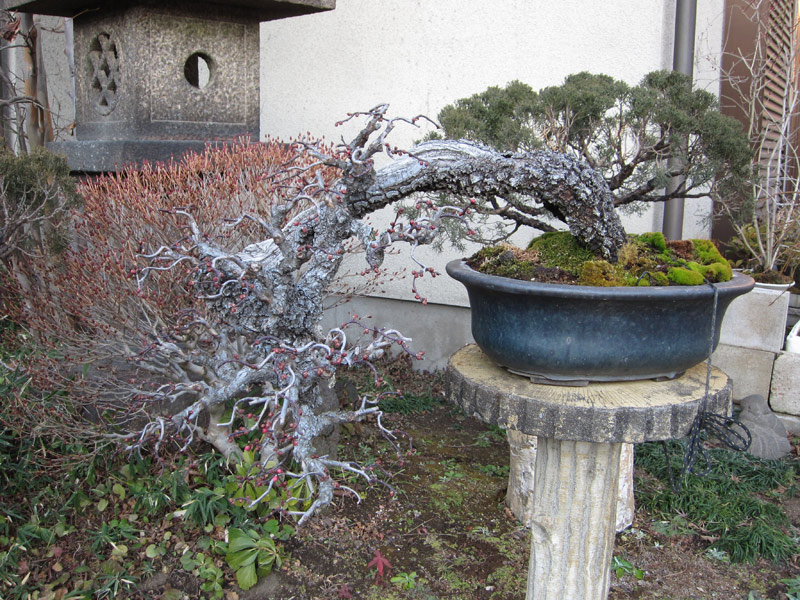
The grafted bonsai.
Although the grafts looked to not have completely healed nearly all of them were producing flowers as can be seen below.
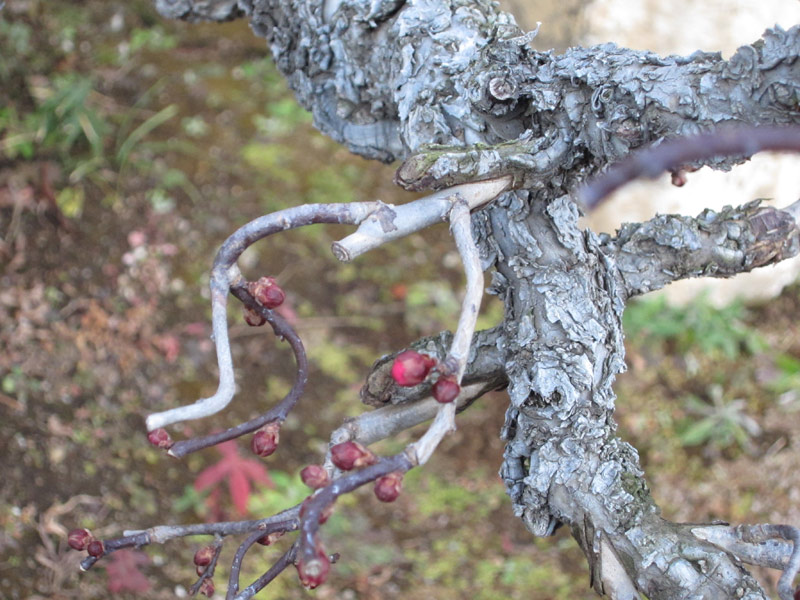
The grafting in detail.
One of the other trees that caught my eye was a maple with an enormous nebari. The bonsai was being worked on by one of the apprentices who was wiring all the branches to the tips.
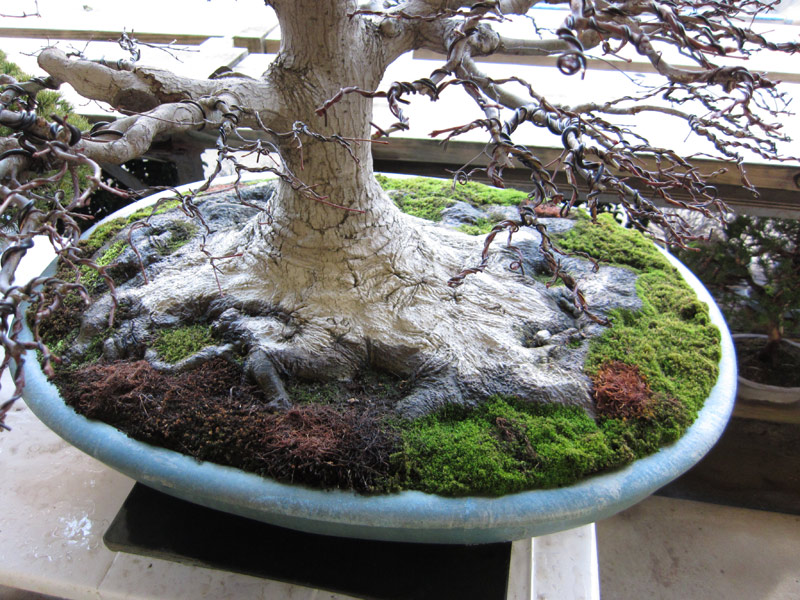
An impressive nebari
I always enjoy seeing techniques done by Japanese professionals. Even seemingly simple tasks can reveal tip and tricks when performed by someone who works at these high levels.
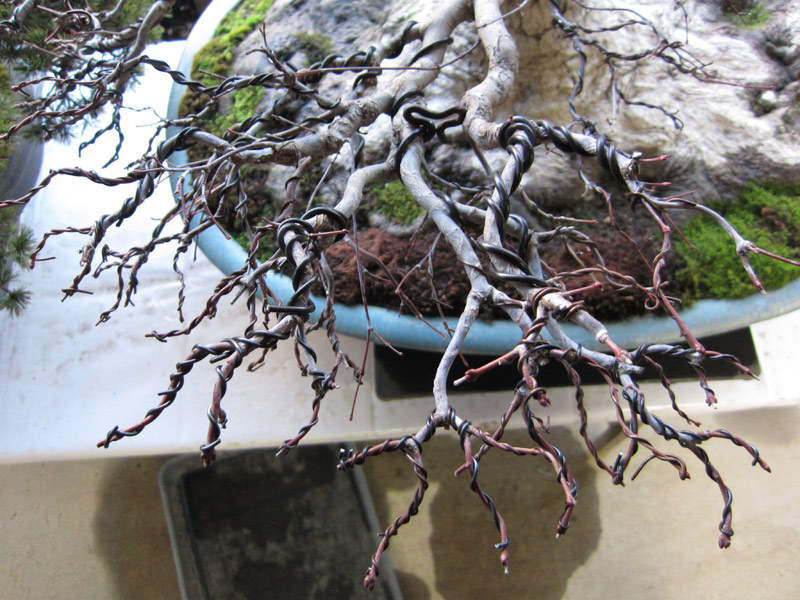
A freshly wired branch.
One such trick that can be learnt from the above image is the use of the little wire bracket. It has been used to gently spread two sub branches. Had this not been used, the two branches would have had to been wired with quite a large diameter wire to achieve the same spreading effect. Having avoided using a heavy gauge wire, the wire that is on the branch appears far less obtrusive than it could have. A small trick with large results.
I always look out for these little tricks when ever I am around other people’s bonsai, as I find there is always something to learn.
It’s that time of the year again.
It’s a time of the year that I both look forward to and dread. Once you amass a certain number of pines you begin to realise just how much time you need to set aside to give each tree its seasonal maintenance. This year, I have moved house and as a result some of the trees I would have normally have worked on earlier in the month were left until now, so the back log of tasks compounded the time I needed to spend on them. That being said, once I began the work I really enjoyed getting to see just how each tree had been growing over the season. When you thin needles you get to inspect very closely every branch of the tree and evaluate each new bud, needle and twig. You really get to know your trees while doing these tasks.
Why do you thin needles? You should thin needles at this time of year for a few reasons.
- By removing last season needles you let more light and air into the canopy which in turn encourages back-budding.
- By removing some of this seasons needles on strong areas you are able to balance strength across the tree foliage.
- By removing surplus needles you also reduce the amount of places that insects and other pests are able to hide.
I like to think that needle reduction for pines works a little like defoliation does for deciduous trees. I figure that the pine realises it suddenly has less foliage and as a result sets new buds which will grow the following spring to replace the needles that you removed. As pines cannot simply grow new needles they have to throw new buds. Most of these new buds will be dormant buds back within the canopy. These are the buds you want. This back-budding is what will give you foliage to cut back to in the future and which will prevent branches becoming leggy.
This year I have left a few more pairs of needles then I usually may on some trees as I plan to re-pot them come spring and figure they could benefit from the extra strength more needles will provide.

A Formal upright Black Pine in the making. This image was taken prior to beginning needle thinning.

The same tree after thinning. It is still very much in developement but after a few years of work i hope to have a more complete looking tree.

This is another JBP from the same batch as the above pine. It has developed much better than the above pine. It avoided many of the mistakes the other tree had to endure as i was learning. Photo was taken before thinning.

The same tree after thinning. It needs the apex developed but otherwise is on the right track. I am also planning to graft a back branch or two into the upper section this spring which may be the topic of a future post.
I also thinned my large Radiata. I again left more needles on it that i usually might for two reasons. The first reason is because I will be re-potting it this spring and I want it to be strong. The second reason is because I am experimenting with leaving more foliage on it much like you would on a white pine. We will have to see how that works out.

A Radiata branch prior to thinning.

And the same foliage after a light thinning.
If you read my previous post Pinus Radiata (Monterey Pine) Techniques you are probably wondering how the progress is going. The answer is slowly but surely.
After asking all over the net, i have come to the conclusion that not a whole lot is known about growing this species as bonsai. Funnily enough the most information came from Australians. I am guessing that this is due to its wide availability in Australia and Australia’s lack of other dig-able pine species.
There are quite a few growers of this species here and quite a healthy debate was started on Ausbonsai and some very nice examples of Raditatas grown as bonsai were posted. There was also a lot of interesting information shared such as how easily they airlayered.
What has come out of this? Well I think it will be a bit of an ongoing project, ticking away in the background. I plan to document over the next 12 months the various changes in a couple of my trees as they grow in the hope that once I understand their growth habits a bit better I will be able to work out a timing for pruning and candle removal.
I will keep giving updates from time to time as I document them.
I will leave you with two images. Both images were taken on the same day, from different trees. One needed repotting and the other had been repotted this year. I think it is clear that one has neat needles while the other does not. This pair of images gives me hope i can get radiatas to consistently give short neat needles like those in the picture of the older tree.

A young tree
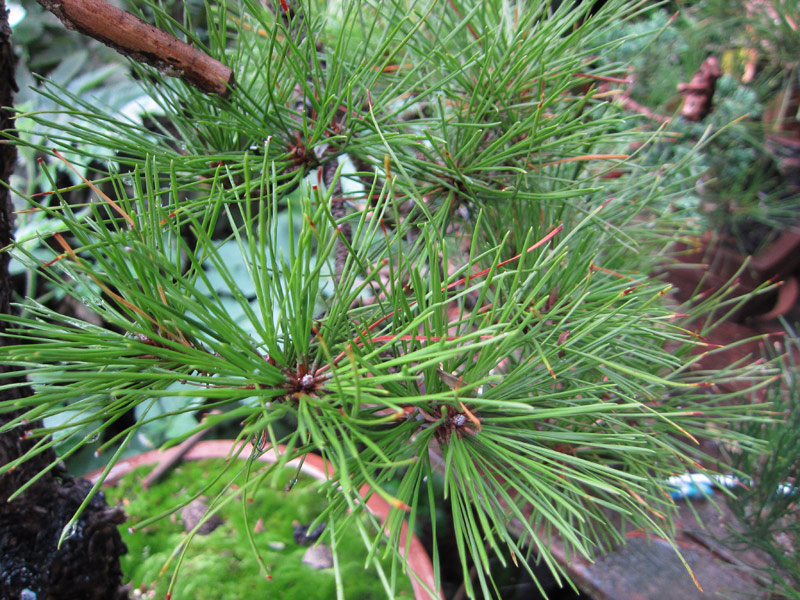
An older tree
Stay tuned.
Pinus radiata was first introduced into Australia in the early 1850’s but was not commercially planted in large numbers until the 1960’s. Since their implementation as a commercial timber crop, Australia has planted around 740 000 ha of the pine.
In plantations, seed produced by the pines germinates readily and many seedling pines can be found around areas where plantations are present. As Australia doesn’t have any true pines native to it, these plantation escapees are the closest thing to the yamadori pines of other countries that we have. In fact, the radiata is such a vigorous grower and reproduces so easily that in many states it is declared an invasive noxious weed species.
Pinus radiata or ‘The Monterey Pine’ although prolific as a timber species around the world is not commonly used in global bonsai circles. This is perhaps because it is a little quirky when grown as bonsai.
They have a lot of traits that make them ideal for bonsai. Fantastic bark, vigorous growth, highly flexible and the availability of ‘wild’ stock to be dug up all add to their bonsai credentials.
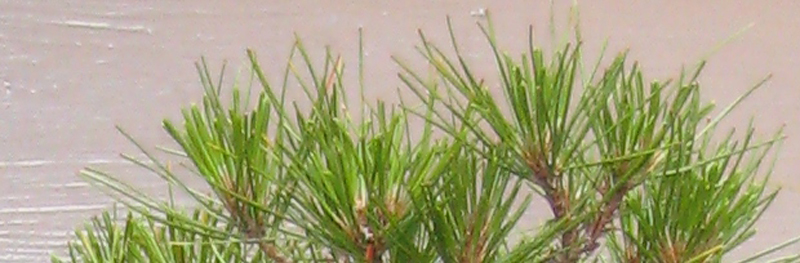
The needles of a mature Radiata bonsai
I have been growing a number of Radiatas and I am still yet to find the magic bullet for refining them.
Black pines seem difficult to grow until you understand their growth patterns and then prune, candle cut and needle thin at designated times of the year. The result of working within their growth habits produces neat and small needles and a large amount of back budding.
Radiatas I have not found as easy to master.
When I first started growing them I was told how easily they back budded and that you would have ‘almost too many buds’. This sounded too good to be true, and during the subsequent years of growing them I unfortunately found this to be the case.
The other problem I find with them is their needles. They can often be long, twisted and curled, but on some trees (one of mine being a key example) I have noticed shorter, neater and straight needles appear after the previous year’s unruly growth. This gives me hope that I may be able to work out a way to evenly force a neater shorter needle length by working with the tree’s growth cycles.
I have received a whole range of advice on taming this species. This has covered a whole range of often conflicting techniques, see below:
- Treat them like a black pine
- Treat them like a white pine
- Pinch them constantly like a juniper
- Wire one side completely, then later wire the other side
- Pot them in an open mix
- Pot them in a heavy mix
- Break candles in half
- Remove new growth totally
Over the next couple of posts I hope to generate some discussion with other growers that may dispel some myths and share successful techniques with the wider bonsai community. So if you know anything about Radiatas or grow them at home and are having similar problems please send me an email (Look under ‘contact me’ in the left side bar) or add a comment below.
To get people thinking I have included an old golden statements article to kick off the discussion that was written by Nancy Eaton on Mr Katsumi Kinoshita back in 1984. I used it as a starting point for my trees. Have a read and let me know what you think. Does the way you grow radiatas differ from those of Mr Kinoshita? I would love to hear about it. Next week I will begin to post about my experiences with the species and some of the things that have shown good results and others that have not been as successful.

Click to enlarge.

Click to enlarge.
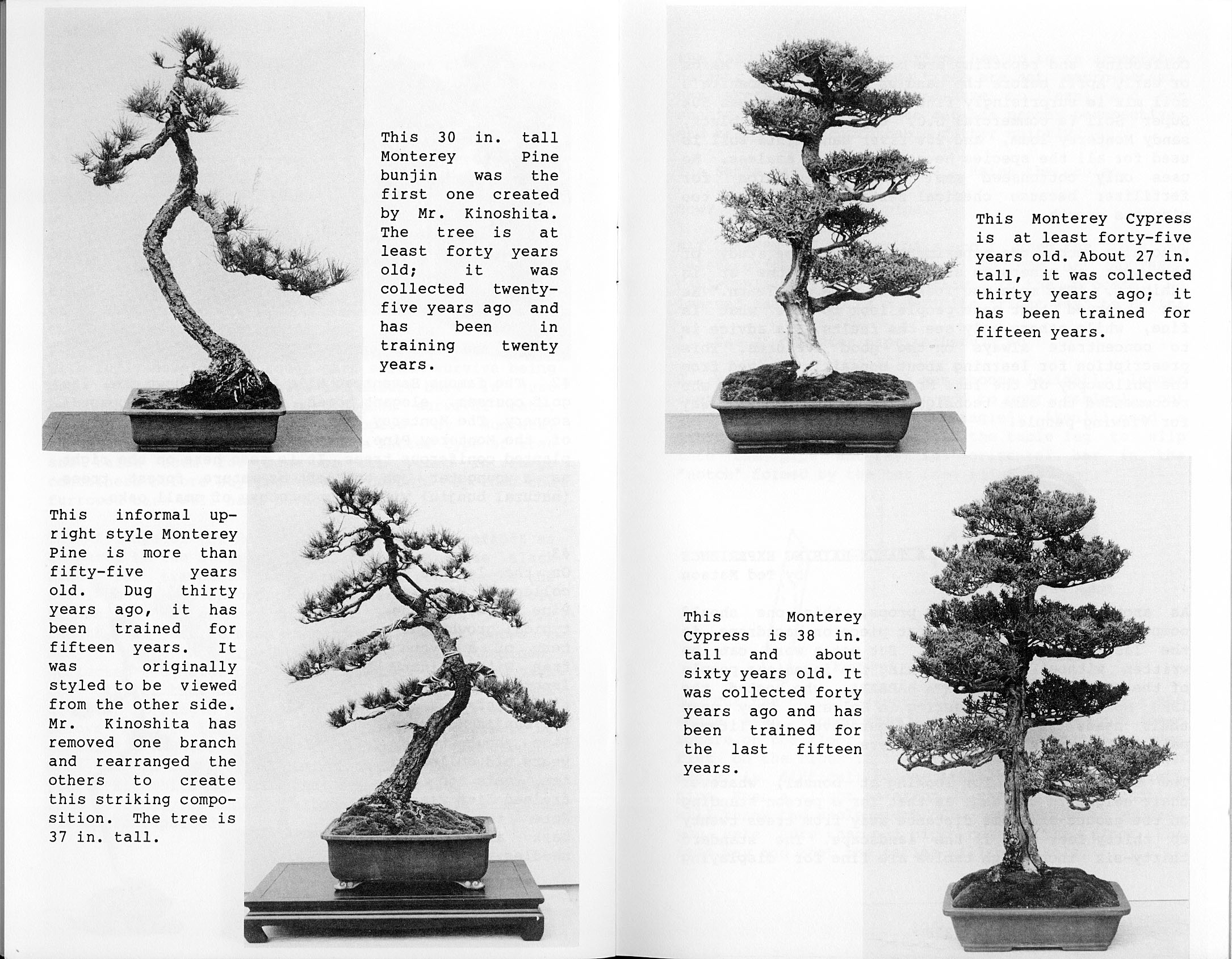
Click to enlarge.

Click to enlarge.
Following on from yesterdays post I thought it would be good to include some examples of approach grafts that were at Taisho en while I was studying. The two examples below are using approach grafting for two different reasons. The first is grafting roots onto an upper section of a trunk to shorten a bonsai. The other is using the technique to both replace foliage and graft on new roots.

What do you do when you want to shorten the trunk of a species such as Tsuga that doesn't aerial layer well? Approach graft!

Here you can see some new roots being grafted to a Tsuga trunk. The roots have been wrapped in cloth and are both watered and fed as if in a standard pot.
The taxus tsuga above was an interesting bonsai with an un-interesting lower trunk. The image of the bonsai could be greatly improved by shortening the trunk and hence roots were approach grafted onto the trunk.
The below juniper was undergoing a major change too. It was a tosho or japanese needle juniper (Juniperus rigida). It was very large stock extending about 2-2.5 meters in length. It had some great movement and excellent jin/shari. The future for this tree was to break it up into sections. By grafting new roots and new foliage along the live vein at key points the large piece of stock would be able to be broken down into 3 or 4 bonsai, all with nice movement and good foliage. Shimpaku juniper was grafted onto the tree instead of more tosho as it is a more popular species and therefore easier to sell once the separation is complete.

As you can see this is a large piece of stock that is both too big to become an exhibitable bonsai (by Japanese standards) and the foliage is that of needle juniper which is not popular in Japan at the moment. How would you improve this material? Approach grafting.

In this case roots are being grafted onto a section of live vein in order to allow the entire trunk to be split up into smaller individual bonsai.
Hopefully from these two posts you can see the possibilities that this technique can provide. The ability to manipulate your stock and bonsai is a powerful tool in the bonsai artists arsenal. Shortening trunks, adding branches and changing foliage types can be controversial in some bonsai circles but I think that when push comes to shove the results speak for themselves.
I have been quite lucky that I have been able to visit a number of Japanese nurseries (SEE HERE). I love seeing the high quality trees and amazing level of finish and polish that these trees posses, but what I have also found very interesting during these visits is looking into the back of house areas where bonsai are in various stages of transformation.
Air layers, grafts and other techniques are all on display out the back of most nurseries. It not only gives you a look into these techniques but also gives you some ideas on what sort of material to apply these techniques to.
One such technique is approach grafting.

A needle juniper is slowly changing its clothes. Soon it will be a much more valuable shimpaku. The white lump is the rootball of the scion which is wrapped in towel to protect its roots.
While I was studying at Taisho-en I was able to see this technique used to improve a range of stock. Shimpaku were given smaller foliage. Needle junipers were given shimpauk foliage. Roots were moved closer to the foliage to shorten trunks. It was obvious that after only a short stroll through their back of house that this was a valuable technique.
The technique itself, whether you are grafting on new roots or new foliage, is rather simple.
- Find a scion whip of the same species around 1-2 pencils thick and slice a sliver of bark off opposite sides at the point you want the whip to be grafted.
- Cut a channel in the trunk the same depth as the whip is thick.
- Widen this channel with a sharp knife to ensure clean cuts. The width of the channel should make a snug fit for the cut down section of scion.
- insert the scion into the stock trunks channel. Ensure that the cambium layers meet up accurately along the top edge of the channel cut.
- Fix the scion into the channel so it will not move or become miss-aligned. You can tie it with grafting tape or use a nail or two, screw etc.
- Cover it all in some type of sealant and wait for it to take.

I drew up a quick diagram to help explain the technique a little.
The scion whip can be from several sources. It could be a long branch doubled back on itself and grafted into the trunk, or could be a small whip that is growing in its own pot. If your scion is of the second type you may need to wrap the root ball in hessian or towel if the root ball ends up in a strange position after being grafted.
How long does the graft take to be successful? That is a difficult question. It is species dependent, growth dependent and also depends on how well you aligned the cambium layers in the first place. Although you can have success with poorly aligned cambium layers in this technique due to the face that both scion and stock support themselves before the graft takes, it is much faster to align the cambium correctly from the get go. I would say that most approach grafts would need one to two years to take. After that you could begin to reduce the original foliage over time and slowly let the new grafted foliage take over.
All in all it is a very useful technique that can be use to get you new roots, new foliage and generally improve difficult stock.
In the next day or so I will be posting a few examples to further illustrate the technique.
To see some real life examples have a look at “Approach grafting 2”.
 Nichigo Bonsai