You are currently browsing the category archive for the ‘Bonsai Maintenence’ category.
The following tree was a large Shimpaku (Juniperus chinensis) I worked on towards the end of my first stay at Taisho-en, Japan.

Before the majority of the work (first branch wired)
It is a tanuki (or phoenix graft) which had a couple of issues.
The first problem was that the grafted foliage was of a very large and coarse variety which at the time of styling was not particularly popular with buyers in Japan. They were more interested in the fine dense foliage of the itoigawa shimpaku from the Niagata region and similar fine shimpaku varieties.
The other problem was that the live veins were not entirely convincing in how they were attached to the deadwood.
Having said that I still feel that the tree ended up an impressive bonsai and I am proud that I was allowed to have an imput into the tree future.
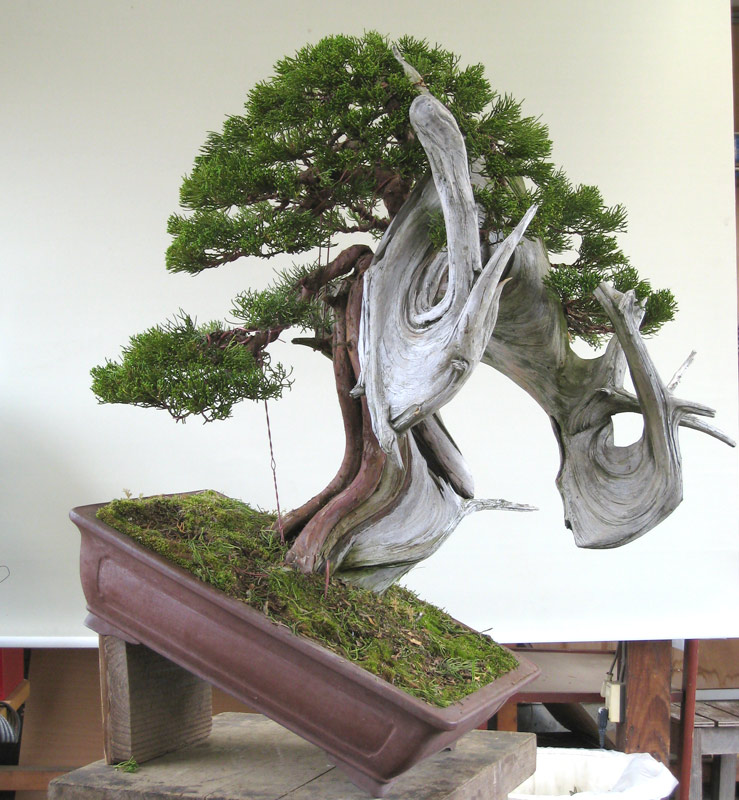
After many hours wiring
This spring is much wetter that what we have become use to over the last 5-10 years of drought. This drought breaking rain that we are experiencing has come as a welcome beginning to this seasons growth for my bonsai. They are all growing like crazy. Judging from what i have seen in the month or so since spring has started i am guessing that we are in for an excellent bonsai year ahead.
One of the trees that has been growing strongly is the trident maple that is pictured below. It has been growing so well that i have decided to defoliate is a little earlier that i normally might in the hope that i will be able to defoliate two or even three times to encourage far more fine ramification i would get in a normal growth year.
If you look towards the base of the tree you will notice a small seedling that is being grafted into the nebari to fill in a small gap in the root spread.
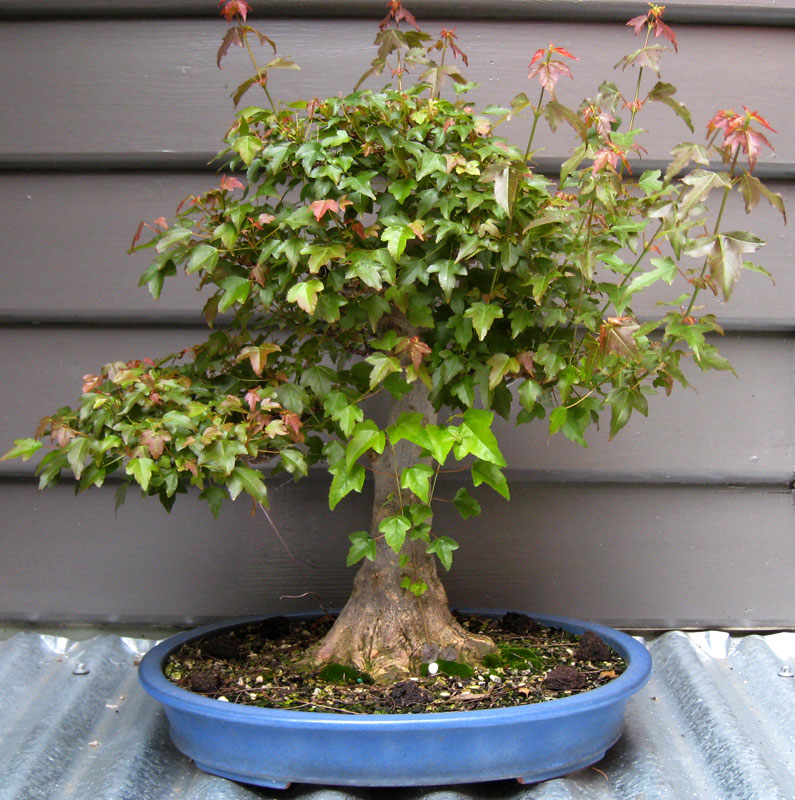
The trident before defoliation.
I have been growing this tree for a number of years and it is really starting to become on of my favorites.
This year i rewarded it with this old ‘Reihou’ tokoname pot that i bought on my last trip to japan. I think the blue really suits the tree well. I will make a separate post about this and other pots in a subsequent post.

The trident after defoliation.
This is how the tree looks after defoliating it. I have left leaves on the shoots that were weak in order to give them a head start over the new growth. This ballancing of shoot strength should even-out the energy distribution over the trees canopy.
I also like to add a few more fertiliser cakes to the tree after defoliation to help the new buds form.
One of the other things i am trying to achieve with this defoliation is to pop a bud that is between the first and second branches on the back of the trunk. There is a bud there that has slowly been getting bigger and bigger but has not yet formed a shoot. Hopefully this work will be the catalyst that sees the bud grow a branch right where i want one.
Those who look closely will notice one of the shots seems to have been bent back in towards the trunk. This is a thread graft that i have put in place to fill a gap in the canopy. Hopefully by the end of this season the branch will have grafted onto the trunk and will have begun to ramify.
I look forward to seeing this tree progress over the course of the summer and hopefully it will reward me with some nice autumn colours.
This is a tree I styled on during my second stay at Taisho-en, Shizuoka, Japan. It is a Tosho (Needle Juniper) that was most likely collected.
I had seen it during my previous stay and had helped graft shimpaku foliage onto the live vein via the process of approach grafting. Subsequently, for what ever reason the shimpaku whip died and the tree grew out to a shaggy silhouette. Mr. Urushibata had decided that instead of trying to graft the foliage a second time that he would instead have me re-style it utilizing the original foliage.
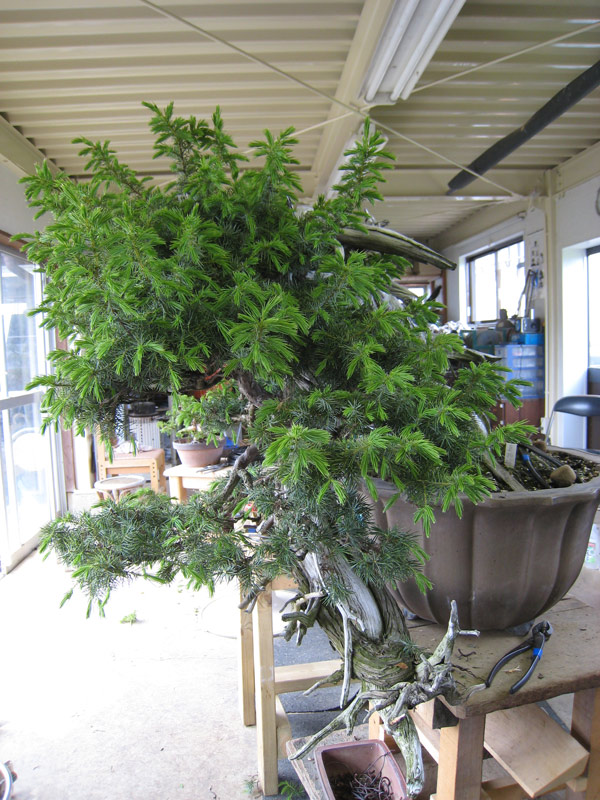
The tree before the work
As tree had grown out so much it had to be pruned quite severely but enough remained to establish a good structure upon which future ramification could be built.
Tosho are an interesting species to work with. They display an ancient image (especially if you are lucky enough to have material such as this) and the contrasts between deadwood, live vein and the blueish hue of the foliage make them quite unique.
They are not the easiest species to style as they can be quite uncomfortable to work with. As their name suggests, their foliage is needle sharp and pierces your skin with almost every touch. This negative is countered by so many of the good features of this species. Even the dry heart wood rewards those who endure the sting with a magical sweet scent.
Personally I do like the fact that the tree leaves a mark on you. Days later while my hands were stinging while washing up under a cold tap I would find my mind drifting back to the tree that left the marks.
Sometimes things are worth a bit of a struggle.

The Needle Juniper after the work
I hope that this tree is at the nursery when i next find the time to get back there as i would love to see how it is progressing and possible have a opportunity to feel its sting again.

