You are currently browsing the category archive for the ‘Bonsai Maintenence’ category.
The tree in this post was another i worked on while in Japan. It arrived at the nursery one day and was in need of a re-think and re-style.
The major change was to stand it up.

Before the work.
I first wired the tree, keeping the small second trunk and then re-potted it into its new upright position.
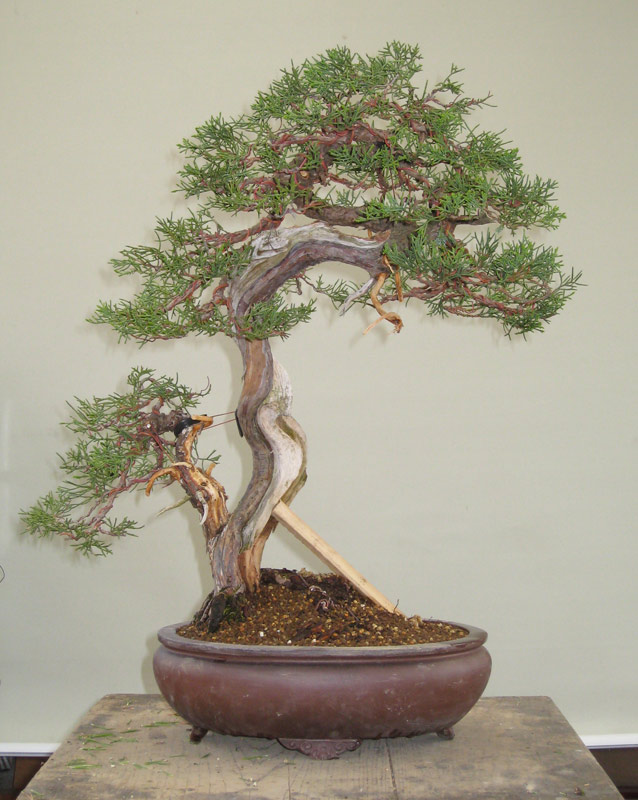
After the work
As the tree had its angle changed so dramatically it needed time to re-establish a new rootball that could support it in its new position. In the mean time a bamboo prop was used to take the weight of the tree while the rootball became stable enough to support itself.
Unfortunately some of the lower shari had been buried in the previous potting angle and as a result had rotted. I feel that the base would have appeared much more impressive had it still had deadwood at its base.
It was a nice tree to work on, but at the time i guess it got lost amongst all the other high quality trees in the nursery.
This was by no means a top tree but looking back at it now I would kill to work on material such as this in Australia.
I guess I will have to sharpen the shovel and keep an eye open for urban junipers in friends gardens.
The tree below is a very nice old hinoki (False cypress) that i worked on while i was in Japan. This tree had been shown in Kokufu, so i was very honored to get to work on such a nice tree. (If any one reading this can find it in an old album please let me know what number)
The tree had been grown out without much maintenance for a number of years and as a result the it had grown very dense and had lost some inner branching.

This is the tree after the first branch had been pruned.
My job was to thin out the entire canopy, remove un-needed branches and reduce the remaining branches back to a more manageable structure. This work was intended to stimulate back-budding prior to a future wiring.

The pruning is half done.
As the tree was large, it took me a full day just to prune it from bottom to top.

The pruning is finished.
After the work the structure of the tree started to become apparent. Although it still has a long way to go, it is now easy to imagine it future .
The tree had the most amazing twisting bark that i am sure will add to its chances of one day again being shown in Kokufu.
Unfortunately i was unable to work out what species of Chamaecyparis it was. I am guessing Chamaecyparis obtusa but i am not 100% sure. It had fine foliage that i had not seen before. If anyone reads this and can identify the species from the pics below please add a comment or send me an email.

The foliage up close.
It was a great tree to work on and taught me a lot about pruning. At the start of the process i was concentrating too much on the tip density. Mr. Urushibata spent some time explaining how you often you have to look deep within a branch structure and cut out some secondary branches rather than thinning the tips. It was a concept that like many in bonsai seemed simple enough but was not apparent until someone pointed it out.
Although there are many forestry species of pine planted around Australia, Pinus radiata is by far the most prolific. Known as radiata in Australia it is also known as the Monterey pine in places such as America where it is indigenous to.
As it has been planted on mass it is one of the few coniferous species that you can find to dig. They produce seed well and generally anywhere you find a plantation you will also find feral seedlings. This is so much of a problem in some areas that they are declared weed species.
The up side of all this is there are many opportunities to dig and grow these pine as bonsai.
The below pine is a radiata that i obtained through a friend. He had sourced it from an old grower who had no longer been able to care for it.
When i received it, it had a lot going for it; old bark, nice nebari and a trunk with some movement and age. These were all factors that encouraged me to pursue its future.
That said it also had a whole host of problems.
It was quite sick and all the needles were yellow. It had lost most of the lower branches and those that remained all were angled upwards and had foliage mainly at the tips. When I cut the tie wires in the pot it fell over because it had barely any roots.
I re-potted and fed the tree back to health over the corse of a year and then began to think about styling.
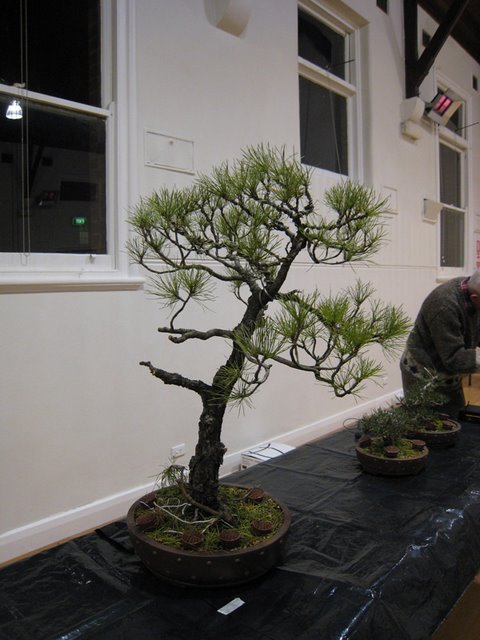
This was the tree before styling began
As the branches were all old with quite old bark i was reluctant to bend them into their future downward position in one go as i was pretty sure they were going to be brittle.
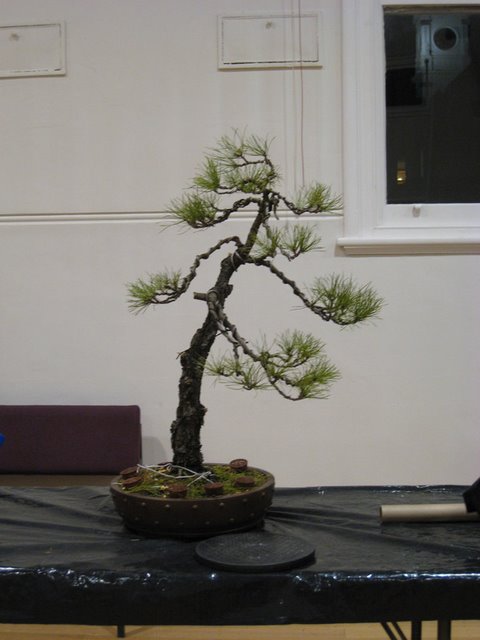
After the first round of bending
After bending the branches into the above positions almost every branch had began to crack. It was now a matter of letting the tree grow out and recover before completing the bending.
A year later the tree had been growing strongly and was ready for round two. I had slowly increased the downward angle of some of the branches over the course of the growing season but they had not yet reached their final possitions.

The tree had recovered well and it was time to make some decisions.
I had decided that the first branch would be removed and i would fill this visual position with a ‘Nozoki no eda’ or peeping branch. This type of branch is basically a first or main branch that originates from behind the tree but occupies the space a first branch would. This style of branch is often seen is junipers.

The branch removed
I removed the branch and began to wire the tree. You can see the result of this first real styling in the image below.

After the first styling
The tree was fully wired into shape and some jin was created at the base of the removed branch. I left it long for future use as a guy wire attachment point and still have not removed it. I will probably get around to shortening it and refining it this winter.
Since the above photo the tree has grown strongly and has had one re-wiring. It was starting to take shape and was ready to be un-wired.
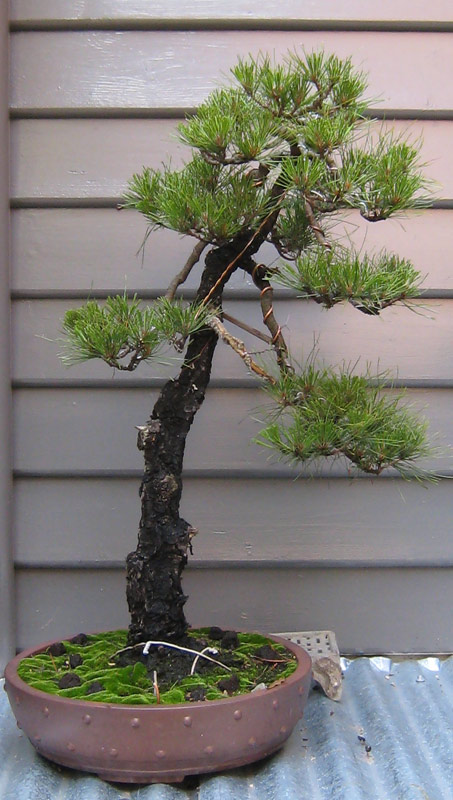
After some strong growth.
I un-wired the tree and did a small amount of re-wiring mainly to the tips of the branches.
It is nice to reach a stage with a tree where you no longer have to wire every main branch.

After a basic wiring.
Above is how the tree ended up after a basic wiring. It really needs a full wiring which i plan to do this coming winter. Hopefully this seasons growth will fill a couple of gaps in the apex and generally give some more weight to some of the foliage and at the same time strengthen some of the weaker buds so i can reduce the branches to them.
The tree is really only beginning its journey to become a refined bonsai but most of the structure is there. Unfortunately the day that i took the above photo it was raining so the bark is dark and it is hard to see just how nice and crackily the bark is.
Radiata’s are a tree that i am still really trying to work out how to grow well. Last year i tried to treat them like a black pine and cut all new growth off around christmas time. It did not respond very well and didn’t really produce any back-budding. This year i am going to grow them a little more like some of the other growers in my area. That is they pinch out strong growth as it appears and continue to do so throughout the growing season.
I was kind of hoping that there would be a calendar bases technique i could use to remove the new growth but at this time it doesn’t seem like there is. Perhaps overtime i will understand them more and then will be able to develop a better method. In the mean time i will just enjoy watching them grow and the work associated with those phases.
If anyone has any techniques that work with these pines, please share them in the comments.
I like growing and working on shohin sized bonsai. This Shimpaku was another that I was lucky enough to style while at Taisho-en, Japan.
It had all the makings of a good bonsai, but had become overgrown and needed to be styled.

This is the small Shimpaku before the work began.
The trunk line had an interesting twist and the shari and live vein had started to contrast with one another nicely.

And this is the tree after styling
This work was really just a wiring exercise. I was able to position most of the foliage into good positions but it really needed a year or twos growth to fill out some of the weaker branches. The foliage was positioned in a way to allow the viewer to see the nice twists in the trunk and shari.
All in all it is a very nice tree that can only improve as it ages. This was definitely a tree I wished I could have put in my suitcase before I left.
The following tree was a large Shimpaku (Juniperus chinensis) I worked on towards the end of my first stay at Taisho-en, Japan.

Before the majority of the work (first branch wired)
It is a tanuki (or phoenix graft) which had a couple of issues.
The first problem was that the grafted foliage was of a very large and coarse variety which at the time of styling was not particularly popular with buyers in Japan. They were more interested in the fine dense foliage of the itoigawa shimpaku from the Niagata region and similar fine shimpaku varieties.
The other problem was that the live veins were not entirely convincing in how they were attached to the deadwood.
Having said that I still feel that the tree ended up an impressive bonsai and I am proud that I was allowed to have an imput into the tree future.
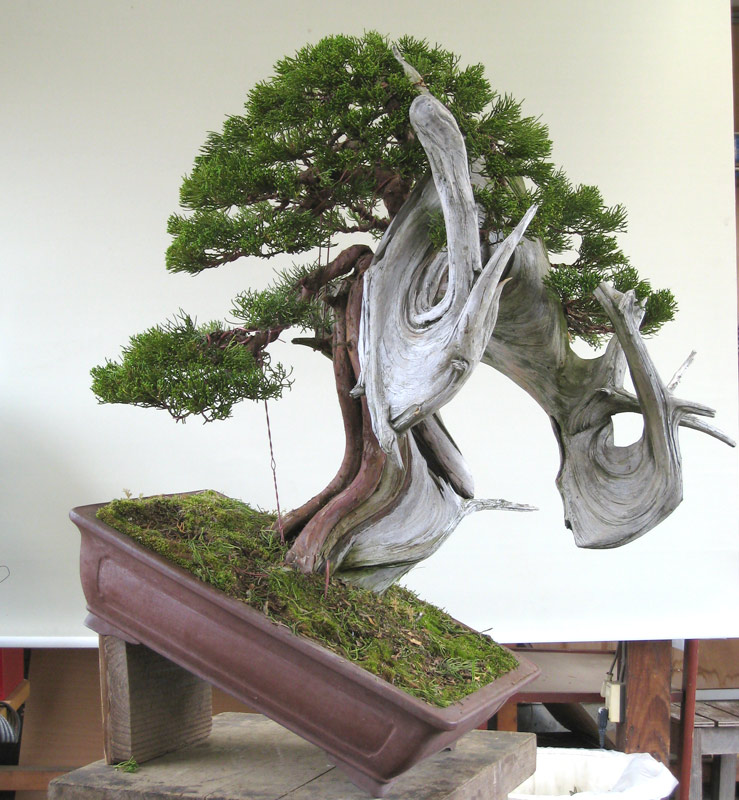
After many hours wiring
This spring is much wetter that what we have become use to over the last 5-10 years of drought. This drought breaking rain that we are experiencing has come as a welcome beginning to this seasons growth for my bonsai. They are all growing like crazy. Judging from what i have seen in the month or so since spring has started i am guessing that we are in for an excellent bonsai year ahead.
One of the trees that has been growing strongly is the trident maple that is pictured below. It has been growing so well that i have decided to defoliate is a little earlier that i normally might in the hope that i will be able to defoliate two or even three times to encourage far more fine ramification i would get in a normal growth year.
If you look towards the base of the tree you will notice a small seedling that is being grafted into the nebari to fill in a small gap in the root spread.
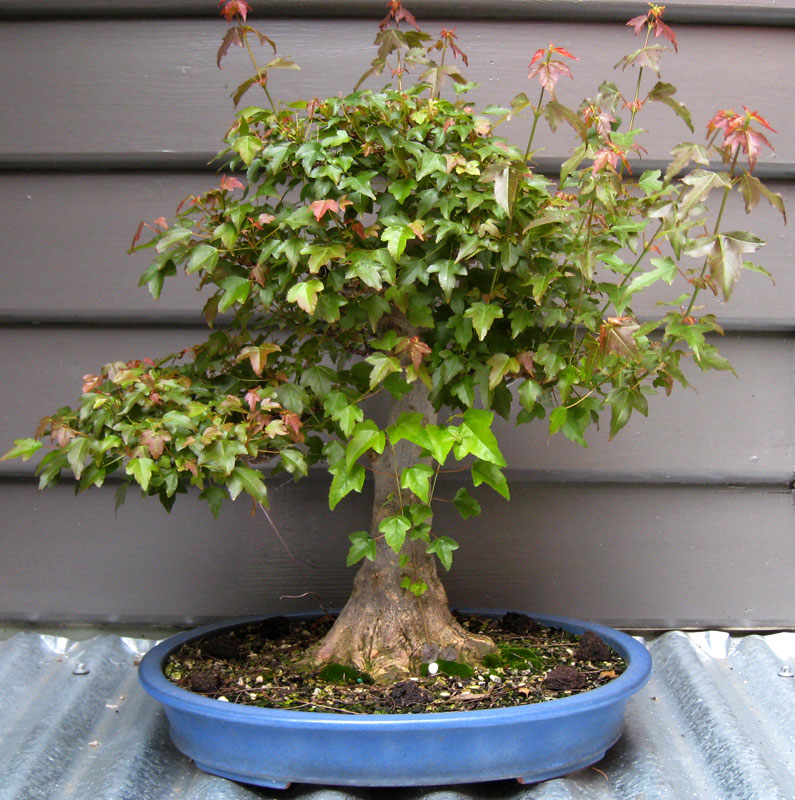
The trident before defoliation.
I have been growing this tree for a number of years and it is really starting to become on of my favorites.
This year i rewarded it with this old ‘Reihou’ tokoname pot that i bought on my last trip to japan. I think the blue really suits the tree well. I will make a separate post about this and other pots in a subsequent post.

The trident after defoliation.
This is how the tree looks after defoliating it. I have left leaves on the shoots that were weak in order to give them a head start over the new growth. This ballancing of shoot strength should even-out the energy distribution over the trees canopy.
I also like to add a few more fertiliser cakes to the tree after defoliation to help the new buds form.
One of the other things i am trying to achieve with this defoliation is to pop a bud that is between the first and second branches on the back of the trunk. There is a bud there that has slowly been getting bigger and bigger but has not yet formed a shoot. Hopefully this work will be the catalyst that sees the bud grow a branch right where i want one.
Those who look closely will notice one of the shots seems to have been bent back in towards the trunk. This is a thread graft that i have put in place to fill a gap in the canopy. Hopefully by the end of this season the branch will have grafted onto the trunk and will have begun to ramify.
I look forward to seeing this tree progress over the course of the summer and hopefully it will reward me with some nice autumn colours.
This is a tree I styled on during my second stay at Taisho-en, Shizuoka, Japan. It is a Tosho (Needle Juniper) that was most likely collected.
I had seen it during my previous stay and had helped graft shimpaku foliage onto the live vein via the process of approach grafting. Subsequently, for what ever reason the shimpaku whip died and the tree grew out to a shaggy silhouette. Mr. Urushibata had decided that instead of trying to graft the foliage a second time that he would instead have me re-style it utilizing the original foliage.
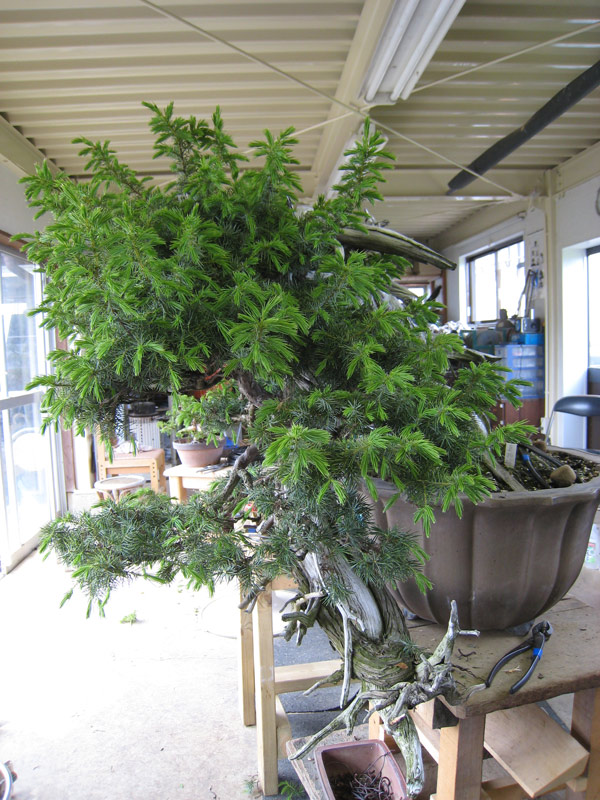
The tree before the work
As tree had grown out so much it had to be pruned quite severely but enough remained to establish a good structure upon which future ramification could be built.
Tosho are an interesting species to work with. They display an ancient image (especially if you are lucky enough to have material such as this) and the contrasts between deadwood, live vein and the blueish hue of the foliage make them quite unique.
They are not the easiest species to style as they can be quite uncomfortable to work with. As their name suggests, their foliage is needle sharp and pierces your skin with almost every touch. This negative is countered by so many of the good features of this species. Even the dry heart wood rewards those who endure the sting with a magical sweet scent.
Personally I do like the fact that the tree leaves a mark on you. Days later while my hands were stinging while washing up under a cold tap I would find my mind drifting back to the tree that left the marks.
Sometimes things are worth a bit of a struggle.

The Needle Juniper after the work
I hope that this tree is at the nursery when i next find the time to get back there as i would love to see how it is progressing and possible have a opportunity to feel its sting again.
 Nichigo Bonsai