You are currently browsing the tag archive for the ‘Australian Bonsai’ tag.
Things have been a bit slow of late on the blog as I am in the process of moving both offices at work and houses. The good news is the house I am moving into has a bigger backyard and the office is closer to home. Both these factors should make for more bonsai time.
That being said I have still been thinking about Radiatas.
I had received some information that some growers in the USA were classing the Monterey pine in its own 3 needle group along with Ponderosa pines. So, i started looking for information on Ponderosa care to see if the techniques would cross over.
I was looking for ponderosa information when i came across Ryan Neil’s website. (Have a look if you haven’t already). After seeing the amazing work he is doing on ponderosas I decided to send him an email seeing if he was willing to share his techniques. He was. An excerpt is below.
Ryan Neil wrote:To answer your question about ponderosas, I do a few things that seem to help. The main thing is to focus on increasing the number of needles on the tree. With ponderosas, much like white pine, they are only geared up to produce one flush of growth/year. As a result cutting buds or needles is not an option and so the energy of the tree must be distributed amongst a large number of needles in order to dilute the strength put into any single needle. On very old Monterey Pine the same is true. This means not plucking any old needles until the fall and always feeding and fertilizing well during the development stage so as to increase bud and needle count. On most trees I have years that are sacrificial of needle size in order to get budding and density, after which I am able to control needle length much easier. I fertilize heavy during these sacrifice years and care little about needle length. However, once a reasonable amount of needles are present, I will not fertilize my ponderosa until September and only give them small amounts in the fall so as to not overly increase their vigour. Again, this applies to trees that have the bud and needle density I’m after.
I was really impressed with Ryan’s generosity and eagerness to share information. He has already demonstrated that he has a lot to give to the bonsai community and i am sure he will help to raise the standard of western bonsai further.
He did mention that he would at some stage like to come out to Australia so fingers crossed for the future.
What do people think about using his ponderosa techniques on Radiatas? His techniques seem to make a lot of sense and from my own experiences i had found that they do not respond very well to black pine techniques so treating them more like a white may be the next step.
If you read my previous post Pinus Radiata (Monterey Pine) Techniques you are probably wondering how the progress is going. The answer is slowly but surely.
After asking all over the net, i have come to the conclusion that not a whole lot is known about growing this species as bonsai. Funnily enough the most information came from Australians. I am guessing that this is due to its wide availability in Australia and Australia’s lack of other dig-able pine species.
There are quite a few growers of this species here and quite a healthy debate was started on Ausbonsai and some very nice examples of Raditatas grown as bonsai were posted. There was also a lot of interesting information shared such as how easily they airlayered.
What has come out of this? Well I think it will be a bit of an ongoing project, ticking away in the background. I plan to document over the next 12 months the various changes in a couple of my trees as they grow in the hope that once I understand their growth habits a bit better I will be able to work out a timing for pruning and candle removal.
I will keep giving updates from time to time as I document them.
I will leave you with two images. Both images were taken on the same day, from different trees. One needed repotting and the other had been repotted this year. I think it is clear that one has neat needles while the other does not. This pair of images gives me hope i can get radiatas to consistently give short neat needles like those in the picture of the older tree.

A young tree
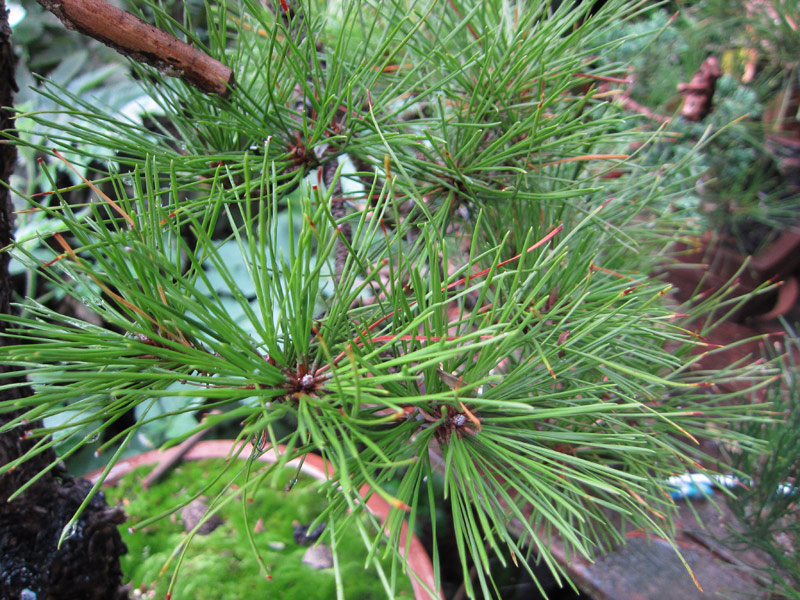
An older tree
Stay tuned.
Pinus radiata was first introduced into Australia in the early 1850’s but was not commercially planted in large numbers until the 1960’s. Since their implementation as a commercial timber crop, Australia has planted around 740 000 ha of the pine.
In plantations, seed produced by the pines germinates readily and many seedling pines can be found around areas where plantations are present. As Australia doesn’t have any true pines native to it, these plantation escapees are the closest thing to the yamadori pines of other countries that we have. In fact, the radiata is such a vigorous grower and reproduces so easily that in many states it is declared an invasive noxious weed species.
Pinus radiata or ‘The Monterey Pine’ although prolific as a timber species around the world is not commonly used in global bonsai circles. This is perhaps because it is a little quirky when grown as bonsai.
They have a lot of traits that make them ideal for bonsai. Fantastic bark, vigorous growth, highly flexible and the availability of ‘wild’ stock to be dug up all add to their bonsai credentials.
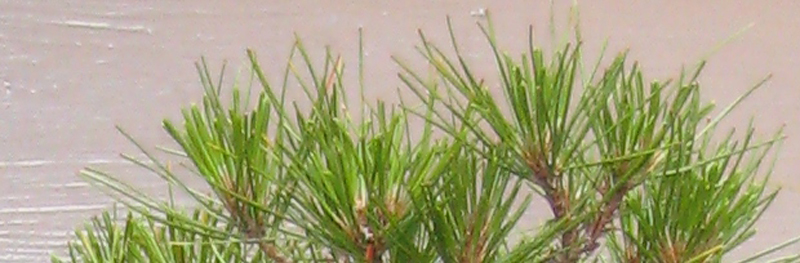
The needles of a mature Radiata bonsai
I have been growing a number of Radiatas and I am still yet to find the magic bullet for refining them.
Black pines seem difficult to grow until you understand their growth patterns and then prune, candle cut and needle thin at designated times of the year. The result of working within their growth habits produces neat and small needles and a large amount of back budding.
Radiatas I have not found as easy to master.
When I first started growing them I was told how easily they back budded and that you would have ‘almost too many buds’. This sounded too good to be true, and during the subsequent years of growing them I unfortunately found this to be the case.
The other problem I find with them is their needles. They can often be long, twisted and curled, but on some trees (one of mine being a key example) I have noticed shorter, neater and straight needles appear after the previous year’s unruly growth. This gives me hope that I may be able to work out a way to evenly force a neater shorter needle length by working with the tree’s growth cycles.
I have received a whole range of advice on taming this species. This has covered a whole range of often conflicting techniques, see below:
- Treat them like a black pine
- Treat them like a white pine
- Pinch them constantly like a juniper
- Wire one side completely, then later wire the other side
- Pot them in an open mix
- Pot them in a heavy mix
- Break candles in half
- Remove new growth totally
Over the next couple of posts I hope to generate some discussion with other growers that may dispel some myths and share successful techniques with the wider bonsai community. So if you know anything about Radiatas or grow them at home and are having similar problems please send me an email (Look under ‘contact me’ in the left side bar) or add a comment below.
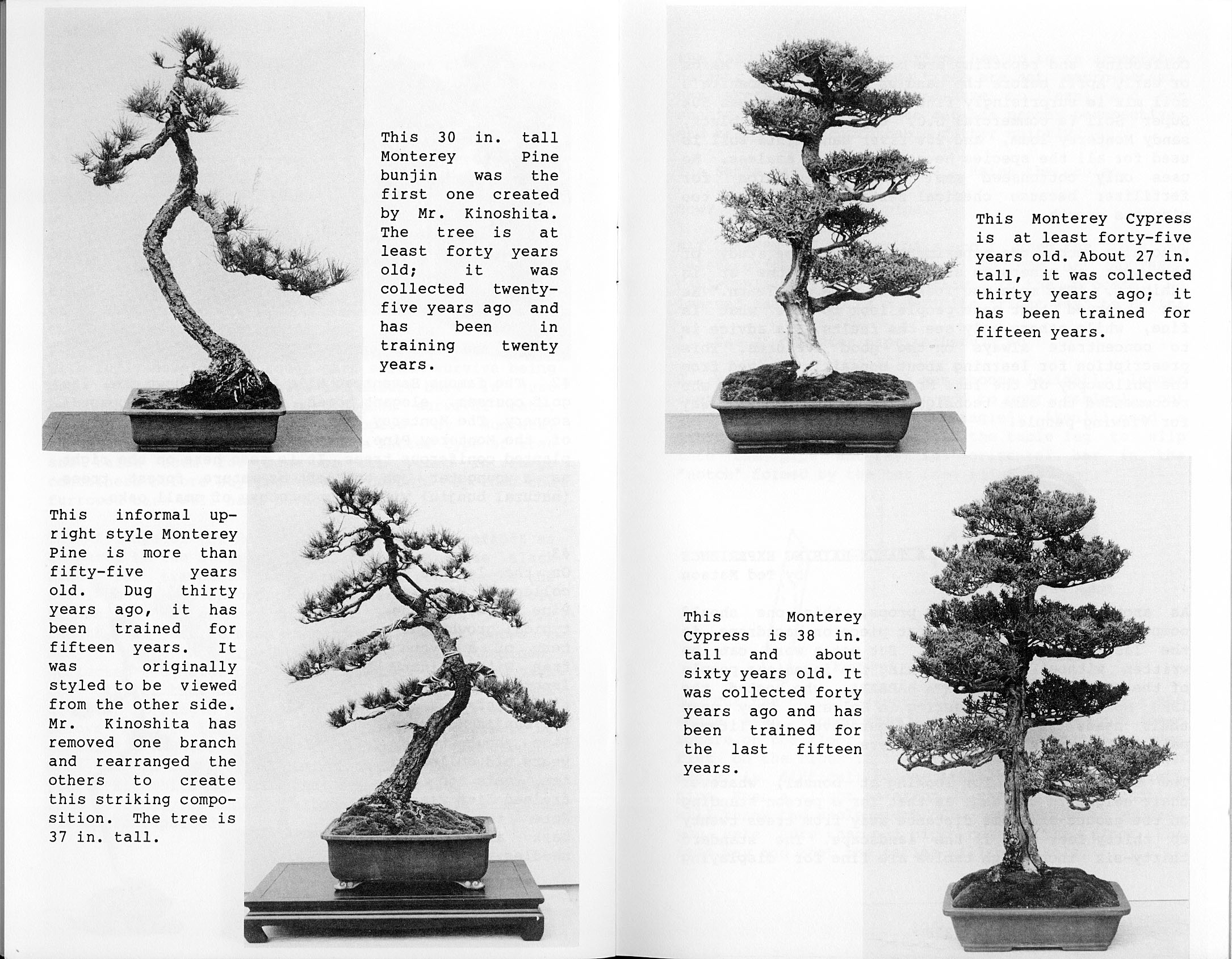
To get people thinking I have included an old golden statements article to kick off the discussion that was written by Nancy Eaton on Mr Katsumi Kinoshita back in 1984. I used it as a starting point for my trees. Have a read and let me know what you think. Does the way you grow radiatas differ from those of Mr Kinoshita? I would love to hear about it. Next week I will begin to post about my experiences with the species and some of the things that have shown good results and others that have not been as successful.

Click to enlarge.

Click to enlarge.
Click to enlarge.

Click to enlarge.
The following bonsai is one of the first trees I collected a number of years ago.
It is a radiata or Monterey pine (Pinus radiata). I quite like the species to work with but i am still trying to really get a grip on how to best grow and refine them. Perhaps i should make a future post on this subject.
Before it began its life as a bonsai it was located on the edge of a pine plantation where it had grown on a road batter. It had a very interesting curve in the trunk which was either from machinery running it over at some stage of its life or from it trying to seek the light through the long, tangled grass in which it was growing.
After collecting it took a couple of seasons for it to recover and become strong enough to be styled.

The tree before is life as a bonsai. It was needle plucked and readied for its first styling.
I styled is initially at a club night as part of a demonstration. At this time i wrapped the trunk in electrical tape as a substitute for raffia and put a second large bend in the trunk. The bend seemed quite severe to those watching at the time but the little pine bent easily. I then wired it fully and placed the foliage.

The first branch bent into position before the major bend was made.

A top view taken some time after the first styling. The dotted line shows the trunk line. The second bend is the one made during the first styling.
The tree recovered well and I lived with its style for some years while working on ramifying the branches. I didn’t mind the style but, I always thought there was something not quite right about it.

The bonsai was growing well after its first styling. It was un-wired and soon needed work.

The back side. I had often looked at it from this side and thought about a possible front.

The front after a re-wire. It was around this time that the shari seen in the next images started to develop.
Even after a re-wire the style still was not sitting well with me so, i decided to take it to a critique session by a visiting Japanese Professional, Hirotoshi saito. He suggested that we do re-style and stand the tree up roughly 90 degrees. So, a few days later the tree was styled. It was quite a dramatic change but definitely one for the better.

The results after the second re-style.
That was back in July. The tree was very healthy and had grown strongly, as a result there were multiple places where wire was cutting in.

The pine after its spring growth.
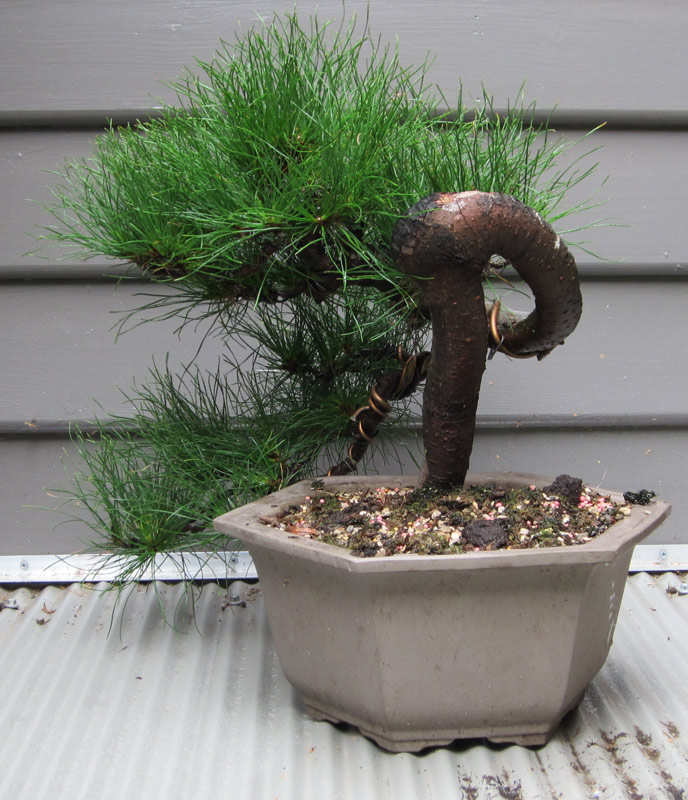
A side view.
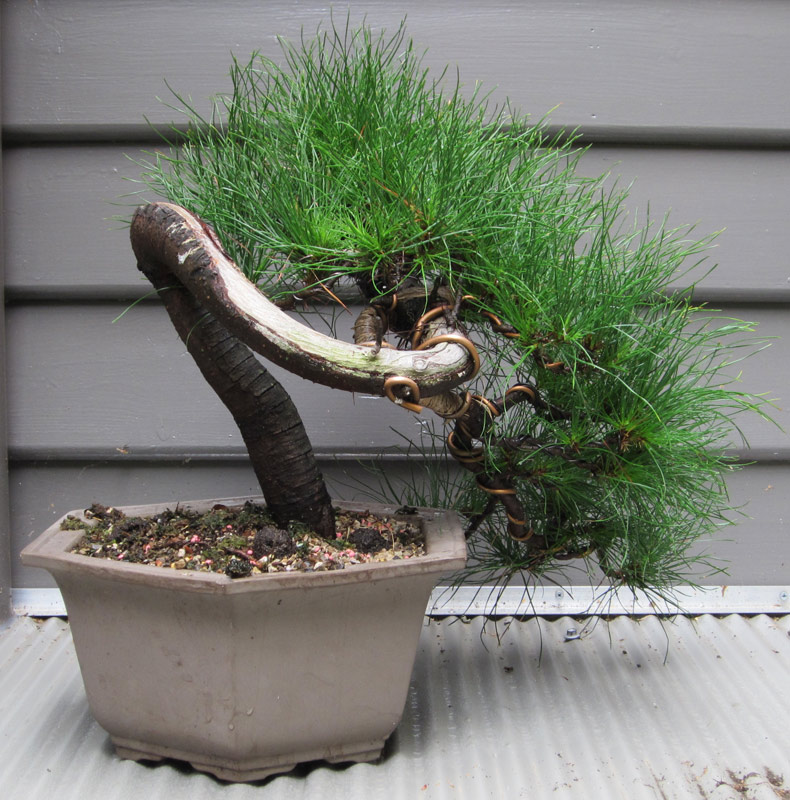
The back. From this view you can get an idea of the extent of the shari that naturally developed. Hopefully i can extend this over time to the front of the lower trunk.
It was time for some work. I plucked and cut needles to allow more light and air into the interior of the tree and also removed most of the wire. I was happy to see that most of the branches had set in position.
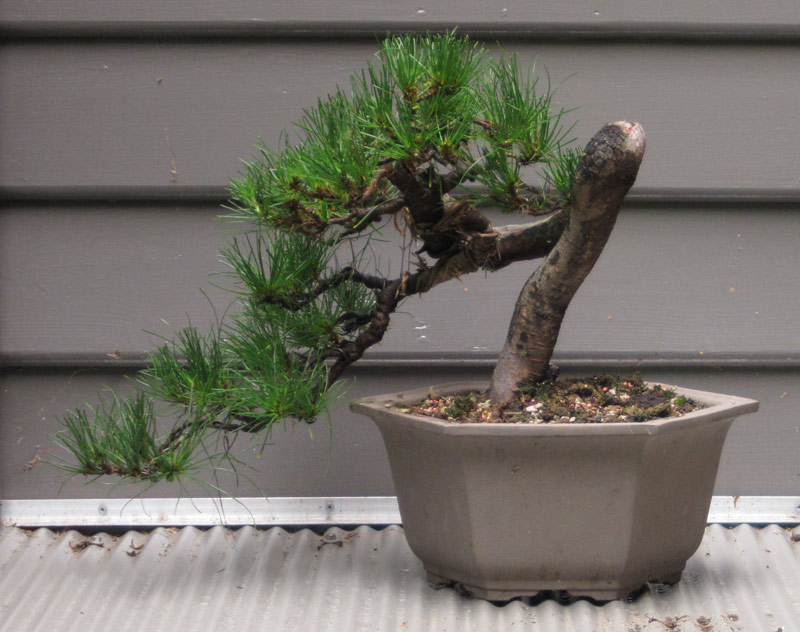
The tree after the work.
The tree is far from finished and i will need to re-wire it again this winter. Pines with movement such as this are common in collected pines in europe but you rarely see them in Australia.
Hopefully if everything goes to plan it will have a bright future in its new upright style.
Although there are many forestry species of pine planted around Australia, Pinus radiata is by far the most prolific. Known as radiata in Australia it is also known as the Monterey pine in places such as America where it is indigenous to.
As it has been planted on mass it is one of the few coniferous species that you can find to dig. They produce seed well and generally anywhere you find a plantation you will also find feral seedlings. This is so much of a problem in some areas that they are declared weed species.
The up side of all this is there are many opportunities to dig and grow these pine as bonsai.
The below pine is a radiata that i obtained through a friend. He had sourced it from an old grower who had no longer been able to care for it.
When i received it, it had a lot going for it; old bark, nice nebari and a trunk with some movement and age. These were all factors that encouraged me to pursue its future.
That said it also had a whole host of problems.
It was quite sick and all the needles were yellow. It had lost most of the lower branches and those that remained all were angled upwards and had foliage mainly at the tips. When I cut the tie wires in the pot it fell over because it had barely any roots.
I re-potted and fed the tree back to health over the corse of a year and then began to think about styling.
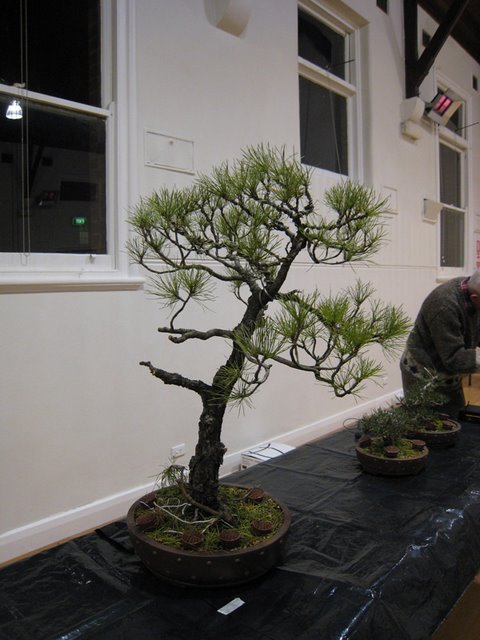
This was the tree before styling began
As the branches were all old with quite old bark i was reluctant to bend them into their future downward position in one go as i was pretty sure they were going to be brittle.
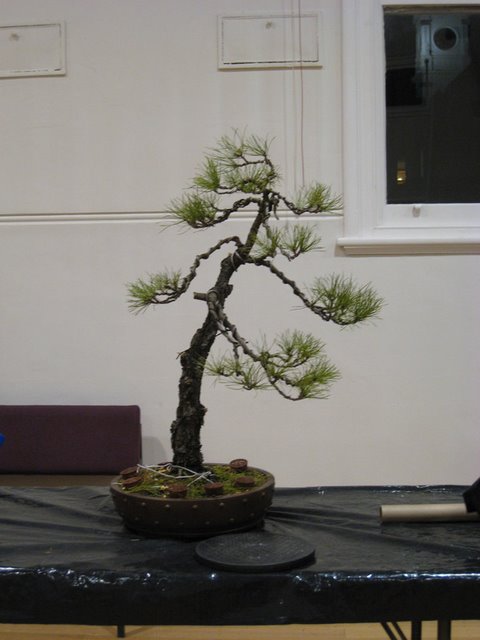
After the first round of bending
After bending the branches into the above positions almost every branch had began to crack. It was now a matter of letting the tree grow out and recover before completing the bending.
A year later the tree had been growing strongly and was ready for round two. I had slowly increased the downward angle of some of the branches over the course of the growing season but they had not yet reached their final possitions.

The tree had recovered well and it was time to make some decisions.
I had decided that the first branch would be removed and i would fill this visual position with a ‘Nozoki no eda’ or peeping branch. This type of branch is basically a first or main branch that originates from behind the tree but occupies the space a first branch would. This style of branch is often seen is junipers.

The branch removed
I removed the branch and began to wire the tree. You can see the result of this first real styling in the image below.

After the first styling
The tree was fully wired into shape and some jin was created at the base of the removed branch. I left it long for future use as a guy wire attachment point and still have not removed it. I will probably get around to shortening it and refining it this winter.
Since the above photo the tree has grown strongly and has had one re-wiring. It was starting to take shape and was ready to be un-wired.
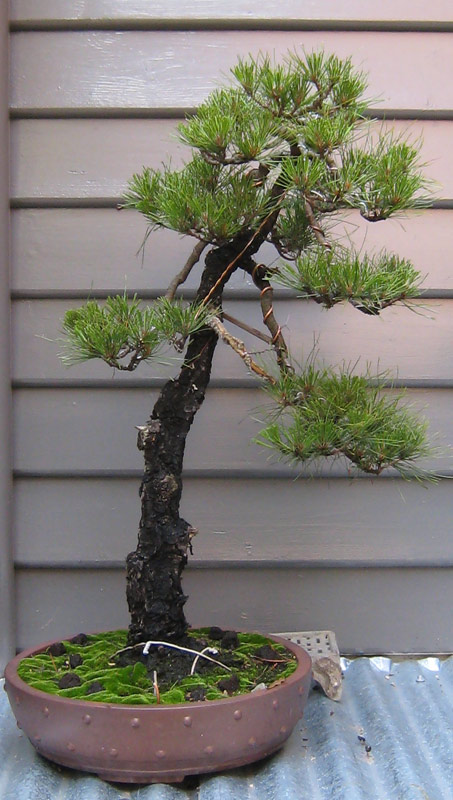
After some strong growth.
I un-wired the tree and did a small amount of re-wiring mainly to the tips of the branches.
It is nice to reach a stage with a tree where you no longer have to wire every main branch.

After a basic wiring.
Above is how the tree ended up after a basic wiring. It really needs a full wiring which i plan to do this coming winter. Hopefully this seasons growth will fill a couple of gaps in the apex and generally give some more weight to some of the foliage and at the same time strengthen some of the weaker buds so i can reduce the branches to them.
The tree is really only beginning its journey to become a refined bonsai but most of the structure is there. Unfortunately the day that i took the above photo it was raining so the bark is dark and it is hard to see just how nice and crackily the bark is.
Radiata’s are a tree that i am still really trying to work out how to grow well. Last year i tried to treat them like a black pine and cut all new growth off around christmas time. It did not respond very well and didn’t really produce any back-budding. This year i am going to grow them a little more like some of the other growers in my area. That is they pinch out strong growth as it appears and continue to do so throughout the growing season.
I was kind of hoping that there would be a calendar bases technique i could use to remove the new growth but at this time it doesn’t seem like there is. Perhaps overtime i will understand them more and then will be able to develop a better method. In the mean time i will just enjoy watching them grow and the work associated with those phases.
If anyone has any techniques that work with these pines, please share them in the comments.
This spring is much wetter that what we have become use to over the last 5-10 years of drought. This drought breaking rain that we are experiencing has come as a welcome beginning to this seasons growth for my bonsai. They are all growing like crazy. Judging from what i have seen in the month or so since spring has started i am guessing that we are in for an excellent bonsai year ahead.
One of the trees that has been growing strongly is the trident maple that is pictured below. It has been growing so well that i have decided to defoliate is a little earlier that i normally might in the hope that i will be able to defoliate two or even three times to encourage far more fine ramification i would get in a normal growth year.
If you look towards the base of the tree you will notice a small seedling that is being grafted into the nebari to fill in a small gap in the root spread.
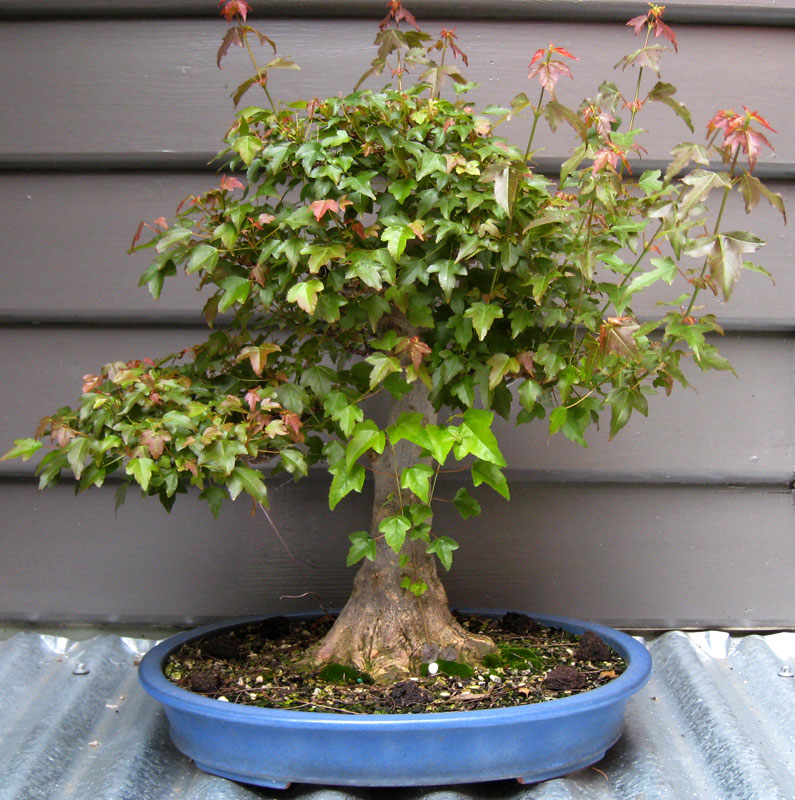
The trident before defoliation.
I have been growing this tree for a number of years and it is really starting to become on of my favorites.
This year i rewarded it with this old ‘Reihou’ tokoname pot that i bought on my last trip to japan. I think the blue really suits the tree well. I will make a separate post about this and other pots in a subsequent post.

The trident after defoliation.
This is how the tree looks after defoliating it. I have left leaves on the shoots that were weak in order to give them a head start over the new growth. This ballancing of shoot strength should even-out the energy distribution over the trees canopy.
I also like to add a few more fertiliser cakes to the tree after defoliation to help the new buds form.
One of the other things i am trying to achieve with this defoliation is to pop a bud that is between the first and second branches on the back of the trunk. There is a bud there that has slowly been getting bigger and bigger but has not yet formed a shoot. Hopefully this work will be the catalyst that sees the bud grow a branch right where i want one.
Those who look closely will notice one of the shots seems to have been bent back in towards the trunk. This is a thread graft that i have put in place to fill a gap in the canopy. Hopefully by the end of this season the branch will have grafted onto the trunk and will have begun to ramify.
I look forward to seeing this tree progress over the course of the summer and hopefully it will reward me with some nice autumn colours.
 Nichigo Bonsai