One of the things that surprised me in Japan was the apparent lack of theft. Now I am sure things do ‘walk’ from time to time but for the most part I never really saw any signs that theft was much of a problem.

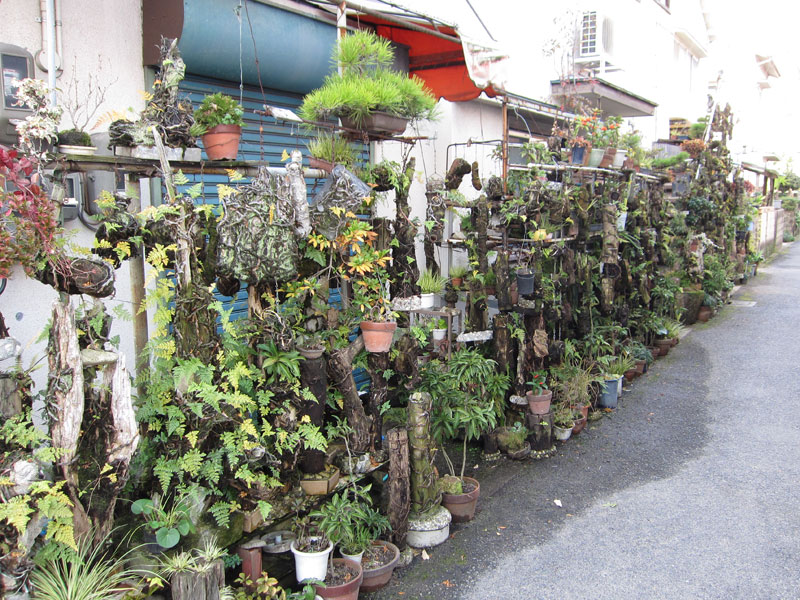
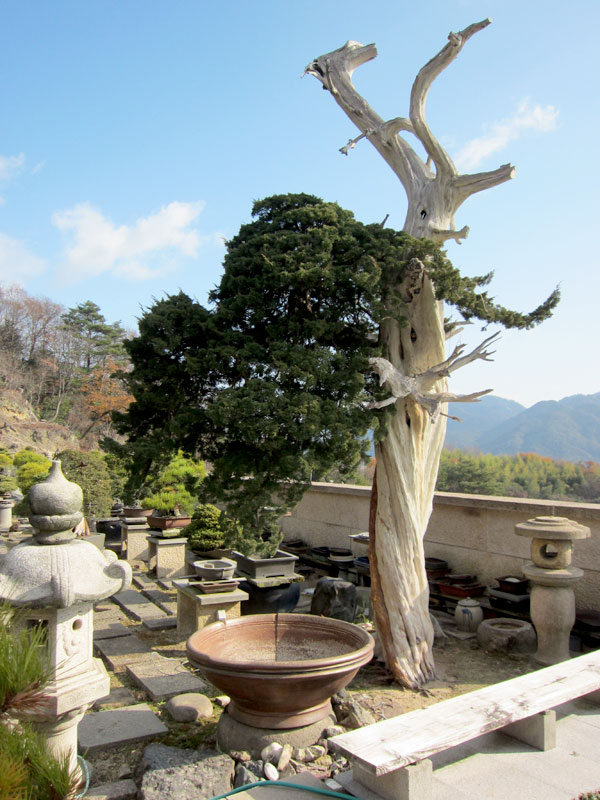
I really loved discovering bonsai in plain view of the street on the walks I took around neighbourhoods of the various cities I visited.

Someones collection visible from the street.

Now I don’t know what the rest of the western world is like, but I am pretty sure that if I had my collection on display like this outside my house it would have been stolen within minutes of putting it there. Now Australia is not full of theives but we seem to have a much bigger problem with theft than what i could tell Japan has.

Someones collection of plants (including bonsai) occupying the space between their house and a public laneway.

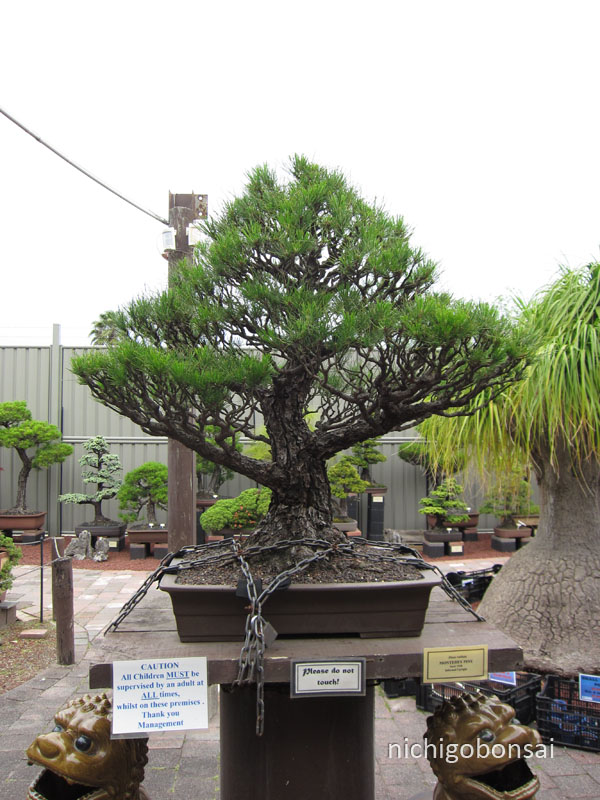
Why is this? In the case of bonsai nurseries in Japan they rarely have more security than a low fence or wall to stop the theft of some very expensive trees. In Australia on the other hand one particular nursery has 3 meter high walls with barbed wire, cameras, security lights and they still have to chain down the expensive trees to prevent theft.

Bonsai in an Australian nursery.

And this seems to be the norm for nurseries in Australia. Steel cages, chains, electric fences, alarms and dogs are all common in Australian nurseries and yet are virtually non-existent in their Japanese counterparts.

I would love to be able to stroll the streets of Australian neighbourhoods and discover front yards full of bonsai like you might see in Japan. Perhaps you might meet the owners as they were watering or pruning and ask some advice while leaning on their front fence. This might be a bit of an idealised view but it is always nice to dream.

Sadly I don’t see this happening any time soon, as most people understandably keep their collections a secret and only invite a very small number of people into their gardens the fear that they may get knocked off one day. I feel that this really locks up (pun intended) both trees and knowledge to those few that are privileged enough to be allowed into growers gardens.

Sure at clubs and local shows you get to see some of people’s trees but it is often the works in progress at the back of these people’s gardens that are the really interesting material. It is often these works in progress that you can really learn from yet they often never see the light of day.

Are other countries like this? Surely these problems extend beyond Australian shores?

I often hear the term ‘Cookie cutter’ thrown around from time to time when people are talking about Japanese bonsai. For those not familiar with the term, I believe it relates to people suggesting that certain bonsai seem to come from the same mould and or ‘cookie cutter’ which produces similar or same bonsai. Personally i think that the term often is applied by those who havent really got a good understanding of what is actually out there in Japanese gardens and nurseries.

Now there are a lot of mass-produced bonsai in Japan that are grown to a rough formula but these trees are not a good representation of bonsai in Japan as a whole. On the other hand there are a lot of trees that can seem similar at first glance on benches in nurseries throughout Japan but closer inspection reveals quite dramatic differences.

Cookie Cutter?

What was one of the biggest surprises to me when I first visited japan was the huge amount of irregular styles and forms of trees that by no means could be classified as what some people dismiss as ‘cookie cutter’. In fact most of the nurseries I have visited were full of unusual and or ‘different’ bonsai. I know that when you look through various exhibition books you see some unusual trees, but its only when visiting the nurseries that you actually get a clear idea of just how many irregular bonsai are being grown.

During my last trip i met with Peter Tea at Aichi-en and he explained what his Oyakata Mr. Tanaka had explained to him about unusual trees.

He said that unusual bonsai would always be worth less than ‘standard or correct’ trees during the developement stages. Once the trees reached exhibition standard however, the unusual tree would suddenly become much more valuable. There are many correct bonsai in Japan and most nurseries could sell you one. Unusual trees on the other hand are one offs and if a customer wants to buy one they must pay accordingly as they cannot simply go next door to get something similar.

Strangely we don’t get to see many of these types of trees in western magazines or literature instead these forms are associated with European and American yamadori. I was certainly surprised to see so many when I first travelled to Japan. Now I find that they are the trees that I gravitate towards when I arrive at a nursery.

Below are a few interesting trees that i saw during my travels that didn’t fit the mould (some of them look like they totally broke the mould!) I hope you enjoy them as much as I do.

Dramatic movement.

A close-up of the twisted movement.

A very angular exposed root style.

I wonder if this tree was grown or collected?

Black pines shouldn’t have shari? Well this one does.

I think you will agree that it works very well in this case.

Unusual?

A very non-conforming Nebari for a non-conforming tree.

Read more about this strange trident HERE.

Bunjin, Semi-cascade or a combination?

Interesting.

I like to look at trees such as the above and think about what they must have looked like pre-styling. Material such as this requires a high level of creativity to style into a well-balanced image and often results in trees that really stick in your head. I know that it is these types of trees that I always spend the most time in front of.

So next time you are out and about evaluating future material keep an eye out for the unusual, you never know, you might get yourself a bargain!

Well, re-potting season is a while off here in Australia but while I was in Japan I did spot something that might speed up the whole process when the time does come around.

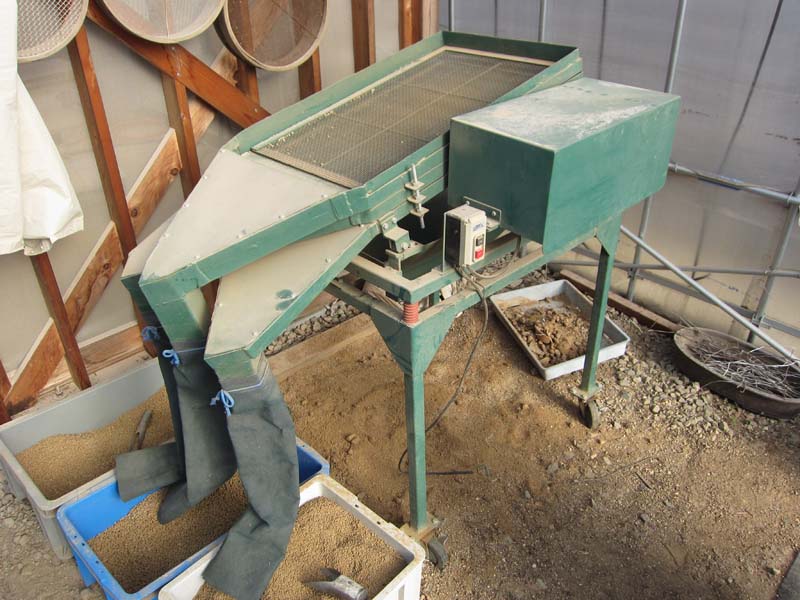
In one of the green houses at the back of Taisho-en I spotted a sifting machine.

I want one!

I have a small hand sifting set at home which takes me ages to sift enough material to do a hand full of trees. I am sure with a machine like this I could do the whole collections worth of soil in no-time!

From what I could tell it was a simple contraption with 3 sizes of mesh screens that gently shook to give you 3 graded sizes of soil and the unwanted dust simply fell through to the floor.

It might be a good machine for someone who doesn’t have a team of apprentices to do the sifting for them!


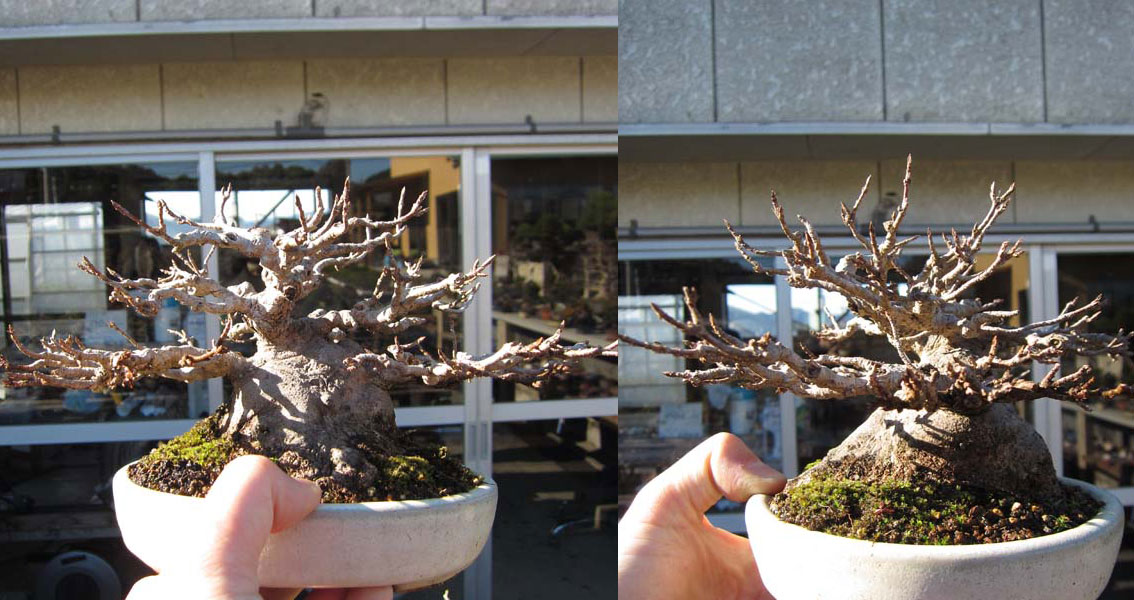
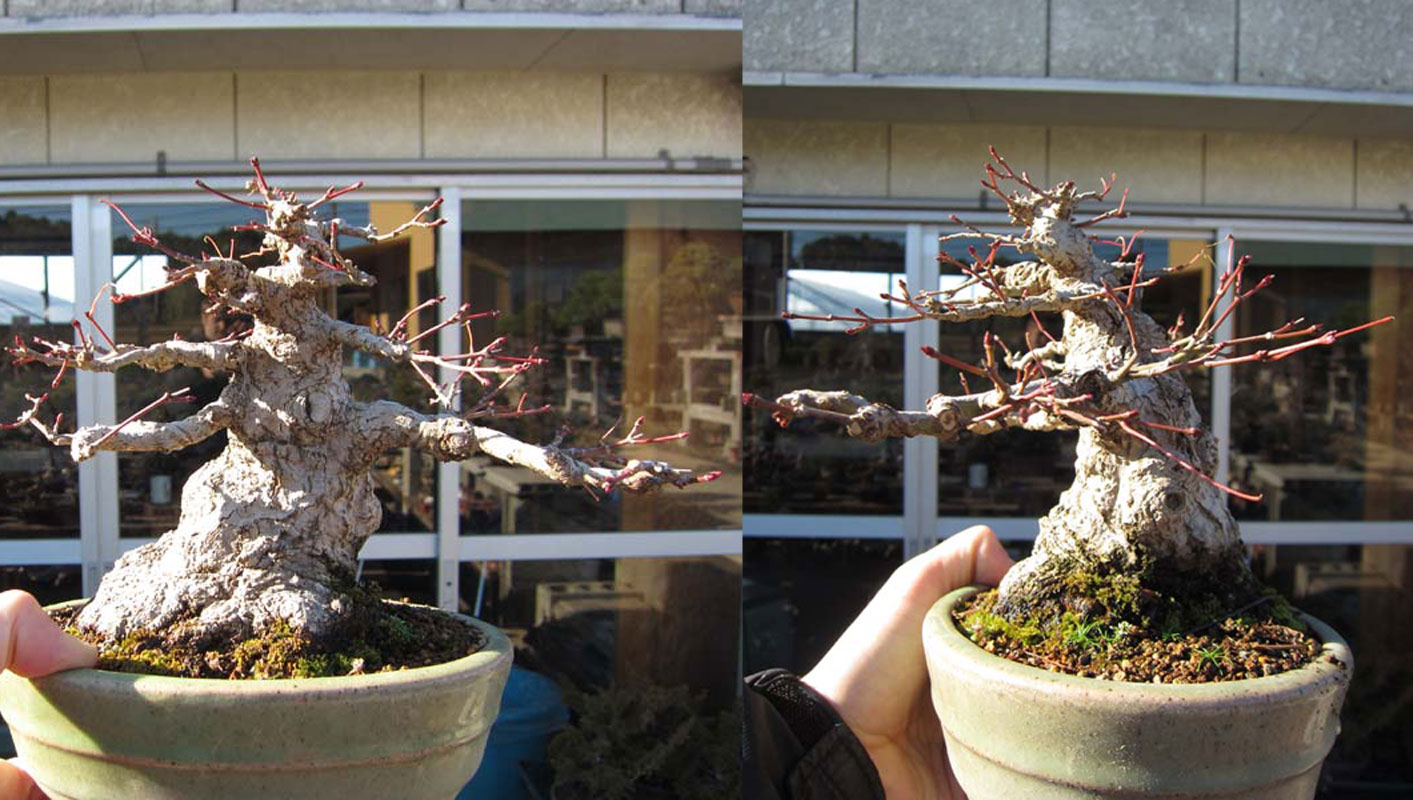
Before I left for Japan a friend (who runs an interesting blog) asked me to take some pictures of bonsai from the side so he could get a good idea of how the trunk lines and apex were constructed.

He has begun growing some stock in the ground and was keen to see how the japanese constructed their trunks. So as I was snapping pics I sometimes remembered to take a few shots from different angles to show a more 3d view of the trunks.

He asked I photograph a wide range of trunks but I realised that the deciduous trees were the only ones that you could easily see the trunk movement and structure so those were what I focused on.

(Left image: front, Right image: Side view)

A medium-sized root over rock Trident maple.

Shohin Trident Maple

Another shohin Trident Maple

A shohin Japanese Maple

Looking back at the photos it is interesting to see just how far forward some of the apexes are. I guess this allows you to get a much more compact apex with many branches. If you imagine standing these apexes up you can picture that it would raise the height of the tree and also spread out the ramification in the top section creating a taller less dense image.

Looking over my own trees at home over the weekend I think that some of them could become more compact and dense from a simple tilting forward of their upper structure. It was a good exercise taking these pictures as I had seen hundreds if not thousands of trees over the years but have never really focused on this one detail. I think I will have to look over all my other photos and pick out individual styling details and see what they reveal.

On the last day of our recent Japan trip we managed to make a last-minute stop in at Gafu-ten while on the way to the airport at Kansai.

Gafu-ten is held in early January at the Miyako-messe building in Kyoto, Japan. The exhibit showcases some of the best shohin bonsai in Japan and the sales area attached to the exhibition has equally impressive shohin related trees, pots and goods.

This is my second time visiting Gafu-ten. I was at the exhibition last year (See HERE) and after seeing the trees on display and those for sale i was keen to get back.

This years show lived up to expectations with many high quality displays (unfortunately photos were prohibited).

A bonsai for sale at Gafu-ten.

In Japanese exhibition you can only exhibit individual trees once every 4 years. That means that every year you are guaranteed to see different trees. This years mix of bonsai had quite a different feel to those of last year with some quite unusual stylings exhibited. As we couldn’t take photos of the exhibition those wishing to see the trees might like to purchase a copy of the exhibition album.

We had a great time filtering our way through the displays and then moved into the sales area.

Some of the offerings.

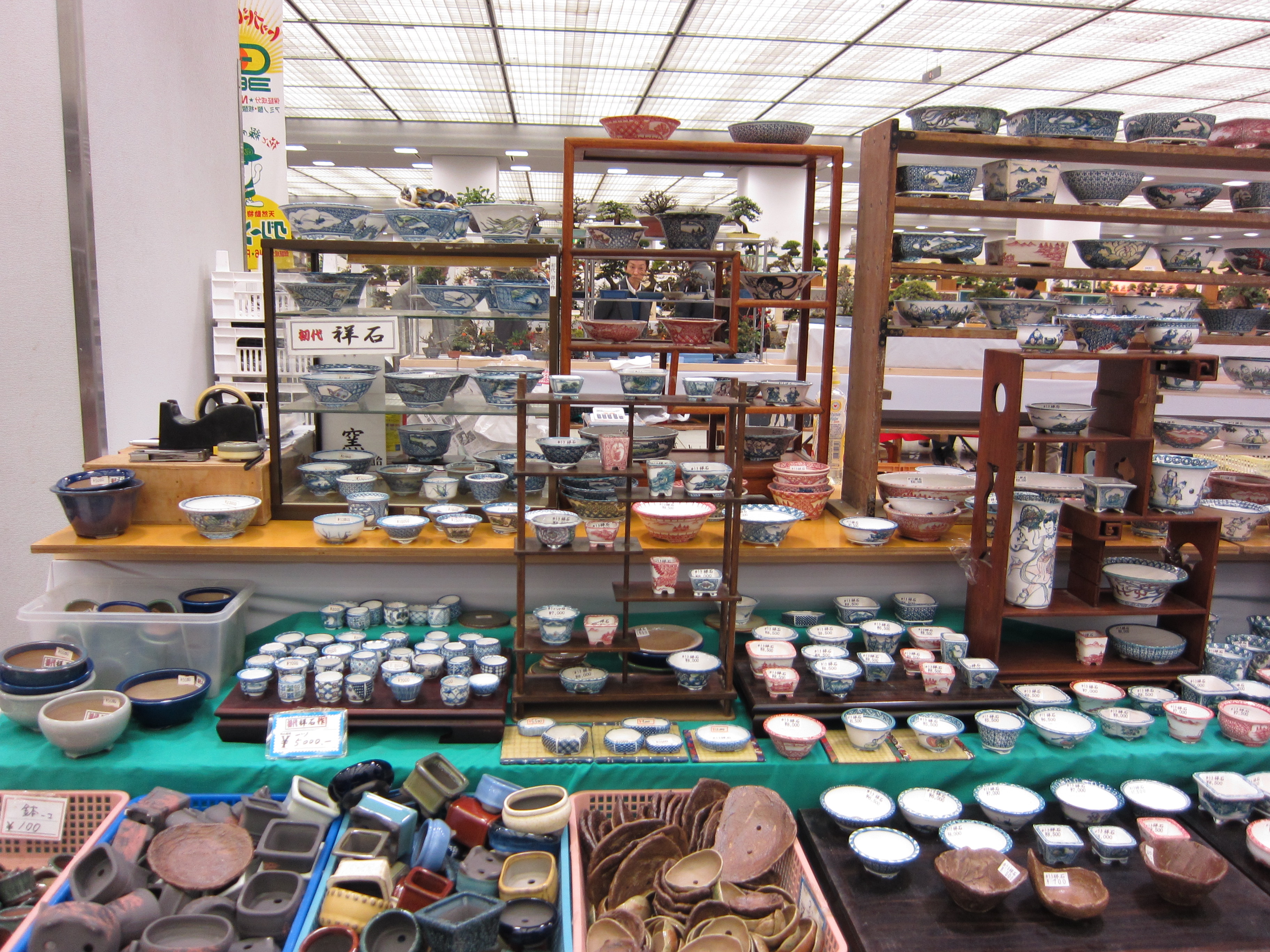
For those of you that havent been to a sales area in a japanese show let me try to explain it. It is like walking into bonsai heaven. Trees, pots, stands, suiseki, tools, books, and almost anything else bonsai related you can think of can be found in the sales areas. Gafu-ten’s sales area is almost the same size as the exhibition and from the look of the people shopping there it gets the same if not more attention than the show itself.

Shoseki pots for sale.

We spent a good amount of time catching up with some vendors we knew, shopping and dreaming of trees we’d like to take home before we finally had to head off to catch our flight at Kansai.

For those interested, the full collection of photos can be found HERE.

I’m Back. We had a very busy 4.5 weeks away. Apart from the family and friend catch-ups, weddings and birthdays I did manage to see my share of bonsai. As I sort my photos I will share some of the sights and interesting bonsai that I came across in the coming weeks.

In the mean time I thought i would share a picture of a fairly amazing shimpaku I found by accident. Some friends took me to a local bonsai nursery where we stumbled across the below tree.

I am not sure if the pot will fit it or not but even though it is cracked it’s the best we could find.

Shimpaku and pot

It is a little hard to gauge the scale of this tree so below is another pic with someone along side it for scale comparison.

Size comparison.

This nursery actually had a couple of exceptional garden junipers which may have to make it into future posts as like the above tree, they were too big to make it into my suitcase.

For the next 4 or 5 weeks I will be in Japan so will most probably not have the opportunity to post on the blog as much as I would like during that time. My trees are going off to be baby sat this weekend as we make our final plans. Although the trip is family based I am going to make sure I squeeze a few bonsai stops in along the way and hopefully also make it to the Gafu-ten show in Kyoto as well as a handful of nurseries.

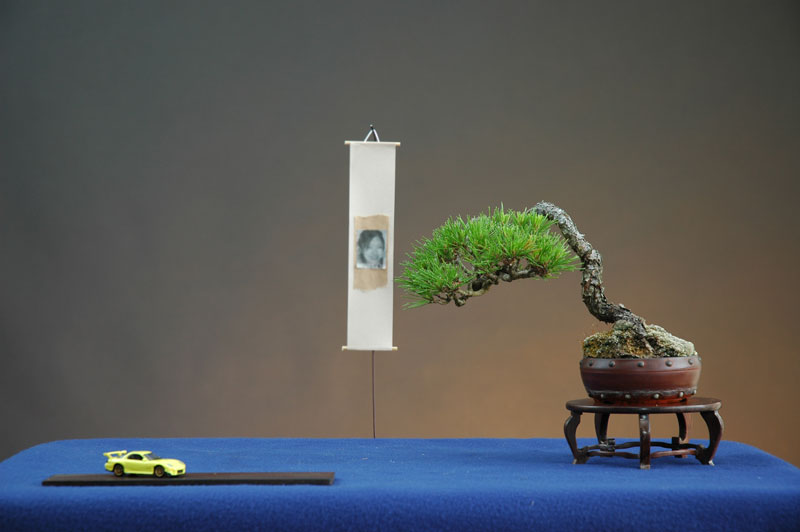
In the mean time, I will leave you with a display I made with the talented Mario Komsta when I was studying at Taisho-en. We were talking about display and quickly grabbed some small items that were at hand that were in scale with this tiny black pine. We played around with various arrangements and stands to test a few different ideas.

This was the final arrangement. We jokingly called it ‘3 points of our lives’ as most of the days we spent working together on bonsai, we talked about girls, cars and Mario’s favorite topic, motorbikes.

3 points of interest? convenience store toy car, hand-made news paper pop star girl scroll and beautiful mini black pine.

When I get back from Japan I should have a whole heap of photos to share.

Until then…….

Amongst the display trees that I saw at collectors corner (which can be seen HERE and HERE) I noticed that a large percentage of the display trees were Pinus Radiata. In fact the first tree that greets you once you enter the nursery is a big old Radiata.

The welcome tree

This tree has been in possession of the nursery for a number of years and has always been an impressive bonsai. So impressive it seems it needs to be chained down!
Old bark

The old bark that the tree exhibits is beautiful and the crackled plates of bark seem in a good scale with the rest of the bonsai.

Now why does this tree have a post of its own? Well I thought that this bonsai was a good example of some of the problems that these old radiatas face.  From a distance the tree seems to be full of foliage but upon closer inspection a different story is told.
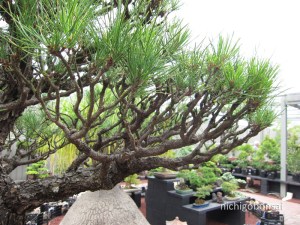
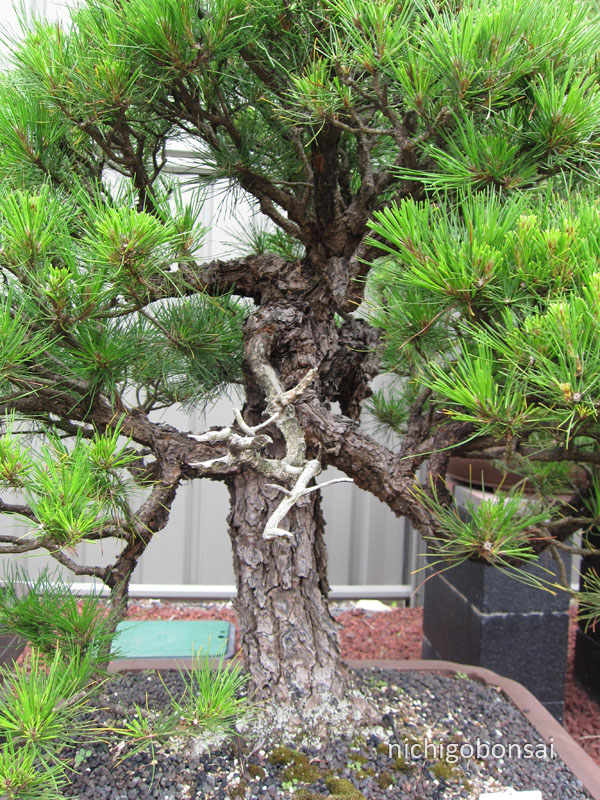
A main branch

As you can see from the above image the foliage is only on the tips of long leggy branches. This is a problem. The tree has no inner buds and no fine inner branches to cut back to. What this means is that the outline of the tree can never be reduced without the aid of grafting as at least from what i have found and the experiences of other local growers with the species, Radiata’s dont bud onto old wood well.

What does this mean for this tree? Well I think it needs a major re-working. It is always nice to project the future onto trees so I will have a quick go at making a list of the things I think needs doing short of feeding aggressively, watering etc.

  1. The branches have all grown upward. The first port of call would be to correct this by doing some heavy bending on each of the main branches, bending them down to just below horizontal.
  2. Wire all the sub branches and prune growth back where possible. This would have a two-fold effect. Bringing the foliage down would allow for light to get into the inner areas of the tree as well as taking the dominance out of the tips. A tip that is pointed upwards will always grow strongly from the tip. If it is horizontal it is more likely to bud along its length.
  3. Feed feed feed. If you are to hope of getting budding on old wood you will need a healthy, strongly growing bonsai.
  4. I would then look at grafting opportunities to start re-introducing growth into inner areas of the branch structure.

I think with a work routine something like the above the tree could be vastly improved. A nice tree as it is (Age tends to excuse many faults) but I think it could be better. If it were ever to come up for sale I am sure I could find room for it at my place.

After seeing this tree I began to think if these problems are some that  I might be facing with my Radiatas in the future. Hopefully through regular styling I can avoid the upward branch problems but I am a little concerned about the lack of back budding. Hopefully one day I will unlock the key to this dilemma. Perhaps in this case it is a result of a thick canopy shading out inner growth?I think the above tree had just been heavily thinned as my memory of it in previous visits was of a much denser canopy.

Either way, in the mean time I will keep on experimenting with my trees and keep dreaming about other people’s trees that I would love to own. One such tree that caught my eye at the nursery was the pine below. Again another Radiata.

Interesting?

Interesting or ugly?

I keep finding myself being drawn to trees with problems. I think I enjoy both looking at these bonsai that challenge the rigid frameworks some people use and also love to work on them to try to use those awkward features to form a design that works in a classical sense.
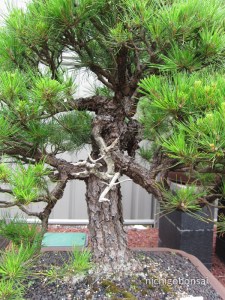
The heart of the problem or the heart of the opportunity?

Again I think the age displayed by this tree excuses a lot of the faults and in a way the faults in branch placement almost add to the ancient feeling the tree exhibits. Would I change things? Most probably yes, but I would like to live with the tree for a long while first to get to know each of its quirks.

Again I think with some creative styling and a total wiring this could become a very interesting tree. Another I could easily make room for at home.

It is interesting to note that this tree also seems full of foliage from a far but on closer inspection it is actually quite leggy and bare on the interior. Now I am not sure if this is a result of age or whether this is due to too thick a canopy being kept that has shaded the interior, killing the inner shoots. Hopefully it was a lack of light and not just the result of the species growth habits. If it is just a lack of light I can rectify this on my own trees.

Well i hope you have enjoyed these trees as much as I did. I always like to see old radiatas. I like to look into them and see if they will give away any hints that may lead to a future technique or method for getting them to back bud on old wood. Perhaps I will never find it, but I will definitely enjoy looking for it.

On that note, does any one out there have old radiata or Monterey pines? How do you grow them? have they ended up leggy? I would love to hear from you. Please comment below or email me at the address on the left of my website.
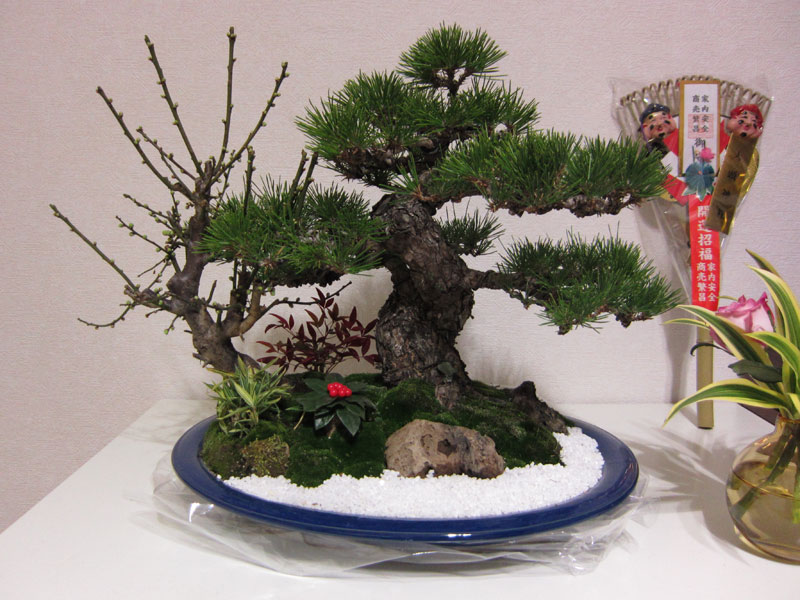
Following on from part 1, I thought I would share a few more bonsai from Collectors Corner. If you happen to find your self in the area it is well worth a visit. Their website is found HERE.

Recently I visited the newly renovated Melbourne nursery Collectors Corner. Collectors Corner maintains a moderately large collection of old display trees of a quality that are hard to find on public display else where in Melbourne. Many of the bonsai had been recently re-potted and were showing the results of this work with flushes of healthy spring growth.

I would love to get my hands on some of the display trees as i think with a couple of years refinement they could be very good bonsai.

The renovations are a great improvement on the old setup even though the overall size of the display seems to be a little smaller the bonsai are much easier to see and appreciate. Well worth a visit if you are in the area.

Some photos are below. I will upload a second lot in my next post.

Enter your email address to subscribe to this blog and receive notifications of new posts by email.

Join 688 other subscribers

Contact me

nichigobonsai***gmail.com

Note: to use email address, substitute *** with @