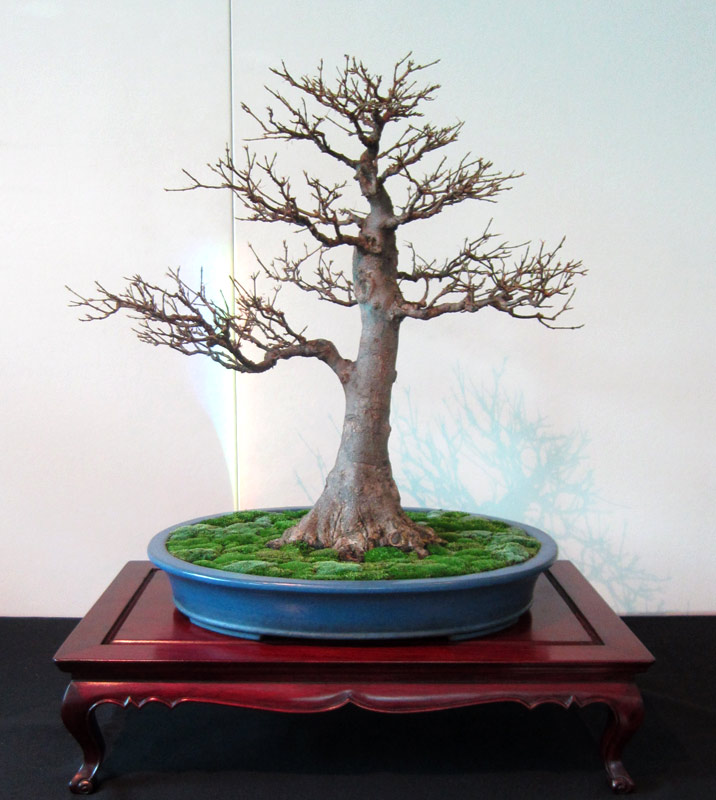
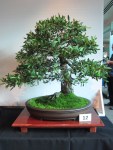
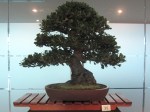
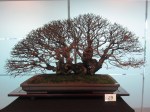
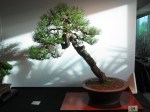
Well, the inevitable happened and another tree has found its way into my collection.

While at a friend’s place I spotted the below corky bark Chinese Elm on his sale benches and decided I could make something of it. It had great taper, nice bark, some interesting movement and only a couple very small scars. Another bonus was it was of a size that would see it make use of several pots I have gathering dust on the shelves at home. For those interested, the tree is from the same grower that produced my other Cork Bark Elm.

The tree as i bought it.

Once I got it home I made a few preparations to set it up for next years growth. I cut off the taper-less apex section of trunk which also removed a lumpy section. I then reduced some of the heavy branches and pruned off any shoots that were not going to become part of the future structure. I think in the next few days I will have a go at bending the first left branch down a touch but we will have to see how that goes.

Ready for springs growth

I will probably re-pot it back into this container this year so I can get some fast growth out of it next season. Once I have the main branches and the start of secondary growth set I will pot it up into a bonsai container where I can start the ramification process. For now all it needs to do is grow, especially the new leader. It needs to really thicken up to continue the line of the trunk. This species is such a strong grower I should have the trunk-line and base branching set after a year.

The Display

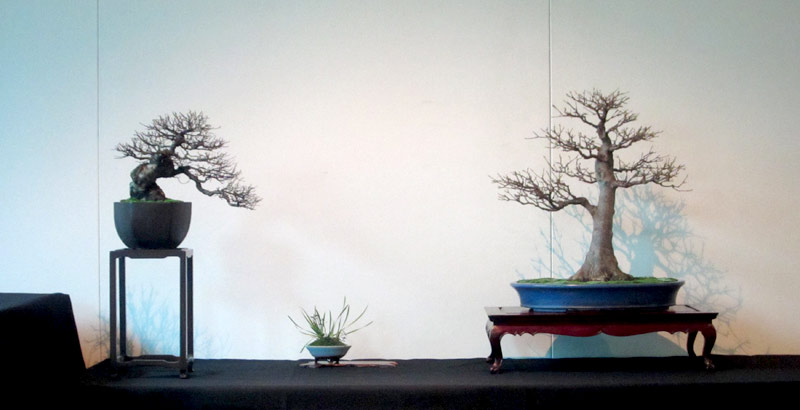
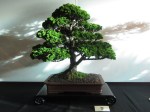
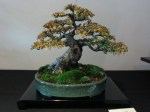
At the recent AABC convention I displayed two trees. One was a Chinese Elm and the other a Trident Maple.

To get these two trees to this state actually took a whole lot of work and time. I didn’t think it would take so long but it took me roughly 2 weekends to prepare these two trees.

Chinese Elm Pre-work

The Chinese Elm had the following done to it:

  • First, I defoliated. This took a long time. there are A LOT of small leaves on this small tree and they are all difficult to get at with a pair of scissors.
  • Next I cleaned up the trunk and did a basic pruning to refine the outline of the silhouette.
  • Then I had to select a pot for the tree (in this case an old Yamaaki pot) and re-pot the tree.
  • Then I mossed the tree
  • Then oiled the pot.

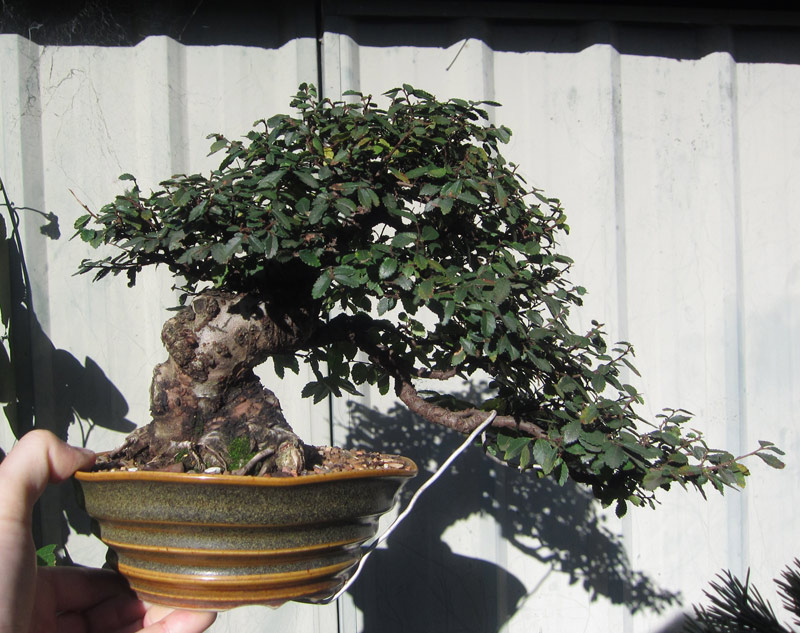
Chinese Elm as displayed.

The tree came up nicely. It improves each year as it’s canopy becomes denser. I think the new pot is a big improvement over its old container. Looking at the above image, it makes me wish I had a more delicate stand for it, but that can wait.

Trident Maple pre-work

Next came the trident Maple. It under went pretty much the same process as the Elm although it was not re-potted. I had considered changing into an antique chinese container but in the end I thought the blue pot was a good match.

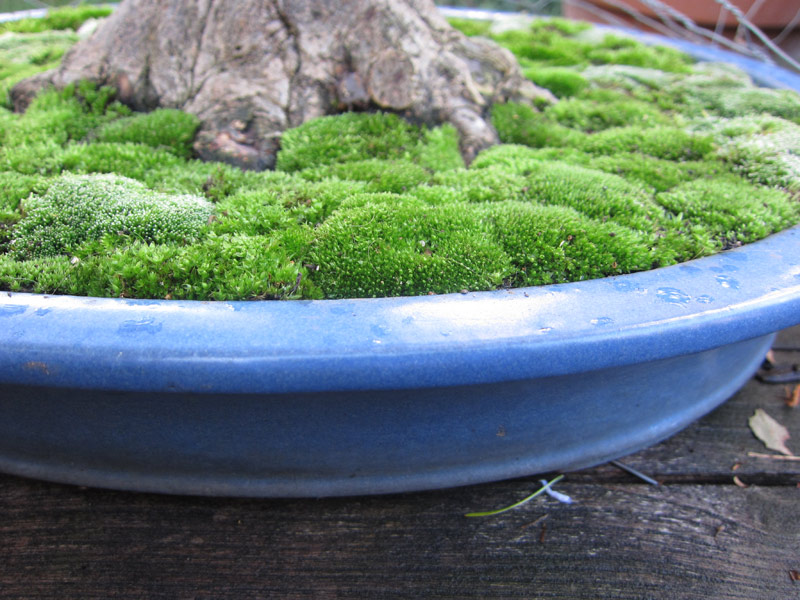
This tree took most of a day to moss. The mossing was the easy part and only took a few hours. It was the finding of the moss that took the time. I had to hunt all over the neighborhood to find enough moss. No gutter was spared. Every time I thought I had enough I would go home to start applying it only to find the moss was either not good enough quality of that after trimming out the bad parts I didn’t have near enough to finish the job, so back out onto the streets I would go. I repeated this process several times, each time heading out to further gutters in search of the perfect moss patch. I didn’t find it, instead I had to collect many small pieces from many gutters.


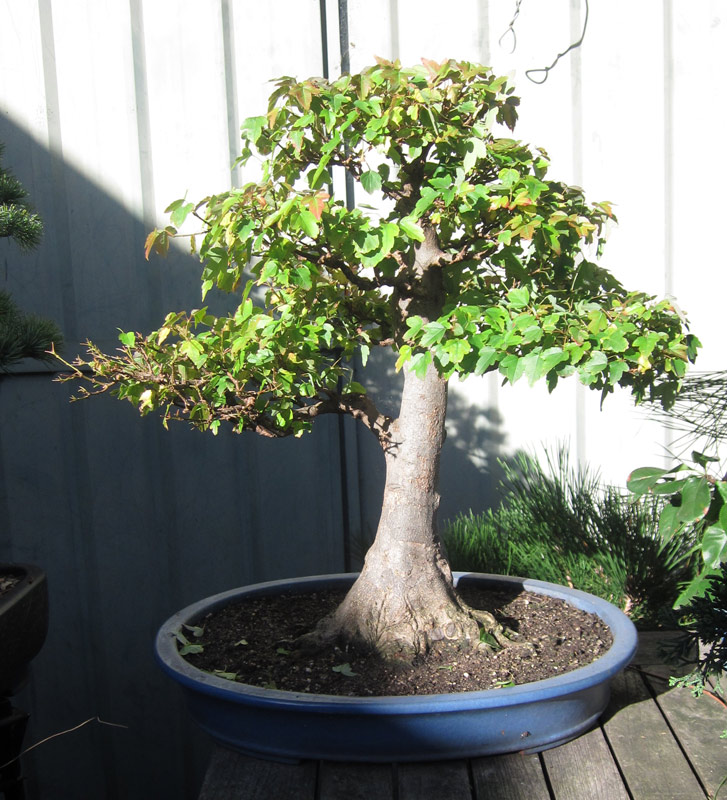
Trident maple as displayed

I finally got the tree mossed and selected the only stand I had that came close to suiting it.

All in all I was pretty happy with how the display ended up but of course like many things in bonsai I saw many areas in which I could improve it.Both trees will look better in a few more years, but when is that not the case?

I guess that is part of the draw of growing bonsai, they are ever-growing, changing and shifting and you are forever adjusting to match the tree’s changing form. Some times you get it right and sometimes you don’t but always if you think about the decisions you are making along the way you will learn something new.


Prior to the recent AABC convention, I was asked to style an established Japanese white pine that had reached a stage where it needed some work to get it back on track.

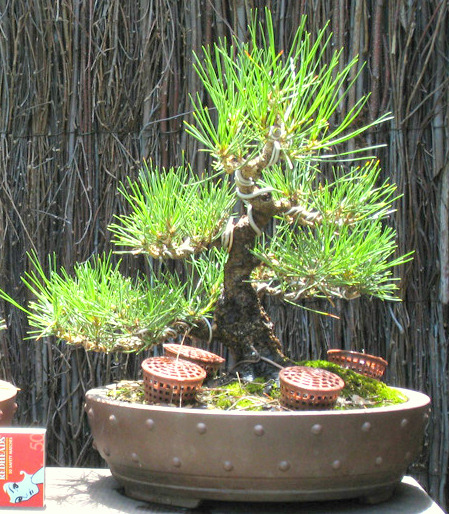
It had been worked on a number of years ago during a workshop held by Hirotoshi Saito where the second trunk was bent upwards from what was a heavy first branch. Since then the tree has grown out with the occasional branch guyed down from time to time and with some trimming to keep the growth somewhat compact. What the tree was desperately needing was a full wiring and styling.

As the tree arrived in my garden.

I cut a good amount of branches off and had to do some heavy bending to move the apex from leaning towards the back to leaning forward. Most of the work was sorting out branch structure and setting basic branch positions to prevent thickening in areas that you might not want it in the future and providing structure for the tree to grow into.

Some of the removed branches.

After a couple of days wiring.

The tree will really benefit from a couple of years growth to fill out some areas such as the apex, but it now has a solid base structure to build upon further in the future.

The graft in this trees case is quite noticeable at the moment but I think that once the white pines park begins to crackle it should start to blend in much more. How long will that take? Who knows. I think 10 years would start to see the process beginning.

You don’t see many White pines in Australia and particularly of this size. It will be a good tree to keep an eye on as it progresses in the coming years.

While I am going through my photos from the convention I thought I might share a few of the bonsai that were on display. The below pics are only a selection of the trees that were on display as I didn’t have the time I thought I might to take photos of the full exhibition. Enjoy.

It is looking like it will be a busy week. I have just moved offices for my day job and have also been preparing trees for exhibition. Between the two I don’t have a whole lot of time to post.

Freshly mossed.

This weekend is the AABC‘s annual national convention which is being hosted by Bonsai Northwest here in Melbourne. I have spent my last couple of weekends wiring, defoliating, cleaning pots, re-potting and mossing up trees as well as preparing accents for the exhibition. I am showing two trees and I wired a third for a friend. For such a small number of trees they have managed to take up nearly all of my spare time.

Once the exhibition has concluded i will share a few pictures of the trees, the displays and some of the things I did prior to the exhibition to get the trees up to show condition.

For those not already booked into the convention, I think you may be able to get a late registration via Bonsai Northwest. It should be well worth coming along to as Boon Manakitivipart (USA) will be doing demonstrations as well as workshops. The exhibition that will accompany the convention will showcase some of the best trees in Victoria if not Australia. The exhibition and sales area is open to the general public so I would recommend that if you cannot make it to the full convention you at least try to get along to see the show and sales area.

Hopefully next week I will have a full report.

Let me start by saying I like tools in general. I like going to hardware stores, searching second-hand markets and looking through garage sales for spanners, wrenches, planes and all other host of hand tools.

Needless to say, I also like bonsai tools. Recently I bought two new tools to add to the toolkit. I like old-fashioned tools, made from good steel. This carries into my choice of bonsai tool aswell. I like the black steel tools over stainless. Stainless steels are great but i like the older feel of the black tools. The black tool’s steel is good, the price is usually cheaper than stainless and they need maintaining.

Now most people don’t like to maintain tools but I enjoy the task. I like inspecting the edges, cleaning the blades and oiling them.

The two tools I bought were black steel Masakuni cutters designed for working on trees that are getting to a ramified state. Now a lot of people say that Masakuni make the best tools…. I dont agree with this 100%. It depends on the tool and the user. I like certain brands for certain tools. For example, I really like Masakuni’s No.9/No.8009 wire scissor yet use kikuwa pruning scissors.

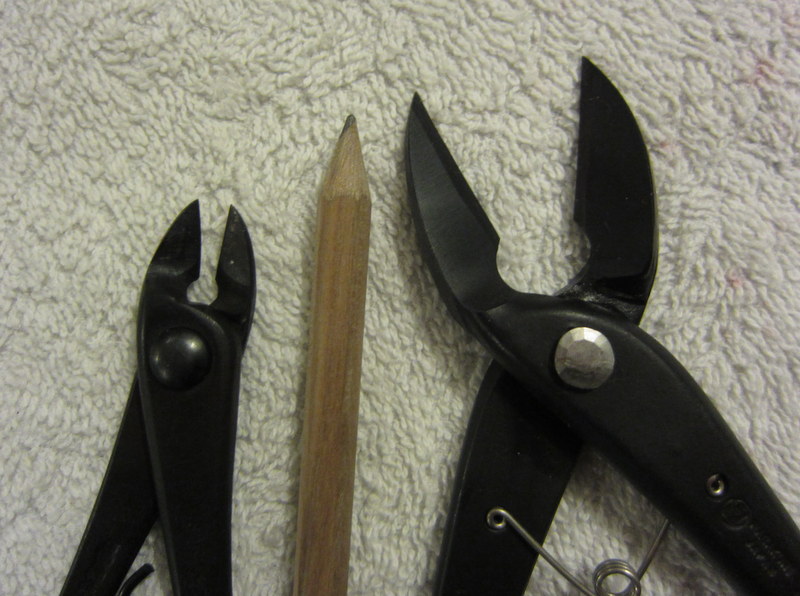
The two tools are essentially two different sizes of branch cutters, or so i thought. No.216 (left) is a small set of branch cutters good for removing small branches up to about 3-4mm thick that are growing in amongst many other twigs. It’s a fairly standard tool but its spring-loaded handle makes doing a large amount of pruning a breeze and it’s tapered head allows you to get it into small places.
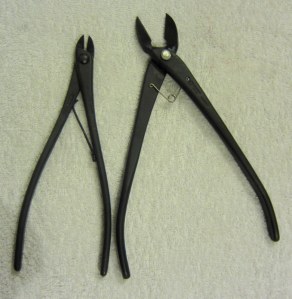
No.216 (Left) and No.61 (right)

The blade profiles

No.61 is the interesting tool. I had imagined that it was a larger version of No.216, but I was a little shocked when it came out of the box. What I was use to seeing in a branch cutter was a concave blade, this one had a convex curve to its blade profile!

Concave No.216 (Front) and the surprisingly convex No.61 (behind)

After the initial shock of seeing the unexpected profile I decided to try the cutters out. To my surprise they performed really well. They are narrow enough to get into dense ramification and make cuts which standard concave branch cutters are unable to do. The cuts the tool made were also really flush and clean. Usually on these hard to get to cuts I use a pair of scissors as they are the only tool able to get in amongst the ramification and make a cut without cutting surrounding branches. The cut stubs that the scissors leave however are always a little ugly and leave small lumps in amoungst the twigs. This tool can make cuts in similarly dense places yet leave perfectly flush cut wounds.

Below are a few pics I took while playing around on a branch removed from a white pine I have recently styled. It’s not really the perfect example as it’s not part of a dense canopy and I can easily get the tools in to make the cuts, but it shows the resulting cuts nicely.

Test branch. Notice pruning stubs at the first fork and just after the second fork.
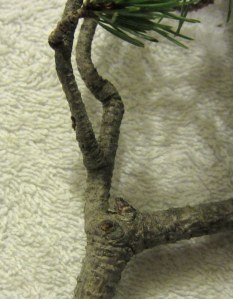
First stub removed. The tool leaves a nice flush cut. I would have previously used scissors for this cut which would have left more of a stub behind.
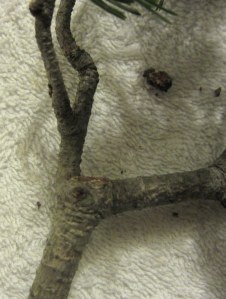
The stub inside the first fork neatly cut. It looks like this stub was left over from a cut made previously by scissors. If this was a branch on a well ramified tree it would have been difficult to get a standard branch cutter into the foliage to make this cut.

Overall they are a pair of really nice tools. Could I live without them? Probably. They are specialist tools which limits their usefulness but its tools like these that really come into their own when you do actually need them. I can see them getting a fair work out this winter when it comes to pruning the deciduous trees.

If you are after some tools to pad out your already full tool roll and you have trees that are either ramified or beginning to become ramified then these tools might be a good option.

Just a quick heads up for my readers…. the smaller No.216 tool was imported directly from Japan and I paid accordingly. I ordered the No.61 tool from an Australian supplier who has a limited range of specialist Masakuni tools that were almost half the price of buying and shipping direct from Japan. Check out their site beebonsai if you are in the market for some tools. They are worth having a look at.
It’s been a busy week and looks like it will be also busy this coming week.

On the 18th, 19th and 20th of this month is the Annual AABC convention which this year is being held in my state, Victoria. I have been lucky enough to have been asked to display a couple of trees and also prepare a friends white pine for the show. I spent the last weekend wiring the White Pine and it has come up well and hopefully I can share a post about its transformation some time after the show.

The trees I am preparing are both deciduous (with one conifer as a back up). It’s a strange time of the year to be exhibiting deciduous trees as they have not started to colour yet unlike trees elsewhere in the state (Some trees from good friend up in the foothills) so I am left with a dilemma, do I defoliate and display bare or do i leave the leaves on?

The leaves are in-between colouring for Autumn and the summer’s growth. Some years we get mild Autumn temperatures and the leaves don’t really colour at all and instead just go brown and fall off. This Autumn is also warm so I don’t like my chances of getting any colour before the show.

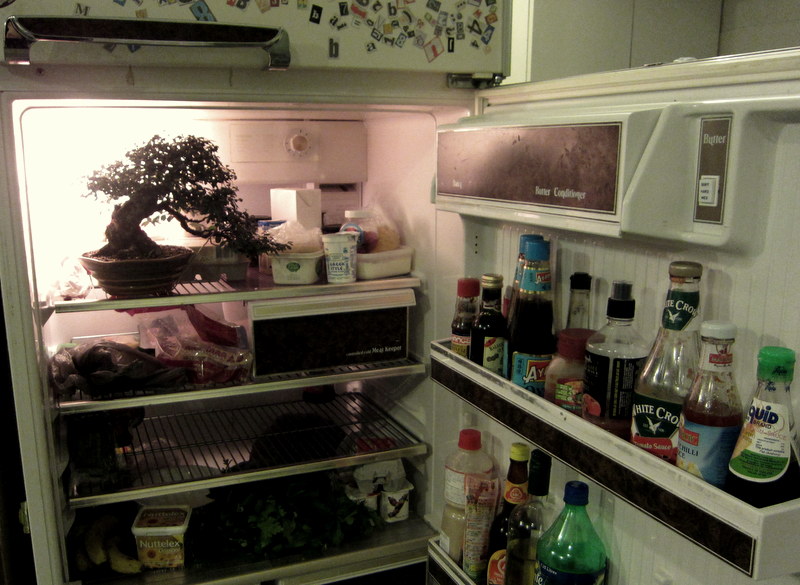
At the moment I am leaning towards defoliating and displaying them bare but as a last dash effort to force some colour i am keeping the smaller of the two trees in the fridge every night to try to force some colour. If this doesn’t work I think I will defoliate.

Hopefully the winter temperatures of the Kelvenator region will induce some colour.

I havent tried this before but I guess I will see how successful this technique is over the coming week or so. If it isn’t showing colour by next weekend I think it will be defoliated for the show. Let the waiting game begin.

It has been a busy couple of weeks. Autumn has begun and with it a range of seasonal tasks. I have been madly plucking Japanese black and Red pine needles. Here in Melbourne we have a convention coming up for which I have to prepare a few trees so I tried to get my needle work out of the way early on.

It took a long time this year. What hadn’t really dawned on me until now was that needle pruning takes more and more time each year. Now this is not a bad thing, its more a by-product of a successful technique. As ramification increases, so does the amount of needles you have to remove. Where last year I was removing needles from one candle there are now two candles at that location that need needles removed from them. Not only are there more needles to pluck, but also the space you have to pluck them in becomes more and more cramped forcing you to use tweezers to negotiate the cramped conditions.

2008

2009

2012

2012 after needle plucking.

The above tree has wholly been grown in Australia and has come great leaps and bounds since I learnt how to properly care for it during my first trip to Japan. It is becoming a nice little tree although it is not perfect and it bears the marks of many of my early mistakes. That being said it has taught me a lot and although I have though about selling it on a couple of occasions I think now I would find it a little hard to part with. After all I have invested a huge amount of time into it.

Perhaps this is something to keep in mind when deciding on how large your collection should grow. How much time do you have, and will this time be enough to maintain your trees to a high level? Bearing in mind that as your trees improve and refine, in turn their maintenance times increase. I really enjoy growing pines but I am very aware of the time I have to spend on them each year. Needle plucking, pruning, wiring and candle work all add up. On a tree that is starting to get refined I am guessing I would be sending 6-10 hours on each of them over the year. When you add up all the pines you grow and then the time you spend on them, combined with the tasks you have for all other species you grow you begin to realise that there is a limit to how many trees you can look after to a high level. I lean towards keeping a smaller collection that is well maintained rather than a larger collection that doesn’t get the attention it deserves. That said it is hard to turn down a good tree.


I am always on the hunt for new material. I don’t necessarily want a bigger collection, but I do want a better collection. I try to sell a tree for every tree I buy or dig. I get rid of the tree with the least promise and replace it with something with more promise. Simple in theory but difficult to put into practice. Somehow the collection always seems to be growing bigger, pun and all.

I Australia we don’t have the yamadori available to dig that other countries have. Unfortunately we don’t really get the snow loads or really have the altitude to produce the volume of material such as the deadwood junipers you see in europe, Japan and the united states. Some native material can be found with nice features but I tend to think that our native species should be left to grow in their natural environment for all to enjoy. It would take hundreds of years for nature to replace them in those alpine ecosystems so I think it’s a little selfish to want to take that for yourself. As a result, i look for introduced species to dig of which there are many.  Elm, Oak, Hawthorn, Pine, plum and olive are just a handful of the species that are strewn across the country. Most of these species become a weed once they establish themselves outside of private gardens and farms.  Being interested in Pines I tend to focus on areas around timber plantations where self-sown escapees can be found.

A nice place for a walk.

Autumn is the season I like to scout these plantations and ear mark potential trees for collection in early spring. I choose autumn for a number of reasons. It’s not too hot so I don’t have to water the trees at home as carefully which means I can go away overnight without worrying. It’s also not too cold so walking around the forests for a few hours without heavy jackets is possible and then of course autumn is also a good time to scout for other things as well……

Most of the areas I walk into are good for numerous thing that I am interested in. I look for bonsai material, fishing spots and also mushrooms.

A little on the large side but interesting movement for its size when compared to its bolt upright neighbors.

I have been into a number of forests already this autumn and have not found any trees worth digging yet, but i did find a lake worth fishing and most of the trips we have come home with mushrooms!

A nice bonus from a day where no dig-able trees were found.

Most of the young pines i find could be easily grown from seed with better movement and better roots so I don’t bother digging them. What I look for is movement and old bark. Bark only happens with time so by digging trees with good bark you are putting yourself ahead of the game, and if you find good bark and good movement you have found a tree worth digging.

It seems others also like this spot, unfortunately it seems they don't like it enough to clean up after them selves.

Even though most fo my outings don’t produce trees they do get me out of the city and into fresh air and great views. Hopefully in the coming months I am able to get out some more and collect some mushrooms, catch a fish and maybe even find a tree worth digging. I always enjoy the trips away even if you come home empty-handed, the day never feels like a waste.

A nice view.

If the scouting trips don’t reveal and trees worth digging I do have a couple earmarked from last year that I might try to liberate.

This is the final post about the Korean Bunjae Museum in Seoul (Part 1) (Part 2). The following photos are from the largest green house on the site which was mainly filled with the trees belonging to the owner of the Nursery.

There were literally thousands and thousands of bonsai inside the huge green house.

A glimpse at some of the trees.

All the trees were sheltering out the winter under cover due to the low temperatures the area experiences. As a result the green house was quite cramped, In a strange way this was quite good as you really had to hunt around to look at all the tree.

One of the wings full of bonsai.

Throughout the collection there were many trees that were a little unusual. Some of these unusual characteristics were due to the fact that they were collected trees and others were grown in ways I was un familiar with.

An exposed root forest.

One such tree was this exposed root forest. I can’t remember seeing a tree like this before and as a result I spent a good amount of time in front of it soaking it up.

Some of the other trees were unusual due to their size, which in some cases was outright huge!

A massive hornbeam.

I couldn’t help but wonder how much time it must take to maintain a collection of this size.

A few pics of some more of the tree are below.

For those travelling through Seoul or thinking of visiting i can thoroughly recommend it. I would actually love to come back some time not in the heart of winter to see the trees in leaf and outside the green houses on display. The day we visited the owner of the nursery was not around but instead his daughter was looking after things.

She had just graduated from a Bonsai University degree and spoke near perfect english. She had many ideas for how she would like to promote bonsai within Korea in the future and I am sure she will achieve them.

So if you are ever in Korea I think a trip to the Korean Bunjae Museum is well worth the effort.

Enter your email address to subscribe to this blog and receive notifications of new posts by email.

Join 678 other subscribers

Contact me

nichigobonsai***gmail.com

Note: to use email address, substitute *** with @