You are currently browsing the category archive for the ‘Bonsai Maintenence’ category.
I’ve had this red pine a while now and first worked on it back in 2016. In the 9 years I’ve been growing it it’s been through a few phases and has been displayed, grown out, brough back in, maintained and generally been in and out of the workshop a few times each of the years I’ve owned it.
It’s even had a couple of post about it POST 1, POST 2
More recently it has really outgrown its previous style.
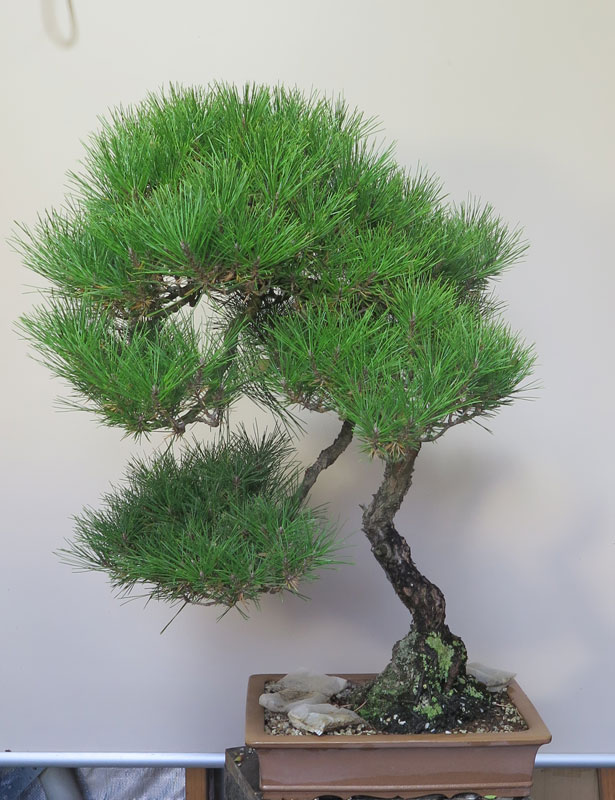
It’s pretty clear from the above image that the foliage has well out grown the trunk size. It feels heavy and makes the trunk seem thin and essentially out of scale.
I’d been thinking a lot about this tree, staring at it each day i was watering, pondering options and playing out scenarios in my head.
I’d always wanted a decent bunjin tree and this tree always seemed half way there, so after much thinking and with a whole lot of needle plucking on the horizon i decided to make the jump. With branch cutters in hand, i began to cut.


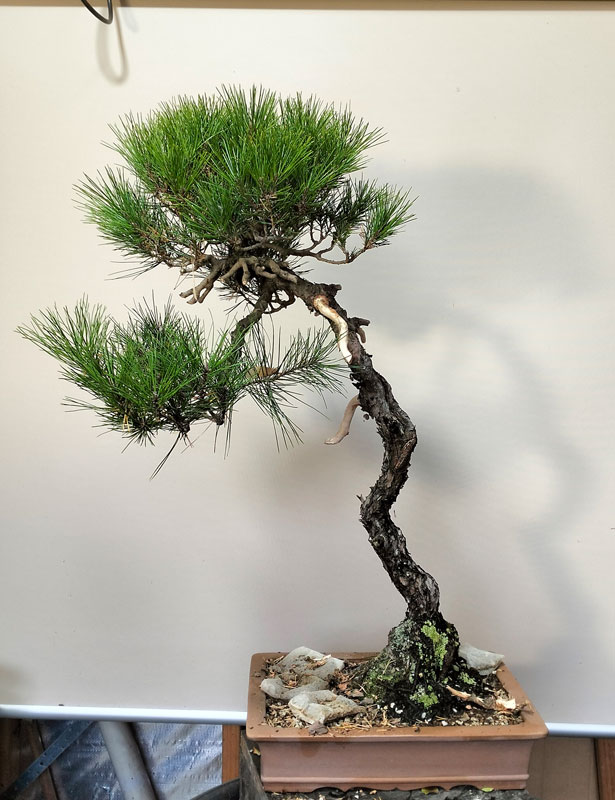
I took off the first, second, third, fourth and a bunch more branches as i worked my way up from bottom to top.
After more cutting and some wire i got the tree into its new shape.

I’m pretty happy with the new style. Looking back to the original styling in 2016, i think that this revision fits the tree even more than that first styling. Back in 2016 i didn’t have the growth i would have needed to make the above image so I don’t think it was something i had even considered back then. It really was a case of having to go on a bit of a journey to end up at this style. It highlights how Bonsai change over time and evolve and you have to be open to that to maintain, reshape and move bonsai through time.
It’s really worth actively reassessing your trees and always looking for new ideas and solutions. It can be really rewarding and provide some refreshing change, and in the case of this tree i think that approach has resulted in a better tree!
Of course, now the hunt for an appropriate pot begins………..
With the first days of summer now under our belts and some solid early spring growth it was time to begin this seasons tasks around the garden. First cab off the rank was this trident which found its way onto my benches recently.
It had been fully wired in winter, most of which had begun to bite in with shoots extending aggressively with an early warmth to spring.
I defoliated the tree and removed the old wire setting it up for its next flush, some new buds and further ramification. Its a very nice tree and I think will develop into something that will always have a space on my benches.


While there is a long way to go with this tree, I think the bones are all in place and you can already get a sense of what the tree might look like in the next 5 years once it has a lot more ramification.
Now I have a sense of where it is heading, I will likely leave a few shoots to run on the lower branches to increase their size a little given how quickly the upper regions are thickening.
Onto the next one!
There’s something satisfying about pinching Maples. I only really do this to trees in a refinement phase as it slows growth of the extending shoot and as a result keeps inter-node length short. Its a good technique to add that final tight twiggy-ness to the canopy. As it slows growth you probably dont want to use it on developing trees as it will slow down the rate of growth across the tree.
It’s also not really something that you can do in one hit, rather pinching a number of tips a day as they slowly open giving you a good reason to closely monitor and spend time with a tree over a number of days or even weeks. You have to wait until the first set of leaves opens and the next set just begin to unfold. Then you get in there and remove that shoot tip. The extension of that shoot will slow or stop and hopefully you will get much tighter bud spacing.
If you have a refined Maple, give it a go as the growth flushes out and see how you like the results.


Below is a pictorial post explaining the steps i went through when styling this tree. I had previously adjusted the planting angle in the last post and now had to adjust the foliage mass in reaction to this. I’ve done my best to explain the thinking process for each of the steps for each of the below images to give some insight into my thoughts and process. I hope it’s interesting.
Above: Where we got to in the last post. The trunk was tilted to the left but the foliage wasn’t pruned or adjusted to the new angle. From a balance perspective, i feel that there is too heavy a visual weight in proportion to the trunk.
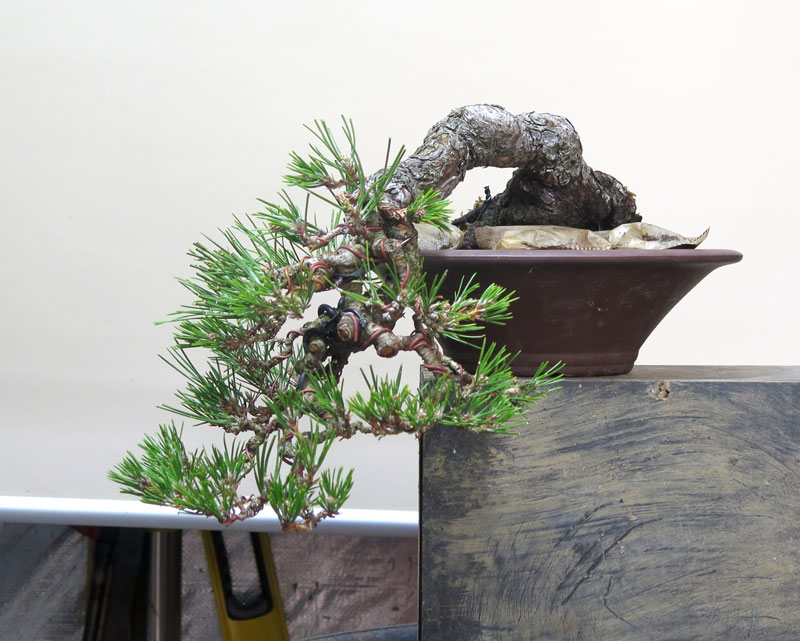
Above: the tree’s branching was pruned a little and thinned with a major branch on the lower right removed to begin lightening the canopy. I fully wired the remaining branches and began to think about the styling. I felt that the foliage was too large and removed the focus from the trunk. Its mass dominated and reinforced a feeling that the trunk was thin.
I also didn’t like the direction the tree lead the eye and felt that combined with the trunk movement it drew the eye away from the tree. I decided that i wanted the tree to move back toward the base of the trunk creating kind of a circular composition. This decision kicked off the below responses.

Above: to facilitate the lower branch moving rightwards, i had to remove a couple of branches to create space for this key branch to occupy. I also began to compact the apex region slightly with the overall aim of creating a smaller and more compact foliage mass.

Above: As i moved the lower branch across i removed another branch to ease the congestion the shifting branch created. Having began to move this key low branch, I felt that the foliage was feeling a little stretched out again taking the eye away from the trunk-line.

Above: I pulled the lower branch across further and brought it upward to further compact the foliage mass and bring it all in closer to the trunk. This also helped fill in the gaps left by the removed branches from the previous image. This is essentially where i will leave this round of work. I will let it fill in this season and perhaps revisit the wiring in autumn.
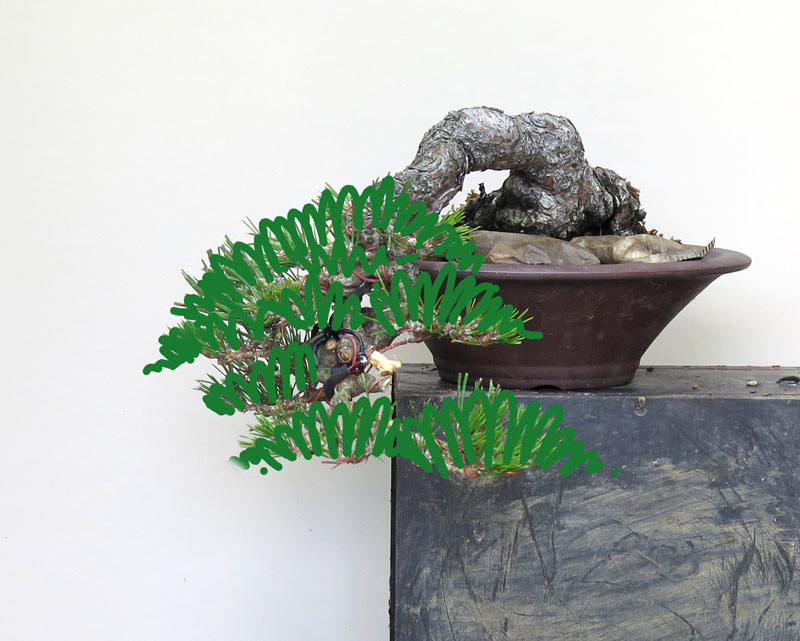
Above: a quick scribble to give a sense of what a more fully filled in canopy might look like.

Above: A quick couple of images to give comparison of where the tree was when i started working on it and where it is now. I am very happy with where the tree is at now and look forward to continuing to develop it over the next few years.
It’s been a funny start to spring with some trees leafing out early and with gusto while others are only just budding out. I put it down to a warm start and a later cold snap which has set a number of trees behind their bench mates.
The below Crabapple is new to my benches and was re-potted a month or so ago and falls firmly into the early leafing category
Since re-potting, It had continued to grow strongly and had leafed out to a point where the inner growth was already being shaded out and the inner buds looked sluggish.
So i brought it into the workshop and cut back extending shoots and also leaf pruned or partially defoliated the canopy.


Above: Before and after.
I have left the tree with two leaves per shoot, having also removed the small inner leaves at the base of shoots that tend not to form buds at their base. I find this goes a long way to increasing the sunlight that reaches the interior without really effecting the budding / ramification. I will see what happens from here but if the leaves keep growing in size and shade the interior too much i may cut them in half to further encourage light to the interior.
There was a lot of growth in the upper regions of the tree so by carrying out this first leave prune i hope that the energy of each branch is much more evenly balanced and has a more even access to light. We will have to see what happens with the second flush to test that thought.
This is a bit of a different post covering a tree that has found its way back into my collection lately.
I originally grew this as stock from a cutting and put some early bends into the trunk line. Soon after the wiring of the cutting i gave it to a friend who did the bulk of the work in forming it into a tree and growing it on.
As luck would have it, the tree recently found its way back into my collection.
Stupidly, i didn’t take any before pics, but when i received the tree i re-potted it, changing the angle a bit and fully wired the tree removing a branch or two in the process. All in all, building on my friends work, its forming into an interesting little tree!

Above: The tree post re-pot and styling.
But…….. it still has a while to go.
Normally a shimpaku of this thickness i would keep as stock and grow hard and fast to thicken the trunk and develop the shari’s and live veins. Luckily we cut shari’s into the trunk last year but i still need to focus on developing trunk thickness and continue to develop the sharis as things thicken.
This is somewhat difficult in a tree that i don’t really want to grow out of shape or get too much larger. What i want is to thicken the trunks and keep the tree’s foliage well managed.
The solution is………. Sacrifice branches.
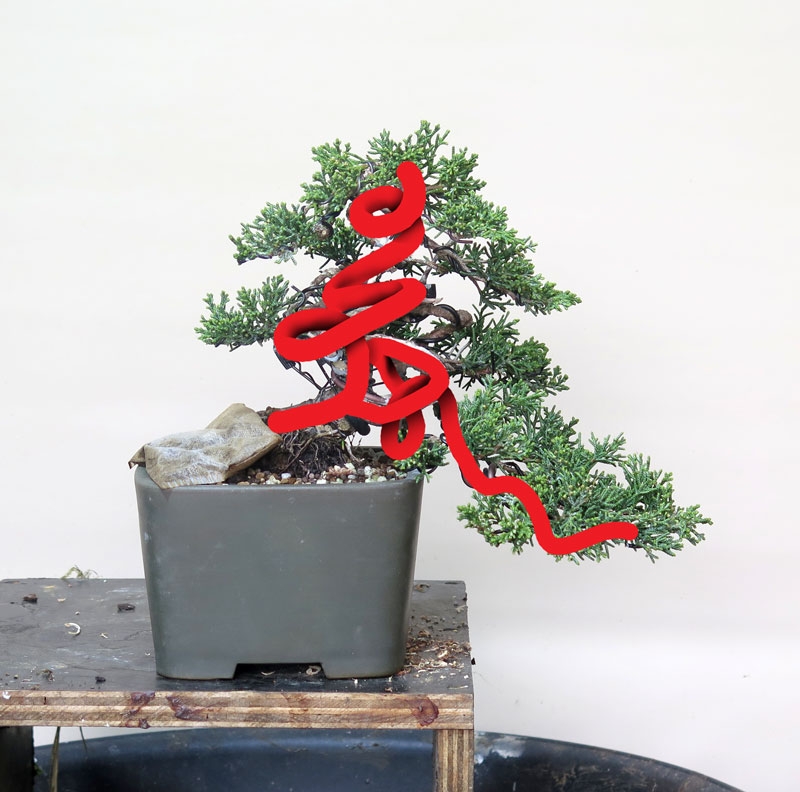
Above: The two main trunk/branch lines.
The tree is built off two main trunk lines as per the diagram above and ideally i would like to thicken both of these lines. To do this i will likely grow two sacrifice branches.

Above: likely locations of sacrifice branching (shown in pink).
I will locate two sacrifice branches (one per trunk line) but in slightly different locations. The sacrifice branch in the apex will be toward the top of the trunk line as i want the entire upright trunk to thicken.
The second sacrifice will be on the first branches trunk line, It will be located back from the first branch tip though, to avoid the branch holding the foliage from thickening too much, keeping it in scale with the other branches.

Above: the image in my head i am aiming for.
I will likely also wire the sacrifice branches into interesting shapes reinforcing the tree’s movement so i can use them as future jins.
To further facilitate this thickening i will be making a shari on the opposite side of the trunk to the shari’s we have already made. I’ve covered this a bit more in THIS post. I am hoping this speeds up the whole process quite a bit. Also keeping the majority of the foliage trimmed and compact should direct a lot of energy into the sacrifice branches which will be left un-pruned. Hopefully allowing them to grow quickly and do their work.
That said however, i do expect this process to take a number of years to get to the thickness level i am after.
This is one of my trees that was partly neglected over the last couple of years. It’s pruning only really focused on cutting back to the silhouette (due to lack of time), so while the canopy out of leaf looked twiggy and dense, the structure was not great and the beginnings of lumps and bumps were forming where too many shoots emerged from one place.
The time came recently to do some work on this tree and it was pruned back and re-potted.

Above: Pre-work. The tree looks dense and ramified but the beginnings of lumps were forming within the canopy. It was time to cut out some problems.

Above: After a cut back. I think about 50% of the fine twigs were removed. While this is a bit of a set back, with a year of strong growth i think i can probably get 3 or 4 flushes out of it and mostly replace what has been lost, but this time upon better structure.

Above: ….. and a re-pot. Not a dramatic change as its the exact same size, style and make of pot, just in a different colour.
This little tree stands 12cm from the rim of the pot which doesn’t really come across in the pics but it is a tree that really fits in the palm of your hand.
During this growing season i will be working towards rounding out the top of the canopy and increasing the ramification. I will do this via:
- Heavy feeding
- Outer canopy defoliation and cut back
- Selective pruning of twig structure to avoid growing more issues into the tree and;
- Possibly some limited wiring.
I will update again if the above is successful.
A very quick update post of THIS pine.
From where we last left off, the pine had been un-wired during the previous season and had grown out quite a bit, hence needing a little tidy up. Recently toward the end of this last winter, it made it into the work shop for a quick wiring before the candles got too fragile.
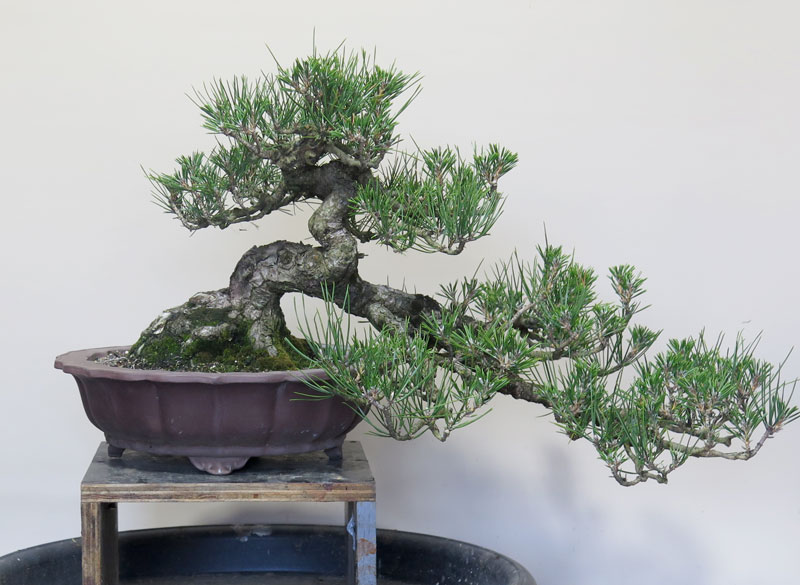
Above: de-wired and grown out of shape.

Above: The first step was bending the lower branch down further to try and separate the foliage masses a little more into individual zones.

Above: Post wiring.
I only wired what was needed which essentially meant only the main branches and sub branches were wired. I am pretty happy with the way it turned out and think it is evolving nicely.
For comparisons sake, below is how it was in 2021 vs. after the styling today.
the combination of a narrower apex area and a more separated lower branch all work together towards a solid slow improvement over the years.
I recently was gifted a number of very nice small trees from a close friend. They were all trees we had been working on together and that had got to a pretty nice point in their development.
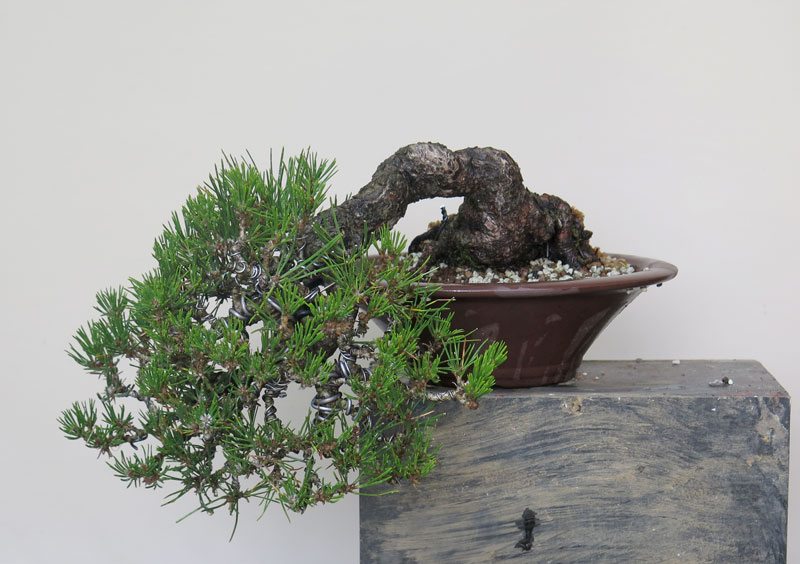
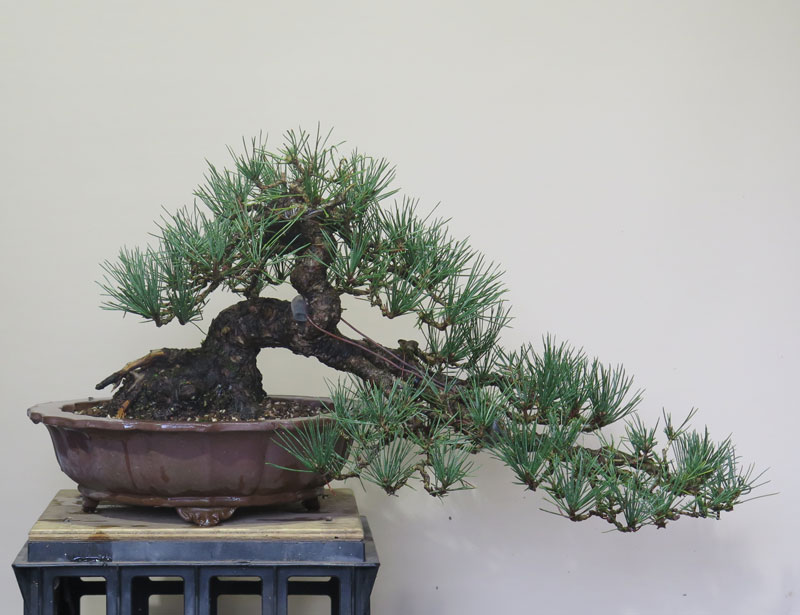
One of the trees was this black pine.
Above: the tree as i received it.
We had previously worked this tree and during its last re-potting we have moved it into this semi-cascade position from a more upright posture.
After staring at it for a while i started to wonder if i could get some more out of it, so out came the plastic pot and I tested a few new potential angles.

Option 01: Use the rear as the front and tilt the tree. I felt this kind of straightened out the trunk (even if a little lumpy) and elongated it a little so I wasn’t completely convinced.

Option 02: the original front but a slight rotation and a decent tilt to the left. I liked this option as it shortened the trunk a little and added what looked like another bend in the trunk’s length.

Above: I only had a couple of pots available for the re-pot. A flared sided round pot and the original banded round one.
I ended up using the flared pot. I liked the flared side as it helped lighten the visual weight of the pot. It also will give some extra clearance for branches which i may want to place close in to the container.
Above: the tree all potted up. I couldn’t quite get the full rotation and as a result the top section of trunk is a little parallel to the pot edge. While it doesn’t bother me too much at this stage, I will likely try to get this further down in the next re-pot.
Of course with an angle change like this there will always be foliage that needs re-styling.

Above: you can see from the angle of the shoots just how much the angle of the tree has changed.
Surprisingly the roots were fairly easy to adjust to get to suit the new angle, with only a couple of finer ones ending up above the new surface level. For those i dressed them with a layer of sphagnum moss to keep things moist while the slowly adjust to their new position.

Above: Sphagnum moss covering a couple of exposed roots.
All in All a successful re-pot and angle change. Once the tree recovers and grows out, i will start to think about part 2 of this process and restyle and re-shape the foliage mass to suit the new angle.
This year i have gone a little Chojubai crazy with a lot of them on the go. The below tree hasn’t helped bench space matters at all as it has multiplied!

Above: the clump in it’s larger form.
I had originally been growing it as a larger clump but after seeing how it had developed since last re-potting i decided that there were actually two nicer smaller clumps within the mass of trunks.
So i set about breaking it up and finding pots for the two settings.

Above: The two smaller clumps that i split out of the larger planting.
I think both smaller plantings have some great characteristics in their own right and they should continue to develop into interesting trees.
I really love Chojubai and would recommend everyone gets a few into their collections!
 Nichigo Bonsai