You are currently browsing the tag archive for the ‘Japanese Black Pine’ tag.
I had some time this weekend to work on one of my pines. This time i chose to re-wire a small Japanese black pine (Pinus thunbergii).
The tree in question had belonged to a member of one of the clubs I belong to. When i received the tree it was estimated to be around 30 years old. It had been a nice little tree, but the last few years before I received the tree it had become leggy and some wire had also been left in the apex which had caused some large swelling and scarring. As a result, I had to prune most of the branches back quite hard and also remove the damaged section of the apex and upper trunk which essentially shortened the tree by a third.
The first wiring happened in March 2009.

One of the first wirings. Before and after, March 2009.
The little pine responded well to heavy feeding and was re-potted into a better mix. It budded back quite well and was ready for another light wiring by April of 2010.
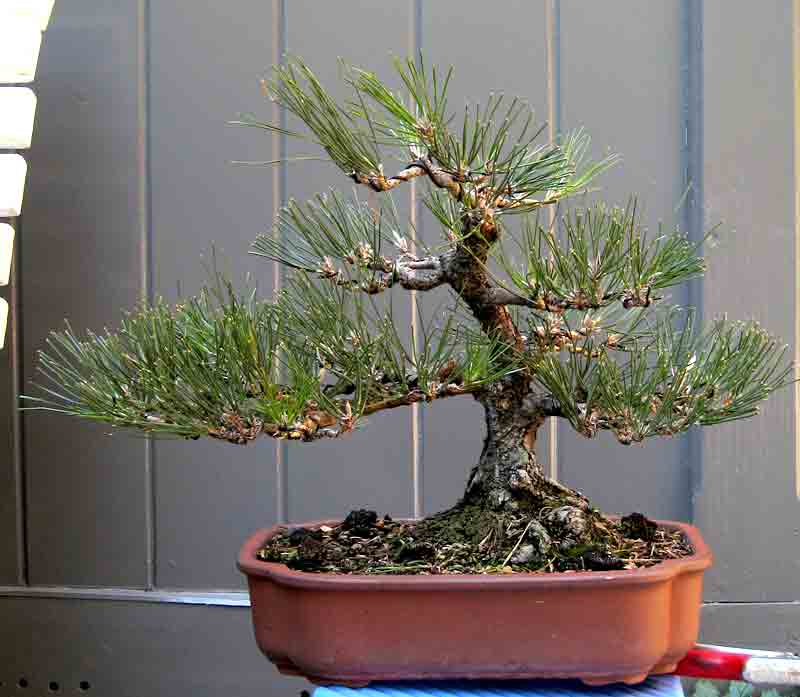
After wiring the tips out. April, 2010.
As you can see the apex still needs a lot of developement. After cutting the damaged upper trunk off in 2009, I had then had to re-build the apex from a single branch. It is a slow process to rebuild a crown but this little pine responded well and produced a number of buds where i needed them.

The tree slowly coming to shape. Pre-wire, first branch and then secondary branches wired.
Every year the ramification increases and I am able to remove problem branches and replace them with better growth. The apex has now taken shape and now needs to increase its ramification to fill out its silhouette.
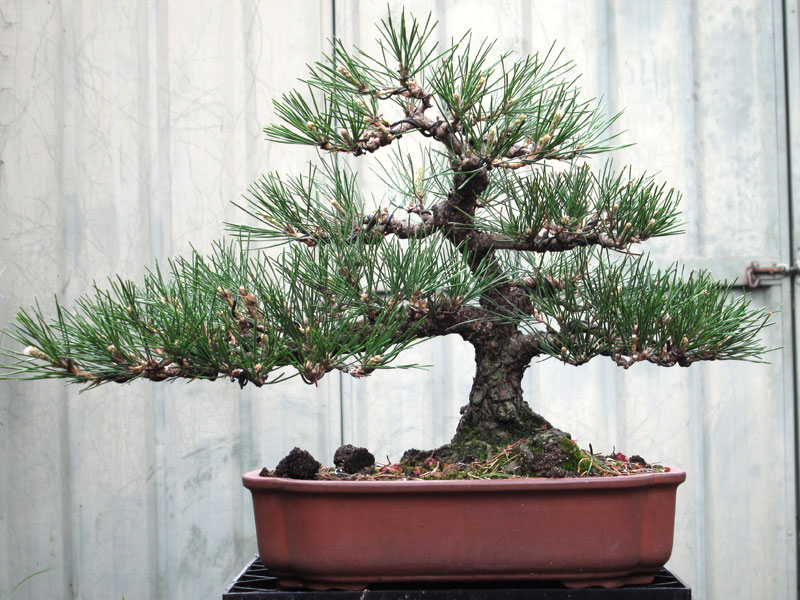
After the latest wiring.
Looking at the above picture the shape of the tree becomes clearer, but i think it still has a way to go. I like the long first branch, but am still toying up whether or not to break the foliage mass up into a couple of pads or keep it as a single mass. This years wiring was not the final wiring the tree will see and was done to achieve two things. The first was to start to set the form of the branches a little closer to how I imagine their final positions and also to let more light into the interiors of the structure. By letting more light into the interior I should be able to strengthen weak inner buds and also encourage further back budding.
I hope that in a couple more seasons I should be able to even out the foliage density and have the tree ready for show.
The longer I am involved with bonsai the more my tastes change and develop.
Below is a Japanese black pine that I have been growing for a couple of years. It’s not a classic beauty but I was drawn to its strangeness and the challenges it presented in regards to styling it. I enjoy the challenge of difficult material. Quite often you have to think outside the square a little in order to get a pleasing result and often the bonsai that are transformed from this unusual material often posses something that makes you look twice at them and linger to explore their curves, movement and styling.

Before the work.
Now this tree had been styled once before, but I had never been entirely happy with the result. I had styled the first branch as just that, a branch. initially this branch was a sacrifice branch, grown to thicken the trunk and when I came to style the tree there was something about it that appealed to me. I had spent all the time since then looking at the tree on my benches trying to work out why it didn’t quite sit right with my eye. I realised this was a simple question for most people because I had many people suggest to just cut it off. I thought about that this time around but decided that I could have another shot at things and try to make the bonsai work with the large first branch.
My new approach was to style the branch more like a trunk. I guess the idea is that the main branch got so strong that it started to turn up and form a trunk in its own right.
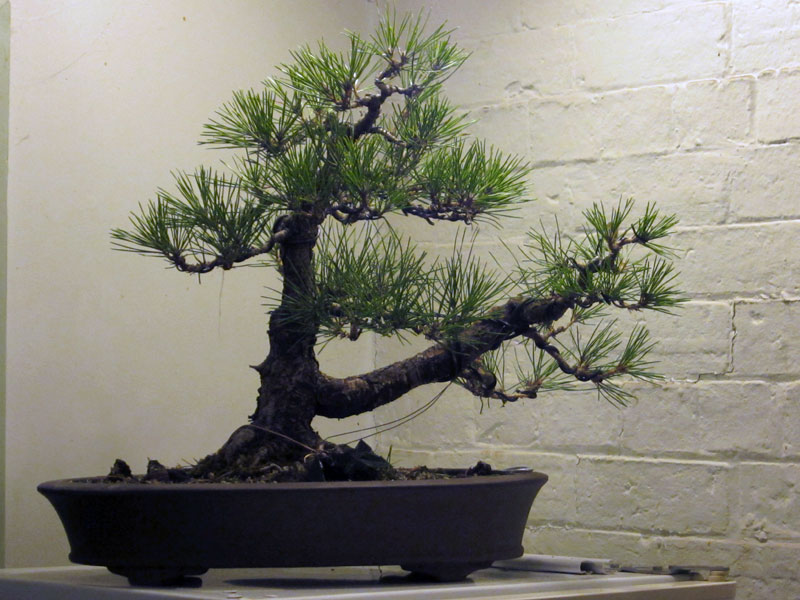
After a quick wire and the addition of a couple of guy wires.
Now as you are probably aware by looking at the above photo that this bonsai has a long way to go but at least now I feel this new structure is something that the tree can grow into and fill out to form an interesting, convincing bonsai.
Now I am sure that I will get suggestions for the rest of this trees life to cut off the first branch. As this tree is, it doesn’t fit the normal image of bonsai.
I have often found that the bonsai that are a little out of the ordinary are the ones that I end up remembering and that I return to at shows to have a second look at.
Just for interest purposes I photoshopped the branch off.
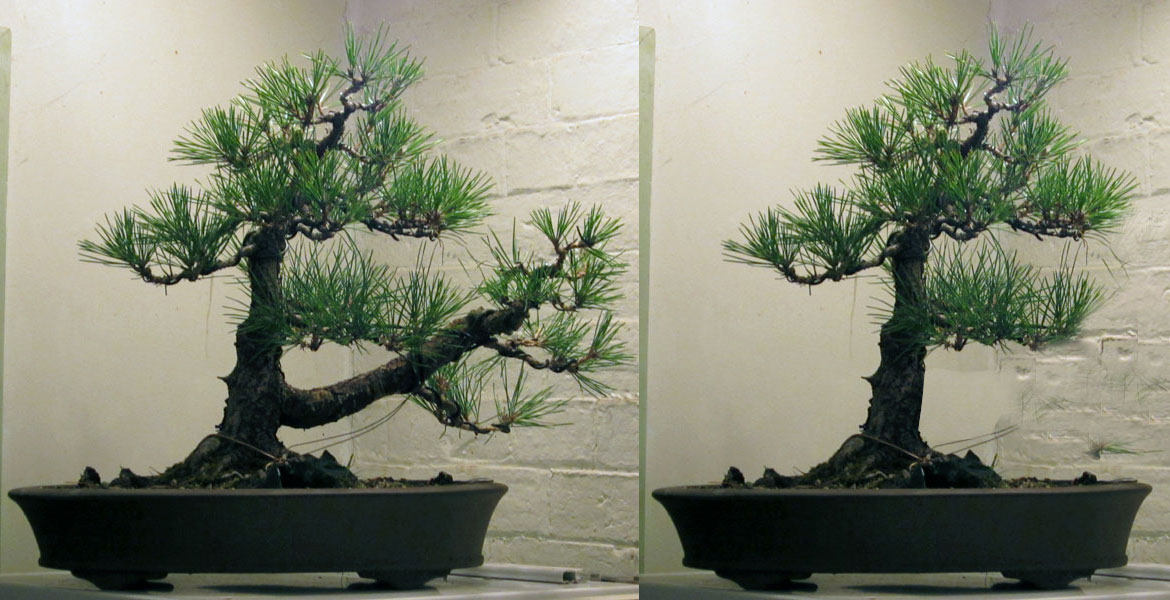
The offending branch virtually removed.
Looking at the above comparison it becomes obvious that this is not the right direction to take this pine in at the moment. The removed branch would reveal a straight trunk and leave behind a mediocre branch and canopy structure. If I was to cut off the branch I cannot see the tree staying in my collection for long.
It’s that time of the year again.
It’s a time of the year that I both look forward to and dread. Once you amass a certain number of pines you begin to realise just how much time you need to set aside to give each tree its seasonal maintenance. This year, I have moved house and as a result some of the trees I would have normally have worked on earlier in the month were left until now, so the back log of tasks compounded the time I needed to spend on them. That being said, once I began the work I really enjoyed getting to see just how each tree had been growing over the season. When you thin needles you get to inspect very closely every branch of the tree and evaluate each new bud, needle and twig. You really get to know your trees while doing these tasks.
Why do you thin needles? You should thin needles at this time of year for a few reasons.
- By removing last season needles you let more light and air into the canopy which in turn encourages back-budding.
- By removing some of this seasons needles on strong areas you are able to balance strength across the tree foliage.
- By removing surplus needles you also reduce the amount of places that insects and other pests are able to hide.
I like to think that needle reduction for pines works a little like defoliation does for deciduous trees. I figure that the pine realises it suddenly has less foliage and as a result sets new buds which will grow the following spring to replace the needles that you removed. As pines cannot simply grow new needles they have to throw new buds. Most of these new buds will be dormant buds back within the canopy. These are the buds you want. This back-budding is what will give you foliage to cut back to in the future and which will prevent branches becoming leggy.
This year I have left a few more pairs of needles then I usually may on some trees as I plan to re-pot them come spring and figure they could benefit from the extra strength more needles will provide.

A Formal upright Black Pine in the making. This image was taken prior to beginning needle thinning.

The same tree after thinning. It is still very much in developement but after a few years of work i hope to have a more complete looking tree.

This is another JBP from the same batch as the above pine. It has developed much better than the above pine. It avoided many of the mistakes the other tree had to endure as i was learning. Photo was taken before thinning.

The same tree after thinning. It needs the apex developed but otherwise is on the right track. I am also planning to graft a back branch or two into the upper section this spring which may be the topic of a future post.
I also thinned my large Radiata. I again left more needles on it that i usually might for two reasons. The first reason is because I will be re-potting it this spring and I want it to be strong. The second reason is because I am experimenting with leaving more foliage on it much like you would on a white pine. We will have to see how that works out.

A Radiata branch prior to thinning.

And the same foliage after a light thinning.
 Nichigo Bonsai