You are currently browsing the tag archive for the ‘Pinus thunbergii’ tag.
Below is a pictorial post explaining the steps i went through when styling this tree. I had previously adjusted the planting angle in the last post and now had to adjust the foliage mass in reaction to this. I’ve done my best to explain the thinking process for each of the steps for each of the below images to give some insight into my thoughts and process. I hope it’s interesting.
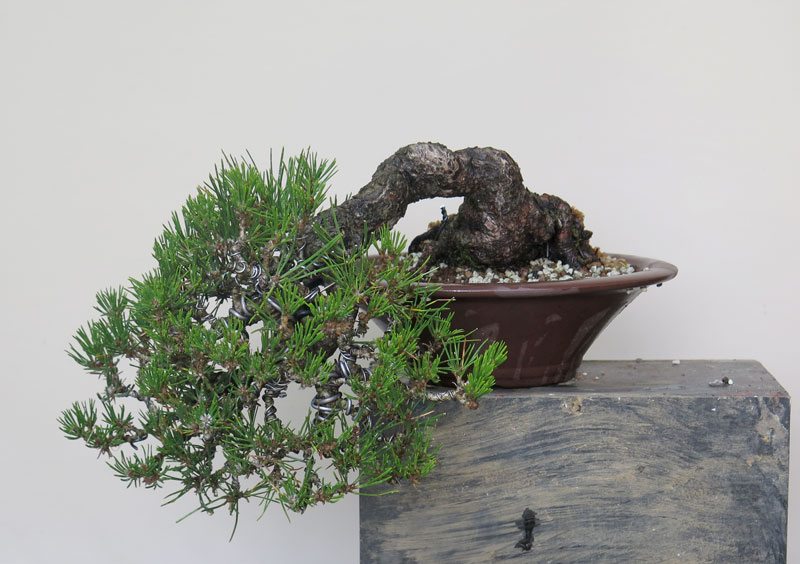
Above: Where we got to in the last post. The trunk was tilted to the left but the foliage wasn’t pruned or adjusted to the new angle. From a balance perspective, i feel that there is too heavy a visual weight in proportion to the trunk.
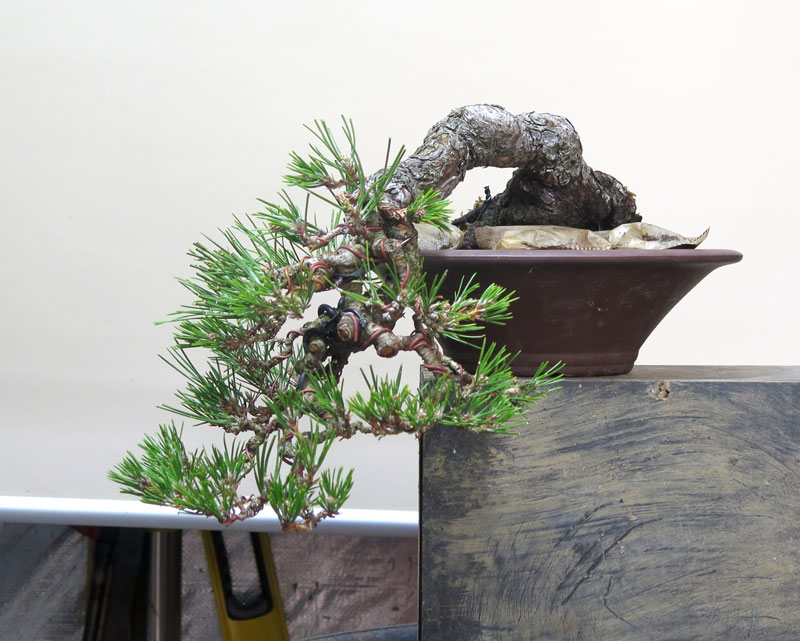
Above: the tree’s branching was pruned a little and thinned with a major branch on the lower right removed to begin lightening the canopy. I fully wired the remaining branches and began to think about the styling. I felt that the foliage was too large and removed the focus from the trunk. Its mass dominated and reinforced a feeling that the trunk was thin.
I also didn’t like the direction the tree lead the eye and felt that combined with the trunk movement it drew the eye away from the tree. I decided that i wanted the tree to move back toward the base of the trunk creating kind of a circular composition. This decision kicked off the below responses.

Above: to facilitate the lower branch moving rightwards, i had to remove a couple of branches to create space for this key branch to occupy. I also began to compact the apex region slightly with the overall aim of creating a smaller and more compact foliage mass.

Above: As i moved the lower branch across i removed another branch to ease the congestion the shifting branch created. Having began to move this key low branch, I felt that the foliage was feeling a little stretched out again taking the eye away from the trunk-line.

Above: I pulled the lower branch across further and brought it upward to further compact the foliage mass and bring it all in closer to the trunk. This also helped fill in the gaps left by the removed branches from the previous image. This is essentially where i will leave this round of work. I will let it fill in this season and perhaps revisit the wiring in autumn.
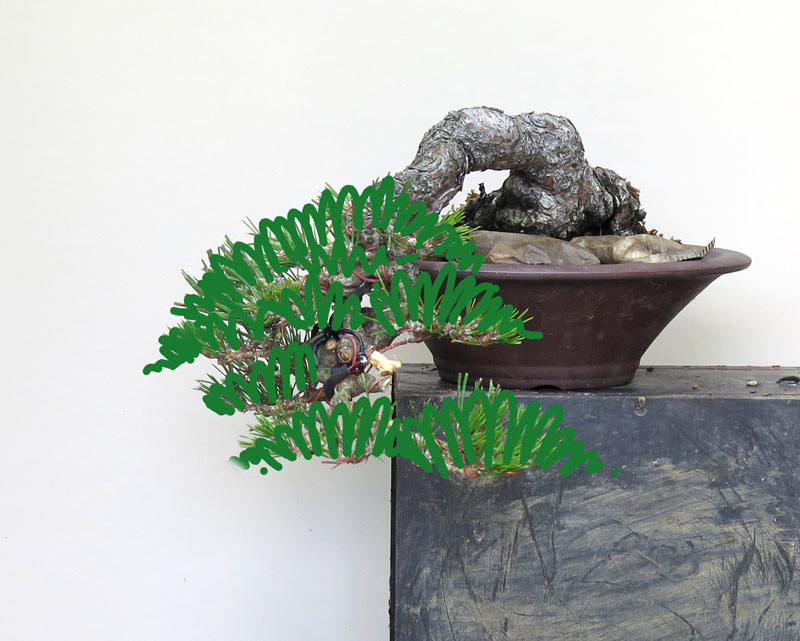
Above: a quick scribble to give a sense of what a more fully filled in canopy might look like.

Above: A quick couple of images to give comparison of where the tree was when i started working on it and where it is now. I am very happy with where the tree is at now and look forward to continuing to develop it over the next few years.
A very quick update post of THIS pine.
From where we last left off, the pine had been un-wired during the previous season and had grown out quite a bit, hence needing a little tidy up. Recently toward the end of this last winter, it made it into the work shop for a quick wiring before the candles got too fragile.
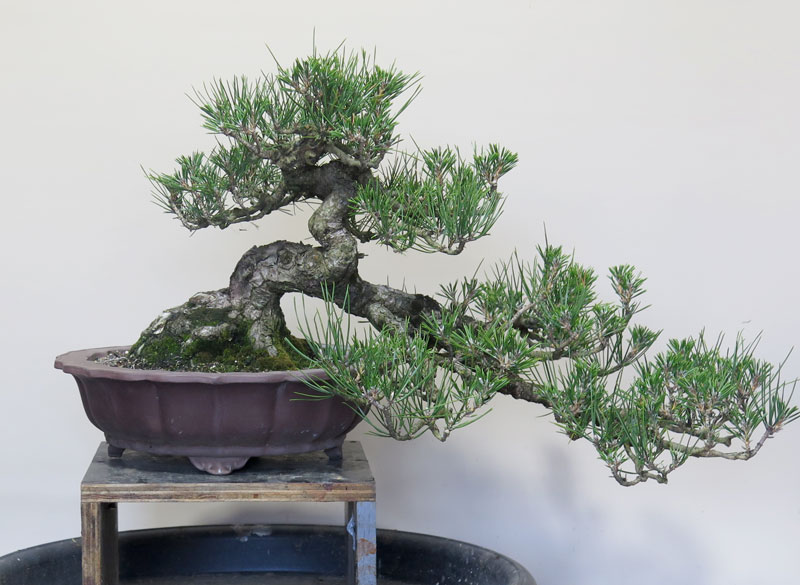
Above: de-wired and grown out of shape.

Above: The first step was bending the lower branch down further to try and separate the foliage masses a little more into individual zones.

Above: Post wiring.
I only wired what was needed which essentially meant only the main branches and sub branches were wired. I am pretty happy with the way it turned out and think it is evolving nicely.
For comparisons sake, below is how it was in 2021 vs. after the styling today.
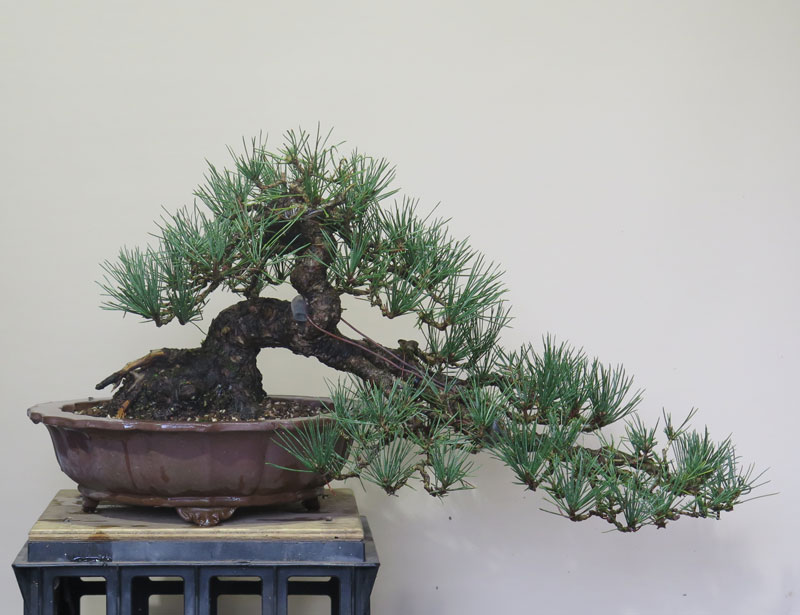
the combination of a narrower apex area and a more separated lower branch all work together towards a solid slow improvement over the years.
I recently was gifted a number of very nice small trees from a close friend. They were all trees we had been working on together and that had got to a pretty nice point in their development.
One of the trees was this black pine.
Above: the tree as i received it.
We had previously worked this tree and during its last re-potting we have moved it into this semi-cascade position from a more upright posture.
After staring at it for a while i started to wonder if i could get some more out of it, so out came the plastic pot and I tested a few new potential angles.

Option 01: Use the rear as the front and tilt the tree. I felt this kind of straightened out the trunk (even if a little lumpy) and elongated it a little so I wasn’t completely convinced.

Option 02: the original front but a slight rotation and a decent tilt to the left. I liked this option as it shortened the trunk a little and added what looked like another bend in the trunk’s length.

Above: I only had a couple of pots available for the re-pot. A flared sided round pot and the original banded round one.
I ended up using the flared pot. I liked the flared side as it helped lighten the visual weight of the pot. It also will give some extra clearance for branches which i may want to place close in to the container.
Above: the tree all potted up. I couldn’t quite get the full rotation and as a result the top section of trunk is a little parallel to the pot edge. While it doesn’t bother me too much at this stage, I will likely try to get this further down in the next re-pot.
Of course with an angle change like this there will always be foliage that needs re-styling.

Above: you can see from the angle of the shoots just how much the angle of the tree has changed.
Surprisingly the roots were fairly easy to adjust to get to suit the new angle, with only a couple of finer ones ending up above the new surface level. For those i dressed them with a layer of sphagnum moss to keep things moist while the slowly adjust to their new position.

Above: Sphagnum moss covering a couple of exposed roots.
All in All a successful re-pot and angle change. Once the tree recovers and grows out, i will start to think about part 2 of this process and restyle and re-shape the foliage mass to suit the new angle.
This year i finally feel like my pines are thriving after a long period of mediocre growth. This bad growth was due to a number of factors including:
- water pH Issues – Solved by moving to rain water.
- soil mix – I have recently moved to Akadama, Pumice and Scoria and believe this is a good improvement.
- fertiliser regime – This year i am using a two part hydroponic fertiliser and am applying weekly, and;
- strange seasonal variation – We have been in an ‘El-nina’ phase which resulted in cool wet years which even threw my tomato crops off kilter amongst other things
Most of the pines have been grown out last year and skipped de-candling to build their strength and from the below pics you can see they are responding well this year.

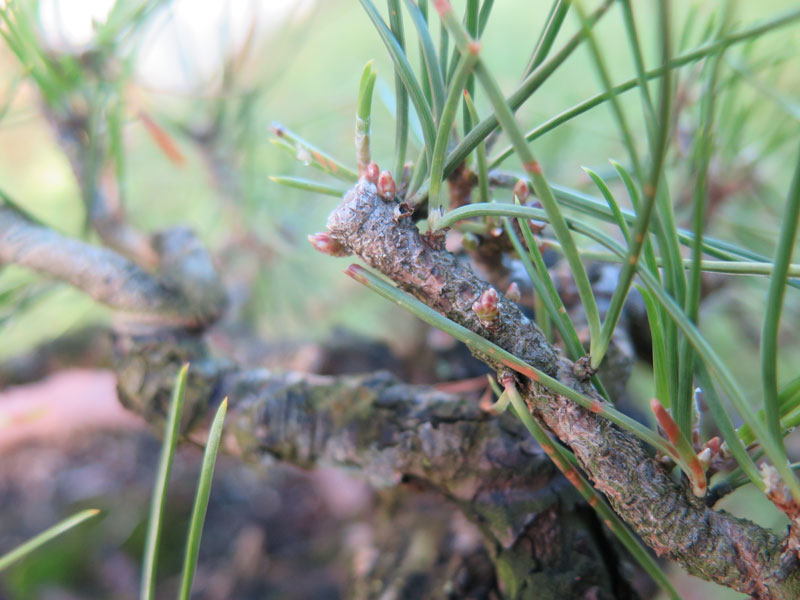
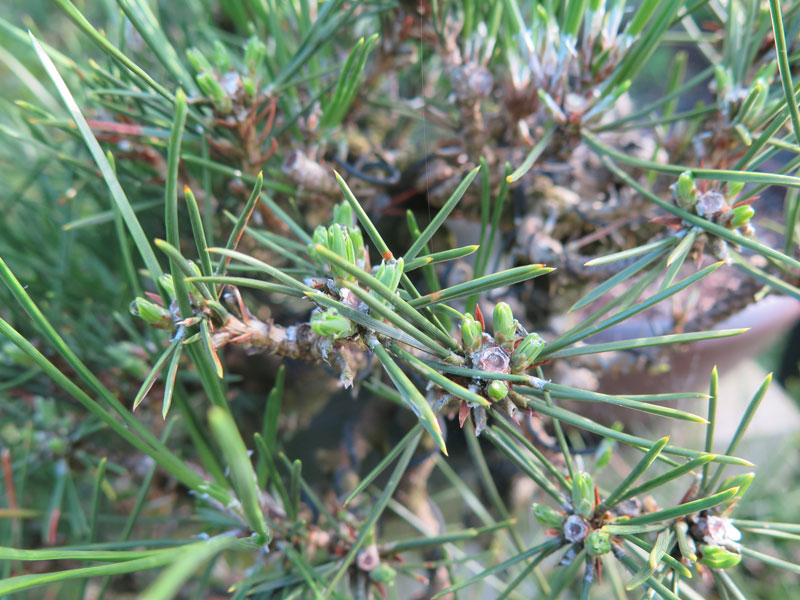
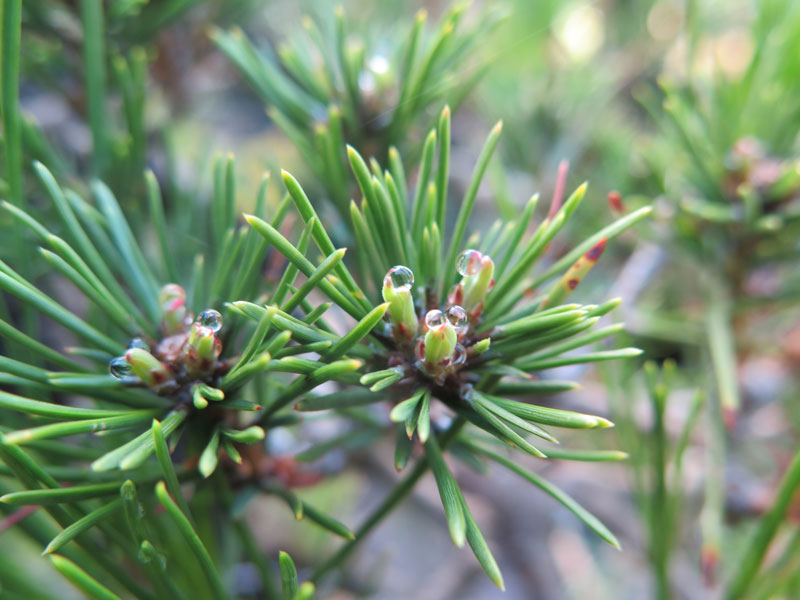

The Radiata is a fairly new addition to my garden after not having one for a while. I am treating it more like a Japanese White pine in regards to foliage management and so far am seeing good results. The process is essentially:
- Grow out the spring flush.
- once it stops extending, prune back leaving some of the new candle’s growth.
- New shoots form and grow out
- Thin needles
- Prune back new shoots to two and reduce length as per Step 2.
- Repeat.
I am guessing i will get 2 or 3 flushes per year using this method. So far needles have not come down in size much but as i build more canopy i assume this will slowly reduce the length.
I probably also need to play around with feeding timing but at the moment i am focused on building branching so am feeding heavily. A post for another day.
A number of years ago we visited Onomichi in southern Japan as a bit of a side trip during a family visit to Japan. I fell in love with the town for some reason. While i cant really put my finger on it, something just ‘clicked’. Its ocean setting, industrial history, creative new industries side by side with their traditional counterparts and of course the amazing shimanami kaido (well worth riding the bike trail if you are so inclined), the hilly landscape, querky old buildings, yellow trains etc all played their part I suppose.
While staying there, we walked to the peak of one of the small hills in the area and managed to stumble across this red pine.
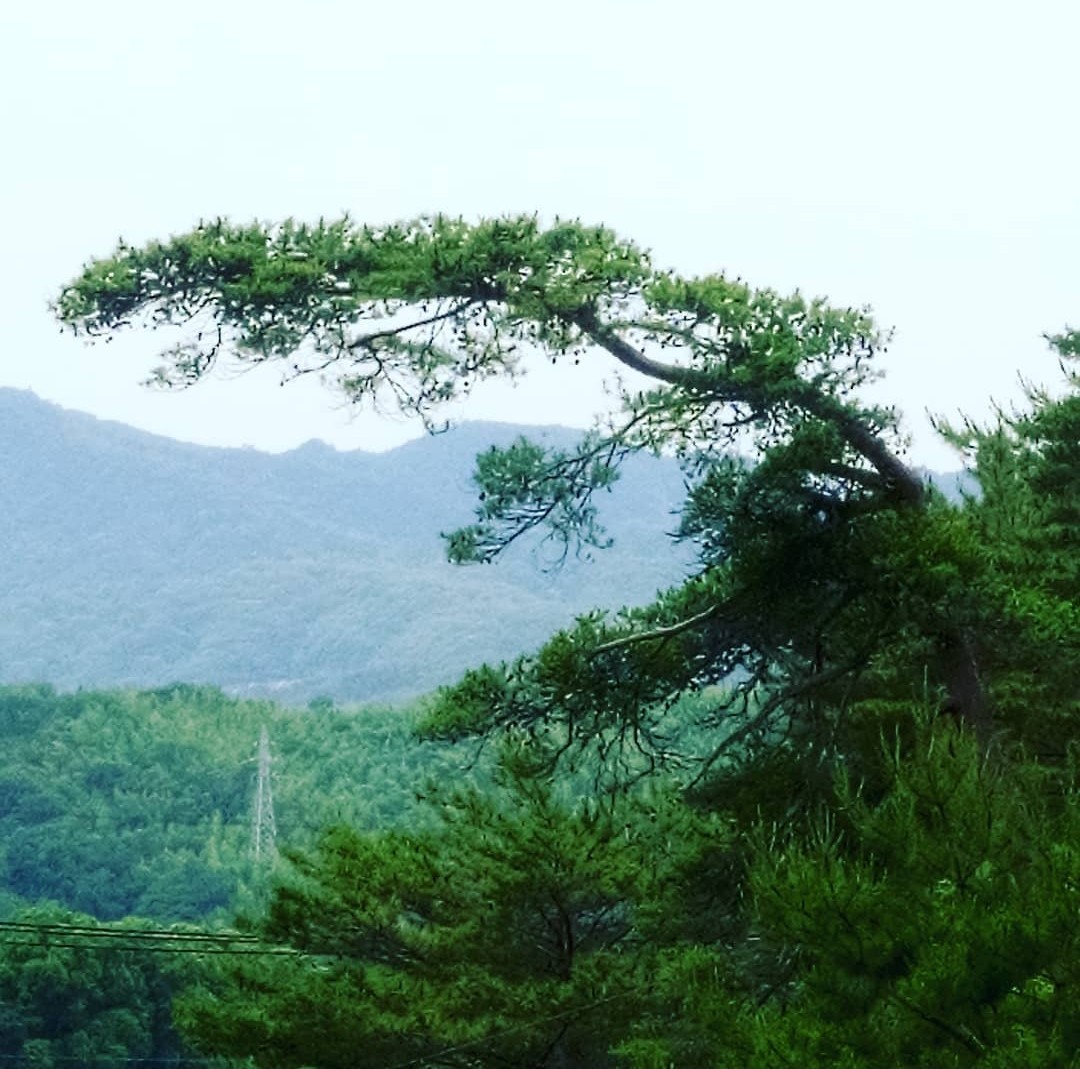
I really liked it, and again, while i cant really put a finger on why i liked it, it again ‘clicked’.
…….Cut to this week, I am looking through some travel pic and stumble upon the above red pine again. As fate would have it I was also trying to think of what to do with one of my black pines.
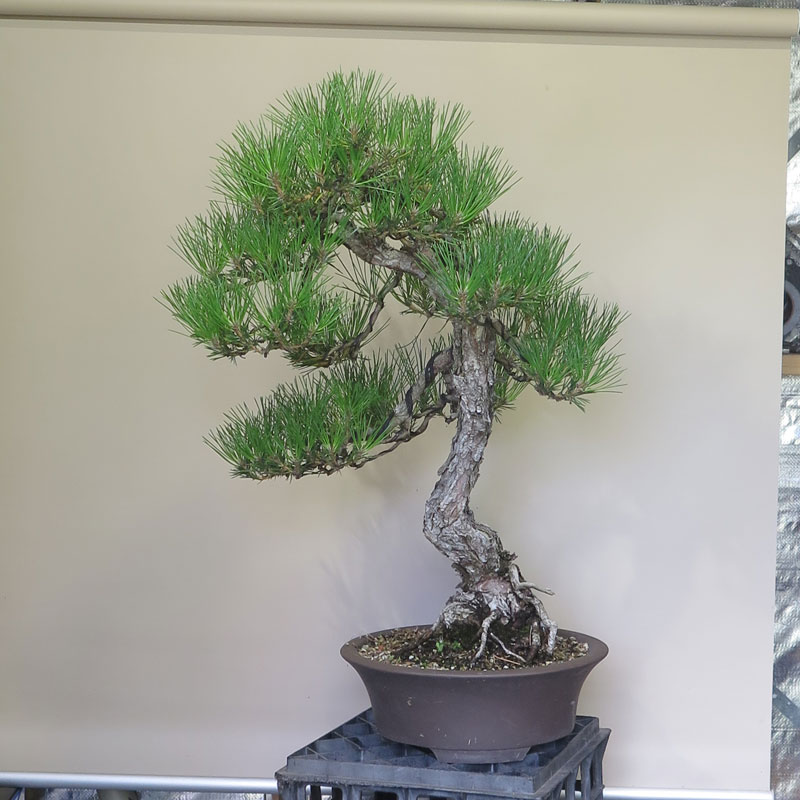
I had another tree that was styled very similarly and I was never quite sure that my collection was large enough to have two very similarly (and kinda of poorly) styled trees, so I would often catch myself staring at this black pine trying to figure out what i could do with it.
When I came across the Onomichi pine picture I had a light-bulb moment and wondered if i could capture the ‘vibe’ of this pine in the (now desperately needing styling) black pine on the benches.
…….. Now vibe is an interesting concept. Bonsai is a whole lot of different things to a whole lot of different people and that’s OK. In fact i think the myriad of different ideas and approaches is what makes it interesting.
For me, i am not really about making miniaturised, scale models of trees. I think what i like to do is try to capture the feeling of trees and or what my sub-conscious is drawn to in trees. It might be an element of a tree (canopy shape, branch movement, strange feature) a feeling that you get (hugeness, ancient-ness, calmness etc) or just somehow trying to reinterpret the spirit of a tree that i am drawn to. I amso am drawn to graphic shapes in the trees i style which is probably from my Landscape Architecture background. I think in summary I’d call it capturing the ‘Vibe’.
So One night I set myself up in my workshop and set about working towards imparting some of the spirit of the Onomichi pine into my black pine.

I’d anticipated a restyling at some point and had pruned and thinned back the foliage last autumn. The tree had been let grow freely the previous season and i think the above image reflects how desperately it needed work!
Now it’s probably on the late side of timing regarding styling black pines. We are entering an El’nino weather phase and the growing season has arrived much earlier than usual so i was caught a little off guard. Candles are extending so i had to be super careful when wiring so as not to break any but think I got away with it.
The process was fairly simple, I chucked on some tunes and switched between looking at the original Onomichi pine image and trying to impart some of it’s ‘vibe’ into the black pine. It was a fun exercise although I’m not sure how successful it was. You are always limited by the material in front of you so of course the end result is not a mirror image but it certainly has turned out being styled in a way i wouldn’t normally have approached the tree.

I quite like the end result but something still bothers me about it.
I think I am going to put it in a spot i can look at it each day and try to work out whats not quite right about it and tweak it over a period of the next few weeks (or leave it as is potentially).
It was a good exercise to go through and I’d recommend it for those with favorite trees and bonsai that share the basic structure. I had to actively go against my baseline styling urges in a number of instances and I learned a lot by doing that that will likely be part of my future work.
As far as the tree’s merit as a bonsai…………. the jury is still out…….. It’s certainly a more interesting tree compared to what I started with and the fact it will now trigger memories of a great family holiday and a favorite place I think will cement it place on my benches for many years to come.
As promised, I’ve been working my way through the seasonal needle work on my black pines. Its a busy time of year for pines (as the title’s poor taste pun suggests) and can become a bit monotonous.
Endless thinning out, cutting back and de-wiring in preparation for next season growth and future styling is the order of the season. It’s not particularly glamorous work but necessary much like the bulk of bonsai care, the dramatic styling we all know and love really are a minor part of growing bonsai.
Of the two trees in this post, one was de-candled last season, the other was not. Can you guess which is which?
Not a whole lot to say that the pictures cant do on their own so I might leave this update brief. I have a bunch more to get through so expect some more updates in the coming weeks.
I was hoping to have a few more done but as is often the way, I got side tracked and began to re-wire on of the trees I was working (possibly a subject of a future post). As a result, it pushed back the other trees I need to clean up but we should be back on track shortly.
Trees below:

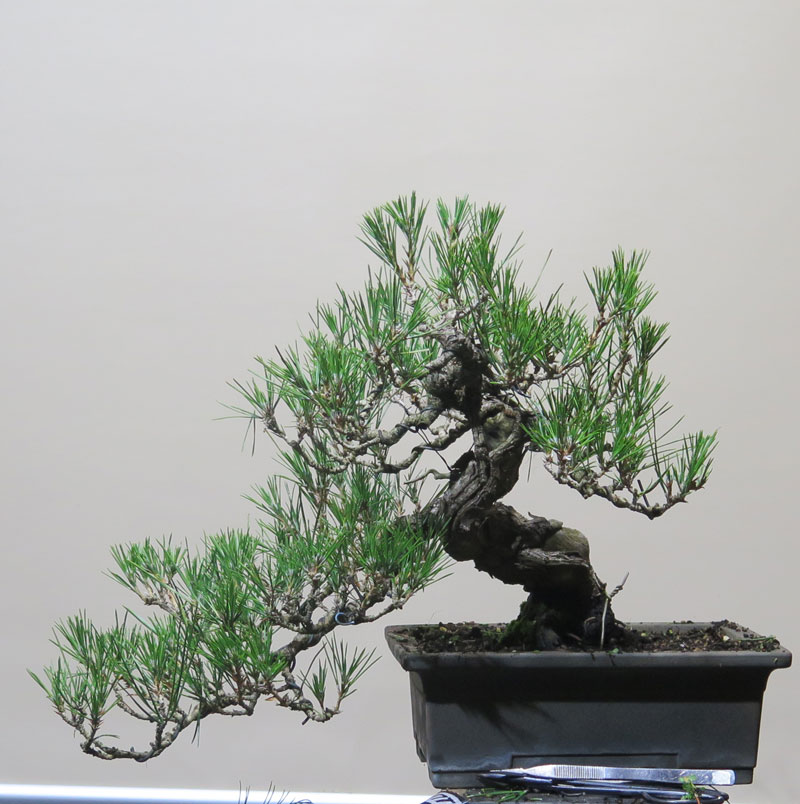


Been busy as per usual but I have managed time to fit in a couple of customer trees.
Below is a quick before and after of a black pine that needed teasing out of a sea of needles. A fun tree to style.
Before
The after shot is a little lacking in quality but I am sure you get the idea.

After a day or so work.
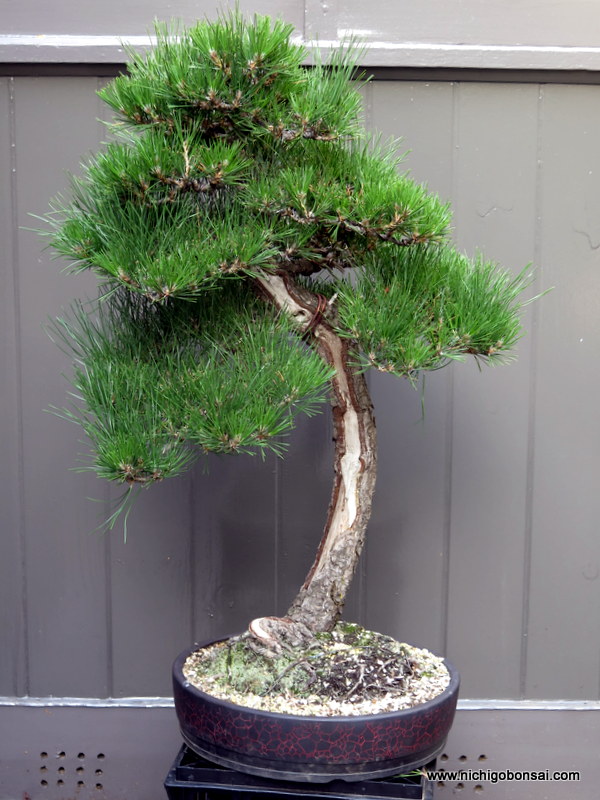
As the days get cooler we slowly approach the time of year where I like to style conifers. This year is gearing up to be a big one for bonsai work as I have taken on a number of customers trees to be styled. Following on from the last Black Pine I worked on, I had the opportunity to work on a similar tree.
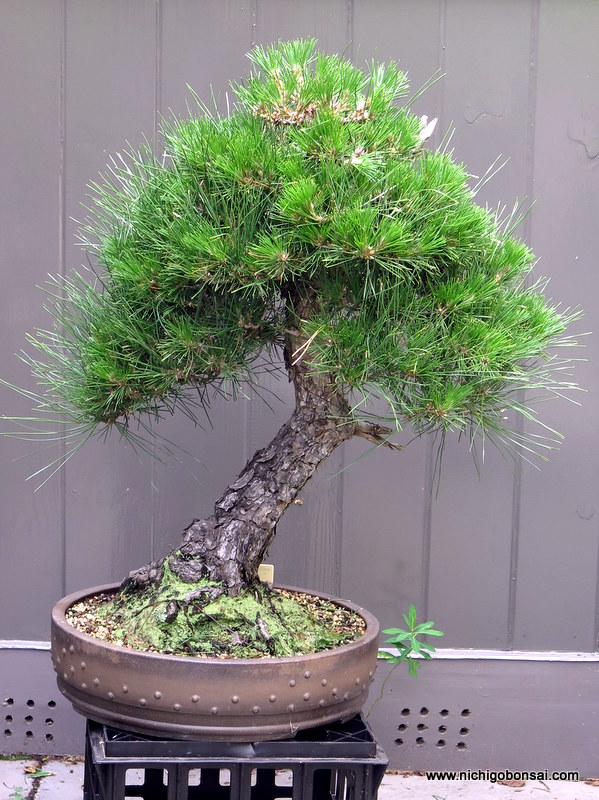
Before starting the work.
At least it looked similar before the work begun, but soon after the old needles were removed a new set of structural challenged presented themselves to be solved.

Old needles removed and ready for pruning and styling. (slightly rotated)
I decided to rotate the front slightly which brought up the issue of the first branch. That is it was now heading towards the rear of the tree so with the help of a screw in the trunk I was able to bend it forwards. This then set the base of the tree and the rest of the canopy could be built around it. The head was finally lowered and rounded out to create the final image.

After the work.
Again this tree now needs a couple of years to grow into its new shape but even after the couple of weeks that passed between starting the job and finishing, new buds are beginning to form which should see this tree become show-able in the not too distant future.
Over the years while growing black pines I have always strived for more buds. Each year i tried to get back buds to form and most times I was successful although sometimes the tree I was working on would show signs of promise and then wave them in my face as it took them away again.
What am I talking about? I am sure you have all seen them; those small buds that form and give you hope, only to swell but never open, and then after a few seasons growth, wither and die.

A few of the buds in question.
As far as i can work out, these are needle buds and or weak adventitious buds that for what ever reason can never really get themselves into gear. Even after candle pruning the rest of the tree theses buds often still sit and do nothing. The most frustrating thing about these buds is they always seem to appear right where you want them which makes seeing them die all the more difficult.
I have tried a number of methods to awaken them but none have worked. I have had them in both shaded locations and spots where they get full sun, on bottom branches and in the apex, on strong growth and on weak. Nothing seemed to work no matter where they occurred or what I tried.
But there is still hope. At the convention a month ago Ryan Neil talked about these buds and passed on a technique I had not heard of before. He said these buds could be awakened by slightly damaging them with a scissor cut done at the same time you candle prune. That is to say that when you cut the candles, you also make a small incision into these sleeping buds. He said it was this damage that would trigger these buds to put out a flush of growth at the same time as the cut candles re-grow their second flush.
As we in winter at the moment I have not yet had the chance to try this method out, but I look forward to trying it this coming summer. Hopefully it is the answer to this annoying sleeping bud issue.
As the season rolls on I am slowly getting to the end of my needle work which in turn will mark the time to begin preparing the deciduous trees for winter.
The tree below is another that has been slowly developing over the years and with another wiring and another years candle pruning I think it will be close to exhibit-able.
The tree has appeared on the blog before HERE where you can see the progress it has made and the ramification it has gained. It also makes obvious just how much it needs a re-wire.

Before the work

After a the needle plucking.
Yet another of my trees that desperately needs a re-wire, it will have to get into line behind all the others that I plan on doing this winter.
 Nichigo Bonsai