You are currently browsing the category archive for the ‘General Bonsai’ category.
At what point does nature stop being natural? Can we nurture nature to be natural?
I’ve been doing a bit of thinking lately (perhaps too much) and somewhere along the line, I started to think about the idea of nature and ‘looking natural’ in relation to bonsai.
I find the idea of striving to ‘be natural’ in bonsai ironic and somewhat funny as just about everything we do in bonsai is artificial, manipulated and controlled. In fact, if we put a tree in a pot and let ‘nature’ do it’s thing, it grows into something that usually isn’t accepted as bonsai.
Then what is the aim of bonsai? What are we trying to represent?
Most people I talk to are trying to represent a tree when they are considering styling a bonsai. But there is inherent problems with replicating full sizes trees in a shrunk down form.
Making a shrunk down, 100% accurate scale model of a tree is an impossible task to achieve with living plant material. You simply cannot recreate most of a full sized tree’s detail in miniature.
So even when attempting to make a scale model in bonsai, a certain level of approximation or abstraction has to be employed which pushes the end product away from it’s natural inspiration.
What is an acceptable level of abstraction or approximation?
Whether consciously or unconsciously, we make these abstraction decisions when designing bonsai. We decide what characteristics we believe represent a certain tree or species, or use what the collective unconscious holds as an archetypal symbol of a tree (or bonsai) and use it in our designs. This of course can shift culturally and may vary across the world as peoples’ experience of different climates, ecosystems and their relationship with the world around them varies.
So what natural bonsai is, is actually what humanity has deemed to be natural.
‘Natural’ as an idea or construct is a man-made construct in the first instance.
So then are all the results of natural processes ‘natural’ by definition? And following on from that thought, is nature what we are striving to recreate in the first place?

Is it not more interesting to look at bonsai as human kind’s relationship with the natural world?
Humans experience of the world is a limited one. Our brains, eyes and ears filter out a whole range of information that is out there in the world around us.
We cant see the infrared spectrum, hear certain frequencies or smell in the way other animals can. By default our experience of nature is not the full picture.
Depending on the person that is viewing the world around them, different elements or areas will become more prominent depending on their interpretation.
A simple example of this might be asking two people to pick a single element that represents a forest in their minds. Depending on the person’s previous experiences and knowledge you may get one person thinking of a dense green canopy over head with another focusing on a tight rhythm or collection of trunks.
Another might be one individual noticing hundreds of tiny mushrooms on the forest floor as the next person walk past oblivious to their existence.
When we are designing bonsai we use this limited window that we look through to make choices, meaning that the decisions that are made, the abstractions, the areas of focus etc are all based from a human perspective and say more about the person that has created the bonsai than about the world it is trying to represent.
So how do you see the world around you? Have you ever stopped to think about how your interpretation of the world differs from someone else?
Are you trying to represent nature in your bonsai? Or something else?
Me, I’m not too concerned with representing scaled down trees or trying to replicate ‘nature’.
I don’t even mind if a species of bonsai doesn’t look like that same species in the wild. (a topic for another day)
Over my bonsai growing experience thus far I have enjoyed unpicking how I see the world, figuring out what i’m drawn to and what interests me.
I’m not interested in the perfect average example of a species. I like the outliers. I like the weird and wonderful, and I think that flows through into the types of bonsai I like to look at and aspire to grow.
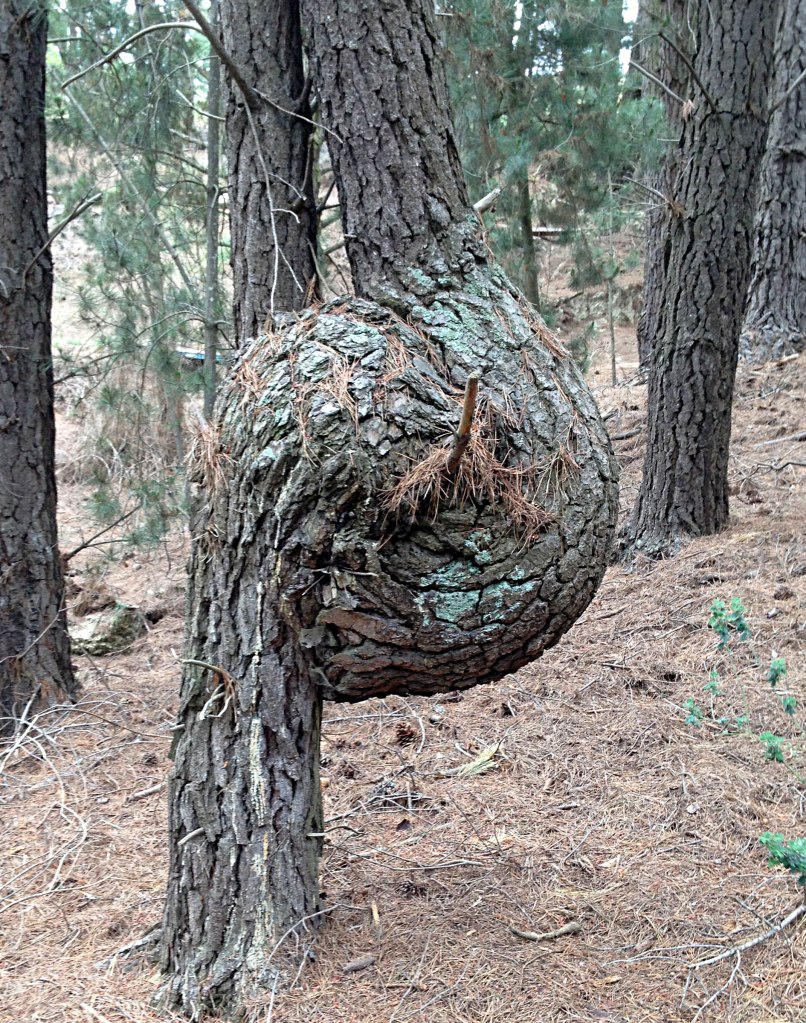
I’ll end this rambling with a favourite tree not far from my home that has featured on the blog before. Nature can sure make some un-natural forms!
Do you ever look at a tree and wonder what you were thinking when you made a previous decision about it?
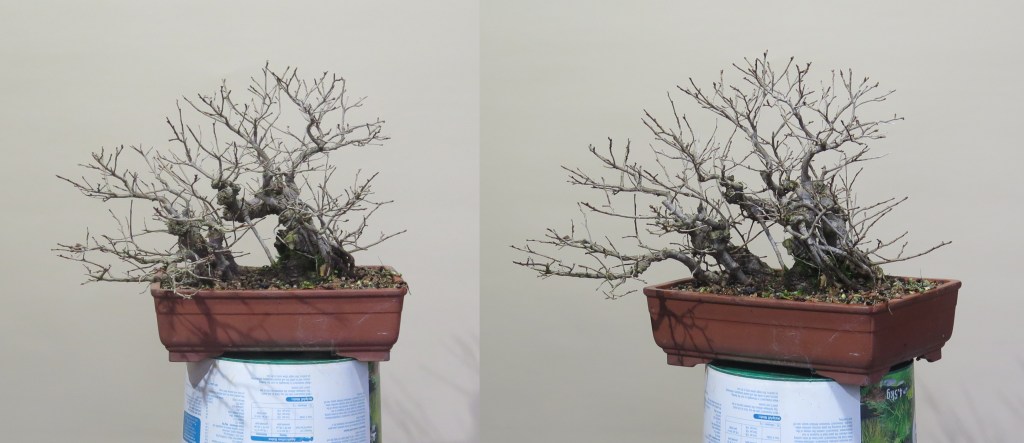
Pretty sure (according to my detailed and hazy recollection) that this tree was re-potted some time in the last two to three years. It hazards a guess then as to why I chose to pot it with this front at the time?
The tree in question is another English Elm (brother of THIS tree) that I have been slowly growing branches on. I tracked down the gnarled trunk a number of years ago along with some other weird and wonderful stock which are also in similar stages of branch building.
I brought this particular tree into the workshop the other day and removed some old Autumn leaves along with the weeds that were thriving under my care.
As is often the case when performing routine maintenance, you really get a good chance to look at a tree from all angles, inspect features and generally get reacquainted with it, which is exactly what happened here.
Having turned the front 15 degrees I realised that it was a much better front (the square hole of negative space disappears, the canopy is more even, movement is more directional and it flows better).
After making this discovery, it had me questioning why I had chosen the original front in the first place?
Had the tree developed in such a way that the front had gone from a good decisions to a poor choice? Had I not been paying enough attention last time I potted the tree? Has my eye developed so I am now seeing something I previously couldn’t?
There must have been an answer at one point, unfortunately it seems to be lost to my immaculate mental record keeping and the rigors of time.
This is another tree ready for a change of pot (to something more suitable than its current grow pot) and hopefully in the coming months I can rectify these past miscarriages of bonsai artistry and who knows, i might also get around to re-wiring the branching (particularly the lower left branch).
This constant update and change that happens with bonsai is one of the points that keeps me engaged and interested in growing them. As I develop as a grower (heaven forbid I brand myself an artist, (more on bonsai and art in a future post) my eye and tastes have shifted which has often seen previous good decisions become bad choices that need to be remodeled and remade.
It brings me back to the idea of self reflection and looking at your bonsai objectively with fresh eyes each time you work on them. Never accept what you are presented with, and always look to push past where you last left off.
Maybe to be able to do this well you need to forget the decisions that came before…………..

This post comes a little late (lets call it fashionably late) as the announcement regarding demonstrators, program and venue was made around 2 weeks ago.
That said I am also very happy to announce that i have been selected to demonstrate as part of the event. I feel very lucky, grateful (and a touch nervous) to have been given the opportunity to stand along side artists that I have admired during my own journey down the bonsai rabbit hole.
Some of the names you might recognise are:
• Hugo Zamora – Latin America region
• Kim Seok Ju – Asia-Pacific region
• Ravindran Damodar – South Asia region
• Zhang Zhigang – China region
• Shinji Suzuki – Japan region
• Marc Noelanders – Europe region
• Michael Hagedorn – North America region
• Jonathan Cain – Africa region
• Tony Bebb – Australia-New Zealand region
• And me…. Joe Morgan-Payler – Australia-New Zealand region
There will also be a suiseki display critique by Seiji Morimae which will no doubt be insightful and interesting.
The full program and other information about the convention and perth in general can be found at the convention website:
https://www.worldbonsaiconvention2021.com/
You can also keep up to date on the facebook page found here:
https://www.facebook.com/WBC2021/
For the astute reader, you can also find a bearded me (convention video) and a clean shaven me (convention booklet) hidden around the site.
With every thing happening across the globe at this time I am really looking forward to this event as something positive to aim for. It’s going to be a great event!
I hope to see and meet as many of you as I can in 2021 in Perth. If you see me in beard or without come up and say hello!
I’ve been trawling through some of my old photos lately, pictures of previously sold or styled bonsai or trees that I’ve worked on over the years.
It’s been good to look over them with a fresh set of eyes, noticing all the mistakes, problems and weaknesses. Trees that I was once proud of now show bare my shortcomings during that period.
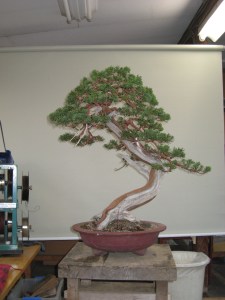
A tree I styled almost 10 years ago while in Japan in 2007. When cleaning the foliage I was overly keen on stripping old growth from the first branch, leaving it weak, and was reprimanded accordingly. I didn’t do that again.
Some of those trees still bare signs of those errors years later and it will take many more years to correct them. It is a good reminder of just how far my skills have improved over time and how this art we pursue is an ever evolving learning process.
Just when you think you think you are getting a handle on what it is you are doing, a new avenue of possibility opens up and challenges your understanding.
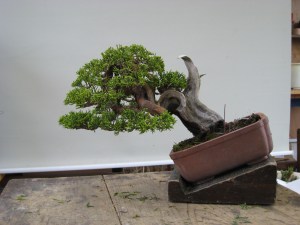
A huge flat bottom pad. I would approach that differently these days.
The beauty of bonsai is that the trees we work on evolve over time along with our skills, vision and understanding of the art. Your actions on the tree, right or wrong, shape both the bonsai and yourself.
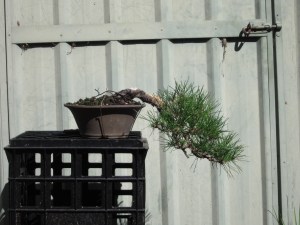
I was overly concerned with needle length over health and candled pruned when I shouldn’t have. It set this tree back years and is only really just getting back into it’s rhythm again 5 years later.
There are trees that I have worked that have shaped the way I look at bonsai as much as I have shaped them. I am constantly challenged and surprised by trees I see which keeps the art fresh and engaging.
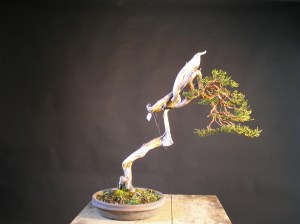
I tightened the bends in the deadwood, leaving it less interesting than when I begun.
I’ve enjoyed digging back through time in this way and I look forward to gazing back in another few years time and seeing how my understanding of the art has once again changed, improved and ultimately furthered my approach to creating bonsai.
The idea of using Australian native plants as bonsai has been gaining momentum over the last few years. Bonsai growther in Australia are very excited about developments and experiments with various local species to the point where dedicated native bonsai clubs have been established.
This is all good news in my books. We have a great range of interesting plants and while I personally think that many that are used as bonsai currently are not ideally suited to bonsai there are some species that not only are suited to bonsai cultivation but thrive under it.
Having said that, I haven’t owned any natives in my collection. It’s not that I didn’t want some, it was more to do with the fact that I haven’t come across any stock that grabbed me or that I was willing to collect.
Most stock i see is converted from normal nursery stock and has never really grabbed me although i know of at least one grower that is now putting in the hard yards to grow high quality native stock spefically for bonsai.
I also have mixed thoughts on collecting natives from the “wild” and personally would rather remove the many exotic weeds that are damaging the bush rather than remove the few interesting native bonsai specimens that i might find. I personally have enjoyed stumbling across contorted native material during hikes into the bush and Ithink it is somewhat selfish to remove this opportunity for others just so i can have something in my backyard.
My native bonsai situation changed however this past winter when a good friend allowed me to dig a plant from her garden. It’s a Baeckea and has some amazing features that should see it becoming a top tree in years to come.
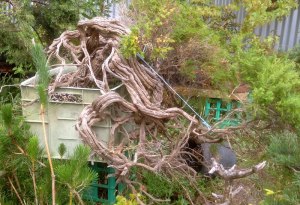
Twisting deadwood, extreme movement and tight foliage should all work together to form an interesting bonsai in the future.
It was my first time digging a Baeckea and while it suffered some die-back after collection the remaining growth is now putting out new shoots which is always a comforting sign. I will not be in a hurry to develop this tree as it really needs to recover, put on new growth and develop new roots prior to me doing any work.
I will then be looking to down-size the container it is in and begin working on the structure of the tree. This is probably a number of years off but I am looking forward to the journey from this early starting point. I will keep the blog updated as it progresses.
Well it has been a big year for me. I have spent it studying japanese full-time, while teaching, demonstrating and working on bonsai and client’s trees. This has all come with its challenges but all in all has been a great experience. On top of this, a couple of weeks ago I returned from a trip to Japan for both language immersion and bonsai which was the best way I could imagine to see out the last months of the year.
With all these things going on though it has not left much time for me to update the blog. Hopefully in the new year I will have more time to dedicate to posts and of course my own trees.
While I was in Japan I was lucky enough to visit the Taikan-ten exhibition. This time around they allowed photography by the general public so I was able to take many photos of the trees on display and as I process the images I will upload them over a series of posts. The show itself was a bit of a mixed bag with both extremely high quality trees which were sometimes next to trees that looked like they needed further work and developement. Of course the entire show was well worth the visit and as was the sales area.
For the time being I have included a teaser of future posts. Enjoy the photos and happy new year!
-
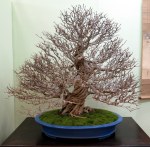
- Pomegranate
-
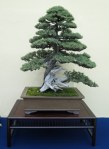
- Needle Juniper
-

- Quince
-

- Red pine
-
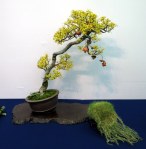
- A Pomegranate in an interesting pot….
-
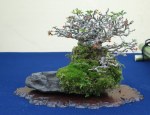
- Chojubai
-

- Maple
-

- White pine
-

- White beech
-
- Procumbens
At the moment I am studying japanese and I came across my first bonsai related exercise in my text-book and thought I’d share.

Not a bad informal upright by the looks of it…..
私はおじさんに怒られました。 – My uncle got angry at me.
I’m guessing it must have been a nice antique chinese pot to get smoke like that appearing!
I am currently growing two species of Australian deciduous orchids. Both are known as ‘green hoods’ although they vary in habit a little from one another. I think they both show great promise as accent plants as they are interesting without being too bright or showy to take away from a tree they might be exhibited with.
Pterostylis curta is an upright form that sends up flower spines of about 20cm upon which small flowers sit.
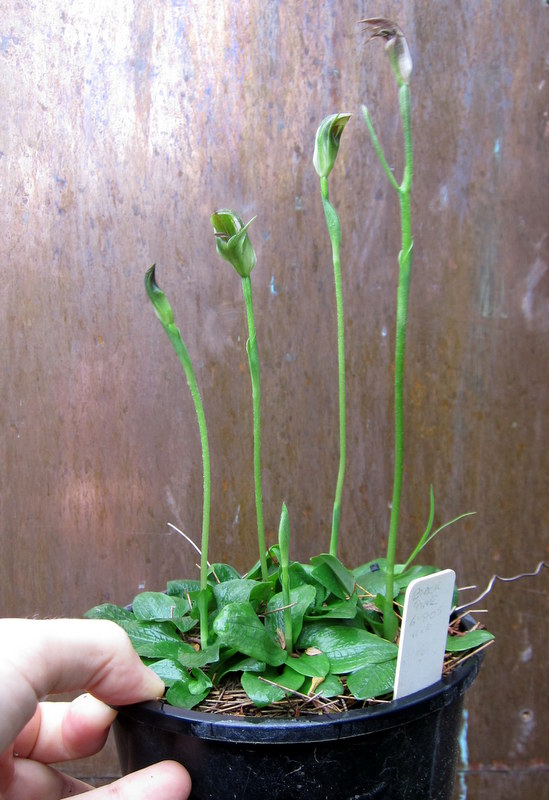
Pterostylis curta
Pterostylis nutans on the other hand sends up slightly shorted spines and has flowers that bow over or nod which is why they are also refered to as the nodding green hoods.

Pterostylis nutans
The best part about these orchids is how easy they are to care for. They are deciduous and require very little water over their growing season and none whilst they are dormant. They also reproduce easily and produce new bulbs each year which you can separate at re-potting time to make new plants. They seem very happy in pot culture which is another plus for the species.

Pterostylis nutans
Potted up they make interesting accents although once this pot fills with a few more tubers it will make for a better display.

Interesting shapes.

Close up they are very pretty.
You often find these orchids available at orchid shows and specialist nurseries, but as they reproduce so easily if you can find someone who has them chances are they will have some spare at re-potting time.
Well worth a look if you are after a native accent.
Things have been a little slow on the blog of late. I have been busy with work and have just had a wrist re-construction on my dominant hand. It is slowing me down but I have a bit of time off work now to recover from the surgery so hopefully I can get a few posts written.

My wrapped up hand.
As for my bonsai, they havent slowed down a bit. My new fertiliser regime seems to be working as I have a whole lot of healthy growth.
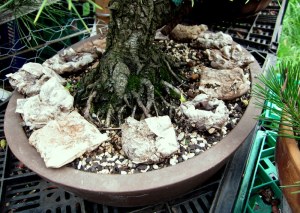
A well fed pine.
The problem this time of the year is finding room to add more fertiliser. Most of my pines have their soil surfaces pretty much covered. I will be starting to replace the older fert bags with new ones in the coming weeks.
With all this feeding I have got strong healthy pines with lots of new growth. All this new growth will be coming off in a few weeks once de-candling time arrives. I am still not sure how this will work one-handed but I should be able to get it done one way or another. I will make sure I have a few pics taken to document the process, in the mean time I will try to get a few things done around the yard and get a few posts uploaded.
Balance of growth and strength is a concept that should be applied to all your bonsai. Weakness should be supported and strength should be held back to result in an even growth pattern across your trees. Maintaining balance ensures that inner buds survive and that exterior growth does not get to course. It’s what I think is one of the most important factors to take into account when growing bonsai.
What I have been noticing lately in my garden is that a few trees are out of balance. Pines readily let you know areas that are strong or weak. During spring, candles that grow long are strong, and those that remain short are weak. Pretty simple. In my gardens case, I have re-potted most of my pines this year and some trees are reacting differently to others.

Strong growth
The bonsai above has started to extend its candles. They are about 50mm long and are beginning to form their needles.
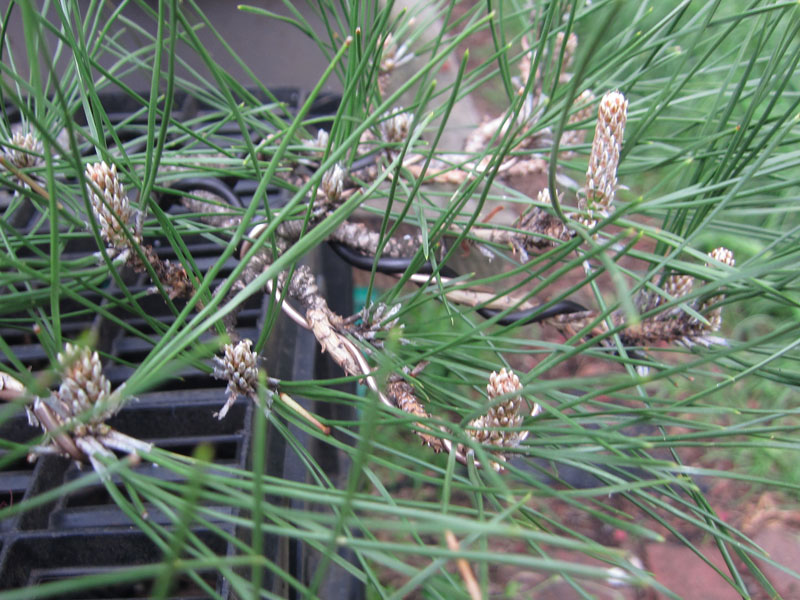
Weaker growth.
The second picture taken on the same day of a tree beside the first shows the much weaker growth. there are some healthy candles but overall this tree is much weaker than the first. The candles are extending very slowly and the needles have not yet started to form.
Although both trees have a couple more months of growth before de-candling time, i have found that often the early growth is a good sign of the state of the tree and rarely do weak candles become strong enough to de-candle over the course of the spring.
What does this mean? Well identifying balance issues between trees can help you decide wether or not you will do certain task to particular trees or not.
For example, this year I will de-candle the first tree while leaving the second to grow freely and build up strength. By identifying overall strength this will allow you to identify weak trees and exclude them from stressful techniques such as de-candling, styling etc. that may further weaken the tree and or even kill it.
So go out and have a look over your trees, look for areas of in-balance and look for trees that are not as healthy as the others. That way when you apply techniques across your collection this season you can be sure that you will be furthering their developement rather than hindering it.
 Nichigo Bonsai