You are currently browsing the category archive for the ‘General Bonsai’ category.
It’s spring in my garden and I am enjoying watching my trees wake up from their winters rest.
One thing that I noticed was that I seem to have two distinct types of trident maple in my yard.

Left: Red new growth. Right: Green new growth.
The above photo shows the differences nicely. Some of my trees leaf out with red new growth that slowly goes green, where as the other tridents new growth is green from the start.
The trees with red new growth tend to form better ramification as a rule where as the green new growth trees it is a bit more course and they are less likely to form fine growth. I know another local grower, Neil of Shibui bonsai has had made similar observations. He was saying that the red growth trees formed good ramification where as the green growth trees trunks and roots tended to be better.
Does anyone have any experiences similar to this? I am pretty sure they are from the same seed source but I guess they could be from different places? Maybe just seed variation?
Is this a common observation across the globe? I would be keen to hear people’s thoughts. Please comment below.
I had been waiting for my quince to flower for the last few seasons and this year it finally set flower buds. As luck would have it though as they were opening we had a few days of heavy rain which damaged the blooms. I should really have taken the tree inside to avoid the rain but I totally forgot about it until it was too late.

Budding left and rain damaged on the right.
On the bright side at least the quince has begun to flower so hopefully next year it will set more buds and with the ramification I hope to build this season it should make for a better display.
While digging trees out at Shibui Bonsai I was very aware of the need to stay well hydrated. As a small part of my planning I made sure to bring sufficient liquids to help keep the digging crew’s liquids well replenished.
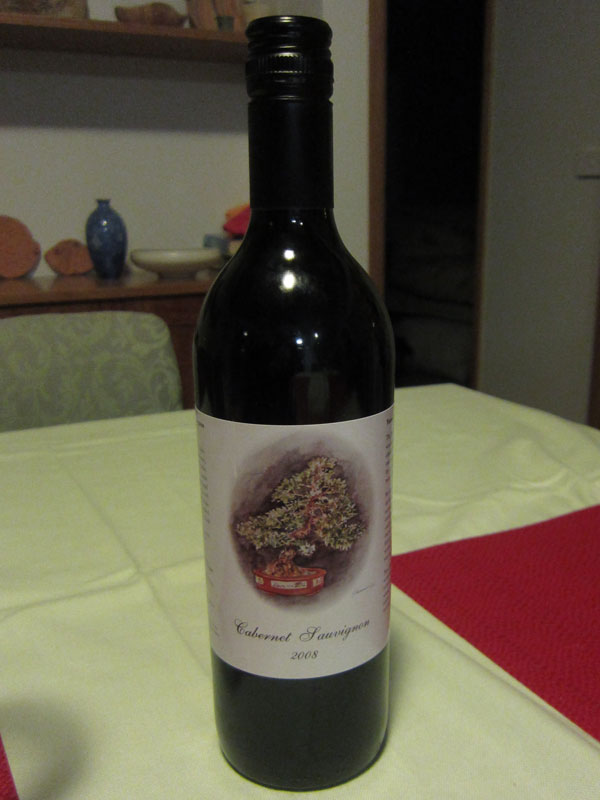
Bonsai Wine?
A month or so ago I did a demonstration at one of the local clubs which is located in the Yarra Valley, right in the heart of some of Victoria’s wine country. The Yarra Valley Bonsai society had presented these bottles as a thankyou gift. It turns out, it was their very own wine! Since recieving them, they had been sitting on the mantle piece waiting for the right occasion to drink them. I figured that there was probably no better time to enjoy a bonsai wine then over a bonsai weekend, so I put them into the car when I headed up to Shibui.
Some of you may recognise the tree on the label from the recent AABC convention. It’s a big Banksia owned by one of their members. Keen eyes will also notice it has been mirrored!
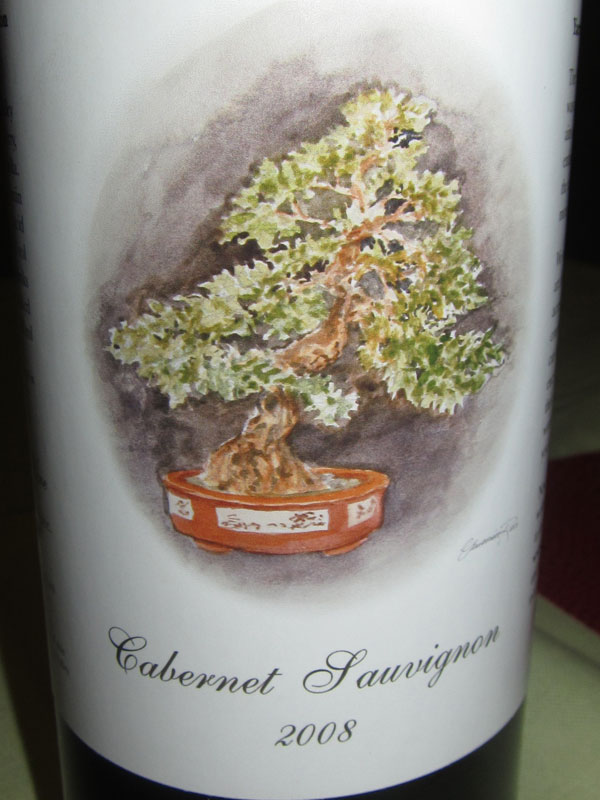
The Label.
Is this the only wine around with a bonsai on the label? It must be the only one with an Australian native!
Thanks Yarra Valley Bonsai, the wine was delicious and much appreciated afer the day’s digging.
It’s a strange season. Here in Australia we are in the middle of winter, yet in my garden some of my trees think its spring.

Trident Maple budding out.
For what ever reason, my trees seem to be ahead of schedule by a couple of months.

Chinese Elm.
My Chinese Quince dropped its leaves in autumn and almost straight away began to leaf out again and is now almost back in full leaf.

Chinese Quince leafing out.
I guess this means that at least for some trees I will have to move the re-potting window forward a little to keep up with their early movement. I think next year i will re-pot the Chinese Quince as soon as it drops it’s leaves in case it decides to move early again.
Are any other Australians seeing an early spring?
I wonder if these trees leafing out early will make for a big year of growth or if their lack of winter sleep will mean they are weaker than those trees that are taking the full winter sleep? It will be interesting to see what happens this season.
Another point of interest in my garden at this time of year is the ‘Choujubai’ flowering quince which although flowers throughout the year really blooms out in a big way now. It’s a nice splash of colour in amongst the bare deciduous trees. I had been hunting for ‘Choujubai’ in this country for a few years before finding one being grown by a friend. I am really enjoying it even though it is just a piece of stock at the moment. I hope to take a number of root cuttings this spring but perhaps that is the topic of a future post.

Choujubai colour.
It is looking like it will be a busy week. I have just moved offices for my day job and have also been preparing trees for exhibition. Between the two I don’t have a whole lot of time to post.
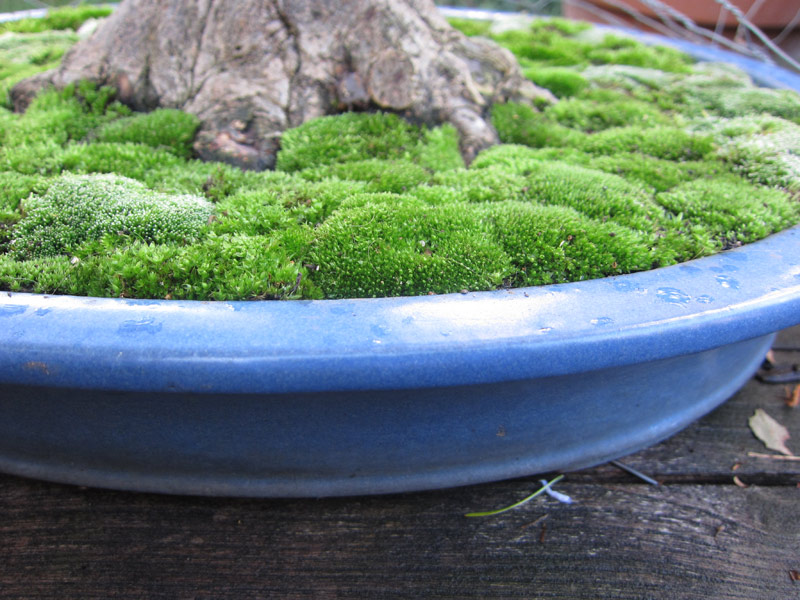
Freshly mossed.
This weekend is the AABC‘s annual national convention which is being hosted by Bonsai Northwest here in Melbourne. I have spent my last couple of weekends wiring, defoliating, cleaning pots, re-potting and mossing up trees as well as preparing accents for the exhibition. I am showing two trees and I wired a third for a friend. For such a small number of trees they have managed to take up nearly all of my spare time.
Once the exhibition has concluded i will share a few pictures of the trees, the displays and some of the things I did prior to the exhibition to get the trees up to show condition.
For those not already booked into the convention, I think you may be able to get a late registration via Bonsai Northwest. It should be well worth coming along to as Boon Manakitivipart (USA) will be doing demonstrations as well as workshops. The exhibition that will accompany the convention will showcase some of the best trees in Victoria if not Australia. The exhibition and sales area is open to the general public so I would recommend that if you cannot make it to the full convention you at least try to get along to see the show and sales area.
Hopefully next week I will have a full report.
Let me start by saying I like tools in general. I like going to hardware stores, searching second-hand markets and looking through garage sales for spanners, wrenches, planes and all other host of hand tools.
Needless to say, I also like bonsai tools. Recently I bought two new tools to add to the toolkit. I like old-fashioned tools, made from good steel. This carries into my choice of bonsai tool aswell. I like the black steel tools over stainless. Stainless steels are great but i like the older feel of the black tools. The black tool’s steel is good, the price is usually cheaper than stainless and they need maintaining.
Now most people don’t like to maintain tools but I enjoy the task. I like inspecting the edges, cleaning the blades and oiling them.
The two tools I bought were black steel Masakuni cutters designed for working on trees that are getting to a ramified state. Now a lot of people say that Masakuni make the best tools…. I dont agree with this 100%. It depends on the tool and the user. I like certain brands for certain tools. For example, I really like Masakuni’s No.9/No.8009 wire scissor yet use kikuwa pruning scissors.

The two tools are essentially two different sizes of branch cutters, or so i thought. No.216 (left) is a small set of branch cutters good for removing small branches up to about 3-4mm thick that are growing in amongst many other twigs. It’s a fairly standard tool but its spring-loaded handle makes doing a large amount of pruning a breeze and it’s tapered head allows you to get it into small places.

No.216 (Left) and No.61 (right)
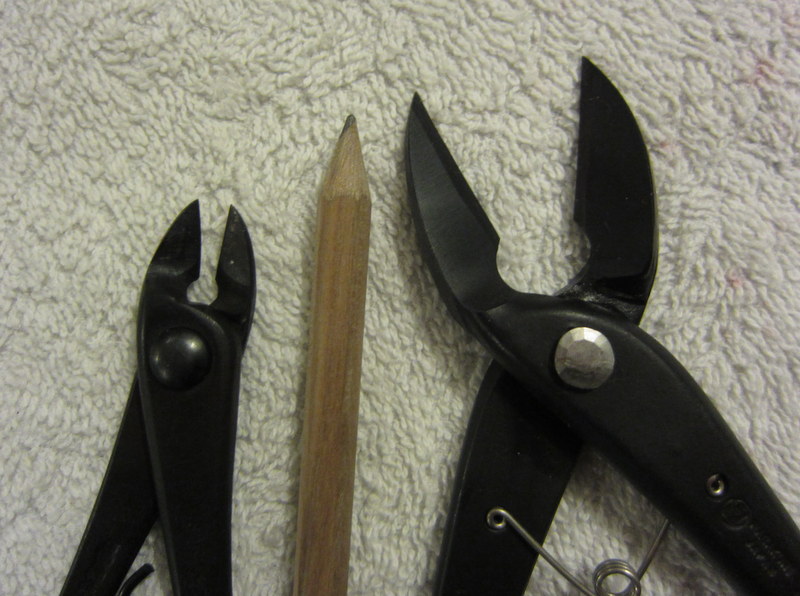
The blade profiles
No.61 is the interesting tool. I had imagined that it was a larger version of No.216, but I was a little shocked when it came out of the box. What I was use to seeing in a branch cutter was a concave blade, this one had a convex curve to its blade profile!

Concave No.216 (Front) and the surprisingly convex No.61 (behind)
After the initial shock of seeing the unexpected profile I decided to try the cutters out. To my surprise they performed really well. They are narrow enough to get into dense ramification and make cuts which standard concave branch cutters are unable to do. The cuts the tool made were also really flush and clean. Usually on these hard to get to cuts I use a pair of scissors as they are the only tool able to get in amongst the ramification and make a cut without cutting surrounding branches. The cut stubs that the scissors leave however are always a little ugly and leave small lumps in amoungst the twigs. This tool can make cuts in similarly dense places yet leave perfectly flush cut wounds.
Below are a few pics I took while playing around on a branch removed from a white pine I have recently styled. It’s not really the perfect example as it’s not part of a dense canopy and I can easily get the tools in to make the cuts, but it shows the resulting cuts nicely.

Test branch. Notice pruning stubs at the first fork and just after the second fork.

First stub removed. The tool leaves a nice flush cut. I would have previously used scissors for this cut which would have left more of a stub behind.

The stub inside the first fork neatly cut. It looks like this stub was left over from a cut made previously by scissors. If this was a branch on a well ramified tree it would have been difficult to get a standard branch cutter into the foliage to make this cut.
Overall they are a pair of really nice tools. Could I live without them? Probably. They are specialist tools which limits their usefulness but its tools like these that really come into their own when you do actually need them. I can see them getting a fair work out this winter when it comes to pruning the deciduous trees.
If you are after some tools to pad out your already full tool roll and you have trees that are either ramified or beginning to become ramified then these tools might be a good option.
Just a quick heads up for my readers…. the smaller No.216 tool was imported directly from Japan and I paid accordingly. I ordered the No.61 tool from an Australian supplier who has a limited range of specialist Masakuni tools that were almost half the price of buying and shipping direct from Japan. Check out their site beebonsai if you are in the market for some tools. They are worth having a look at.
I am always on the hunt for new material. I don’t necessarily want a bigger collection, but I do want a better collection. I try to sell a tree for every tree I buy or dig. I get rid of the tree with the least promise and replace it with something with more promise. Simple in theory but difficult to put into practice. Somehow the collection always seems to be growing bigger, pun and all.
I Australia we don’t have the yamadori available to dig that other countries have. Unfortunately we don’t really get the snow loads or really have the altitude to produce the volume of material such as the deadwood junipers you see in europe, Japan and the united states. Some native material can be found with nice features but I tend to think that our native species should be left to grow in their natural environment for all to enjoy. It would take hundreds of years for nature to replace them in those alpine ecosystems so I think it’s a little selfish to want to take that for yourself. As a result, i look for introduced species to dig of which there are many. Elm, Oak, Hawthorn, Pine, plum and olive are just a handful of the species that are strewn across the country. Most of these species become a weed once they establish themselves outside of private gardens and farms. Being interested in Pines I tend to focus on areas around timber plantations where self-sown escapees can be found.

A nice place for a walk.
Autumn is the season I like to scout these plantations and ear mark potential trees for collection in early spring. I choose autumn for a number of reasons. It’s not too hot so I don’t have to water the trees at home as carefully which means I can go away overnight without worrying. It’s also not too cold so walking around the forests for a few hours without heavy jackets is possible and then of course autumn is also a good time to scout for other things as well……
Most of the areas I walk into are good for numerous thing that I am interested in. I look for bonsai material, fishing spots and also mushrooms.

A little on the large side but interesting movement for its size when compared to its bolt upright neighbors.
I have been into a number of forests already this autumn and have not found any trees worth digging yet, but i did find a lake worth fishing and most of the trips we have come home with mushrooms!

A nice bonus from a day where no dig-able trees were found.
Most of the young pines i find could be easily grown from seed with better movement and better roots so I don’t bother digging them. What I look for is movement and old bark. Bark only happens with time so by digging trees with good bark you are putting yourself ahead of the game, and if you find good bark and good movement you have found a tree worth digging.
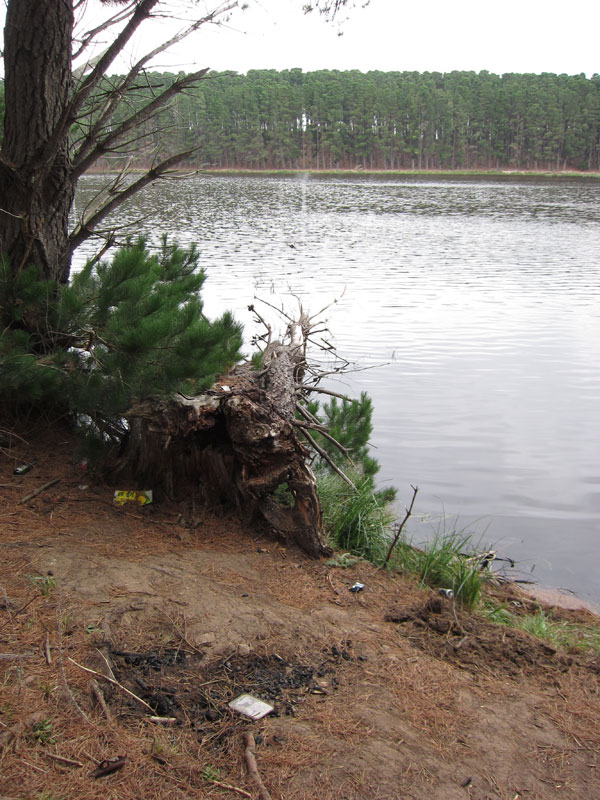
It seems others also like this spot, unfortunately it seems they don't like it enough to clean up after them selves.
Even though most fo my outings don’t produce trees they do get me out of the city and into fresh air and great views. Hopefully in the coming months I am able to get out some more and collect some mushrooms, catch a fish and maybe even find a tree worth digging. I always enjoy the trips away even if you come home empty-handed, the day never feels like a waste.

A nice view.
If the scouting trips don’t reveal and trees worth digging I do have a couple earmarked from last year that I might try to liberate.
Shochikubai is a type of planting sold at New years time in Japan to bring good fortune for the coming year. The below example was one a friend had bought and was on display in their apartment when I visited.
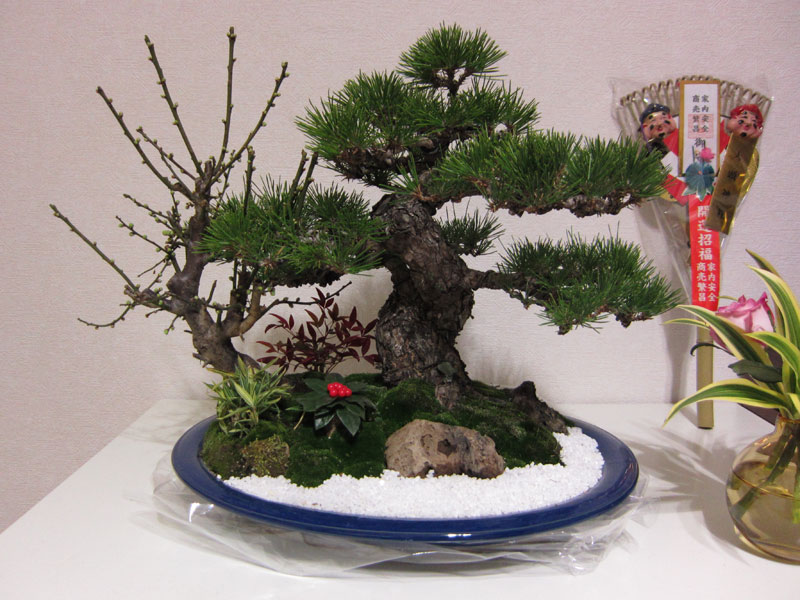
Pine, Bamboo, Plum.
Shochikubai (松竹梅) is a chinese reading of the japanese kanji: matsu (pine), take (bamboo) and ume (plum). The pine represents strength, the bamboo longevity and the plum stands for beauty and optimism. Around the New year you would see these pop up at businesses, department stores and homes across Japan.
This is probably the closest Japan comes to ‘Mall-sai’, although I think that this pine has a lot more promise than any I have seen for sale in shopping centres here.
How long these plantings survive outside of the new year period is hard to say, my friend’s planting is still alive but I am not sure for how long. They don’t have a history of green thumbs and they live in a small apartment with a small balcony, not ideal bonsai conditions. Come to think of it, I don’t remember seeing any really established ones anywhere else which might suggest their survival rates are similar to the expected survival rates the mall-sai we get here.
No matter what the future holds for these plantings, I think that any year starting with a black pine bonsai is going to be a good one!
One of the things that surprised me in Japan was the apparent lack of theft. Now I am sure things do ‘walk’ from time to time but for the most part I never really saw any signs that theft was much of a problem.
I really loved discovering bonsai in plain view of the street on the walks I took around neighbourhoods of the various cities I visited.

Someones collection visible from the street.
Now I don’t know what the rest of the western world is like, but I am pretty sure that if I had my collection on display like this outside my house it would have been stolen within minutes of putting it there. Now Australia is not full of theives but we seem to have a much bigger problem with theft than what i could tell Japan has.
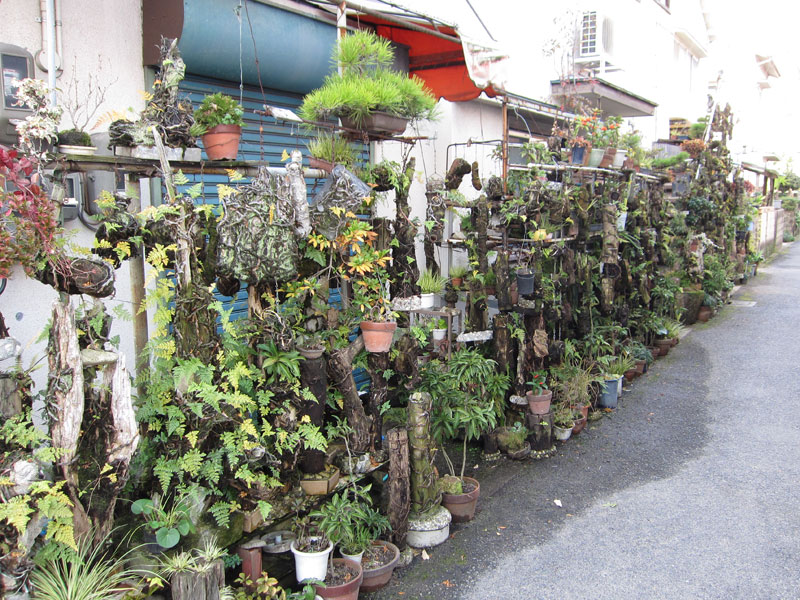
Someones collection of plants (including bonsai) occupying the space between their house and a public laneway.
Why is this? In the case of bonsai nurseries in Japan they rarely have more security than a low fence or wall to stop the theft of some very expensive trees. In Australia on the other hand one particular nursery has 3 meter high walls with barbed wire, cameras, security lights and they still have to chain down the expensive trees to prevent theft.
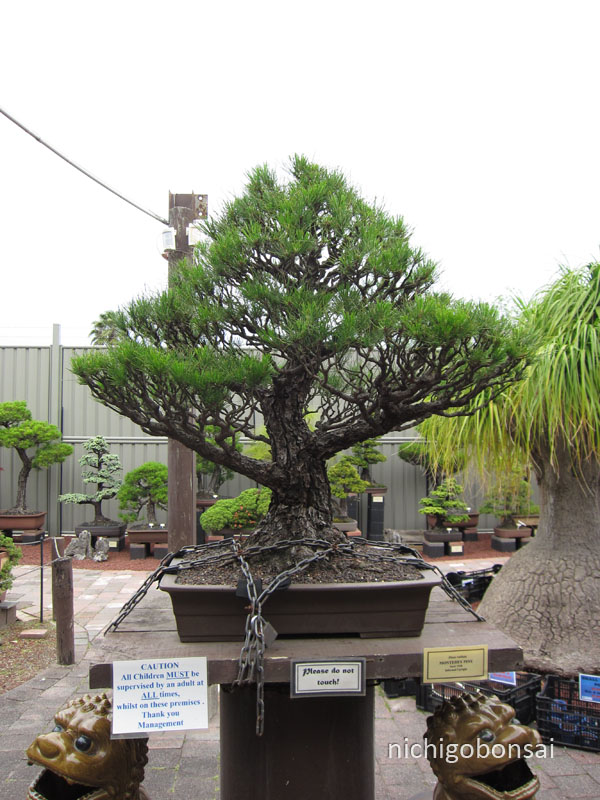
Bonsai in an Australian nursery.
And this seems to be the norm for nurseries in Australia. Steel cages, chains, electric fences, alarms and dogs are all common in Australian nurseries and yet are virtually non-existent in their Japanese counterparts.
I would love to be able to stroll the streets of Australian neighbourhoods and discover front yards full of bonsai like you might see in Japan. Perhaps you might meet the owners as they were watering or pruning and ask some advice while leaning on their front fence. This might be a bit of an idealised view but it is always nice to dream.
Sadly I don’t see this happening any time soon, as most people understandably keep their collections a secret and only invite a very small number of people into their gardens the fear that they may get knocked off one day. I feel that this really locks up (pun intended) both trees and knowledge to those few that are privileged enough to be allowed into growers gardens.
Sure at clubs and local shows you get to see some of people’s trees but it is often the works in progress at the back of these people’s gardens that are the really interesting material. It is often these works in progress that you can really learn from yet they often never see the light of day.
Are other countries like this? Surely these problems extend beyond Australian shores?
I often hear the term ‘Cookie cutter’ thrown around from time to time when people are talking about Japanese bonsai. For those not familiar with the term, I believe it relates to people suggesting that certain bonsai seem to come from the same mould and or ‘cookie cutter’ which produces similar or same bonsai. Personally i think that the term often is applied by those who havent really got a good understanding of what is actually out there in Japanese gardens and nurseries.
Now there are a lot of mass-produced bonsai in Japan that are grown to a rough formula but these trees are not a good representation of bonsai in Japan as a whole. On the other hand there are a lot of trees that can seem similar at first glance on benches in nurseries throughout Japan but closer inspection reveals quite dramatic differences.

Cookie Cutter?
What was one of the biggest surprises to me when I first visited japan was the huge amount of irregular styles and forms of trees that by no means could be classified as what some people dismiss as ‘cookie cutter’. In fact most of the nurseries I have visited were full of unusual and or ‘different’ bonsai. I know that when you look through various exhibition books you see some unusual trees, but its only when visiting the nurseries that you actually get a clear idea of just how many irregular bonsai are being grown.
During my last trip i met with Peter Tea at Aichi-en and he explained what his Oyakata Mr. Tanaka had explained to him about unusual trees.
He said that unusual bonsai would always be worth less than ‘standard or correct’ trees during the developement stages. Once the trees reached exhibition standard however, the unusual tree would suddenly become much more valuable. There are many correct bonsai in Japan and most nurseries could sell you one. Unusual trees on the other hand are one offs and if a customer wants to buy one they must pay accordingly as they cannot simply go next door to get something similar.
Strangely we don’t get to see many of these types of trees in western magazines or literature instead these forms are associated with European and American yamadori. I was certainly surprised to see so many when I first travelled to Japan. Now I find that they are the trees that I gravitate towards when I arrive at a nursery.
Below are a few interesting trees that i saw during my travels that didn’t fit the mould (some of them look like they totally broke the mould!) I hope you enjoy them as much as I do.

Dramatic movement.

A close-up of the twisted movement.

A very angular exposed root style.

I wonder if this tree was grown or collected?

Black pines shouldn’t have shari? Well this one does.

I think you will agree that it works very well in this case.

Unusual?

A very non-conforming Nebari for a non-conforming tree.
Read more about this strange trident HERE.

Bunjin, Semi-cascade or a combination?

Interesting.
I like to look at trees such as the above and think about what they must have looked like pre-styling. Material such as this requires a high level of creativity to style into a well-balanced image and often results in trees that really stick in your head. I know that it is these types of trees that I always spend the most time in front of.
So next time you are out and about evaluating future material keep an eye out for the unusual, you never know, you might get yourself a bargain!
 Nichigo Bonsai