This post will likely be the first of many documenting this tree’s progress from stock through to ‘bonsai’ over the next few years.
I haven’t had a post like this for a long time because I have been actively reducing my collection to a more manageable size, which hasn’t seen much rough stock make it onto my benches. At the same time, the trees i have kept continue to develop and become refined which hasn’t really seen much rough development type work, until………..
Recently myself and a friend came across a large amount of stock which you will likely start to see show up on the blog as we develop it and progress it towards a higher level of refinement.
It’s actually a bit of a funny story really how we ended up with all this material.
A good mate Dave, (well his name is not Dave, i am using Dave to give him some anonymity, his name is actually Jeff) did a drastic cut back of his collection at the recent Bonsai Northwest show. He sold somewhere in the vicinity of 25 trees leaving his collection compact and manageable. Now Jeff didn’t want to expand his collection much beyond this level but he did want to add a single Juniper to the mix, something a little less refined than what he had previously sold so he had a project to work on and develop.
I respect Jeff’s general approach to bonsai. He has had previously a huge collection and has cut it back savagely on several occasions. I have asked him about this and he essentially came to realise that what he really enjoyed about the bonsai process was taking stock and refining it, styling it and making it into what would be accepted as a bonsai. From this point forward however, he got little enjoyment from the often mundane ongoing refinement and maintenance, so he now builds a collection, then sells of components of it and starts the process a fresh with new owners enjoying taking his creations deeper into the refinement phase. It takes a fair amount of self reflection and self honesty i think to come to such a realisation and then decide that its ok to select a component of the bonsai process that you enjoy and are good at to focus on, essentially being somewhat unique in your bonsai practice compared to the general community.
Anyway, i digress.
So Jeff had told me he wanted just one new juniper, and as fate would have it i had just visited another good friend Kris’s new garden where he had just put aside a bunch of junipers and pines he wanted to get rid of.
Kris is another grower I really respect. He is pretty humble and wouldn’t admit the following but he produces some really great stock and trees, all of which he has produced by reverse engineering Japanese photos of shohin bonsai and rough material. The stock he passed on to us was in the throw out pile so don’t use the below as examples of his work, but just know he has produced some amazingly good material over the years.
So to cut a long story short, after taking Jeff to get a single tree, we ended up leaving with 30 pieces of material and left a pile of pines to be picked up at a later stage.
Essentially that is how Jeff set out to get one tree and came back with 30.
Needless to say, you will be seeing a lot of this stock on the blog being worked and developed over the coming years.
Below is is one of the first I have worked, and have named ‘The Octopus’.
Like most of the stock, this is its first real styling since being wired for movement during its early creation. The material need to develop its foliage and trunk further so it will be grown as styled stock in development rather than go into a bonsai pot. As a result the ‘final’ image below looks scrappy and messy. This is somewhat intentional as all I want to achieve this styling is to establish some branch positioning and trunk lines. As they are setting in place, i will also work to tighten up and get back budding on the areas that will become future branch pads. During this process it can look unruly as health, vigor and growth are what i am targeting over neatness.
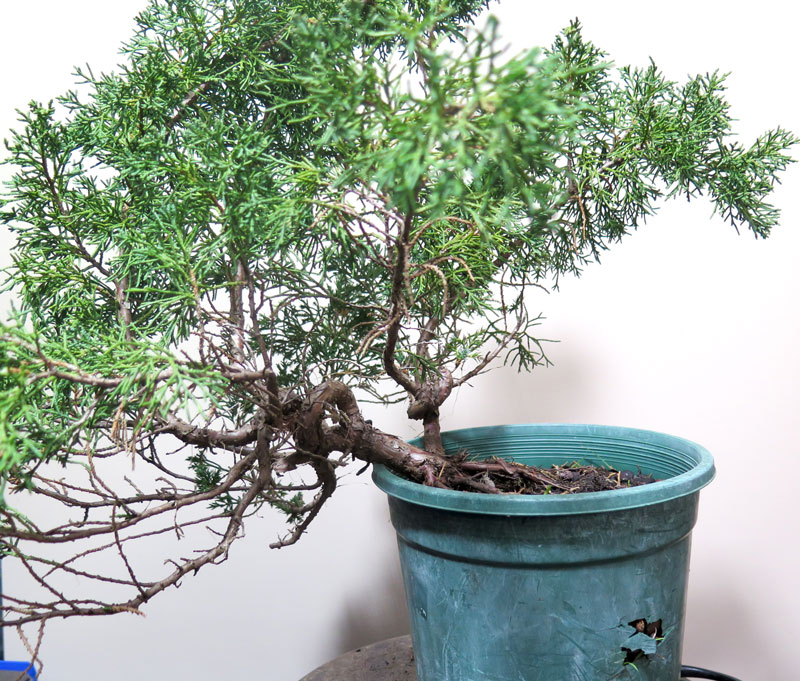
Typical of most stock that has been grown uninterrupted for a number of years, this tree was full of dead shoots, old pruning stubs and leggy foliage. Cleaning up that was the first priority which gave me a better understanding of the branches and trunk movement. For anyone overwhelmed or stuck on a piece of material i cannot recommend doing a basic foliage and trunk clean up enough. Doing this clean is how you get to know the material and you often discover features within the tree and get ideas for the styling moving forward.
Post cleanup, i began to introduce some shari into the two main trunk lines.
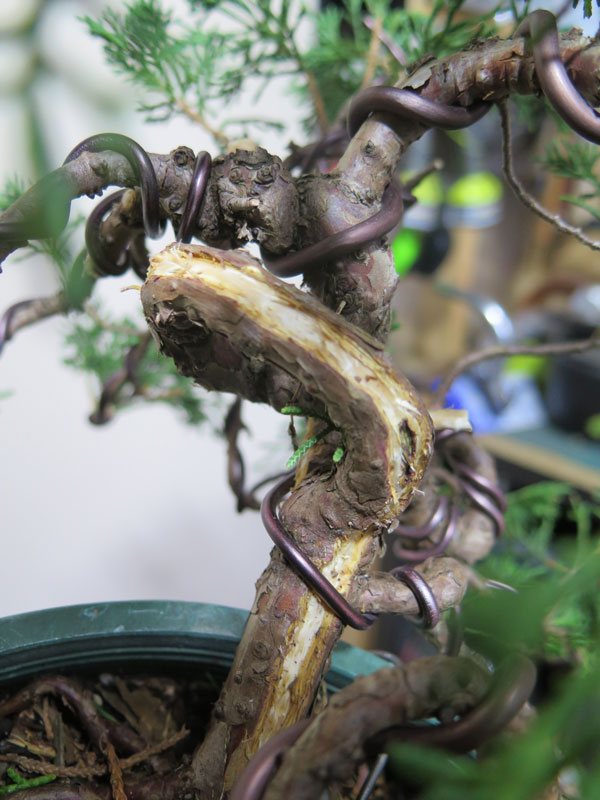

Above: The beginning of shari’s trying to follow the trunk movement.
The incorporation of shari into juniper bonsai are beneficial on a few levels.
Firstly from a design sense, the shari adds a great white contrast to the green foliage and orange trunk line acting almost as a highlight to draw your eye into the movement.
Secondly, by reducing the area of live trunk but maintaining a similar amount of foliage above forces the trunk to thicken the existing live areas at a rate faster than if the whole trunk was growing. You see this in live vein creating where the vein ‘muscles up’ and bulges as a large amount of sap and resources is channeled through a reduced area. This can be manipulated further by leaving the live areas of bark in spots you want to thicken, ie. a live vein either side of a trunk will only see the trunk expand in those directions, creating more side to side thickening than if a similar amount of growth was to occur on a fully live trunk. But i digress again……
At this point i hadn’t really thought about angles, fronts or trunk-lines so after some pondering and some wiring i shaped the tree into a strange composition that i quite liked. I aimed to continue the movement that Kris had formed early on and also establish some flow within the composition which in turn directed branching and the likes. As i said above i was really just looking to set main lines so the end result is a bit messy. Neatness and refinement will come in future years.
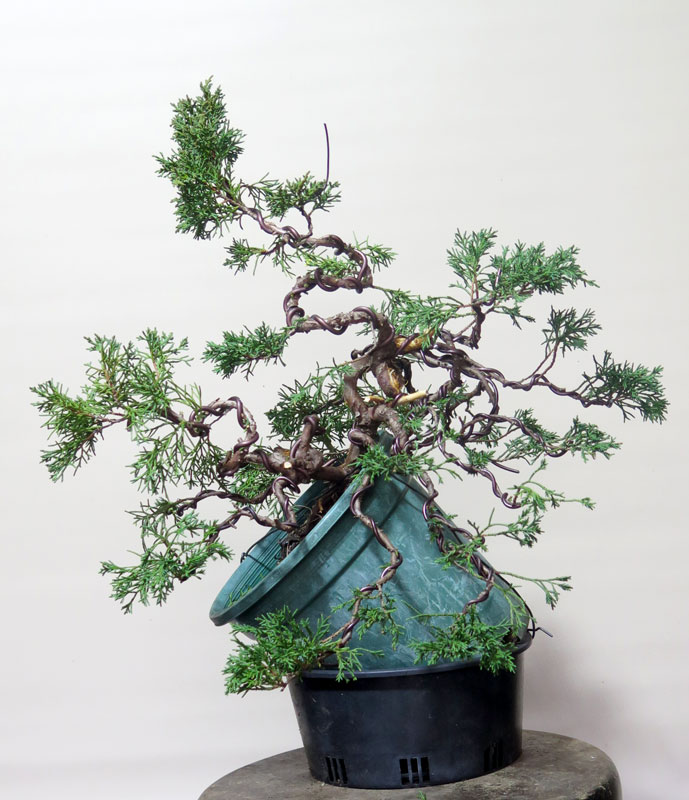
It’s certainly going to be an unusual one. you can see why i have decided to call it ‘The Octupus’ with its twisted limbs going out in all directions.

I think i have set a good base building on the early movement in the lower trunks. I have also done a bit of a bad rough sketch which is below to mostly remind me of the direction it is heading.

From here a lot of growing needs to happen which will likely see this tree staying in larger grow containers for at least a few more years. I really want to thicken the trunk lines while also developing shari’s and the live veins. This is something that simply takes time but i think i will be able to simultaneously work on the foliage pad as i go, hopefully minimising the overall development timeline.
Anyway, that’s all for today, keep an eye out for the other trees from this batch which i will post as i get them worked on.
 Nichigo Bonsai
Leave a comment
Comments feed for this article